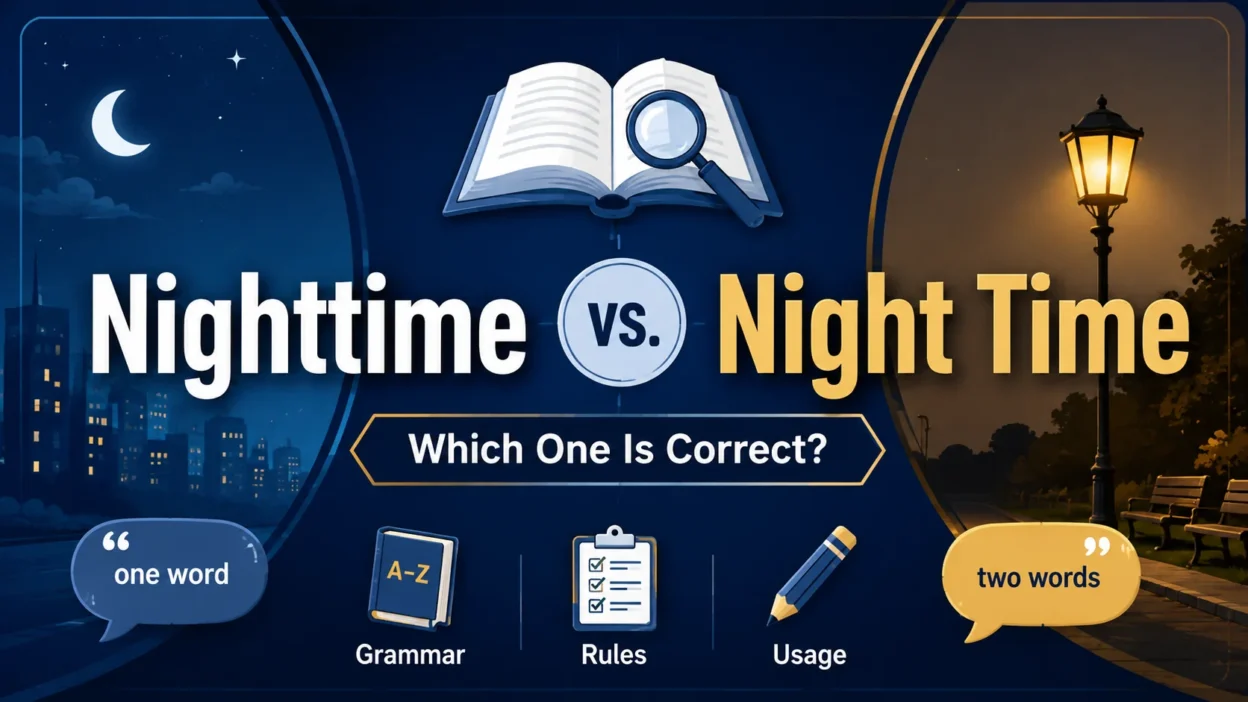
Nighttime vs. Night Time can seem confusing, but understanding the standard form makes the spelling choice much easier for everyday English writing. Nighttime is the established one-word form in modern English, including American English, while night time is a two-word form that you may still encounter in some contexts. The word describes the period of darkness between sunset and sunrise, when daylight has faded, the sky becomes dark, and the moon may be visible. Merriam-Webster and Cambridge recognise nighttime as an established noun connected with the time or hours of darkness. Although British English, modern American English, and ordinary American English can show differences in usage, the single-word spelling offers the clearest and safest choice when you want clarity, accuracy, and a smooth flow. The hyphenated form night-time may also appear, but it is less straightforward than the standard compound form.
Many students, bloggers, professionals, native speakers, learners, and experienced writers have paused and wondered whether to write nighttime or night time. The easiest way to clear up the question is to remember that nighttime works naturally as a noun, especially in phrases such as nighttime activities, nighttime writing, and nighttime hours. By contrast, a writer may use night time as separate words when the surrounding phrase, expression, rhythm, emphasis, or nuance makes that structure feel natural, such as at night time in some forms of casual speech or casual conversation. Compound words often develop from older phrases into a single accepted term, and English evolves through repeated writing, reading, and everyday communication. This explains why one word, two words, and the hyphenated form can appear in texts, documents, websites, books, and literature. American style guides generally prefer the single-word version, although regional and stylistic variation can influence a writer’s choice. Understanding the grammar, meaning, and purpose helps you avoid treating every use of night time as a grammar mistake.
The distinction matters most when you need consistent spelling in academic work, professional documents, business communication, business writing, a school essay, a business email, a social media caption, or a blog post. In formal and professional writing, the correct and consistent form can improve professionalism, precision, credibility, and writing clarity. A good writer considers the audience, tone, flow, expression, context, and purpose instead of following an obscure rule without understanding its function. Grammar experts, dictionaries, style guides, and other references can help resolve the grammar debate surrounding common grammar confusion, common mistakes, spelling decisions, and grammar rules. The same idea applies to night activities, dusk, dawn, morning, day, a 24-hour period, sunset, sunrise, hours, daylight, and the transition from light to darkness. Regular practice, learning, and attention to standard English make the correct form easier to remember. A useful memory trick is to treat nighttime as the standard compound word for the general concept while recognising that night time can sometimes function as separate words. This approach helps you avoid confusion, maintain the right tone, and develop more natural language usage. The historical development and evolution of the compound expression, along with references such as the Chicago Manual of Style, can provide a definitive answer when crafting a detailed article, outline, or 2500+ word blog post with examples, tables, case studies, and simple explanations.
Nighttime vs. Night Time: Quick Answer
Nighttime is the preferred modern spelling when you mean the period of night.
Correct: I prefer to study during nighttime.
Preferred: The animals are most active at nighttime.
Preferred: We have a nighttime security system.
Night time can appear as a two-word expression, but it isn’t normally the preferred spelling for the established compound in American English. Collins, for example, records night-time and night time alongside nighttime, particularly in British English usage.
So, if you’re writing an article, email, report, school assignment, or website content for a US audience, use nighttime unless a specific style guide or quotation requires another form.
What Does “Nighttime” Mean?
Nighttime refers to the part of the day when it is dark. In a broad sense, it covers the period between sunset or dusk and sunrise or dawn.
Merriam-Webster gives the definition “the time from dusk to dawn,” while Cambridge defines it as the time in a 24-hour period when it is dark.
The exact clock hours aren’t fixed because nighttime changes with location, season, latitude, and local sunrise and sunset times. In summer, nighttime may begin later and end earlier than it does in winter.
For example:
- Nighttime temperatures can fall quickly after sunset.
- Some animals are more active during nighttime.
- The city looks completely different at nighttime.
- Nighttime driving requires extra attention.
- The hotel offers nighttime security.
Notice something important in these examples: nighttime works naturally as both a noun and a modifier.
Nighttime as a Noun
As a noun, nighttime names the period of darkness.
For example:
Nighttime is usually quieter than daytime.
Here, nighttime is the subject of the sentence.
You can also use it after prepositions:
The streets become quieter at nighttime.
Some animals hunt during nighttime.
However, grammatical correctness and natural style aren’t always the same thing. In everyday American English, at night is often more concise and natural than at nighttime.
Compare:
I usually read at night.
I usually read at nighttime.
Both can work, but the first sounds more natural in ordinary conversation.
Nighttime as a Modifier
Nighttime can also describe something associated with or occurring during the night.
This use is especially common in compound expressions:
- nighttime activities
- nighttime driving
- nighttime temperatures
- nighttime curfew
- nighttime routine
- nighttime hours
- nighttime vision
- nighttime visitors
- nighttime wildlife
Cambridge’s examples include expressions such as nighttime curfew, nighttime activities, and nighttime hours, showing how naturally the closed form functions in modern English.
Nighttime vs. Night Time: Key Difference
The practical distinction is simple:
| Form | Typical use | American English preference |
| nighttime | Established compound meaning the period of night | Preferred |
| night time | Separate-word construction; also found in some usage | Less common |
| night-time | Hyphenated variant | Not normally preferred in US English |
| night | General word for the dark period | Very common |
| overnight | Happening during the night or from one day to the next | Different meaning |
The most important point is that nighttime isn’t merely a casual abbreviation of night time. It has become an established English word.
Why Do People Write “Night Time”?
The confusion comes from the structure of the word itself.
Nighttime contains two recognizable words:
- night
- time
When people see two familiar words next to each other, it’s natural to wonder whether they should remain separate.
English makes this especially tricky because compound words don’t follow one universal spelling rule. Some remain open:
ice cream
Some become closed:
bedroom
Some remain hyphenated in particular uses:
well-known
And some compounds vary by dialect or editorial style.
That’s why spelling nighttime can feel less obvious than its meaning.
There’s also a strong semantic relationship between night and time. After all, nighttime literally describes a period of time associated with night. That makes night time look perfectly logical.
But spelling isn’t determined by logic alone. Established usage matters.
How “Nighttime” Became a Compound Word
The history of nighttime is older than its modern appearance might suggest.
Merriam-Webster gives the first known use of nighttime as the 14th century. Collins also traces the word to Middle English, dating its origin to approximately 1350–1400.
That historical detail matters because it shows that nighttime isn’t a recent internet-era invention.
English compounds often develop gradually. A phrase may appear in different forms across different periods before one spelling becomes dominant. Writers and editors then reinforce the most established form through repeated use.
The history of nighttime fits that broader pattern.
Early Forms and Historical Usage
Older English frequently used combinations of words more flexibly than modern standard English does. Spacing conventions weren’t always as fixed as they are today.
As English spelling became more standardized through printing, dictionaries, education, publishing, and editorial practice, many compounds developed more consistent written forms.
The modern closed spelling nighttime eventually became firmly established.
The Rise of the One-Word Form
The modern spelling makes sense because nighttime expresses one recognizable concept: the period of night.
Compare it with daytime.
We normally write:
daytime
not:
day time
The parallel relationship between daytime and nighttime also helps explain why the one-word spelling feels so natural in contemporary English.
Merriam-Webster and Cambridge both treat nighttime as a dictionary headword rather than merely an informal combination of night and time.
Nighttime in American English
In American English, nighttime is the normal closed form.
You’ll see it in everyday writing, journalism, weather reports, advertising, educational material, and professional documents.
Examples include:
The forecast calls for unusually low nighttime temperatures.
The museum offers special nighttime tours.
Avoid unnecessary nighttime driving during severe weather.
The city introduced a nighttime curfew.
Merriam-Webster’s recent examples also show nighttime in contemporary reporting, including references to nighttime lows and nighttime conditions.
For US-focused content, there’s little reason to choose night time when nighttime expresses the same established concept.
Nighttime in British English and Other Varieties
British English can show more variation.
Collins records night-time as a British English form and also lists night time. At the same time, Cambridge uses the closed spelling nighttime in its British dictionary entry.
That means the issue isn’t as simple as saying, “British English always uses night-time.”
It doesn’t.
Different British publications, dictionaries, and style systems can make different choices. The closed form is fully established and widely understood.
For an American audience, however, nighttime remains the straightforward choice.
Nighttime vs. Night: Are They Interchangeable?
Although nighttime and night overlap in meaning, they’re not always interchangeable in style.
Consider:
I work at night.
This is extremely natural.
Now compare:
I work at nighttime.
This is understandable and grammatical, but it can sound more deliberate or formal.
Meanwhile:
Nighttime work can be exhausting.
Here, nighttime works particularly well because it modifies work.
You could say:
Night work can be exhausting.
That sentence is also natural, but it can carry a slightly different emphasis depending on context.
At Night vs. At Nighttime
| Expression | Naturalness | Typical use |
| at night | Very natural | Everyday speech and writing |
| at nighttime | Correct but less common | Emphasizing the nighttime period |
| during the night | Very natural | Referring to something occurring during a particular night |
| during nighttime | Correct but less common | More general or technical contexts |
If you’re talking casually, at night will often be your best option.
If you’re describing a specific nighttime condition or using the word as a modifier, nighttime becomes more useful.
How to Use “Nighttime” Correctly in a Sentence
Using nighttime is easy once you recognize its two main roles.
“Nighttime” After Prepositions
You can use nighttime after prepositions such as at and during:
The streets are quieter at nighttime.
Some animals become active during nighttime.
However, don’t force the longer construction when a simpler expression works better.
She studies at night.
usually sounds more natural than:
She studies at nighttime.
The difference isn’t about right versus wrong. It’s about idiomatic style.
“Nighttime” Before a Noun
This is one of the strongest uses of nighttime.
Examples:
- nighttime routine
- nighttime temperatures
- nighttime driving
- nighttime activities
- nighttime security
- nighttime sky
- nighttime hours
Dictionary examples confirm that this modifier use is common in contemporary English.
You don’t normally need a hyphen between nighttime and the noun that follows it.
Write:
nighttime activities
not:
night-time activities
for standard US English.
“Nighttime” in Formal Writing
Nighttime works perfectly well in formal writing.
For example:
The study examined differences between daytime and nighttime activity.
The facility uses additional lighting during nighttime operations.
Nighttime temperatures remained below freezing for three consecutive days.
The word isn’t informal. It’s a standard dictionary entry.
Common Mistakes With “Nighttime” and “Night Time”
Mistake 1: Automatically Writing “Night Time”
The most common mistake is assuming that because night and time are separate words individually, they should remain separate together.
In modern American English, that’s usually unnecessary.
Use: nighttime routine
Instead of: night time routine
Mistake 2: Assuming It Must Be Hyphenated
Some writers see compounds and immediately reach for a hyphen.
But nighttime is normally written as one word in American English.
Correct:
nighttime temperatures
Usually unnecessary:
night-time temperatures
Mistake 3: Using “At Nighttime” Everywhere
Even when at nighttime is grammatically acceptable, it may not be the smoothest option.
For example:
I exercise at night.
sounds more natural than:
I exercise at nighttime.
The shorter version gets the same idea across without extra weight.
Mistake 4: Confusing “Nighttime” With “Overnight”
These words overlap, but they don’t mean exactly the same thing.
Nighttime refers to the period of night.
Overnight generally describes something that happens during the night or continues from one day to the next.
Compare:
The store closes during nighttime.
The package arrived overnight.
The first describes a period. The second describes an event occurring over the course of the night or by the following morning.
Nighttime vs. Night Time vs. Night vs. Overnight
| Term | Meaning | Example |
| nighttime | The period of night | Nighttime can be very quiet here. |
| night time | Two-word variant found in some usage | The expression may appear in regional or context-specific writing. |
| night-time | Hyphenated variant, especially associated with some British usage | The shop has night-time staff. |
| night | The general dark period or an evening | I work at night. |
| overnight | Happening during the night or from one day to the next | The temperature dropped overnight. |
Real-World Examples of “Nighttime”
Seeing the word in different settings makes the pattern easier to remember.
Everyday Conversation
The kids have a nighttime routine before bed.
I enjoy walking around the city at nighttime.
The neighborhood is much quieter during nighttime hours.
My dog becomes more active at nighttime.
The first example is especially natural because nighttime directly modifies routine.
Professional and Workplace Writing
Professional writing frequently uses nighttime to describe schedules, operations, safety conditions, and staffing.
The company provides additional security during nighttime operations.
Road crews will complete the repairs during nighttime hours.
Employees assigned to nighttime shifts receive separate scheduling instructions.
These examples demonstrate why the one-word form is useful. It functions neatly as a compound modifier without creating unnecessary visual clutter.
Informational and Educational Writing
The word also appears naturally in scientific and educational contexts:
Many nocturnal animals rely on specialized senses during nighttime.
Nighttime temperatures can influence plant growth.
Astronomers observe celestial objects against the nighttime sky.
Merriam-Webster’s thesaurus also identifies nighttime as an adjective meaning related to or occurring during the night, with nocturnal as a close synonym.
When Should You Use “Nighttime” Instead of “At Night”?
The answer depends on what you want the sentence to do.
Use at night when you’re simply describing when something happens:
Birds sing at night.
Use nighttime when you want to name the period itself or when it modifies another noun:
Nighttime temperatures affect the plants.
This distinction is useful because writers sometimes try to replace every instance of night with nighttime. That isn’t necessary.
Think of nighttime as a more specific label for the nighttime period. Think of at night as a compact everyday expression.
Compare These Examples
We drive at night.
Natural and conversational.
Nighttime driving can require extra caution.
Natural and descriptive.
The roads are dangerous at nighttime.
Correct, although at night may sound more natural in ordinary conversation.
Nighttime road conditions can change rapidly.
Natural because nighttime modifies road conditions.
A Simple Decision Rule: Nighttime or Night Time?
When you’re unsure, use this quick test:
- If you mean the period of night, write nighttime.
- If nighttime modifies another noun, write it as one word.
- If you’re simply saying when something happens, consider at night.
- For standard American English, don’t normally write night-time.
- Don’t separate nighttime into night time just because both parts are recognizable words.
- If you’re following a specific British publication or house style, check that style’s preferred spelling.
A useful memory trick is to pair nighttime with daytime:
daytime / nighttime
That parallel makes the standard spelling easier to remember.
Nighttime vs. Night Time: Practical Usage Table
| Sentence | Recommended? | Explanation |
| I enjoy nighttime walks. | ✅ Yes | Standard compound modifier |
| I enjoy night time walks. | ⚠️ Less preferred | Use the established closed form |
| Nighttime is peaceful. | ✅ Yes | Standard noun |
| Night time is peaceful. | ⚠️ Less preferred | Two-word spelling isn’t normally needed |
| The nighttime temperature dropped. | ✅ Yes | Standard compound modifier |
| She has a nighttime routine. | ✅ Yes | Common modern expression |
| She studies at night. | ✅ Yes | Natural everyday phrasing |
| She studies at nighttime. | ✅ Yes | Correct, but less concise |
| The animals are active at night. | ✅ Yes | Very natural |
| The animals are active during nighttime. | ✅ Yes | Grammatically possible, but more formal |
| The animals are nighttime active. | ❌ No | Incorrect construction |
Nighttime vs. Night Time: Final Verdict
When the intended meaning is the period of night, nighttime is the best choice in standard American English.
It is an established dictionary word with a long history. Merriam-Webster dates its first known use to the 14th century, while Cambridge and Collins both recognize the modern compound and its related variants.
Night time isn’t a mysterious grammatical error. It does appear in English, particularly in some regional or stylistic contexts. However, that doesn’t make it the preferred form for ordinary US writing.
The simplest rule is this:
If “nighttime” means the period of night, write it as one word.
And when you’re simply telling someone when something happens, remember that at night is often the most natural choice.
Conclusion
Nighttime vs. Night Time is a small spelling question, but choosing the right form can make your writing clearer and more professional. Nighttime is the standard one-word form and works naturally in most modern English contexts. Night time can appear as two words in certain expressions or stylistic contexts, while night-time is a less common hyphenated variation. When you’re writing for school, business, websites, or everyday communication, nighttime is generally the safest and most straightforward choice.
FAQs
Q1. Is nighttime one word or two?
Nighttime is normally written as one word. It is the standard spelling used for the general period of darkness between evening and morning.
Q2. Is night time incorrect?
Not always. Night time can appear as two words in certain contexts, but nighttime is generally the preferred standard form when referring to the period of darkness.
Q3. Is night-time correct?
Yes, night-time is a recognisable hyphenated form, although the one-word form, nighttime, is generally more common in modern English.
Q4. Should I use nighttime in formal writing?
Yes. Nighttime is appropriate for academic writing, professional documents, business communication, and general formal writing.
Q5. What is the difference between nighttime and night time?
The basic meaning is similar, but the spelling differs. Nighttime is a standard compound word, while night time treats night and time as separate words.