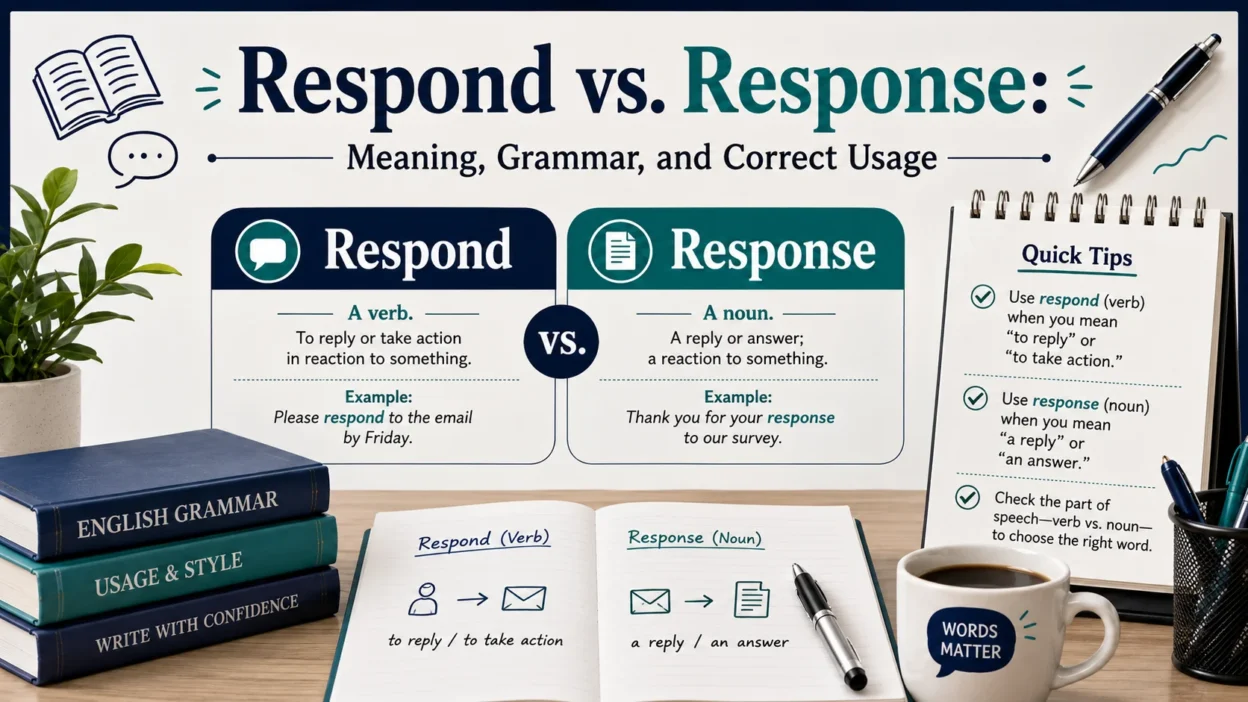
Understanding Respond vs. Response helps you choose the right word because respond names an action, while response names the answer. Although these words look similar, they have different grammatical roles. Respond is a verb used when someone takes action after receiving a question, message, request, or situation. Response is a noun that describes the answer, reaction, or reply that follows. For example, you respond to an email, while you give a response to that email. This simple distinction improves communication, grammar, and clarity in both everyday conversation and professional writing.
The difference also becomes clear in psychology, medicine, and human behaviour. A person may respond emotionally to an unexpected event, while their response describes the reaction itself. Similarly, a patient may respond to treatment, while a doctor may discuss the patient’s treatment response. These examples show how the two words can appear in similar contexts while performing different grammatical jobs. When you focus on language, context, and meaning, the distinction becomes easier to recognise and apply. Think of it this way: respond describes what you do, while response describes what you give, show, or receive.
In everyday and professional writing, knowing when to use each word can prevent common English mistakes. You respond to a question, request, comment, or message, but you give a response, receive a response, or discuss a response to an issue. The same pattern works in formal documents, emails, conversations, and ordinary sentences. From a practical grammar perspective, remembering that respond is a verb and response is a noun gives you a reliable shortcut. Once you connect the action with respond and the answer or reaction with response, you can use both words naturally and confidently while improving your overall vocabulary, writing, and communication skills.
Quick Answer: Respond vs. Response
Respond is a verb meaning to answer, reply, or react.
Response is a noun meaning an answer, reply, or reaction.
Compare these examples:
- Please respond to my email.
- I’m waiting for your response.
In the first sentence, respond describes an action. In the second, response names the reply.
| Word | Part of Speech | Meaning | Example |
| Respond | Verb | To answer or react | “Please respond soon.” |
| Response | Noun | An answer or reaction | “I received your response.” |
A simple rule can help you remember the difference:
You respond. You give a response.
What Does “Respond” Mean?
“Respond” is a verb that means to answer, reply, or react to something through words, actions, or behavior.
Respond Is a Verb
Respond describes something you do after receiving information, hearing a question, facing a situation, or experiencing an event.
For example:
- She responded to my question.
- He responded to the email.
- The company responded to the complaint.
- They responded quickly.
- The patient responded well to treatment.
The word can describe much more than speaking. You can respond with words, actions, gestures, emotions, or behavior.
If someone asks you a question and you answer, you respond. If someone gives you disappointing news and you walk away, you’ve also responded to the situation.
Common Meanings of Respond
Depending on the context, respond can mean:
- To answer: “She responded to the question.”
- To reply: “He responded to my message.”
- To react: “She responded calmly to the criticism.”
- To take action: “The company responded by changing its policy.”
- To react to treatment: “The patient responded well to treatment.”
The common thread is action following something else.
Forms of Respond
Because respond is a verb, its form can change according to tense.
| Verb Form | Example |
| respond | “I usually respond quickly.” |
| responds | “She responds well to feedback.” |
| responded | “He responded yesterday.” |
| responding | “They are responding now.” |
This gives you another useful clue. If the word needs to change into responded, responds, or responding, you’re working with the verb respond.
What Does “Response” Mean?
“Response” is a noun that means an answer, reply, reaction, or action given after something happens or someone communicates with you.
Response Is a Noun
Response names an answer, reply, or reaction.
You can:
- give a response
- receive a response
- get a response
- write a response
- await a response
- expect a response
- make a response
For example:
We received a response from the manager.
The manager provided an answer. That answer is the response.
Another example:
Her response was surprisingly calm.
Here, response names her reaction.
Common Meanings of Response
Response can describe several types of reactions:
- An answer: “I received a response to my question.”
- A reply: “His response arrived this morning.”
- An emotional reaction: “Her response was emotional.”
- A behavioral reaction: “The animal showed a defensive response.”
- A physical reaction: “The body produced a response to the stimulus.”
- A reaction to treatment: “The patient showed a positive response.”
So, response isn’t limited to emails or conversations. It can describe almost any kind of reaction.
Respond vs. Response: The Main Grammar Difference
The easiest way to understand response vs. response is to think about action versus thing.
Respond Describes an Action
Consider this sentence:
The manager responded quickly.
The manager performed an action. Therefore, responded is a verb.
You can change the tense:
- The manager responds quickly.
- The manager responded quickly.
- The manager will respond quickly.
- The manager is responding quickly.
Each form describes an action.
Response Names the Answer or Reaction
Now consider:
The manager’s response was quick.
Here, the response names the reaction.
You can also describe the noun with adjectives:
- a quick response
- a detailed response
- a thoughtful response
- a positive response
- an immediate response
- an emotional response
That grammatical behavior tells you that response is a noun.
Action vs. Result
| If you mean… | Use | Example |
| An action | Respond | “Please respond today.” |
| An answer | Response | “We need your response.” |
| A reaction | Respond | “She responded calmly.” |
| A reaction as a thing | Response | “Her response was calm.” |
When you’re unsure, ask yourself:
Am I describing what someone does, or am I naming the answer or reaction?
That question solves most response vs. response problems.
Sentence Patterns With “Respond”
Use “respond” as a verb in patterns such as “respond to,” “respond by,” and “respond with” to describe an action, reply, or reaction.
Respond to
The most common structure is:
respond to + something
Examples include:
- respond to an email
- respond to a question
- respond to a request
- respond to criticism
- respond to a complaint
- respond to an emergency
- respond to treatment
For example:
The company responded to the customer’s complaint.
Here, responded is the verb, while the customer’s complaint identifies what caused the response.
Respond by
Use respond by + verb-ing when you want to explain how someone reacted.
Examples:
- She responded by apologizing.
- He responded by leaving the room.
- The company responded by lowering its prices.
- The team responded by changing its strategy.
This construction focuses on the action taken.
Respond with
Use respond with + noun when you identify what someone gave or displayed.
Examples:
- He responded with a smile.
- She responded with a short explanation.
- The company responded with a formal statement.
- The child responded with a laugh.
Compare these two structures:
She responded by laughing.
She responded with laughter.
Both are correct, but the grammar differs.
Sentence Patterns With “Response”
Use “response” as a noun in patterns such as “a response to,” “in response to,” and “a response from” to describe an answer or reaction.
A Response to
The standard noun structure is:
a response to + something
Examples:
- a response to the question
- a response to the complaint
- a response to the request
- a response to the proposal
- a response to the criticism
For example:
We received a response to our request.
The answer itself is the response.
In Response to
In response to means as a reaction or answer to something.
Examples:
- The company changed its policy in response to customer feedback.
- The school introduced new rules in response to safety concerns.
- She smiled in response to the compliment.
- The team changed its strategy in response to new information.
This phrase appears frequently in professional, academic, and formal writing.
Response From
Use responses when you identify who provided the answer.
Examples:
- We are waiting for a response from the manager.
- There was no response from the company.
- The school received a response from several parents.
- We finally got a response from the customer.
This structure is particularly common in workplace communication.
Respond vs. Response in Everyday English
In everyday English, “respond” means to answer or react, while “response” means the answer or reaction itself.
Emails and Messages
Email provides one of the clearest examples of the difference.
You might write:
Please respond to this email by Friday.
Here, respond describes an action.
Now compare:
We look forward to your response.
Here, response means the reply you expect.
The two words are closely related, but you can’t simply swap them.
Questions and Answers
Suppose someone asks:
“When will the meeting begin?”
You might respond:
“It begins at 10 a.m.”
Your answer is your response.
The pattern is easy to remember:
Question → respond → response
The same pattern applies to requests, complaints, invitations, comments, and messages.
Requests and Complaints
Imagine that a customer sends a complaint to a business.
The company might:
respond to the complaint within 24 hours.
The written answer becomes:
a response to the complaint.
Both words can appear naturally in the same situation.
Respond vs. Response in Professional English
In professional English, “respond” describes the action of replying, while “response” refers to the reply itself.
Workplace Communication
Professional writing often uses both words:
- Please respond by Thursday.
- We need your response by Thursday.
- The team responded to the request.
- The team’s response was detailed.
The first and third sentences use respond as a verb.
The second and fourth use response as a noun.
Customer Service
Customer service language often includes both forms.
For example:
We aim to respond to all inquiries within two business days.
A customer might then write:
Thank you for your quick response.
The first sentence focuses on an action. The second focuses on the reply.
Response Time
The phrase response time is common in business, customer service, technology, and emergency contexts.
For example:
Our average response time is 24 hours.
You wouldn’t normally write:
Our average response time is 24 hours.
That’s incorrect because response is the noun used to describe the time associated with answering or reacting.
Other common expressions include:
- response time
- response rate
Conclusion
Understanding the difference between commonly confused words can make your writing clearer, more natural, and more professional. The key is to focus on meaning, context, and standard usage rather than relying only on how a word sounds. Once you understand the basic rule, choosing the right form becomes much easier.When you’re unsure, look at the role the word plays in the sentence and consider what you’re trying to communicate. A small spelling, grammar, or usage choice can change the meaning of an entire sentence, so taking a moment to check can save you from confusion later.
FAQs
Q1. What is the easiest way to choose the correct word?
Start by identifying what you want the word to mean. Then check whether it functions as a noun, verb, adjective, or another part of speech. Context usually reveals the correct choice.
Q2. Why do people confuse these words?
Many commonly confused words sound alike, look similar, or have closely related meanings. Everyday speech can make the distinction even harder to notice.
Q3. Is one version always grammatically correct?
Not necessarily. Some variations may be acceptable depending on US vs. UK English, context, style, or regional usage. However, one form may still be more standard for formal American English.
Q4. How can I avoid making these mistakes?
Read the sentence carefully before choosing a word. If two forms look similar, compare their definitions and example sentences. Over time, repeated exposure will make the correct usage feel more intuitive.
Q5. Can these differences affect professional writing?
Absolutely. Using the right word improves clarity and credibility, especially in resumes, emails, academic writing, websites, and business communication. Even a tiny usage mistake can distract readers from your main point.