Annunciate vs. Enunciate can confuse English speakers because the words look and sound alike but have different meanings, contexts, and uses. When you speak or write, this mix-up can trip people up, even if you’re a fluent English speaker. The two verbs are remarkably similar in sound, spelling, and appearance, and they are historically connected through Latin forms, but their modern meanings and jobs are different. Annunciate relates to announcing, declaring, telling, reporting, making known, and proclaiming information, while enunciate focuses on pronouncing words with articulation, clear speech, and clarity. In English usage, context helps you choose the right word. If you are announcing information, announce is normally the natural choice; if you describe someone who speaks clearly, enunciate is the better choice. Their history, modern American English usage, and similar-sounding forms explain why they are sometimes treated as interchangeable, even though their purposes remain distinct.
The practical difference becomes easier to understand through communication, speech, and verbal communication. Enunciate means to pronounce words clearly and distinctly, so listeners can hear and understand them. Good enunciation makes communication easier when you’re speaking in a meeting or using professional and formal language. Poor enunciation may make speech sound hesitated, unclear, or difficult to follow, creating misunderstandings. Annunciate, by contrast, relates to announcing, proclaiming, or making something known. This distinction matters when you’re communicating important information and want to communicate with clarity and confidence. The words may sound alike and appear in similar situations, but their usage is not the same. A correct understanding of their meanings helps you avoid common mistakes in speaking and writing while keeping your standard English precise.
A simple way to remember the distinction is to connect annunciate and enunciate with their different purposes rather than memorising a complicated rule. For clear pronunciation, think of enunciate; when the meaning involves announcing, declaring, or making known, think of annunciate and related language. A practical guide can use examples, tables, analogies, case studies, and bite-sized explanations to make the difference sharper and more natural. You may have wondered why these terms are so often confused, especially because their Latin background makes them feel historically connected, but that shared background doesn’t erase the modern distinction. When you break down their meanings, contexts, and differences, it becomes easier to avoid the mix-up, use them correctly, and insist on precise communication skills without making the explanation overly complicated. Clearly, more clearly, actually, extremely, and normally describe useful aspects of how people speak, but the key is always the intended meaning, usage, and context. Dive into the distinction, and you’ll see why enunciate is the natural choice when the focus is clear speech, while annunciate concerns the act of announcing or proclaiming something.
Annunciate vs. Enunciate: Quick Answer
The easiest way to separate annunciate vs. enunciate is to focus on the action involved.
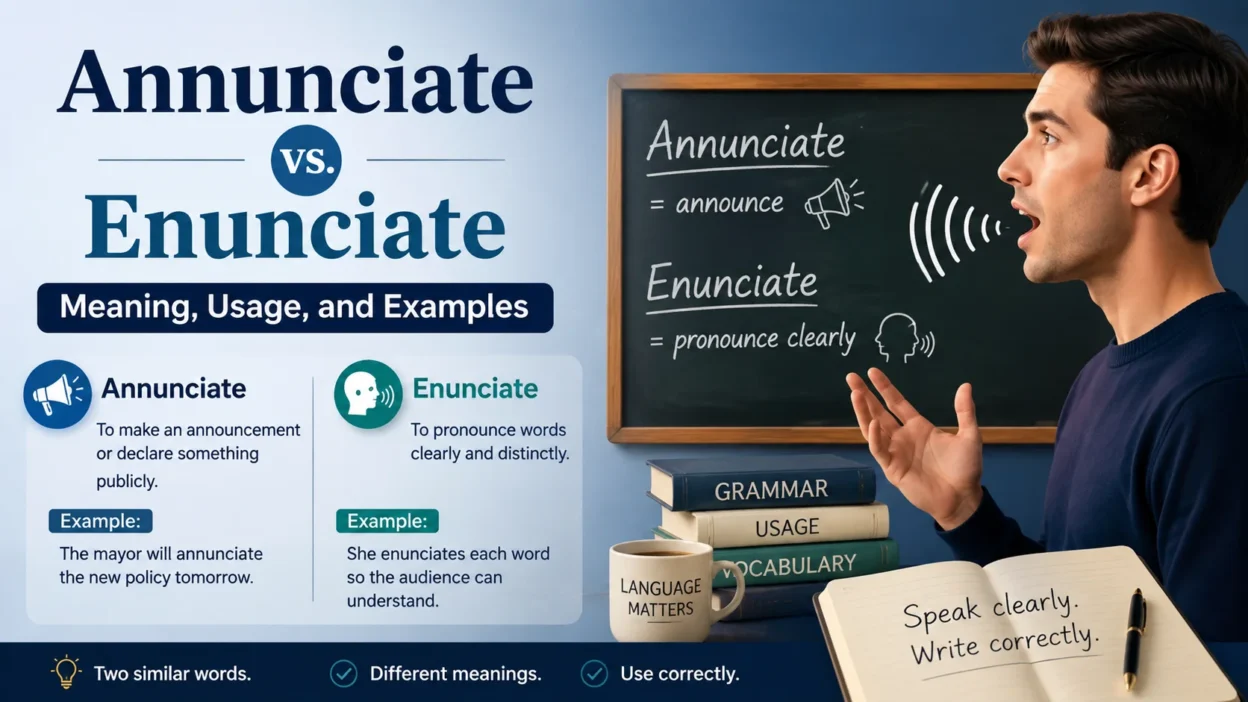
- Annunciate means to announce, proclaim, or make something known.
- Enunciate means to pronounce words clearly and distinctly.
- Enunciate can also mean to state or express an idea clearly or formally.
- Annunciate is a legitimate English word, but it is much less common than announce.
- When discussing clear pronunciation, enunciate is the correct choice.
| Word | Meaning | Typical Context | Example |
| Annunciate | Announce or proclaim | Formal announcements | The organization annunciated its new policy. |
| Enunciate | Pronounce clearly | Speech and pronunciation | Please enunciate each word. |
| Enunciate | State clearly or formally | Ideas, principles, policies | The leader enunciated a new principle. |
| Announce | Make information known | Everyday communication | She announced the winner. |
Merriam-Webster defines annunciate simply as “announce,” while its entry for enunciate includes both clear pronunciation and the act of making a definite statement.
So, if you’re telling a speaker to slow down and make every word clear, say:
“Please enunciate your words.”
Not “Please annunciate your words.”
Annunciate and Enunciate: Why They’re So Easy to Confuse
At first glance, the difference is only a few letters. Both contain the familiar -nunciate pattern, and both can relate to communicating information.
That’s where the trap lies.
Imagine two roads leaving the same town. They share part of the route, but they eventually lead somewhere different. Annunciate and enunciate are similar in much the same way. Their historical roots overlap, but their modern meanings have separated.
Another source of confusion is that enunciate actually has more than one established sense. Besides meaning “pronounce clearly,” it can mean to state or express something clearly and formally. Cambridge Dictionary gives both meanings: pronouncing words clearly and expressing a plan or principle clearly or formally.
That second meaning can make enunciate look even more like annunciate.
Consider these two sentences:
- The spokesperson annunciated the official announcement.
- The spokesperson enunciated every word carefully.
The first concerns making information known. The second concerns how the words were spoken.
What Does “Annunciate” Mean?
“Annunciate” means to pronounce or articulate words clearly and distinctly, especially when speaking aloud.
Annunciate Definition
Annunciate is a verb meaning to announce, proclaim, or make something known openly. Merriam-Webster lists “announce” as its definition and records its first known use as 1533.
The word is valid. However, it isn’t the everyday choice for most modern American writing.
In ordinary conversation, announce is usually cleaner:
- “The company announced its new policy.”
- “The teacher announced the results.”
- “The mayor announced the decision.”
Using annunciate in those sentences isn’t necessarily grammatically wrong. It simply sounds more unusual and formal.
When Should You Use Annunciate?
Use annunciate when the intended meaning is to announce or proclaim something and the formal tone fits the context.
For example:
- The organization annunciated its new position on the matter.
- The speaker annunciated the policy before the assembled delegates.
- The report annunciated several important changes.
Still, there’s a practical rule worth remembering: if “announce” works naturally, it will usually be the better modern choice.
Annunciate Examples in Sentences
Here are examples that show its meaning more clearly:
- The official annunciated the new regulations.
The official formally made the regulations known. - The document annunciated a change in policy.
The document announced or declared the change. - The leader annunciated the group’s position.
The leader publicly stated the position.
These examples involve communicating information, not pronunciation.
Words Related to Annunciate
Several words share the same historical family or meaning:
- Announce
- Announcement
- Annunciation
- Annunciated
- Annunciating
The noun Annunciation has a particularly specific historical and religious use. It refers to the Christian event commemorating the angel Gabriel’s announcement to Mary. The broader sense of “an announcing” is older as well.
What Does “Enunciate” Mean?
Enunciate means to pronounce words clearly and distinctly so they’re easy for others to understand.
Enunciate Definition
Enunciate most commonly means to pronounce words or sounds clearly and distinctly.
If someone mumbles, rushes through sentences, or swallows sounds, another person might say:
“Could you please enunciate?”
The request isn’t necessarily asking the speaker to become louder. It’s asking them to make their speech easier to understand.
Merriam-Webster defines the speech-related sense as articulating or pronouncing clearly.
When Should You Use Enunciate?
Use enunciate when clarity of speech is the main concern.
It works naturally in situations involving:
- Public speaking
- Teaching
- Acting
- Broadcasting
- Presentations
- Interviews
- Voice training
- Reading aloud
- Everyday conversation
For example:
“The actor enunciated every line clearly.”
Here, the actor isn’t announcing the lines. The actor is pronouncing them distinctly.
Enunciate Examples in Context
- Please enunciate the final word.
- The presenter enunciated each technical term carefully.
- She tends to speak quickly, so she needs to enunciate more clearly.
- The actor enunciated every line without sounding unnatural.
- Good broadcasters enunciate clearly enough for listeners to follow them.
Notice the common thread. The focus is clarity of spoken language.
Related Forms of Enunciate
The main related forms include:
- Enunciate — present-tense verb
- Enunciated — past-tense or past-participle form
- Enunciating — present participle
- Enunciation — noun
- Enunciator — a person who enunciates
For example:
Her enunciation was clear enough for everyone in the room to understand her.
Annunciate vs. Enunciate: The Core Difference
The central distinction is surprisingly simple:
Annunciate is about making information known. Enunciate is about making speech clear.
Think of a news reporter.
If the reporter announces breaking news, the focus is the information being communicated.
If the reporter enunciates every word, the focus is the clarity of the delivery.
A Quick Analogy
Think of communication as a package.
Annunciate concerns delivering the package of information.
Enunciate concerns making sure the recipient can clearly hear and understand the label on the package.
That distinction makes the words much easier to remember.
Annunciate vs. Enunciate Side by Side
| Feature | Annunciate | Enunciate |
| Basic meaning | Announce or proclaim | Pronounce clearly |
| Related everyday word | Announce | Articulate |
| Focus | Information | Speech clarity |
| Common in modern American English? | Relatively uncommon | Common in formal speech contexts |
| Can refer to stating an idea? | Yes, through its announcing sense | Yes |
| Can mean “pronounce clearly”? | No | Yes |
One interesting detail is that enunciate itself has a formal “state or express clearly” sense. Merriam-Webster gives examples involving principles and policies, while Cambridge also recognizes this use.
Annunciate vs. Announce: An Important Distinction
Although annunciate is a real word, announce is generally the more familiar and natural choice in everyday American English.
Compare:
- The company announced the merger.
- The company annunciated the merger.
The first sounds ordinary and direct. The second sounds noticeably formal.
That doesn’t make the second sentence automatically incorrect. It simply means word choice should match audience and context.
If you’re writing an email, news article, business report, or casual message, announce will usually be the stronger choice.
Enunciate vs. Pronounce vs. Articulate
These three words overlap, but they aren’t identical.
| Word | Main Focus | Example |
| Pronounce | Saying a word correctly | How do you pronounce this name? |
| Enunciate | Saying sounds or words distinctly | Please enunciate your answer. |
| Articulate | Forming speech clearly or expressing ideas clearly | She articulated her argument well. |
Suppose you’re learning a difficult word.
You might ask:
“How do I pronounce it?”
That’s about the correct sound.
If someone already knows the word but speaks too quickly, you might say:
“Please enunciate it.”
That’s about clarity.
And if someone explains a complicated argument in a clear way, you might say:
“She articulated her point beautifully.”
The overlap is real, but the emphasis changes.
How to Use “Enunciate” Correctly in Everyday English
“Enunciate” means to speak clearly and pronounce each word carefully so your listener can understand you easily.
In the Classroom
Teachers often encourage students to enunciate during presentations and reading exercises.
A student may know the material perfectly but still lose listeners by speaking too quickly or swallowing word endings. Clear enunciation gives each word enough shape for the audience to recognize it.
In Public Speaking
Good public speaking isn’t simply about volume.
A loud speaker can still be difficult to understand. Clear articulation, appropriate pacing, pauses, and deliberate pronunciation usually matter more than shouting.
In Broadcasting and Performance
Actors, broadcasters, and presenters often need especially clear speech because their words carry the entire performance.
A radio host can’t rely on facial expressions or visual gestures. Every sound has to do its job.
In Everyday Conversation
Enunciation can also help during ordinary conversations.
Think about talking in a noisy restaurant or explaining an unfamiliar name over the phone. Clear speech reduces the number of times someone has to ask, “What did you say?”
Common Mistakes With Annunciate and Enunciate
The most common mistake is using “annunciate” and “enunciate” interchangeably, even though they have different meanings and uses.
Mistake 1: Using “Annunciate” for Clear Speech
Incorrect for the intended meaning:
Please annunciate your words.
Better:
Please enunciate your words.
The problem is that the first sentence uses a word associated with announcing rather than the normal word for clear pronunciation.
Mistake 2: Treating the Words as Synonyms
Similar spelling doesn’t mean identical meaning.
Annunciate ≠ enunciate.
Their historical relationship explains the resemblance, but modern usage separates them.
Mistake 3: Assuming Enunciate Means “Speak Louder”
It doesn’t.
Volume describes how loud you speak. Enunciation describes how clearly you form and deliver sounds.
Someone can speak quietly but enunciate beautifully.
Someone else can shout and still mumble.
Mistake 4: Confusing Enunciation With Accent
An accent isn’t automatically poor pronunciation or poor enunciation.
A speaker can have a strong regional or international accent and still articulate every word clearly.
The two concepts shouldn’t be lumped together.
Mistake 5: Using Annunciate When Announce Is More Natural
Because annunciate is uncommon, it can make otherwise simple writing feel unnecessarily ornate.
When you mean “make something known,” announce will often be the clearest option.
Sentence Examples: Annunciate vs. Enunciate
Here are clear sentence examples that show how annunciate and enunciate are used correctly in different contexts.
Examples With Annunciate
- The minister annunciated the government’s decision.
- The organization annunciated its revised position.
- The statement annunciated a major change in policy.
In each example, the verb relates to declaring or making something known.
Examples With Enunciate
- The teacher asked the student to enunciate each word.
- Please enunciate the name so I can write it correctly.
- The actor enunciated every line with impressive clarity.
- The presenter slowed down to enunciate the technical terms.
- She enunciated the sentence carefully for the audience.
Here, the focus is clear expression or pronunciation.
Examples That Show the Difference Side by Side
Annunciate:
The spokesperson annunciated the company’s new policy.
Enunciate:
The spokesperson enunciated the policy clearly.
In the first sentence, the spokesperson made the policy known.
In the second, the spokesperson said the words clearly.
That’s the heart of the distinction.
How to Improve Your Enunciation
If the goal is clearer speech, a few practical habits can make a noticeable difference.
Slow Down Without Sounding Unnatural
Speaking at high speed can blur syllables and word endings.
You don’t need to speak painfully slowly. Instead, give important words enough time to be heard.
Pronounce Word Endings Clearly
Final sounds often disappear when people rush.
Compare:
- “want”
- “wanted”
- “wants”
Those endings carry information. Keeping them audible can make speech much easier to follow.
Open Your Mouth and Articulate Deliberately
Clear speech requires coordinated movement from the lips, tongue, jaw, and other speech structures.
Try reading a paragraph aloud while deliberately forming each word. The goal isn’t theatrical exaggeration. It’s awareness.
Record and Listen to Your Speech
Recording yourself can reveal habits you don’t notice while speaking.
Listen for:
- Mumbled words
- Dropped endings
- Excessive speed
- Unclear consonants
- Repeated filler words
- Sentences that run together
A short recording can be surprisingly revealing.
Practice Difficult Sound Combinations
Choose words you frequently stumble over and say them slowly.
Then place them into sentences.
Finally, return to your normal speaking pace.
This gradual approach is more useful than repeating difficult words at maximum speed.
Focus on Clarity Rather Than Perfection
Perfect speech isn’t the goal.
Understandable speech is.
Natural conversation includes reductions, accents, pauses, and different rhythms. Good enunciation should make communication clearer without making you sound like a robot reading a script.
The Latin Roots Behind Annunciate and Enunciate
The resemblance between these words isn’t accidental.
Annunciate traces back to Latin annuntiare, meaning to announce or relate. Etymonline connects it with Latin nuntiare, “to report,” and ultimately nuntius, meaning “messenger.”
Enunciate comes from Latin enuntiare, associated with speaking out, saying, expressing, or declaring. Its pronunciation-related sense developed later in English. Etymonline dates the “articulate, pronounce” meaning to 1759.
This history explains something important: enunciate wasn’t originally limited to pronunciation.
Its earlier English sense involved declaring or expressing something. That meaning remains visible today when someone says that a person enunciated a principle or enunciated a policy. Merriam-Webster records the word’s first known use in 1623 and its pronunciation sense separately.
How the Prefixes Help Explain the Difference
The Latin forms contain related but different prefixes.
- ad- carried the sense of movement toward or to.
- ex- carried the sense of outward movement.
Both connect with nuntiare, “to report” or “announce.”
Over centuries, English reshaped these inherited forms. Their modern meanings aren’t simply mechanical translations of their Latin pieces, but the historical relationship explains why the words look so much alike.
Is “Annunciate” a Correct English Word?
Yes. Annunciate is a legitimate English verb.
Merriam-Webster defines it as announce and records its first known use as 1533.
The important point is frequency and naturalness, not validity.
A word can be correct while still being uncommon.
For most modern writing, these alternatives will usually sound more natural:
- Announce
- Declare
- Proclaim
- Make known
- Publicize
Choose annunciate when its formal or unusual tone is appropriate.
Is “Enunciate” Only Used for Speaking?
No.
Although enunciate is strongly associated with clear pronunciation, it can also mean to state or express something clearly and formally.
For example:
The philosopher enunciated a new principle of ethics.
Nobody is necessarily commenting on the philosopher’s pronunciation. The sentence means the philosopher clearly stated or formulated the principle.
This broader meaning appears in both Merriam-Webster and Cambridge Dictionary.
Annunciate vs. Enunciate: Quick Reference
| Question | Answer |
| Which word means to pronounce clearly? | Enunciate |
| Which word means to announce or proclaim? | Annunciate |
| Which word is more natural for clear speech? | Enunciate |
| Is annunciate a real word? | Yes |
| Is annunciate common in everyday American English? | No, it is relatively uncommon |
| Is announce usually a better everyday alternative to annunciate? | Yes |
| Does enunciate also mean state something clearly? | Yes |
| Does enunciate simply mean “speak louder”? | No |
| Is enunciation the same thing as accent? | No |
Memory Tricks to Never Confuse Them Again
A simple mnemonic can save you from the spelling trap.
Annunciate → Announce
Both begin with Ann-.
Think:
Annunciate = Announce
Enunciate → Enunciate Clearly
Think of enunciate whenever the issue is how clearly words come out of your mouth.
A quick mental test works well:
Am I making information known?
→ Think annunciate, although announce is usually more natural.
Am I making spoken words clearer?
→ Think enunciate.
The distinction becomes almost automatic after a few examples.
Conclusion
Understanding the difference between annunciate vs. enunciate becomes much easier when you focus on their purpose. Enunciate is mainly about pronouncing words clearly and distinctly, while annunciate is connected with announcing, declaring, or making information known. Although the words look and sound similar, using the right one improves your communication, clarity, and confidence in both speaking and writing.
FAQs
Q1. What is the difference between annunciate and enunciate?
Enunciate means to pronounce or express words clearly and distinctly. Annunciate relates to announcing, declaring, or making something known.
Q2. Is enunciate the correct word for clear speech?
Yes. Enunciate is the appropriate word when you mean speaking or pronouncing words clearly.
Q3. Is annunciate a real English word?
Annunciate does exist, but it is uncommon and has a different meaning related to announcing or making something known. It should not be used as a substitute for enunciate.
Q4. What does it mean to enunciate clearly?
To enunciate clearly means to pronounce words distinctly so that other people can easily hear and understand what you are saying.
Q5. How can I remember annunciate vs. enunciate?
Think of enunciate when you are talking about clear pronunciation and annunciate when you are talking about announcing or declaring information.