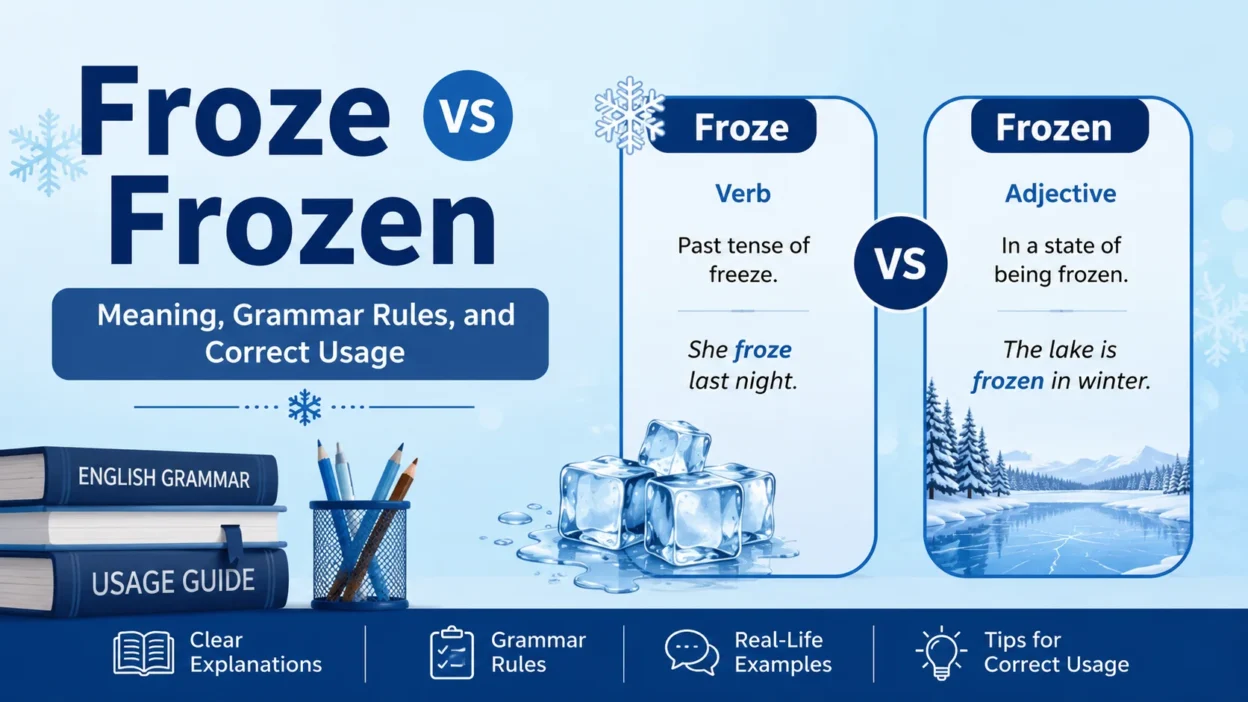
Froze vs Frozen can confuse English learners because each form serves a different grammatical purpose, tense, and role within a complete sentence. The same verb changes form depending on the time and structure being used. Freeze is the base form, froze is the simple past form, and frozen is the past participle form. In English grammar, this pattern is important because the correct choice depends on the sentence structure and tense. For example, “The lake froze last night” describes a completed past action, while “The lake has frozen completely” uses frozen with a helping verb. You can also say, “The lake is frozen,” where frozen describes the current state. When I check these forms, I usually look at the words around each word first. That helps me determine the grammatical purpose and identify which form sounds right. This simple method works well for English learners, students, and native speakers who want clear and correct English.
The pair can confuse people because froze and frozen are closely related, but they appear in completely different grammatical situations. The difference is subtle but important for clear English, correct English, and effective communication. Instead of only memorising forms, connect each form with English tenses and sentence structures. A wrong form can make your writing sound incorrect in professional emails, academic writing, and everyday communication. Common examples include “I have froze it” and “The lake was froze,” which contain errors because the required form is frozen in those structures. Understanding the verb changes, including its vowels, makes the pattern easier to remember. A useful memory trick is to keep the sequence freeze → froze → frozen in mind. Once you understand how the forms behave in different sentences, you can confidently use each form and avoid confusion.
Freeze and frozen also differ in meaning and usage when describing physical changes. Freeze can describe an action in which a liquid becomes a solid by lowering its temperature, such as when you freeze soup for later. Frozen describes something that has been subjected to freezing temperatures and is now solid, such as frozen chicken stored in a freezer before you defrost it. Although these forms may seem interchangeable, using the correct form correctly improves clarity and prevents misunderstandings. The distinction also provides useful guidance when choosing the right term or terms. By examining the meaning, grammar rules, and real-life examples, you can understand how each word works and communicate your ideas effectively without making your writing sound awkward or unclear.
Quick Answer: Froze vs Frozen
Froze is the simple past tense of freeze. Use it when you describe an action or event that happened in the past.
The water froze overnight.
Frozen is the past participle of freeze. Use it with auxiliary verbs such as has, have, or had. It can also describe a condition as an adjective.
The water has frozen overnight.
The water is frozen.
The basic forms are:
| Word | Form | Example |
| Freeze | Base form | Water can freeze quickly. |
| Froze | Simple past | The lake froze last night. |
| Frozen | Past participle | The lake has frozen. |
| Frozen | Adjective | The lake is frozen. |
Cambridge and Oxford both identify froze as the simple past form and frozen as the past participle of freeze.
The easiest rule to remember is:
Froze = simple past.
Frozen = past participle or adjective.
Froze vs Frozen at a Glance
The difference is easier to remember when you see the forms side by side.
| Feature | Froze | Frozen |
| Comes from | Freeze | Freeze |
| Grammatical form | Simple past | Past participle |
| Can act as the main simple-past verb? | Yes | No |
| Used after has/have/had? | No | Yes |
| Can describe a condition? | No | Yes |
| Example | The pipe froze. | The pipe has frozen. |
| Another example | She froze with fear. | She was frozen with fear. |
The crucial distinction is grammar, not meaning.
Both words can refer to the same general idea. The difference lies in how the action fits into the sentence.
Consider these examples:
The river froze last night.
The river has frozen.
The river is frozen.
The first sentence reports a past event. The second uses the present perfect. The third describes the river’s current state.
Understanding the Verb “Freeze”
Before diving deeper into froze vs frozen, it’s useful to understand the complete verb pattern.
Freeze is an irregular verb. It doesn’t form its past tense by simply adding -ed.
Instead, it changes form:
freeze → froze → frozen
This is similar to other irregular verbs:
- break → broke → broken
- speak → spoke → spoken
- steal → stole → stolen
- choose → chose → chosen
- drive → drove → driven
Learning these three forms together makes the difference much easier to remember.
Freeze: The Base Form
Freeze is the base form of the verb.
You use it for general statements, after modal verbs, and in infinitive constructions.
Examples:
- Water can freeze quickly.
- Pipes may freeze during severe weather.
- Don’t let the food freeze.
- The machine could freeze again.
- Some liquids freeze at very low temperatures.
The present-tense form changes for third-person singular subjects:
Water freezes at 32°F.
Oxford’s American dictionary gives freeze as the base form, froze as the past simple, frozen as the past participle, and freezing as the -ing form.
Froze: The Simple Past Form
Froze tells you that the freezing happened in the past.
The structure is straightforward:
Subject + froze + rest of sentence
Examples:
- The lake froze overnight.
- The pipes froze during the storm.
- My computer froze yesterday.
- She froze when she heard the noise.
- The puddles froze before sunrise.
The important point is that froze can stand on its own as the main verb.
You don’t need has, have, or had.
The river froze.
That’s complete.
You wouldn’t write:
The river frozen.
That sentence needs another grammatical element.
Frozen: The Past Participle
Frozen is the past participle of freeze.
One of its most important uses is after have, has, or had.
The pattern is:
have/has/had + frozen
Examples:
- The lake has frozen.
- The pipes have frozen.
- The ground had frozen.
- The food has frozen solid.
- The machine had frozen before the technician arrived.
This explains why the following sentence is incorrect in standard English:
❌ The lake has froze.
The correct version is:
✅ The lake has frozen.
The auxiliary verb has requires the past participle in this construction.
Frozen as an Adjective
There’s another important use.
Frozen can describe a condition or state.
Examples:
- frozen food
- frozen vegetables
- a frozen lake
- frozen pipes
- frozen ground
- a frozen account
Dictionary.com also lists frozen as an adjective for things that have turned to ice, become immobilized, or been fixed at a particular level.
Consider:
The vegetables are frozen.
Here, frozen describes the vegetables.
Likewise:
The road is frozen.
The sentence focuses on the road’s condition.
This is different from:
The road froze overnight.
That sentence focuses on the event that caused the change.
Froze vs Frozen: The Main Grammar Difference
The easiest way to choose between froze vs frozen is to examine the words surrounding the verb.
Use “Froze” for a Simple Past Event
Use froze when you’re describing something that happened and finished in the past.
For example:
The lake froze last night.
The word last night makes the past-time reference obvious.
Other common expressions that can point toward simple past include:
- yesterday
- last night
- last winter
- two hours ago
- earlier
- in 2025
- during the storm
- when I arrived
Examples:
The pipes froze yesterday.
My computer froze during the meeting.
The water froze two hours ago.
In each case, froze is the correct simple-past form.
Use “Frozen” After Have, Has, or Had
This is one of the strongest rules in the entire topic.
If you see have, has, or had, you will generally need the past participle frozen when freeze is the main verb.
Examples:
The pipes have frozen.
The lake has frozen.
The ground had frozen before sunrise.
The food had frozen solid.
The incorrect pattern is:
❌ The pipes have froze.
The standard form is:
✅ The pipes have frozen.
The same rule applies to has and had.
Use “Frozen” With Forms of “Be”
You can also use frozen after forms of be.
Examples:
- The lake is frozen.
- The lake was frozen.
- The pipes are frozen.
- The roads were frozen.
These sentences can describe a state or form part of a passive construction.
For example:
The account was frozen by the bank.
Here, the account didn’t perform the action. Someone or something caused the account to become frozen.
How to Use “Froze” Correctly
“Froze” is the simple past tense of “freeze” and describes something that became solid, extremely cold, or suddenly stopped in the past.
For a Completed Past Action
When something became frozen in the past, use froze.
The pond froze last night.
The water froze during the cold snap.
The pipes froze before the heater was repaired.
The action is presented as something that occurred in the past.
For a Sudden Reaction
Freeze doesn’t always involve ice.
A person can freeze because of fear, shock, surprise, confusion, or nervousness.
Examples:
She froze when she heard footsteps.
He froze when the interviewer asked the unexpected question.
I froze when everyone turned toward me.
The meaning is figurative, but the grammar remains the same.
The past form is still froze.
For Computers and Technology
English also uses freeze when a computer, application, or screen stops responding.
Examples:
My laptop froze during the presentation.
The application froze when I uploaded the file.
The screen froze halfway through the video.
This use is especially common in everyday American English.
Cambridge’s American Dictionary includes freeze for a computer or system that stops functioning normally, as well as for physical freezing and other meanings.
How to Use “Frozen” Correctly
“Frozen” is the past tense and past participle of “freeze,” and it’s commonly used to describe something that has become solid, extremely cold, or unable to move or change.
With Have, Has, or Had
Use frozen as the past participle in perfect constructions.
Examples:
The water has frozen.
The pipes have frozen.
The ground had frozen before the workers arrived.
The system has frozen several times today.
Notice the pattern:
has + frozen
have + frozen
had + frozen
Not:
has + froze
have + froze
had + froze
With “Be” to Describe a State
Use frozen to describe something that is currently in a frozen condition.
The lake is frozen.
The vegetables are frozen.
The pipes were frozen.
The ground was frozen solid.
This is especially useful when the result matters more than the moment the freezing occurred.
As an Adjective
Frozen can modify a noun directly.
Examples:
- frozen fruit
- frozen meat
- frozen vegetables
- frozen lake
- frozen road
- frozen pipes
- frozen account
- frozen assets
The meaning can extend beyond temperature.
For example:
The company announced a frozen salary scale.
Here, frozen means that the amount has been fixed and won’t increase.
Cambridge’s American Dictionary specifically documents freeze for fixing pay or prices at a particular level and for legally restricting access to money or property.
Froze vs Frozen in Different Tenses
Seeing the complete tense pattern can make the rule stick.
| Tense or structure | Correct form | Example |
| Present simple | freeze/freezes | Water freezes at 32°F. |
| Simple past | froze | The water froze last night. |
| Present perfect | has/have frozen | The water has frozen. |
| Past perfect | had frozen | The water had frozen |
Conclusion
Understanding Froze vs Frozen becomes much easier when you remember their different grammatical roles. Froze is the simple past form of freeze, while frozen is the past participle form. Use froze for a completed action in the past, such as “The lake froze last night.” Use frozen with helping verbs or as an adjective, such as “The lake has frozen” or “The lake is frozen.” Keeping the pattern freeze → froze → frozen in mind can help you choose the correct form and avoid common mistakes.
FAQs
Q1. What is the difference between froze and frozen?
Froze is the simple past form of freeze, while frozen is the past participle form. For example, “The water froze yesterday” and “The water has frozen.”
Q2. Is “froze” a past tense word?
Yes. Froze is the simple past tense of freeze. For example: “The lake froze overnight.”
Q3. Is “frozen” a past tense word?
Frozen is the past participle of freeze. It usually appears with a helping verb, such as “has frozen,” or works as an adjective, as in “The food is frozen.”
Q4. Is “I have froze it” correct?
No. The correct sentence is “I have frozen it.” After have, the past participle frozen is required.
Q5. What is the correct form: freeze, froze, or frozen?
All three are correct, but they serve different purposes: freeze is the base form, froze is the simple past form, and frozen is the past participle. The correct choice depends on the sentence structure and tense.