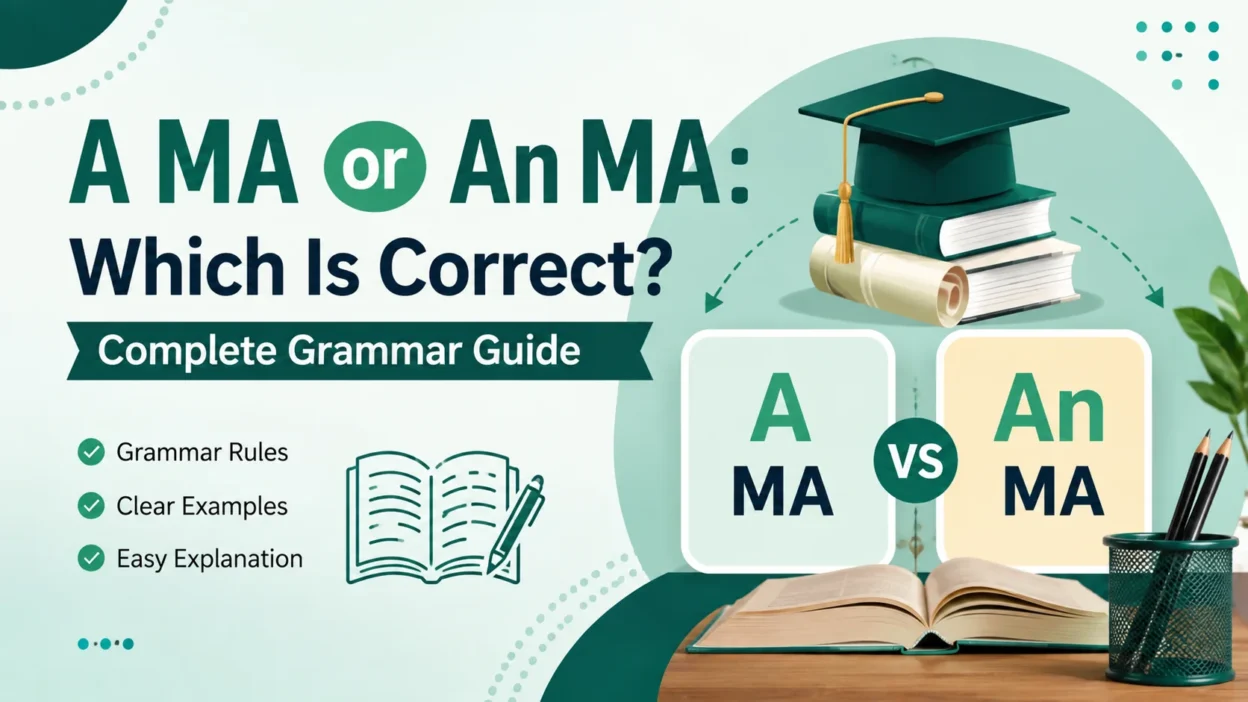
A MA or An MA can seem confusing, but the correct form depends on the sound of the abbreviation. MA stands for Master of Arts, and the letter M is pronounced em, which begins with a vowel sound. That makes an MA degree the natural choice in English grammar. The rule focuses on the spoken form rather than the written letter, so article usage is based on pronunciation, not appearance.
The same pronunciation-based rule applies to other abbreviations and initialism. For example, we say an MBA because M begins with the vowel sound “em,” and an MRI because M is pronounced “em.” In contrast, an abbreviation beginning with a consonant sound takes a. Understanding the initial sound, vowel sound, and consonant sound helps you choose between a and an without having to second-guess your wording. This simple grammar-rule improves accuracy, clarity, and confidence in both academic writing and professional-writing.
You’ll often need this rule when writing about education, higher-education, academic-degree credentials, or qualifications in a resume, resume, CV, curriculum vitae, profile, or university applications. Using an MA degree keeps your writing consistent with standard-English and creates a more polished professional-tone. Paying attention to pronunciation, article usage, proofreading, and grammar-check details can prevent small errors and make your writing clearer for readers, whether the setting is formal or informal.
Quick Answer: A MA or An MA?
“An MA” is correct.
Use an before MA because the abbreviation is pronounced “em-ay,” which begins with a vowel sound.
- ✅ an MA
- ❌ a MA
- ✅ an MA in history
- ✅ She earned an MA in psychology.
- ❌ She earned a MA in psychology.
The important rule is simple:
Use “a” before a consonant sound and “an” before a vowel sound.
The spelling of the abbreviation doesn’t control the article. Pronunciation does.
What Does MA Mean?
MA usually stands for Master of Arts, a graduate-level academic degree.
The degree commonly covers subjects in the humanities, social sciences, languages, education, communication, literature, history, and related fields. The exact structure varies by university and program.
For example, someone might have:
- an MA in English
- an MA in history
- an MA in psychology
- an MA in sociology
- an MA in education
- an MA in political science
- an MA in communication
The abbreviation can also appear as M.A., especially in writing styles that use periods in academic abbreviations.
So you may encounter both:
- an MA
- an M.A.
The punctuation can change. The pronunciation doesn’t. In both cases, the abbreviation begins with the sound “em.”
That means the article remains an.
A MA or An MA: The Basic Grammar Rule
The difference between a and an becomes much easier once you focus on sound rather than spelling.
The Rule of Articles: A vs. An
Use a before a word or abbreviation that begins with a consonant sound.
Examples include:
- a book
- a university
- a teacher
- a BA
- a PhD
Use an before a word or abbreviation that begins with a vowel sound.
Examples include:
- an apple
- an engineer
- an hour
- an MA
- an MBA
- an MS
Notice something important here: the rule concerns sound, not letters.
For instance, university starts with the letter U, but its pronunciation begins with a “yoo” sound. That sound functions like a consonant sound, so we say:
a university
On the other hand, MA begins with the spoken sound “em.” That is a vowel sound.
Therefore:
an MA
Why “An MA” Is Correct
When you see MA, don’t pronounce it as though it were an ordinary word beginning with the letter M.
You say:
M → “em”
A → “ay”
Together:
MA → “em-ay”
The first spoken sound is /ɛ/, the vowel sound at the beginning of “em.”
That’s why the phrase needs an:
an MA
Think of the article as responding to your voice rather than your keyboard. The written letter M may look like a consonant, but its spoken name starts with a vowel sound.
A Quick Pronunciation Test
If you’re ever uncertain about a or an before an abbreviation, say the abbreviation aloud.
Ask yourself:
What sound comes first?
If the answer is a vowel sound, choose an.
If the answer is a consonant sound, choose a.
For example:
| Abbreviation | Pronunciation | Correct Article | Example |
| MA | “em-ay” | an | an MA |
| MBA | “em-bee-ay” | an | an MBA |
| MS | “em-ess” | an | an MS |
| BA | “bee-ay” | a | a BA |
| PhD | “pee-aych-dee” | a | a PhD |
| URL | “you-are-el” | a | a URL |
This pronunciation test is one of the fastest ways to solve the problem.
Correct Meaning and Usage of “An MA”
The phrase “an MA” works naturally when you’re talking about a person who holds, earned, completed, or is pursuing a Master of Arts degree.
Consider these examples:
She has an MA in English.
He earned an MA in history last year.
I’m considering an MA in psychology.
Her MA in education helped her qualify for the position.
The last sentence, however, contains an error unrelated to the article. A better version is:
Her MA in education helped her qualify for the position.
This illustrates another useful point. You don’t always need an article before MA. The article depends on the grammatical structure of the sentence.
When “An MA” Is Needed
Use an when the abbreviation functions as a singular countable noun that requires an indefinite article.
For example:
She earned an MA in literature.
Here, MA refers to one degree.
You could also say:
He completed an MA at the university.
The article introduces the degree as one particular academic qualification.
When You Don’t Need “An”
You don’t automatically put an before every occurrence of MA.
For example:
Her MA is listed on her resume.
Here, MA is being used with a possessive determiner, her. You don’t write:
❌ Her an MA is listed on her resume.
Similarly:
The MA program takes two years.
The definite article already occupies the article position.
Understanding this distinction prevents you from turning the rule into a mechanical formula.
“An MA” Example Sentences
Here are several natural examples:
- She earned an MA in English literature.
- He is pursuing an MA in history.
- Maria has an MA in education.
- An MA can provide advanced academic training in a specialized field.
- She completed an MA before beginning her doctoral studies.
- He holds an MA in international relations.
- The position requires an MA or equivalent graduate qualification.
- I’m thinking about applying for an MA next fall.
Each sentence uses an because the abbreviation MA begins with the vowel sound “em.”
Sentence Breakdown Example
Consider this sentence:
She earned an MA in psychology.
The structure is straightforward:
| Part | Function |
| She | Subject |
| earned | Verb |
| an | Indefinite article |
| MA | Academic degree |
| in psychology | Field of study |
Why do we use an?
Because MA is pronounced “em-ay.” The first sound is a vowel sound.
Test Tip
When grammar questions ask whether to use a or an before an abbreviation, don’t let the written letter trick you.
Instead, mentally pronounce the abbreviation.
For example:
MA → em-ay → an MA
MBA → em-bee-ay → an MBA
PhD → pee-aych-dee → a PhD
This simple strategy works in many grammar tests and editing situations.
A MA or An MA: Real-Life Usage Example
Imagine that you’re writing a professional biography for someone named Daniel.
You want to say:
Daniel has an MA in communication and works as a content strategist.
The phrase sounds natural because MA starts with a vowel sound.
Now imagine replacing the abbreviation with the full degree name:
Daniel has a Master of Arts in communication.
Notice what happened.
We changed:
an MA
to:
a Master of Arts
Why?
Because Master begins with the consonant sound /m/.
This is an excellent example of why you can’t choose an article simply by looking at the abbreviation or the underlying phrase. You have to examine the actual spoken beginning of the expression that follows the article.
The Real-Life Pattern
| Expression | First Sound | Correct Form |
| MA | vowel sound | an MA |
| Master of Arts | consonant sound | a Master of Arts |
| MBA | vowel sound | an MBA |
| Bachelor of Arts | consonant sound | a Bachelor of Arts |
The grammar changes because the pronunciation changes.
Why “An MA” Is Grammatically Correct
The central rule can be summarized in one sentence:
Choose “a” or “an” according to the first sound of the following word or abbreviation.
That rule explains the entire issue.
Key Rule
Use:
a + consonant sound
Use:
an + vowel sound
The distinction isn’t based on whether the next word begins with one of the five traditional vowel letters.
English pronunciation doesn’t always line up neatly with spelling. That’s why this sound-based approach matters.
Compare these examples:
- a university — “yoo-niversity”
- a European country — “yoo-ropean”
- an hour — “our”
- an MA — “em-ay”
- an MBA — “em-bee-ay”
- a PhD — “pee-aych-dee”
The written alphabet gives you clues, but the spoken sound makes the final decision.
Examples for Clarity
Correct:
She has an MA in history.
Correct:
He earned an MBA after completing his bachelor’s degree.
Correct:
She holds a PhD in chemistry.
Correct:
He completed a BA in economics.
Correct:
She has an MS in computer science.
The same grammatical principle operates in every example.
Conclusion
The correct form is “an MA” or “an MA degree,” not “a MA.” The reason is simple: MA is pronounced “em-ya,” and the first sound is a vowel sound. English articles depend on pronunciation rather than the written letter, so an is the natural choice. Remembering this rule will help you write more accurately in academic, professional, and everyday contexts.
FAQs
Q1. Is it “a MA” or “an MA”?
The correct form is “an MA.” The letter M is pronounced “em,” which begins with a vowel sound, so an is used.
Q2. Is it “a MA degree” or “an MA degree”?
The correct phrase is “an MA degree.” Since MA begins with the spoken vowel sound “em,” it takes an.
Q3. What does MA stand for?
MA stands for Master of Arts, a postgraduate academic degree typically awarded in subjects within the arts, humanities, and related fields.
Q4. Why do we use “an” before MA?
We use “an” because articles are determined by the sound that follows them. “MA” is pronounced “em-ya,” and “em” starts with a vowel sound.
Q5. Is “a MA” grammatically correct?
No. In standard English, “a MA” is generally considered incorrect because the abbreviation begins with a vowel sound when spoken.