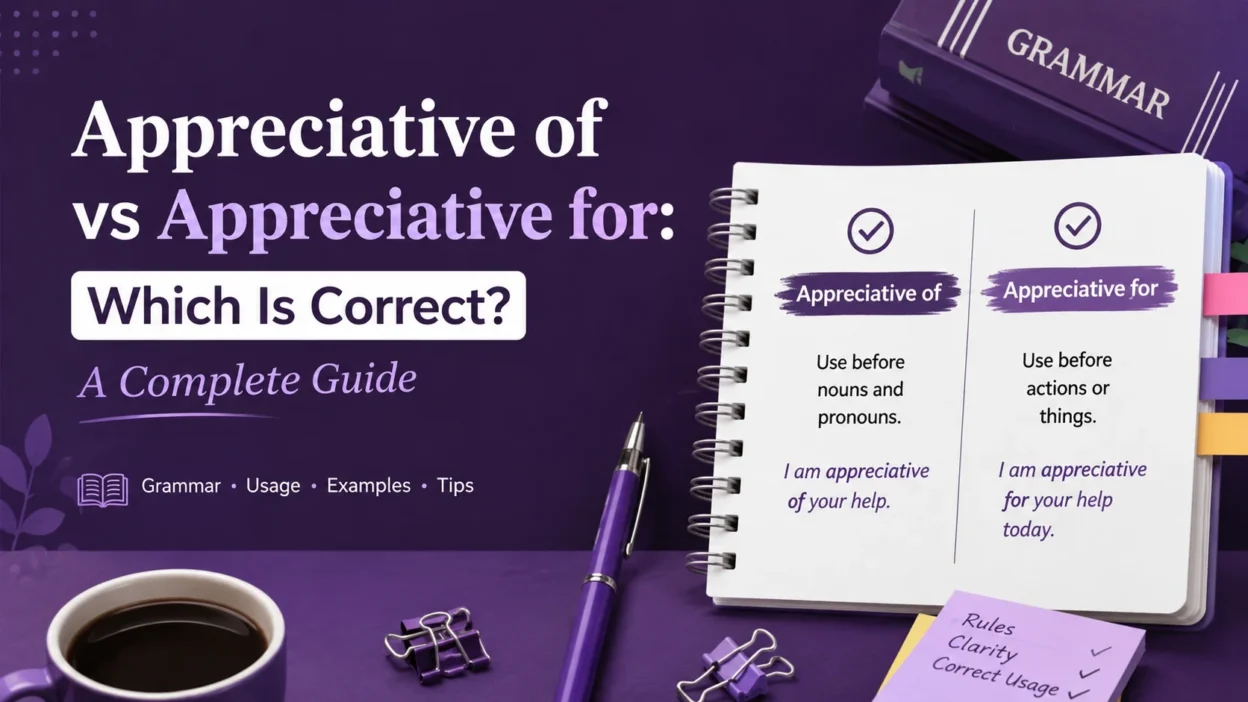
Appreciative of vs Appreciative for: the difference can feel confusing, but appreciative of is the standard and natural expression in English. You use it when you want to show gratitude, respect, or recognition for something valuable. For example, you might be appreciative of someone’s help, effort, kindness, support, talent, or another quality. Appreciative for is much less common and may sound awkward in standard English.
The confusion often comes from the familiar expression grateful for. Because grateful commonly pairs with the preposition for, it’s easy to transfer that pattern to appreciative. However, similar meanings don’t always have identical grammar. English contains many established adjective-preposition combinations, so learners need to understand and remember these patterns rather than assume that one preposition works with every similar word. This small distinction can make your writing and spoken English sound more natural.
If you’re thinking mid-sentence and paused because you’re unsure which form is correct, you’re not alone. Learners and even native speakers sometimes mix these phrases, especially when two expressions have closely related meanings. A useful guide is simple: use appreciative of when you want to recognise or value something specific, and choose grateful for when you want to emphasise thankfulness. Once the pattern makes sense, the choice becomes much easier in everyday conversation and writing.
Appreciative of vs Appreciative for: Quick Answer
Appreciative is the standard and most natural construction in modern English.
Use appreciative of when you want to show that you recognize, value, or feel thankful for a person, action, quality, effort, experience, or thing.
For example:
- I’m appreciative of your help.
- She’s appreciative of your support.
- We’re appreciative of the opportunity.
- He’s appreciative of her honesty.
- They’re appreciative of everything you’ve done.
Appreciative is much less common. In most standard writing and everyday speech, it’s better to replace it with appreciative or grateful for.
| Expression | Main idea | Naturalness |
| Appreciative of | Recognizing or valuing something | Very natural |
| Grateful for | Feeling thankful for something | Very natural |
| Appreciative for | A less common alternative construction | Usually avoid |
The easiest rule is:
Appreciative of
Grateful for
That simple pairing will solve most situations.
What Does “Appreciative” Mean?
Appreciative is an adjective that describes someone who recognizes the value, quality, benefit, or kindness of something.
The word can express gratitude, but its meaning reaches beyond simple thanks. You might be appreciative of someone’s help. You might also be appreciative of beautiful music, a thoughtful gesture, someone’s patience, or an excellent performance.
Consider these examples:
- I’m appreciative of your patience.
- She’s appreciative of his honesty.
- The audience was appreciative of the performance.
- We’re appreciative of the opportunity.
Each sentence expresses a positive recognition of something valuable.
That’s an important distinction because appreciative doesn’t always mean “thankful.” Sometimes it means that someone understands and recognizes the worth of something.
Appreciative vs Grateful
Appreciative and grateful are close in meaning, but they aren’t perfect synonyms.
Grateful usually emphasizes thankfulness. You feel grateful because someone helped you, gave you something, supported you, or created a positive outcome.
Appreciative can express that same gratitude, but it can also focus on recognition, admiration, or enjoyment.
Compare these sentences:
- I’m grateful for your help.
- I’m appreciative of your help.
Both are natural.
Now consider:
- The audience was appreciative of the performance.
- She’s appreciative of his artistic ability.
In these examples, appreciative suggests recognition and enjoyment rather than a simple expression of thanks.
This broader meaning is one reason appreciative of appears in many different contexts.
Appreciative of: The Standard Construction
The normal grammatical pattern is:
appreciative + of + noun, pronoun, noun phrase, or -ing form
For example:
- I’m appreciative of your kindness.
- She’s appreciative of the opportunity.
- We’re appreciative of your feedback.
- He’s appreciative of having another chance.
The word connects appreciative to whatever the person values or recognizes.
What “Appreciative of” Means
When you say you’re appreciative of something, you’re identifying the person, thing, action, quality, or experience that you value.
Look at this sentence:
I’m appreciative of your patience.
The speaker recognizes and values your patience.
Now consider:
We’re appreciative of the team’s hard work.
The appreciation centers on the team’s hard work.
The phrase works in exactly the same way with many other objects.
- appreciative of your support
- appreciative of her kindness
- appreciative of the opportunity
- appreciative of their effort
- appreciative of the feedback
- appreciative of the experience
What Can Follow “Appreciative of”?
Several grammatical structures can follow.
Appreciative of + Noun
This is one of the most common patterns.
- I’m appreciative of your help.
- She’s appreciative of the gesture.
- They’re appreciative of the feedback.
- He’s appreciative of your patience.
The noun identifies exactly what receives appreciation.
Appreciative of + Pronoun
You can also use a pronoun after.
- She’s appreciative of you.
- We’re appreciative of them.
- He’s appreciative of everyone who helped.
However, context matters. In casual conversation, I appreciate you may sound more natural and direct.
Appreciative of + -ing Form
An -ing form can describe an action or experience that someone values.
- I’m appreciative of having this opportunity.
- She’s appreciative of being included.
- They’re appreciative of working with such a talented team.
This construction can be particularly useful in formal or reflective writing.
Appreciative of + Longer Phrase
You can also use a longer noun phrase after of.
- We’re appreciative of all the time you spent helping us.
- She’s appreciative of the support her colleagues provided.
- The organization is appreciative of the effort everyone contributed.
The structure doesn’t change just because the phrase becomes longer.
When toUse “Appreciative of”
You can use appreciative of when recognizing or valuing:
- Help
- Support
- Effort
- Kindness
- Patience
- Honesty
- Feedback
- Guidance
- An opportunity
- A thoughtful gesture
- A person’s qualities
- A performance
- Beauty
- Talent
- An experience
- Good fortune
For example, a manager might say:
“We’re appreciative of your dedication to the project.”
A student might write:
“I’m appreciative of the detailed feedback.”
A friend might say:
“I’m really appreciative of your help today.”
An audience could be described as:
“The audience was appreciative of the performance.”
The phrase works because all these examples involve recognizing some kind of value.
Examples of “Appreciative of”
| Example | What is being appreciated? |
| I’m appreciative of your help. | Help |
| She’s appreciative of his honesty. | Honesty |
| We’re appreciative of the opportunity. | Opportunity |
| They’re appreciative of your effort. | Effort |
| He’s appreciative of the feedback. | Feedback |
| The audience was appreciative of the performance. | Performance |
| I’m appreciative of everything you’ve done. | Actions and support |
Why “Of” Works Here
The reason it sounds natural after appreciative is simple: appreciative is an established adjective-preposition combination in English.
English contains many combinations like this.
You say:
- interested in
- proud of
- responsible for
- aware of
- afraid of
- familiar with
- appreciative of
The preposition isn’t always predictable from the adjective’s meaning. That’s why translating directly from another language or borrowing the preposition from a synonym can lead to mistakes.
In appreciative of, the phrase after of identifies what receives the appreciation.
She is appreciative of the support.
Here:
- She = the person experiencing appreciation
- is appreciative = her attitude
- of the support = what she values
The construction is straightforward once you see the pattern.
Appreciative for: Is It Correct?
“Appreciative for” is generally considered incorrect; “appreciative of” is the standard and natural expression in English.
Why “Appreciative for” Sounds Unusual
The main issue is collocation.
A collocation is a combination of words that naturally tends to occur together. Native speakers become familiar with these combinations through years of hearing and using English.
Common patterns include:
- appreciative of
- grateful for
- thankful for
- proud of
- interested in
The problem often begins when two similar expressions get blended.
You know:
I’m grateful for your help.
You also know:
I’m appreciative of your help.
Your brain may combine them:
I appreciate your help.
That hybrid can sound logical while still sounding unusual to many English speakers.
It’s similar to combining parts from two different recipes. Each ingredient works perfectly in its original dish. The combination isn’t necessarily the best one.
When “For” Can Appear Near “Appreciative”
This is an important detail.
The word for can appear in a sentence containing appreciative without forming the expression appreciative for.
Consider:
I’m appreciative of everything you did for me.
The main construction is:
appreciative of everything
The for belongs to:
did for me
Now consider:
She’s appreciative of you for taking the time to help.
Again, the adjective uses of:
appreciative of you
The phrase beginning with for gives additional information about the action.
So don’t simply scan a sentence for the word for. Look at which words it actually connects.
When “Appreciative for” Should Be Avoided
In professional, academic, or carefully edited writing, appreciative for is usually not the best choice.
Instead of:
I’m appreciative of your support.
Write:
I’m appreciative of your support.
Or:
I’m grateful for your support.
Instead of:
She’s appreciative for the opportunity.
Write:
She’s appreciative of the opportunity.
Or:
She’s grateful for the opportunity.
These alternatives are clearer and more familiar.
Better Alternatives to “Appreciative for”
When you’re tempted to write appreciative for, consider these options:
| Less natural | Better alternative |
| I appreciate your help. | I’m appreciative of your help. |
| She’s appreciative of your support. | She’s appreciative of your support. |
| We’re appreciative of the opportunity. | We’re appreciative of the opportunity. |
| He’s appreciative of your kindness. | He’s grateful for your kindness. |
| They’re appreciative for everything you did. | They’re appreciative of everything you did. |
Conclusion
The main difference between appreciative of and appreciative for is their natural grammar and usage. Appreciative of is the standard expression when you want to recognise or value someone’s help, effort, kindness, support, or quality. Appreciative for is uncommon and may sound awkward. If you want to express clear thankfulness, grateful for is often the better choice.
FAQs
Q1. Is “appreciative of” or “appreciative for” correct?
Appreciative of is the standard and more natural expression in English. Appreciative for is uncommon.
Q2. Why do we say “appreciative of”?
The adjective appreciative normally takes the preposition of when you want to show that you recognise or value something.
Q3. Can I say “I’m appreciative for your help”?
Although you may occasionally encounter appreciative for, I’m appreciative of your help is the more natural standard-English choice.
Q4. Is “grateful for” correct?
Yes. Grateful for is a common and natural expression. For example, you can say, “I’m grateful for your support.”
Q5. What is an easy way to remember the difference?
Remember the pattern appreciative of and grateful for. Of normally follows appreciative, while for commonly follows grateful.