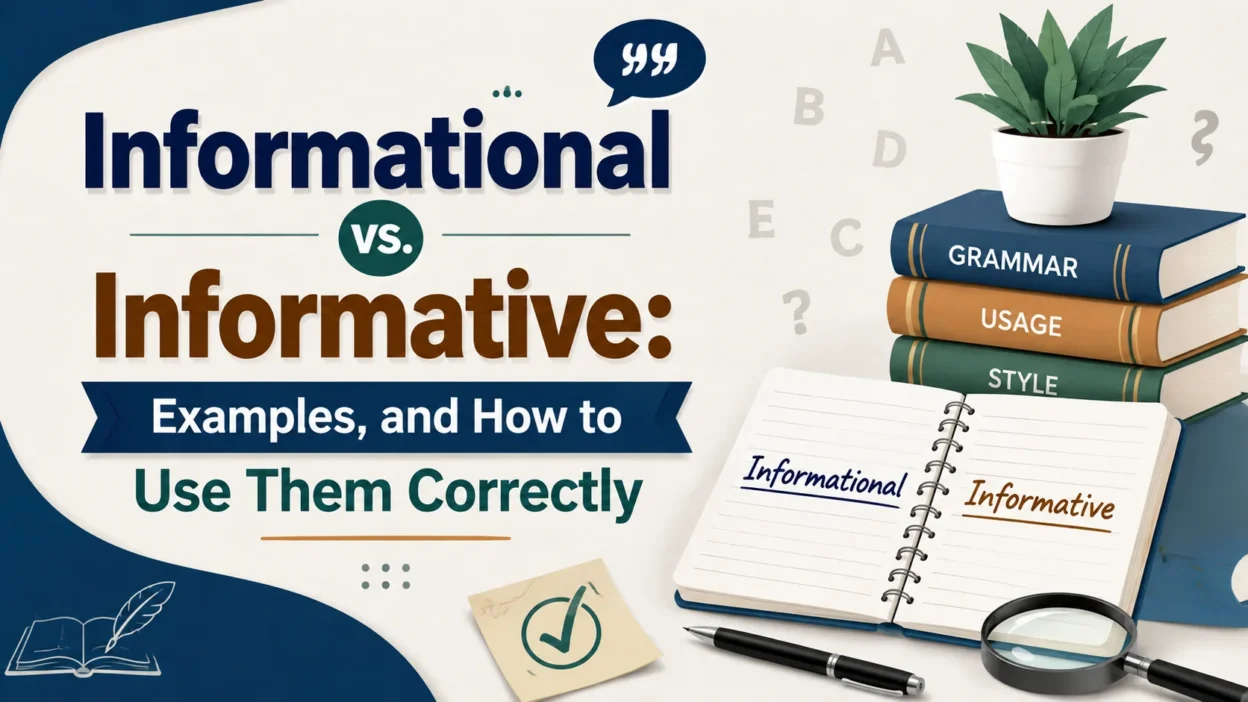
The key difference in Informational vs Informative content is the purpose: one gives information, while the other helps explain ideas clearly. Informational and informative content may look like twins because the words are close in meaning, but they aren’t identical. The difference becomes clearer when you consider the purpose of your writing. Informational content usually presents facts and information, while informative content can explain ideas, build knowledge, and improve understanding. When you write or create digital content, think about your audience, reader intent, and the kind of communication you want to deliver. A simple, human, and practical approach, along with short paragraphs, clear examples, useful tables, and real insights, can make difficult ideas easier to understand today.
The distinction also influences writing quality, tone, structure, and your overall writing approach. If your purpose is to give facts, an informational approach may be the right choice. If you want to explain ideas and teach more effectively, an informative approach can be more useful. These choices matter when you teach, market, or create content. Strong educational content can improve clarity and usefulness, while effective marketing content can help you build trust with readers. A clear content strategy should account for search intent, reader trust, and the information people actually need. You can use this distinction to improve writing quality, match search intent, and create better marketing content without making your message unnecessarily complicated.
The terms also make more sense when you look at their wider context. Informational content focuses on factual information, while informative content often adds explanation and useful learning. Both forms have a place in digital writing, content creation, teaching, and marketing. The guide is to understand what people need before choosing your approach. Although the terms may feel like cousins, they work as related tools: one can primarily supply information, while the other can help readers understand that information more deeply. This distinction also supports a clearer writing purpose, stronger content structure, better information delivery, useful idea explanation, and more effective teaching and effective marketing.
Quick Answer: Informational vs. Informative
Informational means related to information or intended to provide information. Informative means providing useful knowledge, facts, details, or understanding.
A simple way to remember the difference is:
Informational = information-focused.
Informative = knowledge-giving.
For example, informational text describes a type of text that presents information about a subject. An informative article emphasizes that the article gives readers useful knowledge or insight.
| Term | Basic Meaning | Common Examples |
| Informational | Related to or intended to provide information | informational text, informational website, informational resource |
| Informative | Providing useful knowledge or understanding | informative article, informative speech, informative presentation |
| Both | Can describe content that gives people information | informative website, informational article |
The words aren’t strict opposites. In fact, an informational resource can be highly informative. The important difference lies in what you’re emphasizing.
What Does “Informational” Mean?
Informational is an adjective formed from the noun information. It generally describes something associated with information or something intended to provide information.
Think about a public website that explains government services. Its primary role is to make information available to visitors. Calling it an informational website tells you something about the website’s function.
The word often describes the nature, purpose, or category of content rather than judging how useful the content is.
Definition of Informational
Informational means relating to, containing, or intended to provide information.
You might use it to describe:
- informational text
- informational material
- informational resources
- informational websites
- informational brochures
- informational documents
- informational pages
- informational content
The word often answers a question such as:
“What kind of content is this?”
For instance:
The library provides several informational resources for new students.
Here, information identifies the resources as materials that provide information.
Examples of Informational
Consider these examples:
- The museum created an informational brochure for visitors.
- Students used informational texts to research the topic.
- The organization published an informational website.
- The school distributed informational materials about the new program.
- The government released an informational document explaining the policy.
Notice the pattern. Information commonly works as a label for a resource, material, text, or platform whose role involves providing information.
Informational in a Sentence
Here are several natural examples:
The website contains informational pages about local services.
Students read informational texts about the water cycle.
The clinic gave visitors an informational brochure.
The company created an informational guide for new employees.
In each example, the adjective points toward the information-providing function of the thing being described.
What Does “Informative” Mean?
Informative also relates to information, but it carries a slightly different emphasis. It commonly describes something that gives people useful knowledge, facts, explanations, or insight.
If someone says, “That presentation was very informative,” they’re usually commenting on what they learned from it.
That makes informative particularly useful when discussing the effect or value of information.
Definition of Informative
Informative means providing useful information, knowledge, facts, or understanding.
Common examples include:
- informative article
- informative speech
- informative presentation
- informative discussion
- informative documentary
- informative book
- informative lecture
- informative explanation
The word often answers this question:
“What did I learn from this?”
For example:
The lecture was extremely informative.
The sentence doesn’t simply identify the lecture as information-related. It says the lecture gave the audience useful knowledge.
Examples of Informative
Here are some everyday examples:
- The documentary was surprisingly informative.
- She gave an informative presentation about renewable energy.
- The article provides an informative explanation of the process.
- We had an informative discussion about workplace safety.
- His book offers an informative introduction to astronomy.
The emphasis falls on the knowledge or understanding gained.
Informative in a Sentence
Compare these examples:
The website is informational.
This describes the website’s general function.
The website is informative.
This suggests that the website provides useful knowledge or helps visitors understand something.
Both can be correct. The second sentence makes a stronger judgment about the value of the information.
Informational vs. Informative: The Core Difference
The easiest way to understand informational vs. informative is to focus on their emphasis.
Information tends to identify something as information-focused. Informative tends to emphasize the knowledge or understanding someone receives.
Meaning
Informational generally means:
Related to information or intended to provide information.
Informative generally means:
Providing useful knowledge, facts, explanations, or insight.
This distinction isn’t absolute. English has plenty of overlapping adjectives. Context determines which one sounds most natural.
Function in a Sentence
The nouns that follow these adjectives can also give you a useful clue.
Informational commonly appears with:
- text
- resource
- material
- website
- document
- brochure
- page
- content
Informative commonly appears with:
- article
- speech
- presentation
- discussion
- lecture
- documentary
- book
- explanation
These aren’t rigid grammar rules. They’re common usage patterns.
Connotation
The subtle difference becomes clearer through connotation.
Informational sounds more descriptive and functional. It tells you that something concerns or provides information.
Informativity often carries a positive evaluation. Calling something informative usually suggests that it taught you something worthwhile.
Consider this comparison:
The museum created an informational display about ancient Egypt.
The display is designed to provide information.
The museum’s presentation was informative.
The presentation gave visitors useful knowledge.
That’s the difference in a nutshell: information often describes the content’s function, while informative often describes its knowledge-giving value.
Are “Informational” and “Informative” Interchangeable?
Sometimes, yes. Not always.
Both words can describe content that provides information. However, replacing one with the other can make a phrase sound less natural or subtly change its emphasis.
For example:
Informational website
This is a common expression for a website primarily designed to provide information.
Informative website
This is also possible. However, it more strongly suggests that the website is useful or enlightening.
Similarly:
Informational text
This is an established term in education and literacy.
Informative text
This can make sense in a broader context, but it doesn’t necessarily carry exactly the same terminology.
The key lesson is simple: don’t treat the two words as interchangeable twins. They’re close relatives.
Informational Text vs. Informative Writing
This is where the distinction gets particularly interesting.
What Is Informational Text?
Informational text is writing that presents factual information about a subject. In educational contexts, the term commonly refers to nonfiction material that explains, describes, classifies, or discusses real-world subjects.
Examples include:
- textbooks
- reference books
- science articles
- historical documents
- biographies
- news articles
- instructional resources
- encyclopedia entries
An informational text might explain how volcanoes form, describe the causes of a historical event, or present facts about an ecosystem.
It doesn’t need to entertain you. Its primary job is to communicate information clearly and accurately.
What Is Informative Writing?
Informative writing focuses on explaining a topic and helping readers understand it.
A student might write an informative essay explaining how photosynthesis works. A journalist might write an informative article about changing technology. A speaker might deliver an informative presentation about personal finance.
Informative writing often uses:
- facts
- definitions
- examples
- explanations
- comparisons
- evidence
- descriptions
The writer isn’t necessarily trying to persuade the audience. Instead, the goal is to increase understanding.
How They Overlap
An informational text can absolutely be informative.
For example, a science textbook is informational because it provides factual material. It’s also informative because it helps students understand scientific concepts.
This overlap is important because informational and informative aren’t two opposing categories.
One describes the content’s relationship to information. The other often describes its ability to teach or enlighten.
Common Examples of Informational Texts
Informational texts appear almost everywhere you encounter factual material.
Textbooks and Educational Materials
Textbooks explain subjects through definitions, descriptions, examples, diagrams, charts, and supporting details.
A biology textbook might describe cell structures. A history textbook might explain a political movement. A geography textbook might describe climate zones.
These are classic examples of informational texts.
Reference Materials
Reference sources provide information readers can consult when they need specific facts or explanations.
Examples include:
- encyclopedias
- dictionaries
- fact sheets
- reference guides
- manuals
- databases
- glossaries
Their structure often makes information easy to locate.
Reports and Institutional Documents
Reports frequently communicate facts, findings, results, or organizational information.
Examples include:
- annual reports
- research reports
- government reports
- policy documents
- company reports
- school publications
These documents can be highly technical, yet their central function remains informational.
Websites and Information Pages
The internet contains countless informational resources.
Examples include:
- government information pages
- museum websites
- university resource pages
- help centers
- FAQ pages
- public information portals
- knowledge bases
A website doesn’t become informational merely because it contains facts. Its overall purpose and content matter.
Common Examples of Informative Writing
Informative writing can appear in many formats.
Articles and Blog Posts
An informative article explains a topic in a way that helps readers understand it.
For example, an article explaining how credit scores work might define key terms, describe the scoring factors, and give practical examples.
Speeches and Presentations
An informative speech teaches an audience about a topic without making persuasion its primary purpose.
A presentation about ocean pollution could explain:
- What ocean pollution is.
- Where it comes from.
- How it affects marine ecosystems.
- What researchers have discovered.
- Which solutions are being explored.
The speaker’s job is to inform and explain, not simply to dump facts onto the audience.
Essays and Reports
Academic informative writing often develops a topic logically.
A strong essay doesn’t just list information. It establishes context, explains relationships, uses evidence, and helps readers understand why the facts matter.
Guides and Explanations
How-to guides can also be informative when their main purpose involves explaining a subject.
For example, a guide explaining cloud computing may define technical concepts before describing how different services work
Conclusion
Understanding the difference between similar words can make your English clearer, more natural, and more precise. The key is to focus on meaning, context, and usage rather than relying only on how the words look or sound. Once you understand the distinction, choosing the right word becomes much easier.
FAQs
Q1. Why is it important to understand the difference between similar words?
It helps you communicate your ideas clearly and accurately and avoid common grammar or vocabulary mistakes.
Q2. Can similar words always be used interchangeably?
No. Some words have closely related meanings but differ in context, tone, or grammatical function.
Q3. How can I remember the difference between confusing words?
Create simple example sentences and connect each word with its specific meaning or use. Regular practice makes the distinction easier to remember.
Q4. Are these differences important in everyday English?
Yes. Using the right word can make your conversations, emails, essays, and professional writing sound more natural and polished.
Q5. What’s the best way to improve my English vocabulary?
Read regularly, learn words in context, practice writing your own sentences, and pay attention to how native speakers use similar words differently.