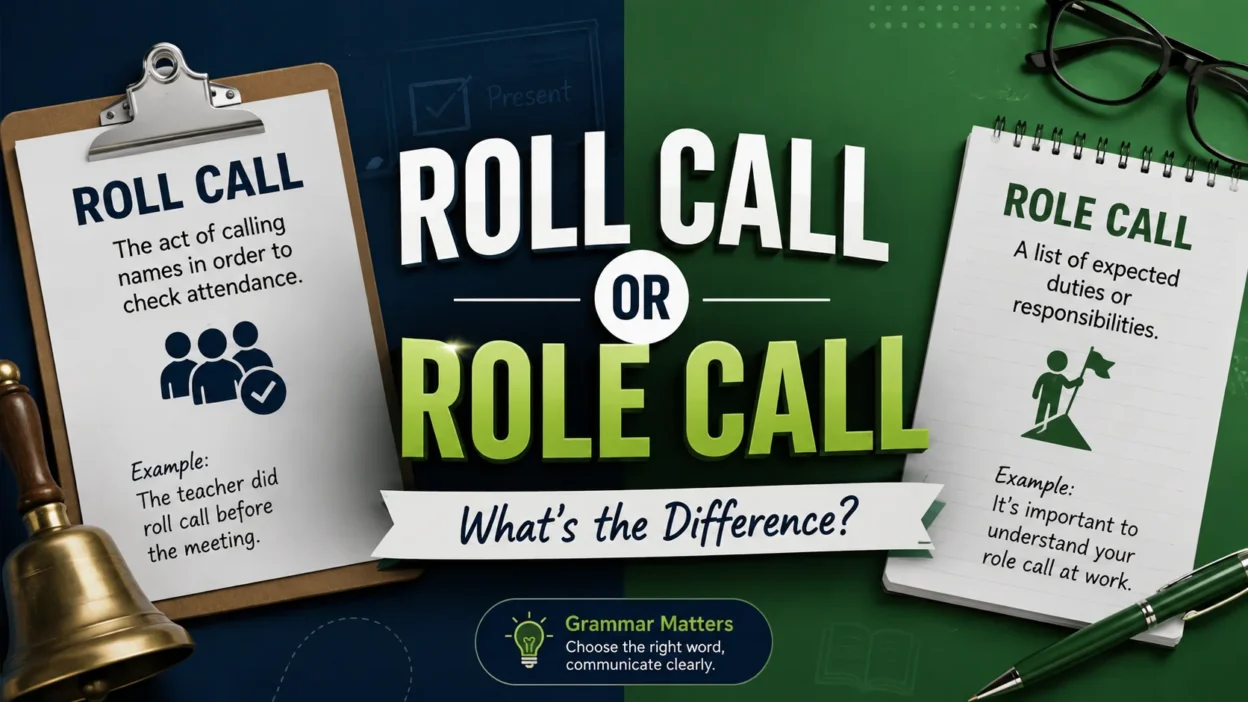
Role Call or Roll Call can be confusing because these homophones sound alike but have different meanings, spelling, and usage. Roll call is the correct phrase for checking attendance, while role means a function, responsibility, position, or part. Remember roll as a list of names or roster, and role as a person’s function or responsibility. This simple distinction helps you choose the right word in school, work, and professional communication.
The main difference becomes clear from context. A teacher may take roll in a classroom, while a military unit may conduct roll call to check personnel who are present. At work or in HR settings, an attendance list, register, or official list may track attendance. By contrast, a manager may explain an employee’s job role, leadership role, or professional role. An actor can have a character role or supporting role in a movie. If you’re calling out names, use roll call; if you’re describing a person’s function or part played, use role.
Regular practice makes the difference easier to remember and apply. When you’re writing in formal writing or professional writing, check the context, word meaning, and correct spelling before choosing your term. Simple examples, memory tricks, and careful word choice can prevent spelling mistakes, incorrect phrases, and common mix-ups. Think roll = roster and role = responsibility. That quick test can keep your English usage clear and accurate.
Roll Call or Role Call: The Quick Answer
If you’re checking attendance, the correct phrase is roll call.
For example:
- The teacher took roll call before the lesson.
- The soldiers assembled for roll call.
- The manager conducted a roll call before the training session.
- The clerk began the roll-call vote.
Role call is generally incorrect when you mean an attendance check.
Here’s a quick comparison:
| Word or Phrase | Meaning | Example |
| Roll | A list, register, or roster in this context | The student’s name appears on the roll. |
| Role | A function, responsibility, or part | She has a leadership role. |
| Roll call | Calling names from a list | The teacher took roll call. |
| Role call | Usually an incorrect spelling of roll call | ❌ The teacher took role call. |
The easiest way to remember the difference is to associate roll with a roster.
Both words start with R. A roster contains names. A roll can also refer to a list of names.
Therefore:
Roll → list → names → roll call.
What Does “Roll Call” Mean?
Roll call refers to the process of calling people’s names from an official list to determine who is present.
You can think of it as a verbal attendance check.
A teacher may have a list of students. A military officer may have a list of personnel. A government clerk may have a list of representatives. When someone calls the names on that list and records the responses, they’re conducting roll call.
The phrase doesn’t belong only to classrooms.
You can find roll call in schools, military organizations, government meetings, workplaces, emergency services, and other organized groups.
Definition of Roll Call
The word roll has several meanings in English. It can describe movement, a sound, a type of food, or a list.
The relevant meaning here is a list or register of names.
That’s why the phrase makes sense:
roll + call = calling names from a roll
For example:
The instructor took roll call before beginning the exam.
The instructor isn’t asking students about their responsibilities. The instructor is checking which students are present.
Where Is Roll Call Used?
Schools: Teachers use roll call to record student attendance.
Military settings: Officers may use roll call to account for personnel.
Meetings: Organizers may call names to establish who has arrived.
Government: Legislative bodies can use roll calls to identify members and record votes.
Events: Small organized groups may use roll call to confirm registered participants.
Emergency services: Personnel checks can help supervisors account for team members.
The setting may change, but the basic idea stays the same: a list of people is used to establish presence or record individual responses.
What Does “Role” Mean?
The word role has an entirely different meaning.
A role is a person’s function, responsibility, position, or part in a particular situation.
You might have a role at work. You might play a role in a family. An actor can play a role in a movie. A team member can have a specific role during a project.
Consider these examples:
- She has a leadership role in the company.
- His role involves managing customer accounts.
- The actor played the lead role.
- Parents have an important role in children’s education.
- Each employee has a clearly defined role.
None of these examples involves attendance.
Role in Professional Life
The word role appears frequently in workplace English.
A job description might explain an employee’s role. A manager might assign each team member a specific role. During a project, people may discuss who has responsibility for particular tasks.
For example:
Maria’s role is to coordinate the marketing campaign.
Here, role means her function or responsibility.
You could also say:
The manager explained everyone’s role before the project began.
Again, the focus is on who does what, not who is present.
Role in Movies and Theater
The entertainment industry provides another familiar use.
An actor receives a role when they portray a character.
Examples include:
- She accepted the lead role.
- He played a supporting role.
- The actor prepared carefully for the role.
- The director offered her a challenging role.
This meaning developed from the idea of an actor’s part in a performance.
Roll Call or Role Call: The Main Difference
The difference becomes obvious when you compare the core meanings.
| Feature | Roll Call | Role |
| Basic meaning | Calling names from a list | Function, responsibility, or part |
| Related word | Roster | Responsibility |
| Common setting | School, military, government | Work, theater, society |
| Used for attendance? | Yes | No |
| Example | We had a roll call at 8 a.m. | She has a leadership role. |
The important point is that roll call is a fixed phrase.
You shouldn’t replace roll with role simply because the two words sound alike.
Why Are Roll and Role Confused?
The answer is pronunciation.
Roll and role are homophones. They have the same pronunciation in standard English but different spellings and meanings.
That makes them easy to confuse in speech.
Think about other homophones such as:
- right / write
- there / their
- two / too
- sea / see
- pair / pear
You can hear the sound but can’t always identify the spelling without context.
The same problem occurs with roll and role.
If someone says, “The teacher will take roll call,” you have to understand the meaning to know which spelling belongs on the page.
Is “Role Call” Ever Correct?
When you mean an attendance check, role call isn’t the standard expression.
Use:
The teacher took roll call. ✅
Not:
The teacher took role call. ❌
However, role and call can appear near each other in a normal sentence.
For example:
The manager called her to discuss her role.
Here, role is correct because it means her function or responsibility.
Another example:
The director called the actor about the role.
Again, role has its normal meaning.
The problem isn’t putting the words role and call in the same sentence. The problem is treating role call as the standard fixed phrase for attendance.
Real-Life Examples of Roll Call
Let’s look at the phrase in different situations.
School Attendance
The teacher started the roll call as soon as the bell rang.
The teacher is checking which students are present.
Military Formation
The unit assembled for the morning roll call.
The purpose is to account for personnel.
Workplace Meeting
The coordinator conducted a roll call before the training began.
The organizer wants to know which participants are present.
Legislative Voting
The clerk conducted a roll-call vote.
Here, lawmakers respond individually and their votes are recorded.
Event Registration
The organizer used roll call to confirm that every participant had arrived.
The names come from a participant list.
In every example, roll connects with a list or roster.
Common Mistakes With Roll and Role
The most common error is straightforward:
❌ role call
✅ roll call
Here are a few more examples.
| Incorrect | Correct |
| The teacher took role call. | The teacher took roll call. |
| We had role call before class. | We had a roll call before class. |
| The officer conducted role call. | The officer conducted a roll call. |
| The clerk started the role-call vote. | The clerk started the roll-call vote. |
The correction is easy once you remember the meaning.
Don’t Confuse Roll and Role Elsewhere
These words have many other uses.
Roll can mean to move by turning:
The ball began to roll down the hill.
It can refer to food:
She ordered a dinner roll.
It can describe a list:
His name appeared on the attendance roll.
Role refers to a function or part:
She plays an important role in the organization.
So the spelling depends entirely on meaning.
How to Remember Roll Call or Role Call
Here’s a simple memory trick that works well:
Roll = Roster
Think:
Roll → Roster → List → Attendance
If you’re calling names from a list, choose roll call.
Role = Responsibility
Think:
Role → Responsibility → Function
If you’re discussing someone’s duties or position, choose a role.
You can also use the five-second test:
Are names being called?
→ Roll call
Are responsibilities being discussed?
→ Role
That distinction will solve most cases instantly.
Roll Call and Role in the Same Sentence
Sometimes both words can appear naturally in the same sentence.
For example:
After roll call, the supervisor explained each employee’s role.
This sentence demonstrates the difference perfectly.
Roll call identifies who is present.
Role explains what each person does.
Another example:
After taking roll call, the teacher assigned each student a role in the classroom activity.
Again, the two words have separate jobs.
That’s a useful way to remember them.
Conclusion
Understanding Role Call or Roll Call becomes easy once you focus on meaning and context. Roll call is the correct phrase for checking attendance, calling names, or confirming who is present. Role refers to a person’s function, responsibility, position, or part. Remembering roll = roster and role = responsibility can help you avoid common spelling mistakes and use the correct phrase confidently in school, work, and professional writing.
FAQs
Q1. Is it Role Call or Roll Call?
The correct phrase is roll call when you mean checking attendance or calling names from a list. Role call is generally an incorrect spelling in this context.
Q2. Why is Roll Call spelled with “Roll”?
Roll can mean a list or register of names. Therefore, roll call refers to calling names from that list to check attendance.
Q3. Does Role Call Have a Different Meaning?
Role call isn’t the standard phrase for attendance. Role means a function, responsibility, position, or part, such as a leadership role or acting role.
Q4. How Can I Remember Roll Call vs. Role Call?
Use this simple trick: roll = roster and role = responsibility. If you’re calling names from a list, use roll call.
Q5. Can Roll Call Be Used Outside School?
Yes. Roll call can describe attendance checks in military units, workplaces, meetings, organizations, and legislative settings. It can also refer to a roll-call vote when individual votes are recorded.