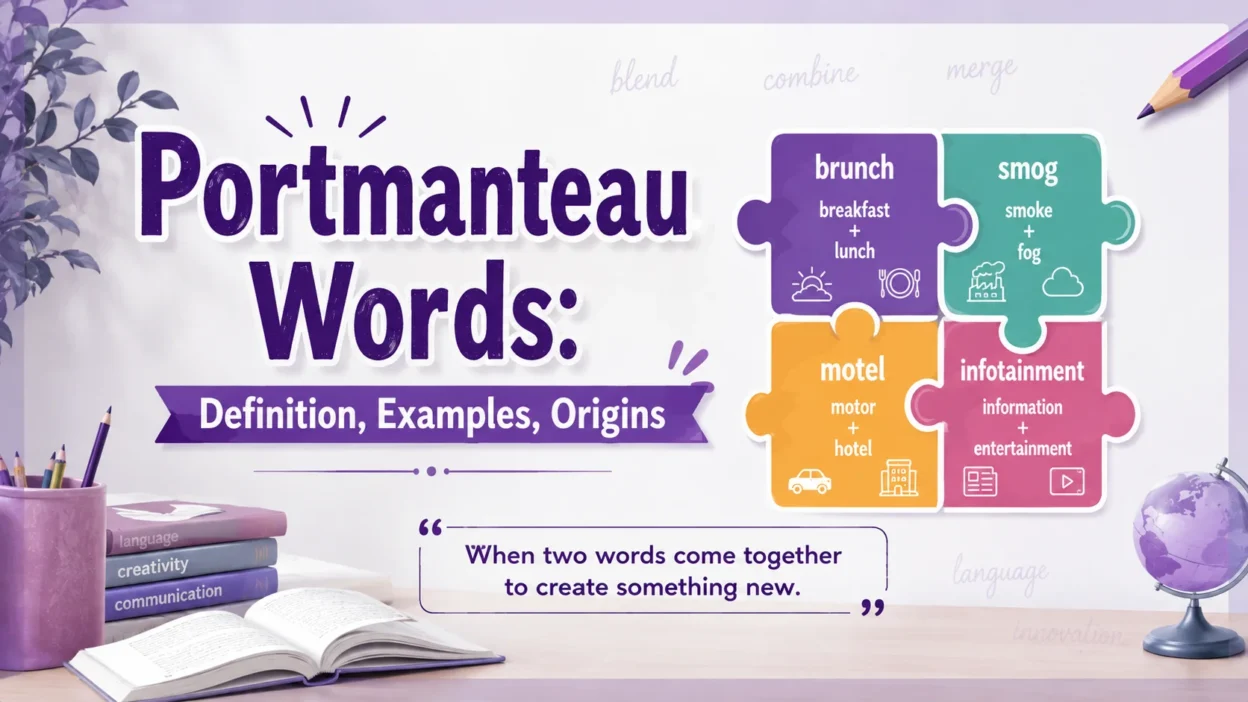
A Portmanteau shows how language changes when people need fresh ways to express familiar ideas. When words blend, their meanings can form one useful term that feels natural in everyday communication. This linguistic process may combine a syllable, sound, or group of sounds from different words. For example, brunch brings together breakfast and lunch to describe one meal. Likewise, smog combines smoke and fog to describe polluted air. These examples show that a portmanteau isn’t random wordplay. Instead, it’s a practical language tool that helps people name new experiences.
The creative side of portmanteau formation becomes clearer as English continues to evolve. People can combine familiar parts to describe new products, experiences, and cultural trends without creating completely unrelated vocabulary. Writers, marketers, students, teachers, and business owners often encounter these blends through modern communication. Technology also encourages new terms because changing habits create fresh needs for language. A clever blend can feel memorable, creative, and descriptive while adding fun and making vocabulary richer. This process reflects the flexibility of modern American English and its ability to adapt as society changes.
For language learners, studying these words offers a practical view of how vocabulary develops. The history of a word can reveal the ideas, sounds, and cultural influences behind its creation. Examples such as brunch and smog show how a temporary blend can move into everyday use and become an established term. Although different source words contribute their own pieces, the final result can become a unique part of modern American English. Understanding this transformation makes it easier to recognize how creativity shapes language and how familiar words can combine to describe changing experiences.
Quick Answer: What Is a Portmanteau Word?
A portmanteau word is a word created by blending parts of two existing words to form a new word with a combined meaning.
For example:
| Portmanteau Word | Source Words | Meaning |
| Brunch | Breakfast + Lunch | A meal between breakfast and lunch |
| Smog | Smoke + Fog | Air pollution mixed with fog |
| Motel | Motor + Hotel | A roadside hotel for travelers |
| Podcast | iPod + Broadcast | Digital audio program |
| Staycation | Stay + Vacation | Vacation spent at home |
Unlike compound words, portmanteaus usually shorten at least one of the original words while preserving ideas from both.
What Is a Portmanteau Word?
A portmanteau word combines portions of two different words into one entirely new word. The new word represents both the sound and meaning of its original parts.
Think of it like mixing two colors of paint. Blue and yellow become green. Likewise, breakfast and lunch become brunch. The original words don’t disappear completely. Instead, they merge to create something new.
Most portmanteau words arise because speakers need an efficient way to describe a concept that didn’t previously have a single word.
For example:
- Infotainment combines information and entertainment.
- Mockumentary blends mock and documentary.
- Flexitarian joins flexible and vegetarian.
These words communicate ideas faster than longer descriptions.
Portmanteau vs. Simply Combining Two Words
Not every pair of words creates a portmanteau.
For example:
- Snowman keeps both complete words.
- Football keeps both complete words.
These are compound words, not portmanteaus.
A portmanteau shortens one or both original words before blending them.
Where Did the Term “Portmanteau” Come From?
The word portmanteau originally referred to a large traveling suitcase with two separate compartments.
The linguistic meaning became popular through Lewis Carroll, author of Through the Looking-Glass (1871). In the book, Humpty Dumpty explains unusual words like slithy, saying they pack two meanings into one word—just as a portmanteau suitcase carries two sets of belongings.
Although Carroll popularized the term, blended words existed centuries earlier.
English speakers had already created words such as:
- Foolosopher
- Electrocute
- Smog
Over time, linguists adopted portmanteau as the official name for this style of word formation.
“Words are living things. They grow because people keep using them.”
That idea perfectly explains why portmanteaus continue to appear today.
How Are Portmanteau Words Formed?
There isn’t one single formula.
Instead, speakers blend words in ways that sound natural and remain easy to recognize.
Beginning + Ending
Many portmanteaus take the first part of one word and the ending of another.
Examples include:
| Word | Source |
| Brunch | Breakfast + Lunch |
| Motel | Motor + Hotel |
| Webinar | Web + Seminar |
Overlapping Sounds
Sometimes similar sounds naturally overlap.
Example:
Smoke + Fog = Smog
Notice that both words share the “o” sound, making the transition smooth.
Blending Meaning
Some blends emphasize the combined idea more than the exact spelling.
Example:
Infotainment
Readers immediately understand that it refers to content that’s both informative and entertaining.
Simple Formation Diagram
Word A + Word B → Blend Sounds → New Meaning → Portmanteau
Example:
Breakfast + Lunch → Brunch
How Do Portmanteau Words Combine Meaning and Sound?
A successful portmanteau does more than merge letters. It blends meanings in a way people instantly recognize.
For example, staycation immediately suggests staying home while taking a vacation. Even someone seeing the word for the first time can often guess its meaning because both source words remain recognizable.
Pronunciation also matters. If a blend sounds awkward or confusing, it probably won’t become popular.
Successful portmanteaus usually share these qualities:
- Easy to pronounce
- Easy to spell
- Easy to remember
- Meaning is obvious
- Feels natural in conversation
That’s why words like podcast spread quickly while thousands of invented blends disappear.
Common Portmanteau Words You Already Use
Many people use blended words daily without realizing they’re portmanteaus.
Everyday Portmanteau Words
| Word | Source Words | Meaning |
| Brunch | Breakfast + Lunch | Late morning meal |
| Smog | Smoke + Fog | Air pollution |
| Motel | Motor + Hotel | Roadside accommodation |
| Chortle | Chuckle + Snort | Laugh loudly |
| Mockumentary | Mock + Documentary | Fiction presented like a documentary |
Technology Portmanteau Words
Technology has created countless new blends.
Examples include:
- Podcast
- Webinar
- Netiquette
- Emoticon
- Blogosphere
These words became common because technology introduced entirely new experiences that needed names.
Food and Lifestyle Portmanteau Words
Modern lifestyles encourage creative vocabulary.
Examples include:
- Staycation
- Mocktail
- Flexitarian
- Hangry
- Frappuccino
Each describes something familiar in today’s culture.
Entertainment Portmanteau Words
Entertainment constantly creates fresh vocabulary.
Examples include:
- Rom-com
- Docudrama
- Cosplay
- Infotainment
- Bollywood
Many eventually become dictionary entries because millions of people begin using them.
Portmanteau Words vs. Compound Words
People often confuse these two concepts.
Here’s the difference.
| Feature | Portmanteau | Compound Word |
| Combines partial words | Yes | No |
| Keeps complete words | Usually No | Yes |
| Creates blended spelling | Yes | Rarely |
| Example | Brunch | Toothbrush |
| Example | Smog | Football |
Examples
Portmanteau
Breakfast + Lunch = Brunch
Compound Word
Snow + Man = Snowman
Both create new vocabulary, but only one blends parts of words.
Portmanteau vs. Blended Word
Many dictionaries use portmanteau words and blend interchangeably.
In linguistics, however, blend often serves as the broader technical term.
That means every classic portmanteau is a blend, but discussions about blends sometimes include additional forms of word creation.
For everyday English, treating portmanteau and blended word as the same concept is generally acceptable.
Why Do People Create Portmanteau Words?
Language favors efficiency.
Rather than saying “a vacation spent at home,” people simply say staycation.
Instead of saying “an online seminar,” they say webinar.
Portmanteaus help people:
- Save time
- Describe new ideas
- Create memorable names
- Add humor
- Reflect cultural changes
- Improve communication
When millions adopt a useful blend, it often becomes standard English.
Portmanteau Words in Branding, Media, and Popular Culture
Businesses love memorable names.
Portmanteaus often create short, distinctive brands that people remember easily.
Examples include:
| Brand | Source Words |
| Microsoft | Microcomputer + Software |
| Pin + Interest | |
| Instant + Telegram | |
| Accenture | Accent + Future |
These names communicate innovation while remaining unique enough for branding.
Entertainment industries also rely heavily on blended words.
Examples include:
- Sitcom
- Rom-com
- Cosplay
- Mockumentary
These words quickly communicate an entire category of entertainment.
Case Study: Microsoft
When Microsoft launched, the company needed a name that represented software designed for microcomputers. Combining the two words created Microsoft, a concise brand name that became recognized worldwide. Today, the name illustrates how a well-crafted portmanteau can evolve from a descriptive label into one of the most recognizable brands in technology.
How Portmanteau Words Become Part of American English
Inventing a word is easy.
Making it part of the language is much harder.
Most successful portmanteaus spread because:
- Journalists use them.
- Businesses adopt them.
- Social media popularizes them.
- Dictionaries eventually recognize them.
- People continue using them naturally.
Many invented blends disappear within months.
Others remain for generations.
For example, smog has existed for over a century because the word still describes a real environmental condition.
Can Anyone Create a Portmanteau Word?
Absolutely.
Anyone can invent a blended word.
However, creating one that people actually use requires careful thought.
A good portmanteau should:
- It sounds natural.
- Be easy to pronounce.
- Clearly combine two ideas.
- Avoid confusing spelling.
- Fill a genuine language need.
Example Coinages
These examples illustrate the process but are not established English words:
- Learncation = Learning + Vacation
- Readventure = Reading + Adventure
- Snackercise = Snack + Exercise
Some invented blends catch on. Most never leave the page.
How to Identify a Portmanteau Word
Ask yourself these questions:
- Does it combine parts of two words?
- Can you recognize both source words?
- Does the meaning come from both?
- Has at least one word been shortened?
- Does it function as one complete word?
If the answer is yes to all five, you’ve probably found a portmanteau.
Famous Portmanteau Words and Their Stories
Many portmanteau words have fascinating origins because they were created by blending two existing words into one. Famous examples like brunch (breakfast + lunch), smog (smoke + fog), motel (motor + hotel), and podcast (iPod + broadcast) became popular because they described new ideas in a simple, memorable way. These creative word combinations show how the English language constantly evolves to reflect changes in culture, technology, and everyday life.
Brunch
Source: Breakfast + Lunch
Created during the late nineteenth century, brunch described a relaxed meal served between breakfast and lunch. Today, it’s a weekend tradition across America.
Smog
Source: Smoke + Fog
This environmental term became popular during the early twentieth century as industrial pollution increased.
Motel
Source: Motor + Hotel
The automobile boom created demand for roadside accommodations, leading to the word motel.
Podcast
Source: iPod + Broadcast
Although podcasts are no longer tied to Apple’s iPod, the original blended name remained.
Chortle
Source: Chuckle + Snort
Lewis Carroll introduced chortle in literature. Readers embraced the playful word, and it eventually entered everyday English.
Portmanteau Words in Modern English
The internet accelerates language change faster than ever before.
Social media, technology, and global communication introduce new ideas daily. Portmanteaus offer a quick and memorable way to name these concepts.
Recent years have popularized blends related to:
- Remote work
- Artificial intelligence
- Streaming media
- Digital communities
- Online learning
- Health and wellness
- Food trends
Some of these words will disappear. Others will become permanent parts of American English.
Language has always evolved this way.
Portmanteau Words in Sentences
| Word | Example Sentence |
| Brunch | We met for brunch before visiting the museum. |
| Staycation | They’re planning a relaxing staycation this summer. |
| Webinar | The company hosted a webinar about cybersecurity. |
| Smog | Thick smog covered the city after several dry days. |
| Podcast | She listens to a history podcast during her morning commute. |
| Mocktail | He ordered a refreshing mocktail instead of a soft drink. |
| Infotainment | The documentary balanced education with infotainment. |
| Motel | We spent the night at a motel near the interstate. |
These examples show how naturally portmanteaus fit into everyday conversation.
Common Mistakes People Make With Portmanteau Words
Even experienced English speakers sometimes confuse word types.
Avoid these common mistakes:
- Assuming every two-word combination is a portmanteau.
- Confusing portmanteaus with compound words.
- Believing every invented blend becomes official English.
- Misidentifying the original source words.
- Creating blends that are difficult to pronounce.
- Using obscure blends that readers won’t understand.
Keeping these points in mind will help you recognize genuine portmanteau words with confidence.
Absolutely — here is the conclusion and FAQs with the key terms bolded.
Conclusion
Portmanteau words show how flexible and creative English can be. By blending parts of two words, speakers create terms that express new ideas in a simple and memorable way. Words such as brunch, smog, motel, and podcast prove that these blends aren’t just playful inventions. Many become useful parts of everyday American English. Once you understand how portmanteaus combine sounds, meanings, and word parts, you’ll start spotting them everywhere.
FAQs
Q1. What is a portmanteau in simple English?
A portmanteau is a new word created by blending parts of two existing words. Brunch, made from breakfast and lunch, is a common example.
Q2. Is brunch a portmanteau word?
Yes. Brunch is a classic portmanteau because it combines parts of breakfast and lunch into one word.
Q3. What are some common portmanteau examples?
Common examples include brunch, smog, motel, podcast, webinar, staycation, mocktail, and infotainment.
Q4. What is the difference between a portmanteau and a compound word?
A portmanteau usually blends parts of two words, while a compound word joins complete words. Brunch is a portmanteau, while toothbrush is a compound word.
Q5. Why are portmanteau words important?
Portmanteaus help English adapt to new ideas, technology, culture, and experiences. They give people short, memorable ways to describe concepts that may otherwise require longer phrases.