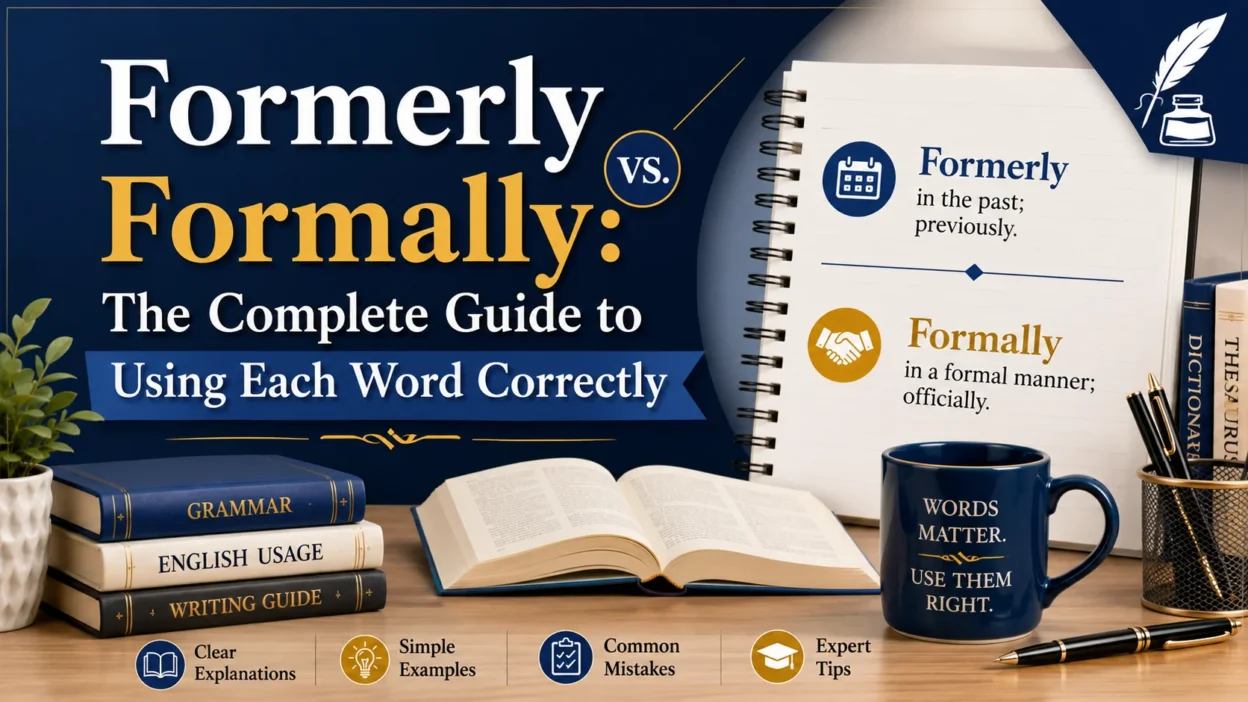
Formerly vs Formally explains how two similar English words can create different meanings because of a small difference in spelling, sound, and usage within a sentence. This language detail helps you build stronger vocabulary and improve your writing by choosing the right word for the right situation. These words may appear alike, but their context reveals their true purpose and prevents common confusion.
The word formerly connects with the past, showing something that was previously true or existed before now. For example, a CEO who used to be the leader of a company may be described through a past role. It highlights an earlier position, identity, or condition. Meanwhile, formally focuses on an official or proper manner of doing things. It describes actions completed according to strict rules, professional standards, or expected behaviour. Someone who is formally dressed may wear official clothes or special clothes for an important event or occasion.
Both words work as an adverb and show how grammar, meaning, and language function together. Through clear examples, you can see that a place that was formerly a school had a previous purpose, while an event that was formally arranged followed an official process. When people mix these words up, the sentence may sound awkward or wrong, but using them correctly creates clearer, sharper, and more professional communication. Understanding how to use these words improves your reader connection and strengthens your overall writing style.
Formerly vs. Formally at a Glance
Before exploring the details, here’s a quick comparison that highlights the main difference.
| Feature | Formerly | Formally |
| Meaning | Previously or in the past | Officially or according to accepted rules |
| Part of Speech | Adverb | Adverb |
| Refers To | Time | Manner or procedure |
| Common Context | Past identities, old names, previous jobs | Business, legal matters, ceremonies, official communication |
| Easy Memory Tip | Think former | Think formal |
This table summarizes everything you need to know in just a few seconds.
The Quick Difference
The simplest way to remember the distinction is this:
- Formerly means previously.
- Formally means officially or properly.
One word talks about time.
The other talks about how something happens.
Whenever you’re unsure which word belongs in your sentence, ask yourself one question:
Am I talking about the past or about an official action?
If you’re discussing the past, choose formerly.
If you’re describing an official process, ceremony, or proper behavior, choose formally.
That one question solves most cases instantly.
What Does “Formerly” Mean?
The word formerly refers to something that existed, happened, or was true in the past.
It tells readers that a person, place, organization, or object had a previous identity or condition.
Definition
Formerly means:
Previously; at an earlier time.
The word comes from former, which means previous or earlier.
Because of that connection, many people find it easy to remember.
How “Formerly” Is Used
You’ll usually see formerly when someone wants to explain that something has changed over time.
Examples include:
- previous careers
- old company names
- earlier ownership
- historical facts
- former locations
- past relationships
Consider these examples.
- The hotel was formerly a courthouse.
- She was formerly the marketing director.
- The business was formerly family-owned.
- He formerly lived in New York.
- Our office was formerly located downtown.
Every sentence refers to something that happened before the present.
Common Situations Where “Formerly” Appears
People
People change jobs, careers, and titles throughout life.
Examples:
- She was formerly a nurse.
- He was formerly an engineer.
- The athlete was formerly a professional swimmer.
Businesses
Companies often rebrand or merge.
Examples:
- The software was formerly called TechSuite.
- The company was formerly known as Digital Point.
- The retailer was formerly an online-only business.
Places
Buildings frequently serve different purposes over time.
Examples:
- The museum was formerly a train station.
- The restaurant was formerly a bank.
- The park was formerly farmland.
Historical References
History books regularly use formerly to explain changes.
Examples:
- The country was formerly part of another empire.
- The road was formerly the city’s main highway.
- The castle was formerly a military fortress.
These examples all focus on change over time.
What Does “Formally” Mean?
Unlike formerly, the word formally has nothing to do with the past.
Instead, it explains how something happens.
Definition
Formally means:
In an official, proper, or ceremonial way.
It comes from the adjective formal, which describes something that follows accepted rules, customs, or procedures.
How “Formally” Is Used
Whenever an action follows official procedures or proper etiquette, formally is usually the correct word.
Examples include:
- legal decisions
- business announcements
- professional introductions
- official appointments
- ceremonies
- government actions
Consider these sentences.
- The board formally approved the proposal.
- She was formally introduced to the audience.
- The agreement was formally signed.
- They formally announced the partnership.
- The judge formally opened the hearing.
Notice that every sentence describes the manner of an action, not the past.
Where You’ll Commonly See “Formally”
Business Communication
Companies use formal procedures every day.
Examples:
- Management formally announced the acquisition.
- The CEO formally welcomed new employees.
- Investors formally approved the merger.
Legal Documents
Law relies heavily on official language.
Examples:
- The court formally accepted the evidence.
- The company formally filed its complaint.
- The contract was formally executed.
Academic Settings
Schools and universities often use ceremonial language.
Examples:
- Graduates were formally recognized.
- The professor formally introduced the guest speaker.
- Students were formally admitted into the program.
Ceremonies
Formal events naturally require formal actions.
Examples:
- The couple was formally introduced at the reception.
- The ambassador was formally welcomed.
- The award winners were formally honored.
Formerly vs. Formally: Understanding the Key Differences
Although these words differ by only two letters, their meanings never overlap.
The following comparison makes that clear.
| Category | Formerly | Formally |
| Main Idea | The past | Official procedure |
| Related Word | Former | Formal |
| Describes | Previous identity | Proper manner |
| Answers | When? | How? |
| Example | Formerly known as ABC Corp | Formally announced the merger |
Difference in Meaning
Formerly answers questions about the past.
Example:
The building was formerly a library.
Formally answers questions about official actions.
Example:
The building was formally opened by the mayor.
Those two sentences describe completely different ideas even though they involve the same building.
Difference in Context
Context determines which word belongs in your sentence.
If you’re discussing:
- previous ownership
- old names
- earlier employment
- historical changes
Used formerly.
If you’re discussing:
- official meetings
- government actions
- business procedures
- legal matters
- ceremonies
Use formally.
Difference in Pronunciation
Many speakers pronounce these words almost the same.
That’s one reason they’re frequently confused.
Instead of relying on pronunciation, focus on the sentence’s meaning.
Meaning always provides the correct answer.
Real-Life Examples of “Formerly”
Seeing words in realistic situations makes them much easier to remember.
Here are several examples.
- The theater was formerly a church.
- She was formerly employed by a large bank.
- The company was formerly headquartered in Seattle.
- My grandfather was formerly a firefighter.
- This smartphone was formerly sold under another brand.
- The road was formerly used by horse-drawn wagons.
- He was formerly captain of the soccer team.
- Their office was formerly located across town.
- The newspaper was formerly published weekly.
- The university was formerly a teachers’ college.
Every example refers to something that existed before today.
Real-Life Examples of “Formally”
Now compare those with sentences that use formally.
- She was formally introduced during the conference.
- The proposal was formally approved.
- The committee formally adopted the recommendation.
- The governor formally signed the legislation.
- The contract was formally accepted by both parties.
- The organization formally launched its new initiative.
- The judge formally closed the hearing.
- The chairman formally welcomed the guests.
- They formally announced their engagement.
- The award recipients were formally recognized during the ceremony.
Notice that every sentence describes an official or structured action.
Business Examples Using Both Words
Business writing often includes both words.
Understanding the difference improves professional communication.
Examples:
- The company was formerly known as Green Systems before changing its brand identity.
- Management formally announced the new corporate name during the annual shareholder meeting.
- She was formerly the finance director before becoming chief operating officer.
- The board formally appointed her as CEO after a unanimous vote.
- The organization was formerly a nonprofit before becoming a public corporation.
- Investors formally approved the acquisition during the special meeting.
These examples show how both words can appear in similar topics while serving completely different purposes.
Case Study: A Costly Business Writing Mistake
A growing technology company prepared a press release announcing its rebranding.
The draft stated:
The company is formally known as NovaTech.
Several editors immediately noticed the mistake.
The sentence suggested that the company had received an official title rather than explaining its previous name.
After revision, the announcement read:
The company was formerly known as TechNova.
That one-word correction completely changed the meaning.
This example highlights an important lesson.
Even experienced professionals occasionally confuse these words.
Taking a few extra seconds to review your writing prevents misunderstandings and presents a more polished, professional image.
Conclusion
Understanding the difference between formerly and formally helps you avoid small mistakes that can change the meaning of your sentences. Although these two English words look and sound similar, they serve completely different purposes. Formerly refers to something from the past, such as a previous name, role, or situation. Formally describes something done in an official, proper, or structured manner.When you remember that formerly connected with former and previous experiences, while formally connected with formal actions and behaviour, choosing the correct word becomes much easier. Clear word choices improve your writing, strengthen your communication, and help your readers understand your message without confusion. A small spelling difference can carry a big meaning, so using these words correctly makes your language more accurate and professional.
FAQS
Q1.What is the main difference between formerly and formally?
The main difference is their meaning. Formerly means previously or in the past, while formally means officially, properly, or in a serious and structured way. One focuses on time, and the other focuses on manners.
Q2.Can formerly and formally be used interchangeably?
No, formerly and formally cannot be used interchangeably. They describe different ideas. For example, “The company was formerly called Bright Solutions” refers to a previous name. “The agreement was formally approved” refers to an official action.
Q3.Is formerly used only for people?
No, formerly can describe people, places, companies, objects, and situations. For example, someone can be a formerly employed manager, and a building can be a formerly used library. It simply shows a previous state.
Q4.When should I use it formally in a sentence?
Use formally when you are describing an official action, professional behaviour, or a proper style. Examples include formally signing a contract, formally introducing someone, or dressing formally for an important occasion.
Q5.How can I easily remember the difference between formerly and formally?
A simple trick is to connect formerly with former, which means something from before. Connect formally with formal, which relates to official events, proper manners, or serious situations. If you think about the past, choose formerly. If you think about official style, choose formally.