The Complaint vs. Complain difference becomes clear when you know each word’s job in English grammar, making every sentence easier to understand. Complaint is a noun, while complain is a verb, and knowing this simple part of speech rule improves your word choice, word usage, and correct usage. A solid understanding of grammar, grammar rules, grammatical roles, meaning, and word meaning helps reduce confusion and makes your writing and speaking more accurate. This practical guide also strengthens your English language skills by showing how these similar words work in everyday communication.
As you improve your sentence structure, every sentence becomes clearer because you know when to use complaint and when to use complain. Strong communication depends on choosing the correct word for the right context, and paying attention to context clues helps you make that choice naturally. Expanding your vocabulary, English vocabulary, and overall language skills also improves your ability to express ideas with confidence. This steady progress supports both language learning and English learning, making your expression more natural and effective.
Instead of memorising long definitions, focus on how these words appear in real situations. That habit will clarify the difference between them and make the distinct differences easier to remember. As you continue practising, your communication skills grow, your correct grammar becomes more consistent, and using complaint and complain correctly soon feels like second nature.
Complaint vs. Complain: The Quick Difference
The fastest way to remember it is this:
- Complaint = a thing
- Complain = an action
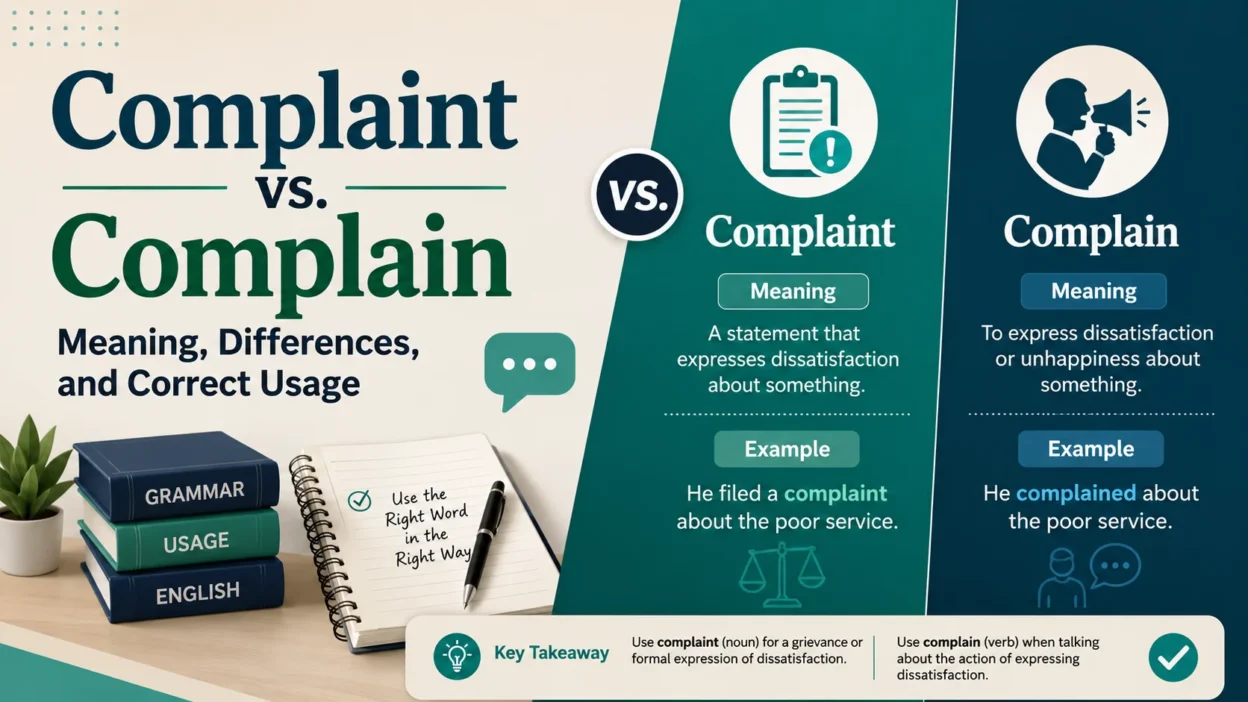
A complaint is a statement, issue, objection, or expression of dissatisfaction.
To complain means to express unhappiness, annoyance, pain, or disapproval.
Simple memory trick for complaint vs. complain
Think of it like this:
- You make a complaint
- You complain about something
Useful rule: If the word needs a noun role, use complaint. If it needs a verb role, use complain.
That one rule solves a lot of writing problems.
Meaning of Complaint
A complaint is a noun. It names the thing being expressed.
You can file a complaint, make a complaint, or receive a complaint. A complaint may be spoken, written, formal, or informal. It can be about poor service, pain in the body, noise, unfair treatment, or almost any problem that someone wants to report.
Complaint in everyday language
Here are a few natural examples:
- She made a complaint about the loud music.
- The customer submitted a complaint online.
- His main complaint was the delay.
- I have no complaint with the service.
Notice how a complaint acts like a thing you can point to. That is the key idea.
Complaint in formal settings
In formal writing, complaint often appear in business, legal, medical, and customer service situations.
For example:
- Customer service: “We received your complaint and will review it.”
- Workplace: “The employee filed a complaint with HR.”
- Medical care: “The patient’s chief complaint is back pain.”
- Legal context: “The complaint was submitted to the court.”
A complaint can sound emotional in daily life, but in formal use it often has a serious, organized meaning.
Meaning of Complain
Complain is a verb that means to express dissatisfaction, annoyance, discomfort, or concern about a person, situation, or experience. People complain when something doesn’t meet their expectations or causes inconvenience. You can complain about poor service, bad weather, loud noise, or physical pain. Unlike complaint, which is a noun, complain describes the action of speaking up or expressing that something is wrong.
Complain in everyday conversations
Examples:
- He complains about everything.
- Don’t complain if you are not ready to help.
- She complained about the delay.
- They complain whenever the food is cold.
Here, complain shows action. It tells you what someone does.
Complain in different forms
The verb changes with tense:
| Tense | Example |
| Present | I complain about the noise. |
| Past | I complained about the noise. |
| Present continuous | I am complaining about the noise. |
| Past participle | They have complained twice. |
This is one reason the verb matters so much. It changes form depending on time and structure.
Complaint vs. Complain: Side-by-Side Comparison
A side-by-side view makes the difference easier to see.
| Word | Part of Speech | Meaning | Example |
| Complaint | Noun | A statement of dissatisfaction | She filed a complaint. |
| Complain | Verb | To express dissatisfaction | She complained about the noise. |
How to choose the right one
Ask yourself a simple question:
- Do you need a thing? Use complaint.
- Do you need an action? Use complain.
That is usually enough.
Complaint vs. Complain in GrammarComplaint vs. Complain in Grammar
The main grammatical difference is that complaint is a noun, while complain is a verb. Use complaint to name a problem or expression of dissatisfaction, and use complain to describe the action of expressing that dissatisfaction. Choosing the correct part of speech makes your sentences clear, natural, and grammatically correct.
Complaint as a noun
Because complaint is a noun, it can be used as:
- the subject of a sentence
- the object of a verb
- the object of a preposition
Examples:
- The complaint was handled quickly.
- I received a complaint yesterday.
- There is no reason for complaint.
Complain as a verb
Because complain is a verb, it needs a subject that does the action.
Examples:
- Customers complain often.
- She complained to the manager.
- They are complaining again.
If the sentence describes an action, complain is the word you want.
Why this matters in real writing
A small grammar slip can make a sentence sound unnatural.
Incorrect: I have a complain.
Correct: I have a complaint.
Incorrect: He complaint about the delay.
Correct: He complained about the delay.
These mistakes are common, especially for learners who are still building confidence with parts of speech.
Common Sentence Patterns with Complaint and Complain
Learning common sentence patterns makes it easier to use complaint and complain correctly in everyday English. You typically make a complaint or file a complaint, while you complain about something that bothers you. These natural word combinations improve your grammar, strengthen your writing, and help your sentences sound clear, fluent, and professional.
Make a complaint
Use this when someone formally reports a problem.
- I want to make a complaint about the service.
- The guest made a complaint at the front desk.
File a complaint
This sounds more official and is common in business, legal, and workplace settings.
- The customer filed a complaint with the company.
- She filed a complaint against the contractor.
Complain about
This is the most common pattern.
- He complains about the weather.
- They complained about the noise.
Complain of
This pattern is more formal and often appears in medical or written English.
- The patient complained of headaches.
- She complained of dizziness and fatigue.
That said, in everyday English, complaining is usually the safer and more natural choice.
Complaint vs. Complain in Real Life
In real-life situations, both complaint and complain appear regularly, but they serve different purposes. People complain when they express dissatisfaction about poor service, unfair treatment, or everyday problems, while a complaint is the formal or informal statement they make about that issue. Understanding this distinction helps you communicate more accurately in school, the workplace, customer service, healthcare, and daily conversations.
At work
In a workplace, a complaint is often a formal report.
- An employee may file a complaint about unfair treatment.
- A manager may complain about missed deadlines.
At school
Students may complain about homework, strict rules, or noisy classrooms.
- The students complained about the long assignment.
- The school received a complaint from a parent.
In customer service
This is one of the most common settings for complaint.
- The customer submitted a complaint about the broken product.
- The support team responded to the complaint within one day.
In healthcare
Doctors and nurses use complaint to describe the patient’s main issue.
- The patient’s chief complaint is chest pain.
- He complained of nausea after lunch.
That medical usage is important because it shows how flexible the word can be.
Real-Life Case Study: Complaint vs. Complain
Imagine a customer receives a damaged product and contacts the company’s customer support team. The customer complains about the damaged item and requests a replacement or refund. After reviewing the issue, the company records the customer’s complaint and begins the resolution process. This example clearly shows that complain describes the action of expressing dissatisfaction, while complaint refers to the issue, report, or statement that is submitted.
Case study one: a restaurant problem
A customer receives the wrong meal. She goes to the manager and says the food is cold and the order is wrong. In this case, she complains.
Afterward, the manager writes down her complaint.
So:
- complains = the action
- complaint = the report or record of the problem
Case study two: a medical visit
A patient visits a clinic and says, “I have pain in my lower back.”
The doctor notes the patient’s chief complaint.
The patient complained of back pain during the visit.
Again, the action is complain. The issue itself is the complaint.
Common Mistakes to Avoid
Many English learners confuse complaint and complain because the words look and sound similar. The most common mistake is using complaint as a verb or complain as a noun, which creates grammatically incorrect sentences. Another frequent error is choosing the wrong preposition, such as saying complain for instead of complain about. Learning the correct part of speech and sentence patterns will help you avoid these mistakes and write with greater confidence.
Using complaint as a verb
Incorrect: She complaint to HR.
Correct: She complained to HR.
Using complain as a noun
Incorrect: I have a complain.
Correct: I have a complaint.
Choosing the wrong preposition
Incorrect: He complained with the noise.
Correct: He complained about the noise.
Incorrect: She made a complaint about the music.
Correct: She complained about the music.
Overusing formal patterns
In everyday speech, complain about sounds more natural than complain of. The second one is not wrong, but it often sounds more formal or medical.
A Few Helpful Quotes and Reminders
Complaint is the result. Complain is the action.
You complain about the problem. You make a complaint when you report it.
These tiny reminders can save time when you are writing, speaking, or editing.
Synonyms and Related Words
Knowing the synonyms and related words for complaint and complain can help you expand your vocabulary and avoid repetition in your writing. Common synonyms for complaint include grievance, objection, protest, and concern, while complain is closely related to grumble, gripe, protest, object, and whine. Although these words have similar meanings, each carries a slightly different tone, context, and level of formality, so choose the one that best fits your sentence.
Synonyms for complaint
- grievance
- objection
- protest
- issue
- concern
- criticism
Synonyms for complain
- grumble
- protest
- object
- moan
- whine
- gripe
Be careful, though. Some of these words are more casual, emotional, or negative than complain. Not every synonym fits every sentence.
Quick Reference Table
| Situation | Best Word | Example |
| Reporting a problem | complaint | She filed a complaint. |
| Expressing unhappiness | complain | She complained about the delay. |
| Medical note | complaint | Chief complaint: headache. |
| Everyday frustration | complain | He complains too much. |
| Formal report | complaint | The complaint was reviewed. |
This table works as a fast check when you are unsure.
Easy Memory Trick
Try this:
- complaint has -aint, like a thing that stays in place
- complain ends with -ain, like an action that is happening
It is not a perfect linguistic rule, but it gives your brain something to hold onto.
A better way to think about it is even simpler:
- complaint = the message
- complain = the sending
Mini Practice
Fill in the blank with the correct word.
- She wants to file a ______ about the delay.
- They often ______ about the weather.
- The doctor wrote down the patient’s chief ______.
- I do not want to ______, but the room is too hot.
Answers:
- complaint
- complain
- complaint
- Complain
Conclusion
Understanding the difference between Complaint and Complain is easier once you know their grammatical roles. Complaint is a noun that refers to a statement of dissatisfaction, while Complain is a verb that describes the action of expressing dissatisfaction. Using the correct word improves your grammar, writing, and communication, making your sentences sound clear, natural, and professional. With regular practice and attention to context, choosing between these two words will soon become second nature.
FAQs
Q1.Is “Complaint” a Noun or a Verb?
Complaint is a noun. It refers to a statement, report, or expression of dissatisfaction, concern, or unhappiness.
Q2.Is “Complain” a Noun or a Verb?
Complain is a verb. It means to express dissatisfaction, annoyance, discomfort, or concern about something.
Q3.What Is the Main Difference Between Complaint and Complain?
The main difference is that Complaint names the problem, while Complain describes the action of expressing that problem. In simple terms, people complain, and they make or file a complaint.
Q4.Can I Say “I Have a Complain”?
No. The correct sentence is “I have a complaint.” Since Complain is a verb, it cannot be used as a noun in this context.
Q5.How Can I Remember the Difference Between Complaint and Complain?
A simple memory trick is to remember that you complain when you express dissatisfaction, and you make or file a complaint after reporting the issue. This easy rule helps you choose the correct word in both speaking and writing.