Thanks for Letting Me Know is a polite, natural phrase used in English conversations to show gratitude when someone shares information and updates. This expression has a warm, clear, simple, and powerful effect because it fits naturally into daily interactions. People use it in emails, conversation, and different settings to express appreciation and acknowledge someone’s effort. The phrase works well when a person provides an update, shares new information, or helps remove doubt. In the English language, small expressions often have deeper nuances, and this straightforward phrase shows how careful word choices improve communication.
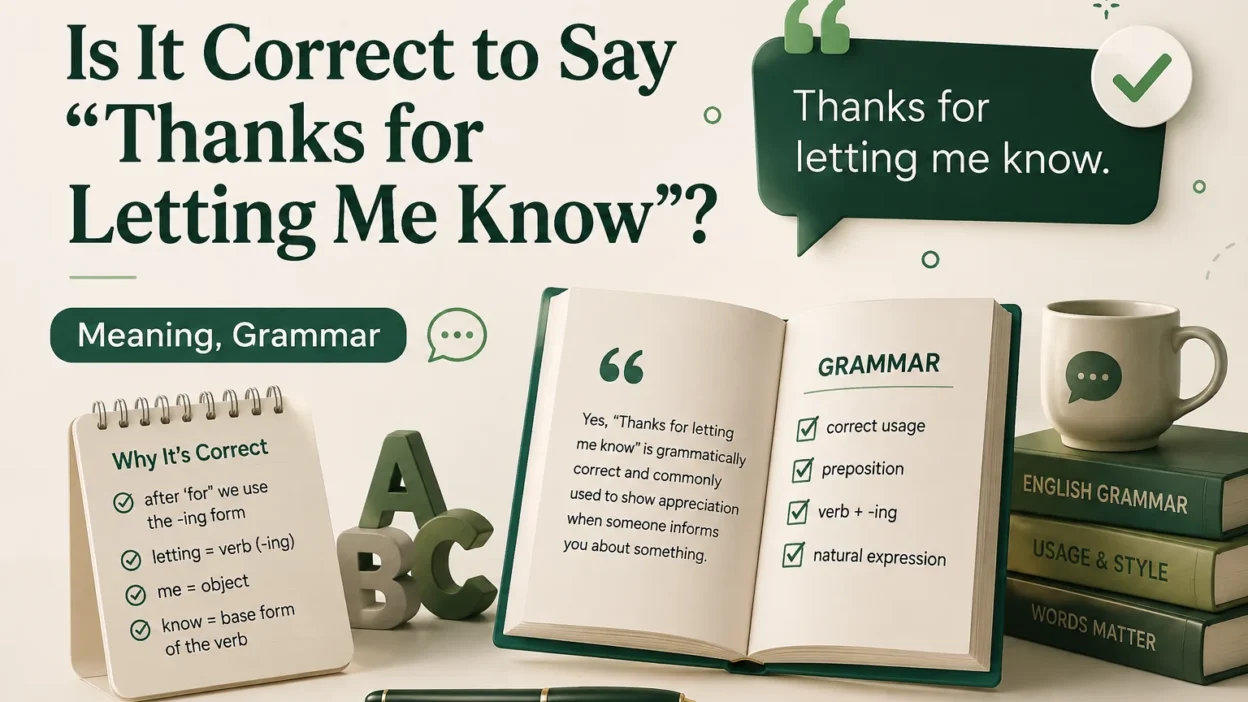
The common expression “Thanks for letting me know” is correct, grammatical, and widely used in modern writing. Many writers consider the context before selecting the right words, but this phrase remains an effective and professional option for emails, texts, team chats, and workplace chat. It creates a friendly tone instead of sounding dry, sharp, or cold. Whether you communicate at work, with friends, or online, the words you choose can shape how others feel about a simple response. It is useful for sharing reactions to news, an important warning, or any message where you want to keep someone informed.
The acknowledgement behind this phrase should feel genuine rather than mechanical or repetitive. Choosing the right variation improves communication by making replies more fresh, thoughtful, and genuine. Other phrases and alternatives may work in different situations, but this expression remains easy to understand and creates a positive impression. Small wording changes can make a big difference in how a message sounds. The grammar is simple because letting comes from let, the base form, while knew has a different meaning. This understanding helps people communicate better, recognise subtleties, and use language with more confidence while showing gratitude, appreciation, and respect.
What Does “Thanks for Letting Me Know” Mean?
The phrase “Thanks for letting me know” is an expression of gratitude used after someone gives you information.
In this context, “let me know” means “tell me,” “inform me,” or “give me the information.”
So, if someone says:
“The office will close early tomorrow.”
You can reply:
“Thanks for letting me know.”
The basic meaning is:
“Thank you for telling me about this.”
The expression doesn’t require the information to be positive. You can use it after hearing good news, bad news, neutral information, or an unexpected update.
For example:
“The deadline has been extended until Monday.”
“Thanks for letting me know.”
Or:
“Unfortunately, your appointment has been canceled.”
“Thanks for letting me know. I’ll reschedule it.”
In both cases, the speaker appreciates being informed.
What “Thanks for Letting Me Know” Conveys
The phrase usually conveys three things:
- Acknowledgment: You received the information.
- Appreciation: You appreciate the person telling you.
- Awareness: You now know something that you didn’t know before.
That’s why the phrase is often more useful than simply saying “Okay.”
Compare these responses:
“The meeting starts at 9 instead of 10.”
“Okay.”
This acknowledges the message but doesn’t express gratitude.
Now compare:
“The meeting starts at 9 instead of 10.”
“Thanks for letting me know.”
The second response acknowledges both the information and the person’s effort to communicate it.
In many situations, that’s exactly what you want.
Grammatical Structure of “Thanks for Letting Me Know”
The phrase follows a simple grammatical pattern:
Thanks + for + gerund phrase
Each part has a specific role.
| Word or phrase | Grammatical role | Function |
| Thanks | Expression of gratitude | Shows appreciation |
| for | Preposition | Introduces the reason for the thanks |
| letting | Gerund | Names the action being appreciated |
| me | Object pronoun | Identifies the person receiving the information |
| know | Base verb | Completes the expression “let me know” |
The key structure is “for letting.”
When for introduces an action in this type of expression, English normally uses the -ing form.
Consider these similar examples:
- Thanks for helping me.
- Thanks for calling.
- Thanks for waiting.
- Thanks for explaining that.
- Thanks for checking.
- Thanks for letting me know.
You wouldn’t normally say:
“Thanks for helping me.”
or:
“Thanks for waiting.”
The same principle explains why “Thanks for letting me know” is correct.
Why “Letting Me Know” Uses a Gerund
A gerund is an -ing form of a verb that functions like a noun in a sentence.
In:
“Thanks for letting me know.”
The phrase “letting me know” represents the action that the speaker appreciates.
You can think of it this way:
Thanks for the information.
and:
Thanks for letting me know.
The first uses a noun phrase. The second uses a gerund phrase.
Both identify the reason for the gratitude.
Why Is It “Letting Me Know” Instead of “Letting Me Knew”?
This is one of the most common grammar questions surrounding the phrase.
The correct sentence is:
Thanks for letting me know.
Not:
Thanks for letting me know.
The reason comes from the grammar of let.
English uses the pattern:
let + object + base verb
Examples include:
- Let me know.
- Let her choose.
- Let him go.
- Let them decide.
- Let us finish.
Notice that the verb after the object stays in its base form.
Therefore:
let + me + know
is correct.
The verb doesn’t change to knew simply because you’re talking about something that happened in the past.
Compare:
She let me know yesterday.
Even though let me know refers to yesterday, know remains in the base form.
The same rule appears in:
He let me leave early.
Not:
He let me leave early.
And:
They let her choose the restaurant.
Not:
They let her choose the restaurant.
This pattern is worth remembering because it appears in many everyday sentences.
Is “Thanks for Letting Me Know” Grammatically Correct?
Yes. “Thanks for letting me know” is grammatically correct in standard English.
There is no grammatical problem with the phrase.
Some people mistakenly think it is incomplete because it doesn’t contain a subject and a conventional finite verb. However, English regularly uses short expressions that function perfectly well as complete conversational utterances.
For example:
- Thanks!
- Good morning.
- No problem.
- Sounds good.
- See you tomorrow.
- Thanks for your help.
- Thanks for letting me know.
These expressions are common because conversation doesn’t always require every idea to appear in a full formal sentence.
The phrase is especially natural because “thanks” works as a conventional expression of gratitude.
If you want a fuller construction, you can say:
Thank you for letting me know.
The meaning remains almost the same.
“Thanks” vs. “Thank You”: What’s the Difference?
Both expressions are correct:
Thanks for letting me know.
Thank you for letting me know.
The main difference is tone, not grammar.
“Thanks” generally sounds more casual. “Thank you” generally sounds more neutral or formal.
That distinction doesn’t mean “thanks” is rude or inappropriate at work. It simply has a more conversational quality.
Consider these examples:
Thanks for letting me know. I’ll update the schedule.
This sounds relaxed and professional enough for many workplace situations.
Now:
Thank you for letting me know. I will update the schedule accordingly.
The second version sounds more formal and deliberate.
Neither is wrong.
When to Use “Thanks for Letting Me Know”
Use “Thanks for letting me know” when the setting is conversational or when you already have a comfortable relationship with the other person.
It works well in:
- text messages
- instant messages
- workplace chats
- conversations with coworkers
- friendly emails
- everyday conversations
- informal professional communication
- quick acknowledgments
For example:
“The manager moved our meeting to Thursday.”
“Thanks for letting me know. I’ll change it on my calendar.”
That’s natural English.
When “Thank You for Letting Me Know” Is Better
Choose “Thank you for letting me know” when you want to sound slightly more formal or polished.
It can be especially useful when communicating with:
- clients
- customers
- supervisors
- teachers
- unfamiliar professional contacts
- people you don’t know well
- recipients in formal situations
For example:
Thank you for letting me know. I’ll review the information and follow up tomorrow.
The wording is courteous without sounding excessively formal.
Is “Thanks for Letting Me Know” Formal or Informal?
“Thanks for letting me know” falls somewhere between informal and neutral.
It’s more casual than “Thank you for letting me know,” but it isn’t slang.
This distinction matters because some writers assume that professional English must always sound formal. That’s not true.
Modern professional communication often favors language that is clear, warm, and direct.
For example:
Thanks for letting me know. I’ll take care of it.
can sound more natural than:
Thank you for informing me of this matter. I shall take the necessary action.
The second version is grammatical, but it may sound unnecessarily stiff in an ordinary workplace.
Good professional writing isn’t about making every sentence sound ceremonial. It’s about choosing a language that fits the situation.
Is “Thanks for Letting Me Know” Professional?
Yes, it can be.
The phrase is perfectly acceptable in many workplace settings, particularly when communicating with coworkers you regularly work with.
For example:
Thanks for letting me know. I’ll send the revised file this afternoon.
That’s concise, polite, and professional.
However, the situation matters.
A message to a close coworker might use:
Thanks for letting me know!
A message to a client might use:
Thank you for letting me know. I appreciate the update.
Both are correct. The second simply creates a slightly more formal impression.
Is It Appropriate for a Boss, Teacher, Client, or Customer?
Usually, yes.
Still, when you aren’t sure about the appropriate level of formality, “Thank you for letting me know” is the safer choice.
For example, if a client writes:
“We’ve decided to postpone the project until next month.”
You might reply:
Thank you for letting me know. I understand. Please keep me updated when you’re ready to resume the project.
That response sounds respectful and professional.
If a coworker sends the same information in a workplace chat, you might simply write:
Thanks for letting me know.
The relationship changes the tone.
When Should You Use “Thanks for Letting Me Know”?
The phrase works whenever someone has given you information that you needed, wanted, or should be aware of.
It can respond to a simple update or something much more important.
Responding to an Update
Suppose your coworker writes:
“The meeting has been moved from Tuesday to Wednesday.”
A natural response would be:
Thanks for letting me know. I’ll update my calendar.
The phrase acknowledges the information while the second sentence communicates your next step.
Responding to Important Information
You can also use the phrase after receiving important news.
For example:
“The application deadline has been extended until Friday.”
Thanks for letting me know. I’ll make sure everything is submitted by Thursday.
The phrase works because the speaker is grateful for receiving timely information.
Responding to Unexpected Information
The information doesn’t have to be something you expected.
For example:
“The store will close early today.”
Thanks for letting me know. I’ll stop by before 4.
The response is practical and natural.
Responding to Bad News
You can even use “thanks for letting me know” after unpleasant information.
For example:
“Unfortunately, the order won’t arrive until next week.”
Thank you for letting me know. I’ll make other arrangements.
Notice what’s happening here.
The speaker isn’t thanking the person for the delay. They’re thanking them for communicating the delay.
That’s an important difference.
Conclusion
“Thanks for Letting Me Know” is a simple but effective phrase that helps people show gratitude, appreciation, and respect in different types of communication. Whether you use it in emails, workplace chat, texts, or everyday conversations, it creates a friendly and professional impression. Understanding its correct use, grammar, and context helps you communicate more clearly and choose words that sound natural. This phrase remains a useful way to acknowledge someone’s effort when they share information, updates, or important details.
FAQs
Q1. Is “Thanks for Letting Me Know” grammatically correct?
Yes, “Thanks for Letting Me Know” is grammatically correct and widely used in modern English. It is a natural way to thank someone for sharing information or providing an update.
Q2. Can I use “Thanks for Letting Me Know” in formal emails?
Yes, you can use this phrase in formal emails. It sounds polite, professional, and clear while keeping your message friendly and easy to understand.
Q3. What is the difference between “Thanks for Letting Me Know” and “Thank You for Letting Me Know”?
Both phrases have the same meaning. “Thank You for Letting Me Know” sounds slightly more formal, while “Thanks for Letting Me Know” feels more casual and conversational.
Q4. When should I use “Thanks for Letting Me Know”?
You can use this phrase when someone gives you an update, shares information, provides news, or tells you something important that helps you understand a situation.
Q5. Are there alternatives to “Thanks for Letting Me Know”?
Yes, some alternatives include “I appreciate the update,” “Thanks for the information,” “I appreciate you telling me,” and “Thank you for the details.” The best choice depends on the context and tone of the conversation.