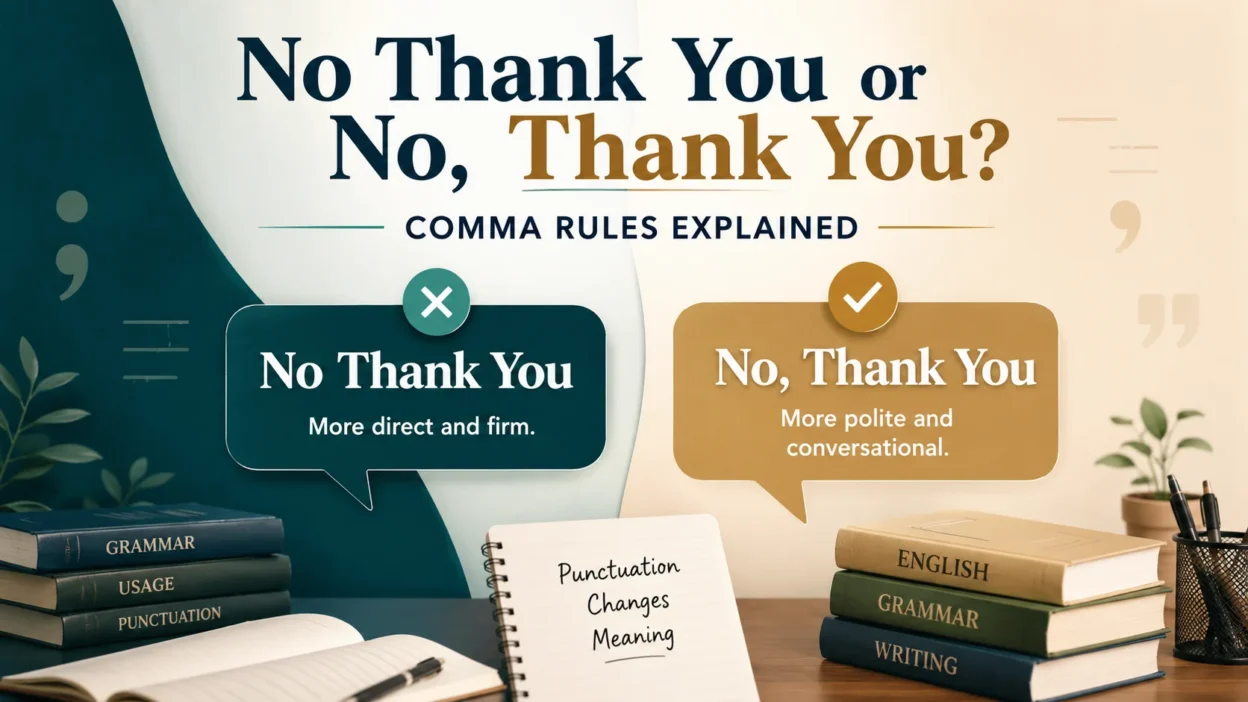
The difference between No Thank You or No, Thank You helps explain how a tiny comma changes a polite refusal, message tone, and English communication. Many people experience confusion because punctuation rules and comma rules can affect the meaning of a sentence. In English writing, the punctuation mark separates the direct decline from the thank you phrase, creating a respectful response. Understanding proper comma placement, grammar rules, and writing skills helps improve clarity and stronger communication skills.
When you write No, Thank You, the comma creates a small pause that shows two different parts working together. The first part expresses refusal, while the second part shows gratitude and respect. This standard form works well when responding to an offer, such as a coffee offer, cake offer, or another polite request. The grammatical role, sentence structure, and intended meaning support this polite expression in everyday situations.
A better understanding of English punctuation makes these small details easier to handle. A helpful guide with examples can show the correct usage and explain when a comma-free version may appear. Similar expressions like No, thanks and Yes, please follow related patterns, helping you build stronger language skills, improve written communication, and create a more clear response in daily conversations, emails, and messages.
No Thank You or No, Thank You: Which Is Correct?
When you’re politely declining an offer, invitation, suggestion, or request, the usual choice is:
No, thank you.
For example:
“Would you like another piece of cake?”
“No, thank you.”
Here, “No” gives the actual answer. The speaker declines the cake. “Thank you” expresses politeness or appreciation for the offer.
The comma helps separate those two functions.
| Expression | Typical meaning | Standard use |
| No, thank you. | A polite refusal | Standard choice |
| No thanks. | A casual refusal | Informal conversations |
| No, thanks. | A casual refusal with a pause | Also common |
| No thank you | Context-dependent | Less typical as a standalone refusal |
If you’re answering someone directly, “No, thank you” is the safest and most widely accepted choice.
It works in casual and professional situations:
- “Would you like some coffee?” — “No, thank you.”
- “Would you like to join us for lunch?” — “No, thank you.”
- “Can I help you with that?” — “No, thank you. I’ve got it.”
- “Would you like to extend your subscription?” — “No, thank you.”
The phrase doesn’t sound excessively formal. It’s simply a polite way to say no.
Why “No, Thank You” Usually Takes a Comma
The comma in “No, thank you” separates a negative response from a following expression of thanks.
You can think of the sentence as having two parts:
No → The answer is negative.
Thank you → The speaker remains polite and acknowledges the offer.
Put those ideas together and you get:
No, thank you.
The comma makes the relationship between the two parts easier to see.
Consider this exchange:
“Would you like some tea?”
“No, thank you.”
The first word answers the question. The second part shows appreciation for the offer.
This pattern isn’t unique to “No, thank you.” You’ll see something similar in:
Yes, please.
Here, “Yes” gives the answer while “please” adds politeness.
Compare:
- Yes, please.
- No, thank you.
- No, thanks.
- Yes, thanks.
These short responses often use punctuation to separate the main response from the polite expression that follows it.
The comma isn’t there merely because a speaker might pause. It reflects how the expression works in the sentence.
Is “No Thank You” Ever Correct?
The answer requires a little nuance.
If you’re writing a simple, standalone refusal, “No, thank you” is the clearest choice:
“Would you like another drink?”
“No, thank you.”
However, the sequence “no thank you” can appear without a comma in certain contexts, especially when the words don’t function as a simple standalone response.
For example:
The sign clearly said no thank you notes were necessary.
Here, “no thank you notes” can be understood as a noun phrase. The phrase means that no thank-you notes were necessary.
In this sentence, the structure differs from:
“No, thank you.”
The first example isn’t a person saying no and then thanking someone. Instead, “no” modifies the noun phrase “thank-you notes.”
Another example:
The invitation included a no-thank-you-needed policy.
This is a less common construction, but it illustrates the point. The words aren’t functioning as a conversational refusal.
So, don’t assume that every occurrence of “no thank you” needs the same punctuation. Always look at the grammatical role of the phrase.
“No, Thank You” as a Polite Refusal
The most common use of “No, thank you” is to politely reject something.
You might use it when someone offers you:
- Food
- A drink
- Help
- Advice
- An invitation
- A product
- An opportunity
- An additional service
- A suggestion
The phrase works because it combines a clear refusal with a courteous response.
For example:
“Would you like some dessert?”
“No, thank you. I’m full.”
The refusal is direct. However, the phrase doesn’t sound harsh.
Compare these responses:
“No.”
“No, thank you.”
“Absolutely not.”
All three reject the offer, but they don’t carry the same tone.
“No” is neutral but can sound blunt depending on the situation.
“No, thank you” is polite and respectful.
“Absolutely not” sounds much stronger and may suggest disagreement or firm rejection.
That’s why “No, thank you” remains useful in everyday English. It allows you to say no without making the other person feel dismissed.
Examples of “No, Thank You” in Everyday Conversations
Here are some natural examples:
Declining food
“Would you like another slice of pizza?”
“No, thank you. I’ve had enough.”
Declining a drink
“Can I get you some more water?”
“No, thank you.”
Declining help
“Do you need help carrying those boxes?”
“No, thank you. I can manage.”
Declining an invitation
“Would you like to come to dinner tonight?”
“No, thank you. I already have plans.”
Declining a suggestion
“You should try this new restaurant.”
“No, thank you. I’m not interested.”
Declining a sales offer
“Would you like to upgrade your plan?”
“No, thank you. I’ll keep my current plan.”
Notice that the comma remains in each standalone response.
“No, Thank You” in Professional Communication
“No, thank you” also works well in professional settings.
You might use it when declining an offer from a colleague, responding to a sales representative, or turning down an invitation.
For example:
“Would you like to attend the optional training session?”
“No, thank you. I won’t be able to attend.”
Or:
“Would you like us to send you a revised proposal?”
“No, thank you. We’ve decided to move forward with another option.”
In business writing, you may sometimes want to soften the refusal even further.
For example:
Thank you for the offer, but I’ll have to decline.
Or:
I appreciate the invitation, but I won’t be able to attend.
These alternatives can work better when the refusal involves a sensitive matter.
A one-word “No” may feel abrupt in an email. “No, thank you” is friendlier, while a full sentence can provide additional context.
When to Use “No Thank You” Without a Comma
The comma-free form deserves careful attention because it’s easy to oversimplify the rule.
When “No, thank you” functions as a direct response, the comma is normally appropriate.
When the words form part of a larger grammatical construction, the punctuation may change.
Consider:
No thank-you note is necessary.
Here, “thank-you note” is a compound noun. The word “no” modifies the noun phrase.
The meaning is:
There is no thank-you note necessary.
That differs completely from:
No, thank you.
In the second sentence, someone is politely refusing something.
The distinction becomes clearer when you look at the sentence structure.
| Example | Function |
| “No, thank you.” | A polite refusal |
| No thank-you note is required. | “No” modifies a noun phrase |
| She gave a thank-you speech. | “Thank-you” modifies a noun |
| He sent a thank-you card. | Compound modifier |
| “No, thank you. I’m fine.” | Refusal followed by explanation |
The key lesson is simple: don’t judge punctuation by the words alone. Look at how those words function together.
“No Thank You” as Part of a Larger Phrase
The expression “thank you” can act as a compound modifier when it describes a noun.
For example:
She wrote a thank-you letter.
He bought a thank-you card.
They organized a thank-you dinner.
In these examples, “thank-you” works together as a compound modifier.
Now add “no”:
No thank-you card was necessary.
The sentence doesn’t mean someone said, “No, thank you.”
Instead, it means that no card expressing thanks was necessary.
That’s a completely different grammatical structure.
This is why the comma rule isn’t as simple as saying “No thank you is always wrong.” The phrase can appear in different structures with different meanings.
When “No Thank You” Can Sound More Abrupt
Even when punctuation isn’t the only factor, it can influence how a short response feels.
Compare:
No.
No, thank you.
No thanks.
No, thanks.
The first response is the most direct.
The second sounds polite and complete.
The third feels casual and relaxed.
The fourth also sounds casual but gives “thanks” a slightly more distinct role.
Now consider:
No thank you.
Without punctuation, some readers may find the phrase visually awkward when it appears as a standalone response. It can look as though “no” and “thank you” have been pushed together into one unit.
That’s one reason “No, thank you” remains the preferred form for a polite refusal.
Still, punctuation doesn’t magically create politeness. Context matters.
For example:
No, thank you.
can sound warm when spoken gently.
But:
NO, THANK YOU!
could sound angry or emphatic because capitalization and punctuation change the tone.
The words stay the same. The presentation changes the message.
Comma Rules for “No, Thank You”
The punctuation in “No, thank you” makes more sense when you consider how short conversational expressions work.
“No” is the response to the question.
“Thank you” is the polite addition.
The comma helps separate the two.
This pattern appears in many common expressions:
- Yes, please.
- No, thank you.
- Yes, thanks.
- No, thanks.
- Well, perhaps.
- Oh, I see.
These examples show how punctuation can help readers understand the relationship between parts of a short expression.
The Comma in Short Answers
Short answers often contain more than one communicative function.
Take:
Yes, please.
The speaker accepts something and politely indicates what they want.
Now compare:
No, thank you.
The speaker rejects something while acknowledging the offer.
You can also expand the responses:
Yes, please. I’d love some coffee.
No, thank you. I’ve already eaten.
The short response becomes easier to understand when you expand it into a complete thought.
Here’s another example:
“Would you like to join us?”
“No, thank you. I appreciate the invitation.”
The first part gives the answer. The second part adds warmth.
In many cases, you can remove “thank you” and still have a grammatically complete response:
“Would you like some tea?”
“No.”
The meaning remains clear. However, adding “thank you” changes the social tone.
The Difference Between a Pause and a Comma
One common punctuation mistake is assuming that every pause in speech requires a comma.
That’s not how English punctuation works.
You might pause naturally while saying:
“I went to the store yesterday.”
That doesn’t mean you should write:
“I went to the store yesterday.”
The comma isn’t needed simply because a speaker might pause.
In “No, thank you,” however, the punctuation has a grammatical and functional purpose. It separates the negative response from the courtesy expression.
So, while spoken rhythm can help you understand punctuation, it shouldn’t be your only guide.
A useful rule of thumb is:
Use punctuation to clarify grammatical structure, not merely to copy every pause in speech.
“No, Thank You” vs. “No Thank You”: Side-by-Side Comparison
The easiest way to understand the difference is to compare the forms directly.
| Form | Meaning or function | Example |
| No, thank you. | Polite refusal | “Would you like coffee?” “No, thank you.” |
| No thanks. | Casual refusal | “Want another one?” “No thanks.” |
| No, thanks. | Casual refusal | “Would you like some?” “No, thanks.” |
| No thank-you note is needed. | “No” modifies a noun phrase | “No thank-you note is necessary.” |
| Thank-you card | Compound noun modifier | “She sent a thank-you card.” |
The most important distinction is between the first and fourth examples.
No, thank you.
means:
I am saying no, and I am thanking you for the offer.
But:
No thank-you note is needed.
means:
A note expressing thanks isn’t needed.
The punctuation helps readers understand that difference.
Which Form Should You Normally Use?
If you’re directly answering an offer, use:
No, thank you.
If you’re writing casually, you can also use:
No, thanks.
If you’re discussing a noun such as a thank-you note or thank-you card, use the appropriate compound form:
No thank-you note is necessary.
The context determines the correct structure.
Common Mistakes With “No Thank You” and “No, Thank You”
Several mistakes appear repeatedly in writing.
Mistake: Treating Both Forms as Identical
Writers sometimes assume that “No thank you” and “No, thank you” are always interchangeable.
They aren’t.
As a standalone polite refusal, “No, thank you” is the standard form.
When “thank-you” functions as part of a compound noun or modifier, the structure changes.
Mistake: Adding a Comma Because You Hear a Pause
Not every pause requires punctuation.
Consider:
“I really appreciate your help.”
You might pause before “your help” while speaking, but that doesn’t automatically justify a comma.
Punctuation follows grammatical relationships rather than every tiny break in speech.
Mistake: Forgetting the Comma in a Standalone Refusal
This is one of the most common problems:
“Would you like some more?”
“No thank you.”
The meaning is understandable. However, standard punctuation favors:
“No, thank you.”
The comma makes the structure immediately clear.
Mistake: Assuming Punctuation Controls Tone
Punctuation matters, but it isn’t everything.
Compare:
No, thank you.
with:
No, thank you!
The second can sound more enthusiastic or emphatic.
Now compare:
No, thank you. I appreciate the offer.
This sounds warmer because the writer adds appreciation.
The words around the phrase often have a greater effect on tone than the comma itself.
Is “No Thank You” Always Wrong?
No.
That would be too broad a rule.
“No, thank you” is the standard choice when you’re politely refusing something. However, “no thank you” can appear when the words have a different grammatical function.
For example:
No thank-you note is required.
Here, “thank-you” describes the type of note. The sentence doesn’t contain a conversational refusal.
Similarly:
She sent no thank-you card after the event.
In this sentence, “no” modifies the noun phrase “thank-you card.”
The comma would be incorrect because the sentence isn’t saying:
No, thank you.
Instead, it’s describing the absence of a card.
This distinction is small but important.
Is “No, Thank You” Too Formal?
Not at all.
In American English, “No, thank you” is a normal and widely understood polite response.
Its tone depends on the situation.
| Expression | Tone | Best context |
| No. | Direct | Simple answers |
| No, thank you. | Polite, neutral | Most situations |
| No, thanks. | Casual | Friends and everyday conversation |
| I’m good, thanks. | Friendly, informal | Casual offers |
| I appreciate it, but no. | Warm, appreciative | Sensitive refusals |
| Thank you, but I’ll pass. | Friendly | Invitations and options |
| I appreciate the offer, but I’ll have to decline. | Professional | Workplace situations |
If you’re unsure which one to choose, “No, thank you” is a reliable option.
It doesn’t sound stiff. It doesn’t sound overly casual. It simply sounds polite.
Conclusion
Understanding the difference between No Thank You and No, Thank You helps improve your English writing, punctuation skills, and everyday communication. In most polite situations, No, Thank You is the preferred form because the comma creates a natural pause between the refusal and the expression of gratitude. This small punctuation mark adds clarity, respect, and a more thoughtful tone to your response.Although No Thank You may appear in some casual writing, the comma version usually follows standard grammar rules and supports clearer meaning. Learning these small details helps you make better word choices, strengthen your language skills, and communicate more confidently in spoken communication and written communication.
FAQs
Q1.Is “No, Thank You” the correct form?
Yes, No, Thank You is the standard form when you politely refuse an offer. The comma separates the refusal from the expression of gratitude.
Q2.Is “No Thank You” ever acceptable?
Yes, No Thank You can appear in some informal situations, signs, titles, or quick messages. However, No, Thank You is usually preferred in normal polite conversation.
Q3.Why does “No, Thank You” need a comma?
The comma creates a small pause and separates two ideas: the decline (“No”) and the polite appreciation (“Thank You”).
Q4.What is the difference between “No, Thanks” and “No, Thank You”?
Both expressions show a polite refusal, but No, Thank You sounds slightly more formal and respectful, while No, Thanks feels more casual.
Q5.Does punctuation change the meaning of a sentence?
Yes, punctuation can affect clarity, tone, and meaning. A small comma can show the relationship between words and make communication easier to understand.