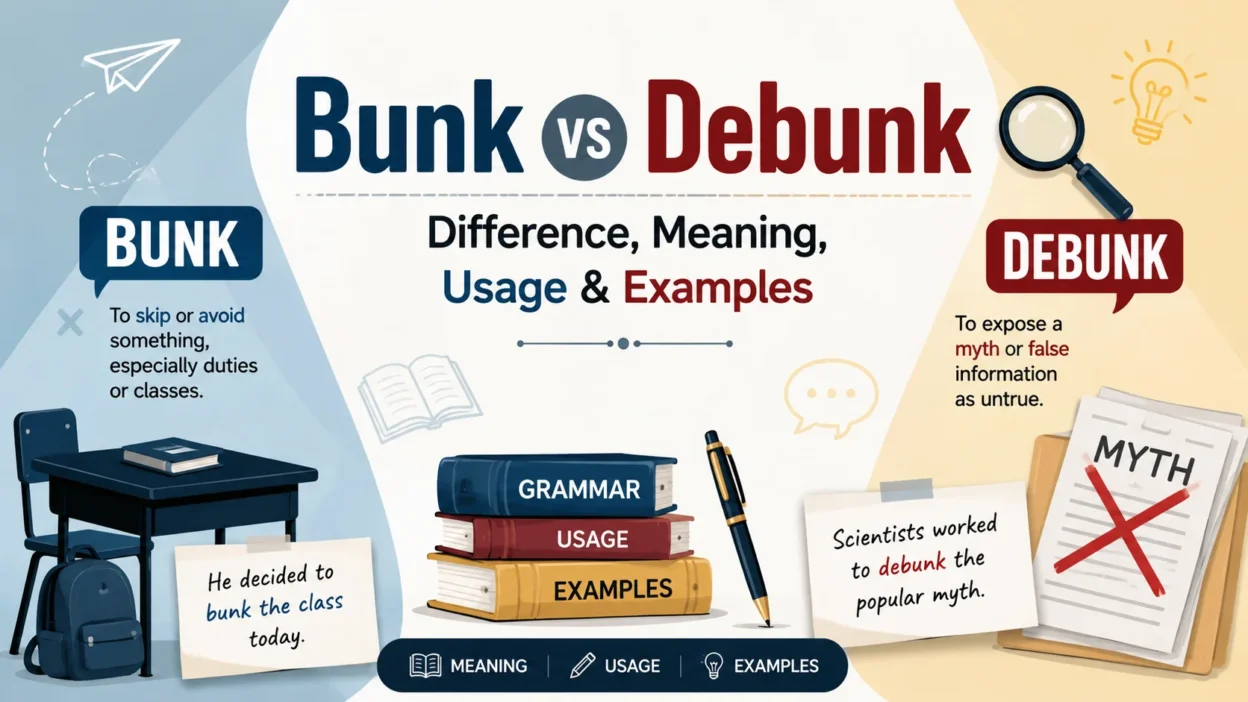
Bunk vs Debunk can seem similar because the words are closely related, but they have a clear difference in meaning and grammatical uses. Bunk can mean nonsense, false talk, or a misleading, unsupported, strange claim without a solid basis. It can also mean a bed or bunk bed used for sleeping or sleeping in a hostel, summer camp, or ship. In this context, bunk may describe a theory that the earth is flat as pure bunk, especially when someone tries to deceive others. These different meanings can be confusing, so understanding the words and their context helps you use them correctly.
Debunk has a more specific meaning. It means to expose something false, misleading, or unsupported by using evidence to show that a claim is unreliable. A researcher investigates evidence and proves what can be supported as true, while a scientist may say a claim has been debunked. For example, a scientist might debunk the myth that eating carrots improves night vision when reliable evidence does not support it. In this way, debunk helps correct misinformation, while bunk describes the questionable idea itself. The contrast becomes easier to understand when you remember that bunk can describe nonsensical talk, ideas, falseness, or hollowness, whereas debunk means to expose why a claim is unreliable.
The distinction also matters in everyday discussion, conversations, social media, news, writing, and speech. You might hear someone call a claim bunk, while an expert has debunked it. The first describes the claim as false talk or nonsense, while the second describes the action of exposing its weakness. Once you know the difference, you can use both words correctly without being confused by how they sound. Their similar spelling does not make them interchangeable. Bunk can refer to an unsupported claim, while debunk describes what someone does to investigate, challenge, and correct it. The physical sense of bunk, such as a bed or bunk bed, also shows why context matters when understanding these related terms.
Bunk vs Debunk: Quick Difference
The easiest way to understand bunk vs debunk is to remember this basic distinction:
Bunk can mean nonsense or false talk, while debunk means to expose something as false or misleading.
Look at these two sentences:
That claim is bunk.
The researchers debunked that claim.
In the first sentence, bunk describes the claim as nonsense or something the speaker considers false. In the second sentence, debunked describes the action of showing that the claim is false or unreliable.
Now consider another sentence:
I climbed into the top bunk and went to sleep.
Here, bunk has nothing to do with nonsense. It means a bed or sleeping berth.
| Word | Part of Speech | Main Meaning | Example |
| Bunk | Noun | Nonsense or false talk | “That’s a load of bunk.” |
| Bunk | Noun | A bed or sleeping berth | “I slept in the top bunk.” |
| Bunk | Verb | To skip or leave, especially in “bunk off” | “They bunked off school.” |
| Debunk | Verb | To expose something as false or misleading | “The study debunked the myth.” |
The key is to look at the context. If you’re talking about an argument or claim, bunk may mean nonsense. If you’re talking about sleeping, it means a bed. If you’re talking about exposing a false claim, debunk is the right word.
What Does “Bunk” Mean?
The word bunk has several meanings in English. Two of the most common are nonsense and a sleeping place.
Although these meanings seem completely unrelated, the surrounding words usually make the intended meaning clear.
Bunk Meaning Nonsense or False Talk
When bunk means nonsense, it refers to an idea, statement, argument, or claim that someone considers foolish, false, exaggerated, or without value.
For example:
The idea that you can become fluent in a language overnight is bunk.
The speaker isn’t talking about a bed. Instead, they’re dismissing the idea as unrealistic or untrue.
You might also hear expressions such as:
- That’s bunk.
- What a load of bunk.
- The whole story is bunk.
- Don’t believe that bunk.
- His explanation was nothing but bunk.
- The advertisement’s promises were complete bunk.
This use of bunk is generally informal. It often carries a dismissive tone. When you call something bunk, you’re essentially saying that you don’t accept it as truthful, sensible, or worthwhile.
For instance:
The salesman promised that the product would solve every problem overnight, but his claims were bunk.
The speaker considers the claims unreliable or exaggerated. The word doesn’t necessarily prove that the salesman deliberately lied. It simply expresses strong doubt about the truth or value of what he said.
In everyday conversation, bunk can be a quick way to reject an idea without using a more formal expression.
Compare these sentences:
That’s bunk.
That claim is unsupported by reliable evidence.
Both sentences express skepticism. However, the first sounds casual and direct, while the second sounds more formal and measured.
Bunk Meaning a Bed or Sleeping Place
Bunk also has a completely different meaning. It can refer to a narrow bed or sleeping berth, especially in a place where several people sleep in a limited space.
You may find bunks in:
- Ships
- Trains
- Military barracks
- Dormitories
- Summer camps
- Hostels
- Cabins
- Shared bedrooms
For example:
I climbed into the top bunk after everyone else went to sleep.
Here, bunk means a bed.
A bunk bed usually consists of two beds arranged vertically. One bed sits above the other, which allows two people to sleep in roughly the same floor space.
You might hear these expressions:
- Top bunk
- Bottom bunk
- Bunk bed
- Bunk room
- Bunkhouse
Consider a few examples:
My brother always wanted the top bunk.
The hostel had four bunk beds in one room.
She kept her backpack underneath the bottom bunk.
The sailors returned to their bunks after dinner.
The context makes the meaning easy to identify. If the conversation involves sleeping arrangements, bunk probably means a bed. If it involves a questionable claim, it probably means nonsense.
Bunk as a Verb
In some varieties of English, especially British English, bunk can also function as a verb.
One common expression is bunk off, which means to leave school, work, or another obligation without permission.
For example:
The teenagers bunked off school to spend the afternoon at the beach.
This use is informal and is particularly associated with British English.
You might also hear:
He bunked off work early.
They decided to bunk off school.
The meaning here is completely different from the noun bunk meaning a bed.
Compare these sentences:
They slept in a bunk.
This means they slept in a bed.
They bunked off school.
This means they skipped school.
The story is bunk.
This means the story is nonsense.
The spelling remains the same, but the context changes everything.
What Does “Debunk” Mean?
Debunk is a verb that means to expose something as false, misleading, exaggerated, or unsupported.
People commonly debunk:
- Myths
- Rumours
- False claims
- Misconceptions
- Hoaxes
- Conspiracy theories
- Misleading information
- Pseudoscientific ideas
For example:
The researchers debunked the popular myth with evidence from controlled studies.
The researchers didn’t simply say they disliked the idea. They examined it and presented evidence that challenged its accuracy.
That’s an important part of the meaning.
Debunk Definition in Simple English
In simple terms:
To debunk something means to show that it isn’t true or that people have misunderstood it.
The word usually applies to a claim, belief, story, or idea.
Common expressions include:
- Debunk a myth
- Debunk a rumour
- Debunk a claim
- Debunk a theory
- Debunk a misconception
- Debunk a hoax
- Debunk false information
- Debunk a conspiracy theory
For example:
The scientist debunked the myth that cold weather directly causes the common cold.
The sentence means that the scientist challenged the myth and explained why it wasn’t accurate.
How “Debunk” Is Used in a Sentence
The verb debunk usually takes an object. That object is often the claim or belief being challenged.
Common sentence patterns include:
The researchers debunked the claim.
The article debunks a common myth.
The journalist debunked the rumour.
The investigation debunked several misleading claims.
The verb can also appear in different forms:
- Debunk
- Debunks
- Debunked
- Debunking
Examples:
Experts debunk false claims regularly.
The article debunks several common misconceptions.
The investigation debunked the rumour.
Researchers are debunking the misleading claim.
Because of this flexibility, debunk appears frequently in journalism, education, science communication, fact-checking, and everyday discussions.
Origin and History of “Debunk”
The history of debunk is interesting because the word is relatively modern.
The term is generally credited to American writer William Woodward, who used the word in his 1923 novel Bunk. The word developed from the older use of bunk to describe nonsense or empty talk.
Over time, debunk became established as a standard English verb meaning to expose falsehood, nonsense, or misleading ideas.
The connection between the words can therefore be understood in a simple way:
Bunk → nonsense or empty talk
Debunk → expose something as nonsense or false
However, it’s important not to interpret debunk as simply meaning “remove bunk.” Modern English has given the word its own established meaning.
Words often develop in this way. A word may begin with one association and gradually take on a more specific meaning as speakers use it over time.
Bunk vs Debunk: Key Differences
The biggest difference between bunk vs debunk lies in their function.
Bunk can describe something that you consider nonsense or false talk. Debunk describes the process of exposing a claim or belief as false, misleading, or unsupported.
Here’s a direct comparison:
| Feature | Bunk | Debunk |
| Basic meaning | Nonsense or false talk | Expose something as false or misleading |
| Common part of speech | Noun; sometimes verb | Verb |
| Typical use | Describes or dismisses a claim | Challenges or exposes a claim |
| Tone | Often informal and dismissive | Neutral to formal |
| Example | “That theory is bunk.” | “The study debunked the theory.” |
| Other meaning | A bed or sleeping berth | No common unrelated meaning |
| Common phrases | Bunk bed, top bunk, bunk off | Debunk a myth, debunk a claim |
The difference becomes clearer when you imagine a simple situation.
Suppose someone claims that a particular product can produce amazing results overnight.
A skeptical person might say:
That’s bunk.
This is a judgment about the claim.
Later, researchers investigate the product. They examine the evidence and explain why the claim isn’t supported.
You could then say:
The researchers debunked the claim.
This describes the process of exposing the claim as false or unsupported.
That’s the central difference between bunk vs debunk.
Bunk vs Debunk: Meaning Compared
A useful way to remember the difference is to think about description versus action.
Bunk can describe the information itself:
The claim is bunk.
Debunk describes what someone does to challenge that information:
Researchers debunked the claim.
This distinction is simple but powerful.
Consider another example:
The article described the rumour as bunk, while the fact-checking team debunked it with evidence.
The word bunk expresses a judgment about the rumour. The word debunked describes the work done to expose it.
Here’s another example:
Although many people called the story bunk, it took an investigation to fully debunk it.
The sentence shows that dismissing something and proving it wrong aren’t necessarily the same thing.
Bunk and Debunk in Context
The two words can naturally appear together because they describe different parts of the same situation.
Imagine someone makes a claim.
First, a person might reject it:
That sounds like bunk.
Then, someone might investigate:
The researchers debunked the claim.
This sequence is useful because it shows the difference between opinion and evidence-based examination.
Calling something bunk is often a quick judgment. It may be correct, but the speaker hasn’t necessarily demonstrated why.
To debunk something generally suggests that someone has examined the claim and provided evidence, reasoning, or explanation that exposes its weaknesses.
That’s why the word debunk often appears in discussions about fact-checking.
Bunk vs Debunk: Examples in Real Sentences
Real examples make the difference much easier to remember.
Examples of “Bunk” Meaning Nonsense
“You can learn a new language in one hour.” That’s bunk.
The salesman made several promises that sounded like bunk.
She refused to believe the story and called it bunk.
The politician’s critics dismissed the speech as empty bunk.
Don’t waste your time on that bunk.
The advertisement’s claims were nothing but bunk.
In each sentence, bunk means nonsense, empty talk, or something the speaker considers unreliable.
Examples of “Bunk” Meaning a Bed
I chose the bottom bunk because I didn’t want to climb a ladder.
The children argued over who would get the top bunk.
The sailors returned to their bunks after dinner.
The cabin had two bunk beds and a small table.
He left his shoes beneath the bunk.
Here, bunk refers to a physical sleeping place.
Examples of “Debunk”
The investigation debunked the rumour.
The scientist debunked the popular misconception.
The article attempts to debunk several common myths.
The evidence helped debunk the false claim.
The fact-checker debunked the story by checking official records.
In each example, debunk means to expose a claim, belief, or story as false or misleading.
Bunk vs Debunk: A Practical Case Study
Imagine a social media post claiming that a certain household product can solve a serious problem within five minutes.
Thousands of people share the post.
Someone might respond:
That claim sounds like bunk.
The person has expressed skepticism. However, they haven’t necessarily provided evidence.
Now imagine that qualified experts investigate the claim. They examine the product, review available research, and explain why the promised result isn’t supported by reliable evidence.
The experts have now debunked the claim.
This example highlights an important difference:
- Calling something bunk expresses a judgment about its credibility.
- Debunking something involves exposing its weaknesses or showing why it is false or unsupported.
The distinction matters when discussing serious subjects. Simply calling something bunk doesn’t automatically prove that it is wrong.
Bunk vs Debunk: Is “Debunk” the Same as “Disprove”?
Not exactly.
The words debunk and disprove overlap, but they aren’t always interchangeable.
Debunk
To debunk something means to expose it as false, misleading, exaggerated, or based on a misconception.
The article debunked the myth.
Disprove
To disprove something means to demonstrate that a claim or proposition is false.
The experiment disproved the hypothesis.
Refute
To refute means to argue successfully against a claim or position, usually by using evidence or reasoning.
The researcher refuted the argument with new data.
Challenge
To challenge means to question or dispute something. It doesn’t necessarily prove that the claim is false.
The journalist challenged the official explanation.
A challenge may eventually lead to a debunking, but the words don’t have exactly the same meaning.
| Word | Core Idea | Does It Necessarily Establish Falsehood? |
| Debunk | Expose a false or misleading belief | Usually aims to show it is false or unsupported |
| Disprove | Demonstrate that something is false | Yes |
| Refute | Successfully argue against a claim | Generally, yes |
| Challenge | Question or dispute a claim | No |
| Question | Express doubt or seek clarification | No |
This distinction is particularly useful in writing about research, science, journalism, and fact-checking.
How to Properly Use “Bunk” and “Debunk”
Choosing between bunk and debunk becomes much easier when you ask one question:
Are you describing something as nonsense, or are you describing the act of exposing it?
If you’re describing the claim:
The claim is bunk.
If you’re describing the action:
The researchers debunked the claim.
This simple test prevents most mistakes.
When to Use “Bunk”
Use bunk when you want to describe something as nonsense, foolishness, empty talk, or unreliable information.
Examples:
I don’t believe that story. It’s a complete bunk.
The advertisement’s promises were nothing but bunk.
She dismissed the argument as political bunk.
Remember that this use is generally informal. It can sound blunt or dismissive.
In a formal report, you might instead choose:
- Unsupported
- Unsubstantiated
- Inaccurate
- Misleading
- False
- Unfounded
For example:
The report’s conclusion is bunk.
This sounds casual and dismissive.
A more formal version would be:
The report’s conclusion is unsupported by the available evidence.
The second sentence is more precise and suitable for formal writing.
When to Use “Debunk”
Use debunk when someone actively challenges or exposes a false claim, myth, rumour, or misconception.
Examples:
The researchers debunked the popular myth.
The journalist debunked the rumour with official records.
The investigation debunked several misleading claims.
The teacher debunked the misconception during the lesson.
The fact-checking report debunked the viral story.
Notice that debunk often involves evidence, research, investigation, reasoning, or fact-checking.
Bunk vs Debunk: Tone and Formality
The two words also differ in tone.
Bunk meaning nonsense often sounds casual and dismissive.
That’s a load of bunk.
This sounds like everyday conversation.
Debunk can fit comfortably into formal and informal settings.
The researchers debunked the widely circulated misconception.
This sentence could appear in a news report, educational article, or scientific discussion.
That doesn’t mean debunk is always formal. People use it in ordinary conversation too. Still, it generally sounds more neutral and precise than bunk.
Historical Context of “Bunk”
The “nonsense” meaning of bunk has an interesting history in American English.
The word became associated with bunkum or buncombe, a term traditionally linked to political speech in the early nineteenth century. The story connects the expression to Felix Walker, a congressman from North Carolina who reportedly gave a speech mainly to satisfy his constituents in Buncombe County rather than to contribute meaningfully to the political debate.
The exact historical details have been debated, but the term bunkum became associated with meaningless political talk or empty rhetoric. Over time, the shorter word bunk developed into a general term for nonsense.
This history helps explain why bunk can describe empty or meaningless statements.
The word eventually moved beyond politics. Today, people may use it for:
- False claims
- Empty promises
- Exaggerated advertisements
- Meaningless arguments
- Misleading statements
- Unreliable information
The evolution of the word also shows how everyday language changes. A term connected to political rhetoric can eventually become a general expression used in ordinary conversation.
Usage in Literature and Media
Writers have often used bunk to criticize statements that sound impressive but lack substance.
The word is especially effective in opinion writing, satire, journalism, and informal commentary because it quickly signals skepticism.
For example:
The columnist dismissed the proposal as political bunk.
Here, bunk suggests that the proposal contains empty promises or meaningless rhetoric.
In modern media, the word may appear when writers criticize:
- Misleading advertising
- Political rhetoric
- Unverified claims
- Sensational stories
- Pseudoscience
- Exaggerated promises
However, bunk remains relatively informal. In formal writing, words such as unsupported, unsubstantiated, false, or misleading may offer greater precision.
Common Confusion About Bunk and Debunk
Bunk and debunk often confuse English learners because the words look closely related, but they have different meanings and uses. Bunk can mean nonsense or a bed, while debunk means to expose a false or misleading claim. Understanding the context helps you choose the right word and avoid common mistakes.
Does “Debunk” Mean to Remove Bunk?
It’s easy to assume that debunk literally means “remove bunk” because the two words look connected.
However, modern English doesn’t use debunk in that literal sense.
Debunk means to expose something as false, misleading, exaggerated, or unsupported.
For example:
The investigation debunked the rumour.
The sentence doesn’t mean that the investigation physically removed something called “bunk.” Instead, debunk is an established verb with its own meaning.
Is “Bunk” Always Synonymous With “False”?
No.
When bunk means nonsense, it can suggest that something is false or unreliable. However, it may also describe something that the speaker considers foolish, empty, or without value.
More importantly, bunk has a completely separate meaning: a bed or sleeping berth.
Compare:
The claim is bunk.
The claim is false.
These sentences are similar in meaning, but bunk sounds more informal and dismissive.
Now compare:
I slept in the bunk.
Here, the word has nothing to do with truth or falsehood.
Can “Bunk” and “Debunk” Be Used in the Same Sentence?
Yes.
For example:
The researcher called the claim bunk and then debunked it with evidence.
Another example is:
Although many people called the story bunk, it took an investigation to fully debunk it.
Using both words in the same sentence can actually make their difference easier to understand.
Common Mistakes to Avoid
When learning bunk vs debunk, keep these common mistakes in mind.
Using “Debunk” When You Mean “Disagree”
Simply disagreeing with someone doesn’t necessarily mean that you’ve debunked their claim.
I disagree with your opinion.
This expresses disagreement.
Compare it with:
I examined the evidence and showed that the claim was based on false information.
This is much closer to debunking.
Forgetting the Bed Meaning of “Bunk”
Not every use of bunk relates to nonsense.
I slept on the top bunk.
Here, the word means a bed.
Always examine the surrounding context before deciding what bunk means.
Assuming “Bunk” Is Always Formal
The word bunk, when it means nonsense, is generally informal.
In professional or academic writing, more precise alternatives may be better:
- False
- Unsubstantiated
- Unsupported
- Misleading
- Inaccurate
- Unfounded
The right choice depends on exactly what you want to communicate.
Thinking “Debunk” Means Any Kind of Correction
A simple correction isn’t necessarily a debunking.
If someone makes a small mistake and you fix it, you might simply correct the information.
If someone spreads a widely believed false claim and you provide evidence showing why it’s wrong, debunk is more appropriate.
Bunk vs Debunk: Synonyms and Related Words
Understanding related vocabulary can help you use bunk vs debunk more precisely.
Synonyms for “Bunk” Meaning Nonsense
Depending on the situation, you might use:
- Nonsense
- Rubbish
- Baloney
- Hogwash
- Drivel
- Foolishness
- Empty talk
- Falsehood
These aren’t perfect substitutes in every context.
For example, baloney and hogwash are strongly informal. Falsehood sounds more formal. Rubbish is especially common in British English, while nonsense is widely understood across English varieties.
Synonyms for “Debunk”
Depending on the context, alternatives include:
- Disprove
- Refute
- Expose
- Challenge
- Correct
- Invalidate
- Reveal as false
Again, context matters.
For example, challenge is weaker than debunk because challenging a claim doesn’t necessarily prove that it’s false.
Bunk vs Debunk: How to Remember the Difference
Here’s an easy memory trick:
Bunk is the claim. Debunk is the action.
Think about these two sentences:
The claim is bunk.
The investigation debunked the claim.
You can also remember the difference this way:
Bunk → “That’s nonsense.”
Debunk → “Here’s why that isn’t true.”
This isn’t a perfect definition of every possible use, but it’s a useful shortcut for everyday English.
There’s another way to remember the word bunk:
Bunk = bed when you’re talking about sleeping.
Bunk = nonsense when you’re talking about questionable information.
Debunk = expose falsehood when someone investigates or challenges that information.
Conclusion
Understanding Bunk vs Debunk becomes easier when you focus on their different meanings and uses. Bunk can describe nonsense, false or unsupported ideas, while debunk means to expose and correct a false or misleading claim. Although the words look similar, they are not interchangeable. Remembering this simple difference can help you use both terms correctly in everyday conversations, writing, and speech.
FAQs
Q1. What is the difference between bunk and debunk?
Bunk can mean nonsense, false talk, or an unsupported idea. Debunk means to expose or prove that a false or misleading claim is not reliable.
Q2. Does bunk have more than one meaning?
Yes. Bunk can describe nonsense or false information, but it can also mean a bed, especially a bunk bed used for sleeping.
Q3. What does debunk mean?
Debunk means to expose the falseness of an idea, claim, belief, or myth by providing evidence or showing why it is unreliable.
Q4. Is bunk the same as false?
Not exactly. Bunk is often used to describe something as nonsense, false talk, or an unsupported claim, while false simply means not true.
Q5. How can I remember the difference between bunk and debunk?
Think of bunk as the questionable or nonsensical claim itself, while debunk is the action of exposing and correcting that claim.