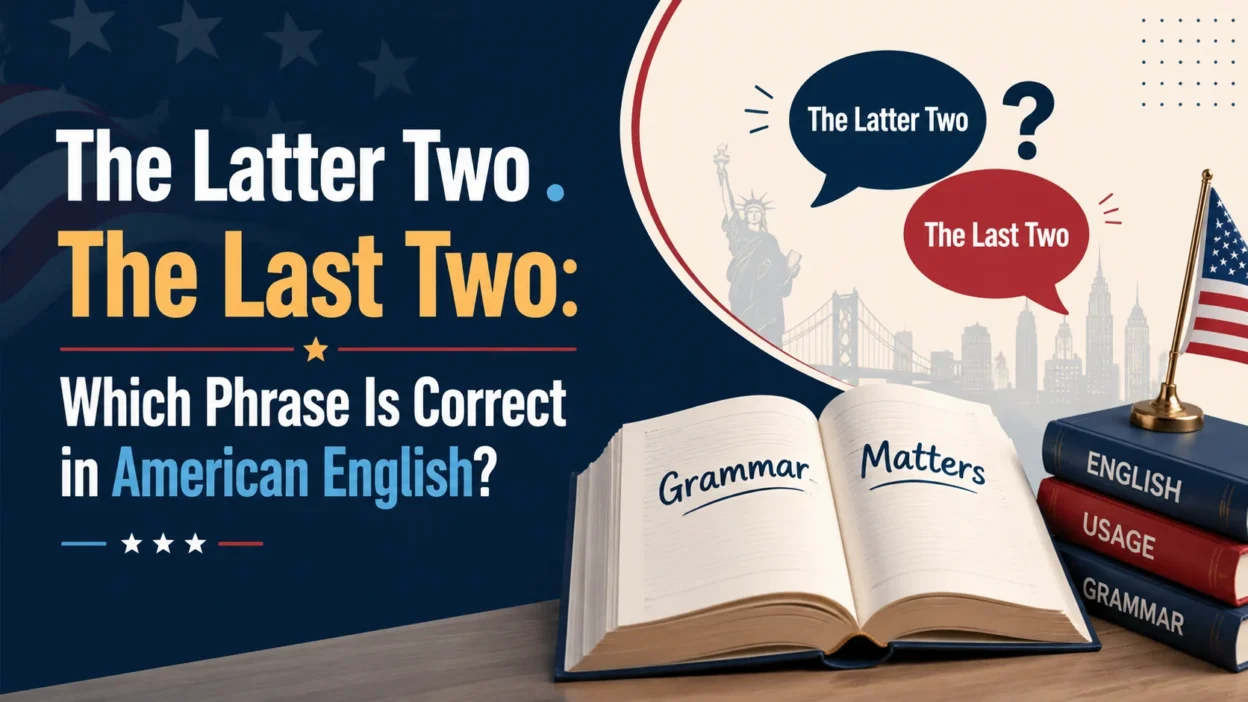
Understanding The Latter Two helps writers choose clear phrases because context, comparison, and grammar rules influence English usage. In American English, the latter two and the last two may seem similar, but their meaning depends on the sentence structure and reference. This small difference affects clarity, writing style, and how easily the reader understands the message without confusion or extra interpretation.
Effective language choices improve communication in professional writing, academic writing, and online content. Writers should focus on correct usage and select the right phrase that fits the sentence. Although the latter two may appear in formal writing, it can sound stiff or vague when the context is uncertain. In many situations, the last two feel more natural and direct when discussing a final pair, final items, or a specific sequence.
A useful grammar guide explains the rule, exceptions, and examples behind these expressions. Many common mistakes happen when writers use the latter outside its traditional purpose. Through simple rewrites, careful editing, and stronger language skills, writers can improve writing quality. These practical examples and usage tips show that choosing the correct expression, direct reference, and formal language makes the comparison, pair, and two items easier for every reader to understand.
Understanding “Former” and “Latter” in Context
The words former and latter come from comparison. They help you refer to two items without repeating both nouns again and again.
- Former = the first of two things mentioned
- Latter = the second of two things mentioned
That is the core rule. Simple, steady, and very useful.
What “former” means
Use former when you mean the first of two items already named.
Example:
I can work from home or in the office. The former gives me more freedom.
Here, the former refers to “work from home,” which came first.
What “latter” means
Use latter when you mean the second of the two items already named.
Example:
I can work from home or in the office. The latter gives me more structure.
Here, latter refers to “in the office.”
A simple memory trick
Many people remember it like this:
- Former = first
- Latter = last of two
That little trick helps because the words often appear in formal comparisons. Once you lock that rule in, the rest gets easier.
A useful note
Former and latter should point back to items that the reader already knows. If the sentence is vague or the list is long, those words can feel awkward. In that case, direct wording usually works better.
Why “The Latter Two” Creates Confusion
The phrase the latter two is common enough to appear in writing, but it often makes readers stop and reread. The problem is not always grammar alone. It is clear.
The phrase sounds like it should mean “the final two”
Many writers use the latter two when they mean the last pair in a list. That sounds logical at first. After all, latter points to the second part of something.
But the word was not built as a general “last” word. It was built as a comparison word for two items. That is where confusion begins.
The phrase can feel vague in long lists
Suppose you write:
The proposal includes budgeting, staffing, timelines, and risk planning. The latter two deserve the most attention.
A reader may understand your meaning. Still, the sentence asks the reader to do extra work. Which two are you pointing to? Staffing and timelines? Timelines and risk planning? The sentence needs more structure.
A clearer version would be:
The proposal includes budgeting, staffing, timelines, and risk planning. The last two sections deserve the most attention.
That version lands faster. No guesswork. No pause.
The phrase sounds formal, but not always helpful
Some writers use the latter two because it sounds polished. Yet polished language is not the same as clear language.
A good rule:
If a phrase sounds clever but makes the reader slow down, the phrase is probably not helping.
That is not a hard grammar law. It is a writing habit worth keeping.
Why “The Last Two” Is Usually the Better Choice
In most modern American English writing, the last two is the cleanest choice when you mean the final pair in a sequence.
It says exactly what you mean
That is the main advantage. The last two leave very little room for confusion.
Examples:
- The last two pages explain the solution.
- The last two chapters contain the results.
- The last two steps finish the process.
- The last two names on the list need review.
Each sentence gives the reader the same clear idea: these are the final two items.
It sounds more natural in everyday English
People say the last two far more often than the latter two in casual speech. That matters because good writing often follows the rhythm of natural speech.
Compare these:
- “Please read the latter two sections.”
- “Please read the last two sections.”
The second sounds easier. It flows better. It feels more direct.
It fits more situations
You can use the last two in:
- business writing
- school work
- blog posts
- emails
- instructions
- reports
- presentations
It works almost everywhere because it is plain and precise.
A quick rule of thumb
If you mean the final pair in a list or sequence, use the last two unless you have a strong reason not to.
A Clear Comparison of the Phrases
Here is a simple table that shows the difference.
| Phrase | Meaning | Best Use | Naturalness in Modern American English |
| Former | The first of two items | Direct comparison between two things | High |
| Latter | The second of two items | Direct comparison between two things | High |
| The latter of the two | The second item in a pair | Formal comparison of exactly two items | Moderate to high |
| The latter two | Often intended to mean the final two items | Narrow or formal contexts, but often awkward | Moderate to low |
| The last two | The final two items in a sequence | Most everyday and professional contexts | Very high |
This table shows the main point fast: the last two is usually the clearest and most natural phrase when you are talking about the final pair.
When “The Latter of the Two” Is Correct
If you are comparing exactly two items, the latter of the two is often a strong choice.
It removes ambiguity
Example:
Between the online course and the in-person workshop, the latter of the two costs more.
That sentence clearly refers to the workshop. The phrase of the two makes the reference precise.
It works well in formal writing
You may see this phrase in essays, reports, and legal or academic writing. It sounds careful and deliberate.
Examples:
- The latter of the two methods produced stronger results.
- Between the printed draft and the digital draft, the latter of the two was easier to edit.
It is better than guessing
If you only have two items, do not stretch the phrase beyond that. The latter of the two keeps the comparison tight.
That is important because the moment you move beyond a pair, the former and latter can lose their sharpness.
How to Refer to More Than Two Items
This is where many writers slip. Once you move past two items, the former and latter become less useful unless you are dividing the group into two clear parts.
Better alternatives for longer lists
When you talk about three or more items, these options are often stronger:
- the last two
- the final two
- the final section
- the closing items
- the third and fourth items
- the second group
- the remaining examples
Choose the phrase that matches the structure
For example:
- If there are five chapters and you mean chapters four and five, use the last two chapters.
- If there are three recommendations and you mean recommendations two and three, use the final two recommendations.
- If you are comparing two groups inside a larger list, use a more exact label.
Avoid forcing “latter” into the sentence
This is a common mistake:
The report contains five sections. The latter two explain the conclusions.
It may sound acceptable, but it is not the clearest option.
Better:
The report contains five sections. The last two sections explain the conclusions.
That version gives the reader no extra work.
The Difference Between “Latter Two” and “Last Two”
This distinction matters because they are not identical.
“Latter two” is comparison-heavy
Latter belongs to a comparison. It asks the reader to think about something previously mentioned. That is fine when the sentence clearly sets up two choices.
“Last two” is sequence-heavy
Last points to position in a line, list, or order. It does not ask the reader to compare. It just tells the reader where something sits.
That is why the last two feel easier in most situations. It describes location in a sequence rather than relying on a comparison word.
Example of the contrast
- The latter two employees arrived late.
- The last two employees arrived late.
Both can be understood. But the second one feels more immediate. It tells you exactly that the final pair arrived late.
Which one sounds better?
In most modern writing, the last two wins. It is shorter, cleaner, and easier to follow.
Case Study: Editing a Sentence for Clarity
Let’s look at a real editing-style example.
Original sentence
The committee reviewed the budget, the schedule, the staffing plan, and the draft report. The latter two required immediate changes.
Problem
This sentence can be understood, but it is not as crisp as it could be. Readers may need a second glance.
Better version
The committee reviewed the budget, the schedule, the staffing plan, and the draft report. The last two items required immediate changes.
Even better if you want full clarity
The committee reviewed the budget, the schedule, the staffing plan, and the draft report. The staffing plan and the draft report required immediate changes.
That final version removes the pronoun-like reference altogether. When a sentence needs maximum clarity, naming the items directly is often the best move.
Lesson from the case study
The goal is not to sound fancy. The goal is to help the reader move through the sentence without stopping.
More Examples of “The Last Two” in Real Writing
Here are some clear uses that feel natural in American English.
In school writing
- The last two paragraphs explain the main argument.
- The last two examples show the pattern clearly.
- The last two chapters summarize the author’s message.
In business writing
- The last two slides highlight the action plan.
- The last two items on the agenda need approval.
- The last two invoices are still unpaid.
In everyday speech
- The last two tickets are mine.
- The last two slices of pizza disappeared fast.
- I saved the last two episodes for the weekend.
In instructions
- Complete the first three steps, then focus on the last two.
- Review the last two sections before you submit the form.
These examples show the same thing over and over: the last two are simple, readable, and flexible.
When “The Latter Two” Can Sound Acceptable
There are moments when the latter two do not sound wrong. It can appear in formal writing where the writer has already set up a strong structure.
Example
The study compares two broad approaches to teaching. The former two-week model uses shorter lessons, while the latter two-week model uses longer sessions.
This is a bit awkward, but the structure helps the reader understand the reference.
Still, many editors would likely revise it.
A cleaner version might be:
The study compares two broad approaches to teaching. The first model uses shorter lessons, while the second model uses longer sessions.
That rewrite is easier to read and less dependent on reference words.
The main idea
Just because a phrase can work does not mean it is the best choice. Good writing does not cling to tradition when a simpler phrase does the job better.
A Practical Guide to Choosing the Right Phrase
Here is a quick decision guide you can use while writing.
Use former and latter when:
- you are referring to exactly two items
- both items were clearly named already
- the writing is formal or polished
- the reader will not lose track of the comparison
Use the latter of the two when:
- you are talking about one item from a pair
- you want clarity in a formal sentence
- you need to avoid repeating the noun
Use the last two when:
- you mean the final pair in a list or sequence
- you want the simplest and clearest option
- you are writing for general readers
- you want your sentence to sound natural in modern American English
Use the items directly when:
- the list is long
- the sentence could confuse the reader
- precision matters more than brevity
That last point matters a lot. Sometimes the best writing is the least decorated.
Common Mistakes and Better Rewrites
Here are some frequent problems and easy fixes.
Mistake: using “the latter two” when the items are not obvious
Weak:
We discussed the design, the layout, the colors, and the fonts. The latter two need revision.
Better:
We discussed the design, the layout, the colors, and the fonts. The colors and the fonts need revision.
Mistake: using “latter” when the sentence has more than two clear choices
Weak:
The first three steps are easy. The latter step takes the most time.
Better:
The first three steps are easy. The final step takes the most time.
Mistake: trying to sound formal when plain language works better
Weak:
Of the four options, the latter two are superior.
Better:
Of the four options, the last two are better.
Mistake: leaving the reader to guess
Weak:
The latter is more effective.
This works only if the reader still remembers the two choices clearly.
Better:
The second option is more effective.
Or:
The latter of the two is more effective.
The second version keeps the comparison intact. The first version removes the risk entirely.
A Small Style Guide for Writers
If you write often, this tiny guide will save time.
Prefer direct wording when possible
Direct wording usually beats reference wording.
- Better: “the last two slides”
- Less clear: “the latter two slides”
Use comparison words only when the comparison is fresh
If the reader has to scroll back and hunt for the nouns, the sentence is too loose.
Keep the rhythm easy
Shorter, cleaner phrases often sound better:
- “the last two pages”
- “the last two steps”
- “the final two examples”
Do not force formal language
Formal does not mean better. Clarity always comes first.
A good line to remember is this:
Plain language is not a weak language. It is a strong language that people understand fast.
How This Topic Helps Your Writing Beyond Grammar
This is not just a grammar lesson. It is also a writing habit lesson.
It teaches sentence control
When you choose between the latter two and the last two, you are really choosing how much work the reader has to do.
It teaches precision
Precise writing says exactly what it means. It does not lean on vague phrases.
It teaches reader awareness
Strong writers think about the reader’s experience. They ask, “Will this be clear at first glance?”
It teaches style judgment
Some phrases are technically possible but still weak in practice. Good style means knowing the difference.
That is the real lesson here. Grammar gives you rules. Writing gives you judgment.
More Before-and-After Examples
See additional before-and-after examples that clearly show the correct usage, helping you recognize and avoid common mistakes in real-world writing.
Example one
Before:
The paper includes the introduction, the method section, the results, and the conclusion. The latter two need more detail.
After:
The paper includes the introduction, the method section, the results, and the conclusion. The last two sections need more detail.
Example two
Before:
I liked the first two songs, but the latter two stood out most.
After:
I liked the first two songs, but the last two stood out most.
Example three
Before:
The first option saves money, and the latter gives better quality.
After:
The first option saves money, and the second option gives better quality.
Example four
Before:
We considered the first draft, the second draft, and the final draft. The latter two were much better.
After:
We considered the first draft, the second draft, and the final draft. The last two drafts were much better.
These rewrites show a pattern. When in doubt, choose the version that sounds most natural to a real person reading quickly.
A Few Facts Worth Remembering
Here are some practical facts about this usage.
- Former and latter are comparison words for two items.
- The last two are usually clearer for final items in a sequence.
- The latter of the two is a strong option when only two items are involved.
- The latter two may appear in writing, but it often sounds less natural than the last two.
- Naming the items directly is often the clearest choice of all.
These are not fancy rules. They are useful habits.
A Short Quote to Keep in Mind
Clear writing is not the art of sounding important. It is the art of making meaning easy to follow.
That idea fits this topic perfectly. A phrase may look elegant on the page, but if it slows the reader down, it has missed the point.
Conclusion
Understanding the difference between the latter two and the last two makes your English usage clearer and more effective. While both phrases may appear similar, their purpose changes based on context, comparison, and the meaning you want to express. Use the latter when referring to the second item in a clear comparison of two choices. Use the last two when you mean the final items in a sequence or list.Good writing is not only about following grammar rules. It is also about helping your reader understand your message quickly. Choosing the right phrase, improving word choice, and avoiding unnecessary confusion can make your writing sound more natural, professional, and confident. When clarity matters, simple language is often the strongest choice.
FAQs
Q1.Is “The Latter Two” grammatically correct?
The latter two can be used in some situations, especially when the context clearly divides a group into two final parts. However, it may sound less natural than the last two in everyday American English.
Q2.What is the difference between “The Latter Two” and “The Last Two”?
The latter two usually connect with a comparison or a previously mentioned group, while the last two directly refers to the final two items in a sequence or list.
Q3.When should I use “The Latter” in a sentence?
Use the latter when you mention exactly two things and want to refer to the second one. For example: “Between tea and coffee, the latter is my choice.”
Q4.Is “The Last Two” better for professional writing?
Yes, in many cases. The last two are often clearer and more direct in professional writing, reports, emails, and online content because readers immediately understand the meaning.
Q5.Can “The Latter” refer to more than two items?
Traditionally, the latter refers to the second of two items. When discussing more than two items, phrases like the final two, the last two, or specific names of items usually create better clarity.