The phrase “How Do You Mean?” helps people ask for more detail when a message feels unclear, unusual, or confusing. In English language communication, this expression connects meaning, context, and speaker intent by encouraging a clearer explanation. Many native speakers understand it as a request for clarification, but its use can depend on tone, conversation, and social interaction. The phrase shows how language, phrasing, and linguistic awareness influence the way people share ideas and understand each other.
When you use “How Do You Mean?”, you are asking someone to explain their statement, idea, or intended meaning in a respectful way. The expression can sound more formal, old-fashioned, or uncommon in some situations, while “What do you mean?” may feel more natural in everyday conversations and spoken English. Understanding grammar, semantics, pragmatics, and contextual appropriateness helps learners choose the right expression and avoid awkward communication.
Strong communication depends on careful interpretation, active listening, and clear articulation. When a listener notices uncertainty, asking “How Do You Mean?” can create a smoother dialogue by improving comprehension and encouraging a better response. With practice, learners gain confidence in using English expressions, understanding linguistic forms, and navigating conversations where nuance, delivery, and cultural background affect the overall message.
What “How Do You Mean?” Means in Conversation
At first glance, the phrase looks strange. That is because the word how usually asks about manner, method, or condition.
For example:
- How did you do it?
- How does this work?
- How are you feeling?
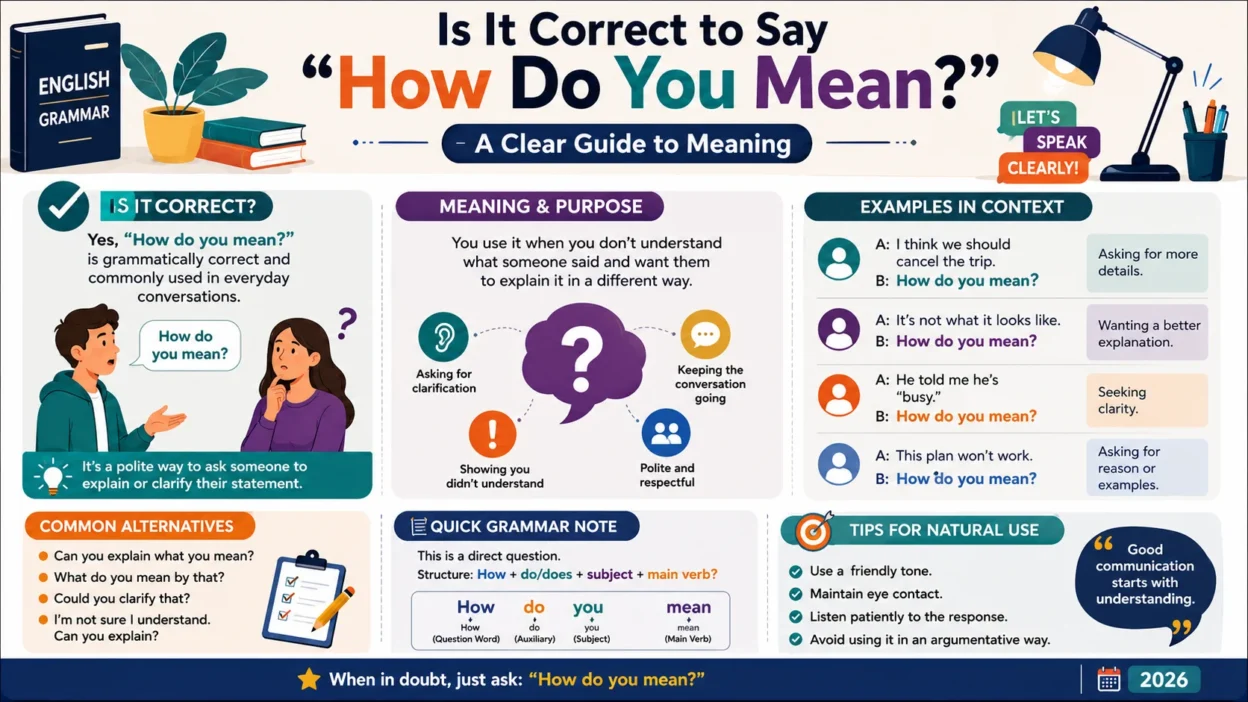
So when someone says “How do you mean?”, they are not asking for a method in the usual sense. They are asking the other person to explain their statement more clearly.
The real message is closer to:
- “Could you explain that?”
- “Can you be more specific?”
- “What exactly are you saying?”
That is the conversational purpose behind it.
The literal sense of the words
Let’s separate the phrase into parts:
- How = in what way
- Do = auxiliary verb used to form the question
- You = the person being addressed
- Mean = intend, suggest, or express
Taken literally, the phrase asks about the way someone intends something. That is not impossible, but it sounds less direct than the meaning most speakers want.
The practical sense in real use
In real conversation, people use the phrase when something feels vague, confusing, or incomplete.
For example:
- “I think that idea is a little off.”
- “How do you mean?”
Here, the speaker is not asking about mechanics. They are asking for clarification.
So the phrase works as a clarification prompt, but it sounds less natural than the alternatives most people use today.
Why “How Do You Mean?” Sounds Unusual
English speakers usually reach for the shortest clear question. That is part of natural conversation.
So instead of a phrase like:
- How do you mean?
people usually say:
- What do you mean?
- Could you explain?
- Can you clarify that?
The reason is simple. What asks for meaning directly. How asks about manner or method, which makes the phrase feel indirect.
That indirectness creates the odd feeling.
A quick comparison
| Phrase | Natural in modern English? | Typical tone | Best use |
| How do you mean? | Not common | Old-fashioned or literary | Rare clarification |
| What do you mean? | Very common | Neutral, direct | Everyday speech |
| Can you clarify that? | Very common | Polite, clear | Work or formal settings |
| Could you explain that? | Very common | Polite, calm | Any setting |
The table makes the difference easy to see. “How do you mean?” is possible, but it does not sound like the everyday default.
“How Do You Mean?” vs. “What Do You Mean?”
This is the most important comparison.
Both phrases can ask for clarification. However, they do not feel the same.
“What do you mean?”
This is the normal, direct choice.
Use it when:
- someone says something unclear
- you need a quick explanation
- you want a natural conversational question
Examples:
- “I’m not sure that plan will work.”
- “What do you mean?”
- “That was a strange comment.”
- “What do you mean?”
This is smooth, common, and easy to understand.
“How do you mean?”
This can work when you want to sound more old-fashioned, dramatic, or slightly stylized.
Examples:
- “The project has changed.”
- “How do you mean?”
- “This situation is different.”
- “How do you mean?”
In these cases, the phrase suggests a request for more detail. Still, it may sound unusual unless the setting supports that style.
Tone difference matters
Here is the key point.
- What do you mean? sounds direct.
- How do you mean? sounds more marked and less common.
If you want natural everyday English, choose what. If you want a literary or stylistic flavor, how may appear in dialogue or a particular voice.
When “How Do You Mean?” Can Work
Even though the phrase is uncommon, it still has places where it fits.
In older or literary-style dialogue
Writers sometimes use it to give a character a distinct voice. It can suggest an older register, a formal manner, or a slightly theatrical tone.
For example:
- “The arrangement is unacceptable.”
- “How do you mean?”
That sounds believable in a novel, stage play, or period-style conversation.
When you want a slightly formal clarification
Some speakers may use it in a serious discussion where they want the other person to explain a broad claim in more detail.
For example:
- “The process has serious flaws.”
- “How do you mean?”
This is still not the most natural choice, but it can work in the right context.
In certain regional or personal speech patterns
Language is not one-size-fits-all. Some people simply use phrases that are less common in wider modern English. A phrase can survive in a region, family, or social group even if it is rare elsewhere.
So the phrase is not impossible. It is just limited in how often it appears.
When You Should Avoid “How Do You Mean?”
Although “How do you mean?” is grammatically acceptable, it isn’t the best choice for most modern conversations. In everyday English, business communication, and academic settings, the phrase can sound old-fashioned or unnatural to native speakers. Instead, use more familiar expressions like “What do you mean?”, “Could you clarify that?”, or “Can you explain?” to make your request for clarification sound clearer, friendlier, and more natural.
In casual conversation
If you are chatting with friends, family, or coworkers, “What do you mean?” usually sounds better.
“How do you mean?” may make you sound like you are translating from another language or copying an older form of speech.
In professional settings
Workplace communication values clarity. You usually want the shortest, cleanest phrase that avoids confusion.
Better choices include:
- “Could you clarify that?”
- “What do you mean by that?”
- “Could you explain a little more?”
These sound polished without sounding stiff.
In customer service or formal support
If you are helping someone or asking for help, you want calm and precise language.
For example:
- “Could you explain what you mean?”
- “Could you give an example?”
These work better than “How do you mean?”, which may distract from the point.
When speaking with English learners
If clarity matters, use the most standard pattern. That makes your message easier to understand and reduces the chance of sounding unnatural.
For learners, “What do you mean?” is the safer, more useful phrase.
Better Alternatives to “How Do You Mean?”
If you want to sound more natural in modern English, there are several better alternatives to “How do you mean?”. Phrases such as “What do you mean?”, “Could you clarify that?”, “Can you explain?”, and “What do you mean by that?” are more common and easier for native speakers to understand. Choosing one of these expressions helps you communicate clearly while keeping your conversations polite, natural, and effective.
“What do you mean?”
This is the most common choice.
Use it when you want a direct clarification.
“What do you mean by that?”
This is a little sharper and more specific.
It works well when you need the person to explain a word, phrase, or statement.
Example:
- “You said the timeline is unrealistic. What do you mean by that?”
“Could you explain that?”
This sounds polite and balanced.
It works well in meetings, classrooms, and general conversation.
“Can you clarify that?”
This is useful when you want a cleaner, more formal tone.
Example:
- “Can you clarify that point?”
“Could you be more specific?”
Use this when someone speaks too broadly or vaguely.
Example:
- “The proposal has issues.”
- “Could you be more specific?”
“Can you give me an example?”
This is useful when you need concrete detail.
Example:
- “The method doesn’t feel right.”
- “Can you give me an example?”
A Simple Decision Table for Choosing the Right Phrase
| Situation | Best phrase | Tone |
| Casual conversation | What do you mean? | Natural, direct |
| Workplace discussion | Could you clarify that? | Polite, professional |
| Asking for detail | What do you mean by that? | Focused, precise |
| Vague statement | Could you be more specific? | Clear, calm |
| Need an example | Can you give me an example? | Practical |
| Literary dialogue | How do you mean? | Stylized, old-fashioned |
This table shows the real pattern. The more modern and practical the situation, the less useful “How do you mean?” becomes.
A Case Study: Two Ways to Ask for Clarification
Imagine this conversation at work:
Person A: “The report feels off.”
Person B: “How do you mean?”
This is understandable, but it sounds a little unusual. Person A may pause and wonder whether the phrasing is odd instead of focusing on the report.
Now compare it with:
Person A: “The report feels off.”
Person B: “What do you mean?”
That version feels immediate and normal. The conversation stays on task.
Now try a more polished version:
Person A: “The report feels off.”
Person B: “Could you explain which part seems off?”
This one sounds even more useful because it invites detail. It moves the conversation forward instead of stopping at a general question.
That is the main lesson. The best phrase does not just ask for meaning. It also keeps the conversation moving.
How Native Speakers Usually Use Clarification Questions
Native speakers often choose the most efficient option.
They ask:
- “What do you mean?”
- “What do you mean by that?”
- “Can you explain?”
- “Can you clarify?”
- “Do you mean that…?”
These questions do the same job with less friction.
That is one reason “How do you mean?” feels unusual. It is not the shortest path to understanding.
Common Mistakes with “How Do You Mean?”
A common mistake is using “How do you mean?” in everyday conversations where “What do you mean?” would sound much more natural. Some English learners also assume both phrases are interchangeable, but “How do you mean?” is less common and can sound old-fashioned or awkward in modern English. Choosing clearer alternatives such as “Could you clarify that?” or “What do you mean by that?” helps your speech sound more fluent and natural.
Using it too often
If you use it again and again, it can sound unnatural. Variation helps.
Using it in serious formal writing
Avoid it in essays, business emails, reports, and academic writing. Better alternatives exist.
Thinking it always matches “What do you mean?”
These two phrases are not identical in tone. What is the standard choice? How is the less common one?
Assuming it is always incorrect
It is not incorrect in every case. The problem is not grammar alone. The bigger issue is naturalness and tone.
Grammar Behind “How Do You Mean?”
From a grammatical perspective, “How do you mean?” is a correctly formed question because it uses the interrogative word “how,” the auxiliary verb “do,” the subject “you,” and the base verb “mean.” However, modern English speakers rarely use this structure because “how” typically asks about a method or manner, while “what” is the preferred question word for asking about someone’s intended meaning. As a result, “What do you mean?” sounds more natural and is the standard expression in everyday English.
The role of “how”
“How” usually asks about method, condition, or degree.
Examples:
- How did you make that?
- How are you?
- How hard did you work?
That is why it feels unusual in a clarification question. You are not really asking for method. You are asking for interpretation.
The role of “mean”
The verb mean can express intention, definition, or implication.
Examples:
- “What does this word mean?”
- “I didn’t mean to upset you.”
- “What do you mean by that?”
In the phrase “How do you mean?”, the verb leans toward implication. You are asking the speaker to expand on their intention or suggestion.
Why the structure feels indirect
English usually prefers direct clarification in this situation. That is why “What do you mean?” feels cleaner.
The structure of “How do you mean?” is understandable, but it places the question through a less natural lens.
Real-Life Examples of Correct and Natural Usage
Understanding how “How do you mean?” works in real conversations helps you choose the right expression. While the phrase is grammatically correct, most people prefer natural alternatives like “What do you mean?” or “Could you explain that?” in daily communication. For example, a coworker may say, “The project needs a different approach,” and a natural response would be, “What do you mean?” This keeps the conversation clear, simple, and easy to follow.
Everyday conversation
- “That answer doesn’t make sense.”
- “What do you mean?”
Better than:
- “That answer doesn’t make sense.”
- “How do you mean?”
Professional discussion
- “The deadline might change.”
- “Could you clarify that?”
Better than:
- “The deadline might change.”
- “How do you mean?”
Literary or dramatic style
- “The arrangement is no longer valid.”
- “How do you mean?”
This works better in a stylized scene than in a normal office chat.
Teaching or learning context
- “This sentence feels wrong.”
- “What do you mean by wrong?”
This is precise and useful. It helps the speaker identify the exact issue.
Alternative Phrases and Their Best Uses
Instead of saying “How do you mean?”, you can choose phrases that sound more natural in modern English. Expressions like “What do you mean?”, “Could you clarify that?”, “Can you explain?”, and “What do you mean by that?” fit most conversations and make your request for clarification clear and polite. Selecting the right phrase depends on the situation, but using familiar expressions helps avoid confusion and keeps communication smooth.
“What do you mean?”
Best for general conversation.
“What do you mean by that?”
Best when you want the person to unpack a statement.
“Could you explain that?”
Best for polite clarification.
“Can you be more specific?”
Best when a comment is too broad.
“Could you give an example?”
Best when abstract language needs support.
“Do you mean that…?”
Best when you want to confirm an interpretation.
Example:
- “Do you mean that the proposal is delayed?”
This pattern is especially useful because it lets you check understanding without sounding confrontational.
Mini Style Guide: Which Phrase Fits Which Situation?
| Goal | Best phrase |
| Simple clarification | What do you mean? |
| Polite clarification | Could you explain that? |
| More detail | Could you be more specific? |
| Confirming an idea | Do you mean that…? |
| Example request | Can you give an example? |
| Stylized dialogue | How do you mean? |
This guide helps you choose the right phrase in seconds.
A Quote to Keep in Mind
A useful rule for communication is this:
Clear language beats clever language when the goal is understanding.
That idea fits this topic perfectly. You do not need the fanciest phrase. You need the phrase that helps the other person answer well.
Why Clarity Matters More Than Exactness
Many English questions are technically possible. Still, the best one is the one that gets the right response with the least confusion.
That is the real test.
If someone says something unclear, your job is not to impress them with an unusual structure. Your job is to move the conversation forward.
That is why “What do you mean?” wins so often. It is direct, familiar, and easy to process.
Conclusion
Understanding “How Do You Mean?” helps you recognise the importance of context, tone, and clear communication in English. Although the phrase may sound less common in modern conversations, it still has value when someone wants a deeper explanation or better understanding of a statement. By learning its meaning, correct usage, and alternatives like “What do you mean?”, you can improve your language skills, express ideas more confidently, and communicate more naturally in different situations.
FAQs
Q1. Is “How Do You Mean?” Grammatically correct?
Yes, “How Do You Mean?” is grammatically correct. It asks someone to explain the way they intended a statement or idea. However, it is less common in modern everyday speech compared to “What do you mean?”
Q2. What does “How Do You Mean?” mean?
“How Do You Mean?” means that you want someone to explain their thought, statement, or intention in more detail. It is a request for clarification and a better understanding of the message.
Q3. Is “How Do You Mean?” common in everyday English?
The phrase is understandable, but it is not as common as other expressions in everyday conversations. Many English speakers usually say “What do you mean?” when they need more information.
Q4. Can I use “How Do You Mean?” in formal communication?
Yes, you can use it in some formal communication settings, especially when you want to politely ask for clarification. However, choosing a more direct phrase may sound more natural depending on the situation.
Q5. What is the difference between “How Do You Mean?” and “What Do You Mean?”
The main difference is focus. “What do you mean?” asks about the meaning of a statement, while “How do you mean?” focuses more on the way someone explains or intends an idea. Both phrases can request clarification, but they have slightly different tones.