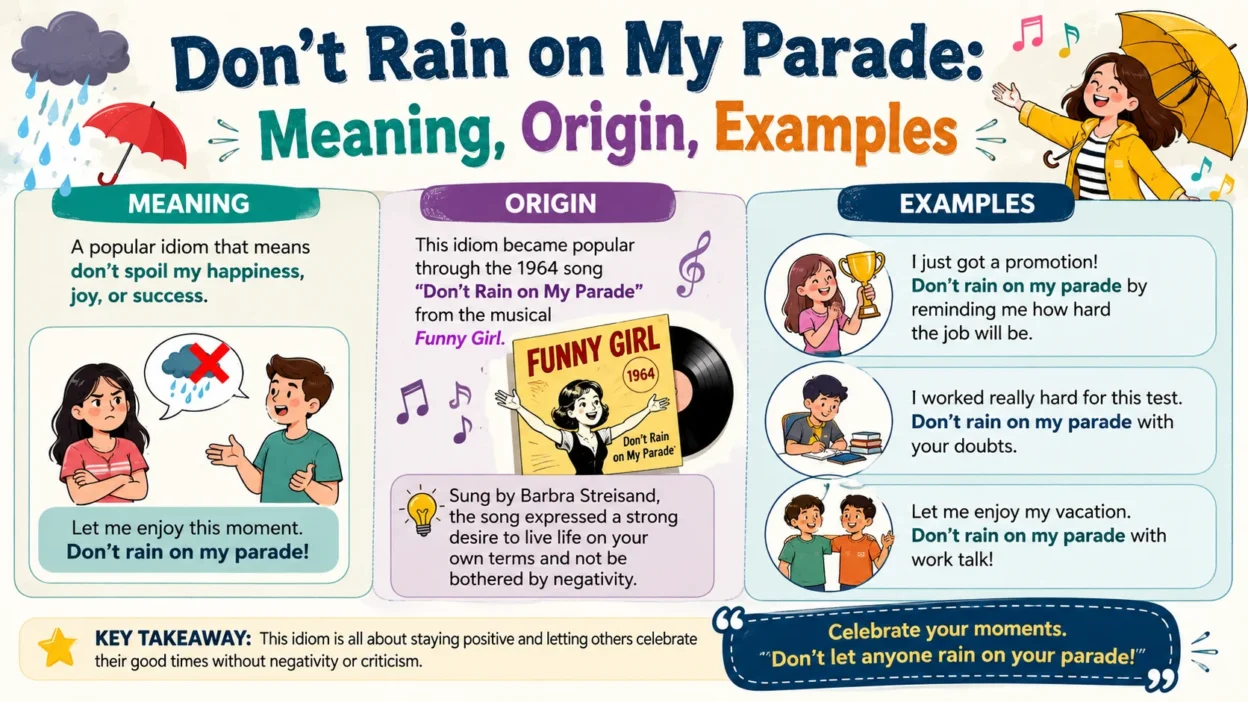
Don’t Rain on My Parade is a popular phrase and a well-known idiom that reminds people not to spoil another person’s happiness, joy, enjoyment, excitement, or positive mood. This English idiom is a colourful expression with a clear meaning, making it easy to understand and use in everyday conversations. I have heard it in movies, songs, and from a friend trying to keep their spirits up. The idea comes from a joyful event, where rain could ruin a parade. Even though it has nothing to do with actual rain or actual parades, the expression has earned a place in every English learner’s English toolbox, and you can easily add it to your daily conversations.
People often say rain on my parade when another person, someone, or others begin criticising, offering criticism, acting negative, expressing doubts, or brings bad news during a joyful moment. For example, you may be celebrating a success, looking forward to a trip, talking about an upcoming birthday party, or planning a birthday party when a person tries to spoil someone’s happiness, spoil your plans, ruin the excitement, or spoil the fun. In that situation, you can politely ask, “Don’t rain on my parade.” The behaviour may happen intentionally or unintentionally, but it still ends up reducing happiness and reducing joy instead of encouraging your enthusiasm and sharing good news.
To use the expression naturally, break down the phrase instead of thinking about ruining a parade. This article gives another example of how the saying fits real life. Whether a friend is telling you something discouraging, criticises your plans, or you hear news that could ruin your positive mood, this lighthearted way reminds everyone to respect another person’s excitement. It is typically used when people want to protect a happy moment rather than let anyone spoil it before the celebration begins.
The Literal Image Behind Don’t Rain on My Parade
The phrase works because the image is easy to picture. A parade is bright, loud, joyful, and full of movement. Rain makes it miserable. It ruins costumes, crowds, music, and the whole atmosphere.
That contrast gives the idiom its power. You do not need a long explanation to understand it. The rain stands for negativity. The parade stands for celebration.
This is why the expression feels so memorable. It paints a picture in your head.
Literal vs. Figurative Meaning of Don’t Rain on My Parade
The literal and figurative meanings are very different, but they connect beautifully.
| Type of Meaning | What It Means | Example |
| Literal | Rain falls on a parade | A storm interrupts an outdoor event |
| Figurative | Do not spoil someone’s happiness | “I just got promoted, so don’t rain on my parade.” |
The figurative meaning is the one people actually use in real life. Still, the literal image helps the phrase stick in memory.
How to Use Don’t Rain on My Parade Naturally
You can use this idiom in casual conversation, social media, texting, and sometimes in writing. It sounds most natural when the situation feels emotional, personal, or celebratory.
For example:
- “I know the project has risks, but don’t rain on my parade. I’m proud of this result.”
- “She was excited about her new apartment, but her friend kept listing everything that could go wrong. It felt like rain on her parade.”
- “He had finally finished the marathon, and he did not want anyone to rain on his parade with criticism.”
The phrase works best when you are responding to someone who is being overly negative in the middle of a happy moment.
Common Situations Where the Idiom Fits
This idiom shows up in everyday life more often than people realize. Here are a few moments where it fits naturally:
- Announcing good news
- Celebrating a win
- Sharing a plan you are excited about
- Defending a choice from criticism
- Asking someone to stop being negative
The phrase is especially useful when someone needs a little emotional space.
When the Idiom Sounds Best
It sounds natural when the speaker is:
- frustrated but still playful
- proud of an achievement
- asking for support
- pushing back against unnecessary criticism
It can also sound slightly dramatic, which is part of its charm.
Don’t Rain on My Parade in Everyday Conversation
In daily speech, the idiom usually appears in one of three ways:
- as a direct request
- as a complaint
- as a joking comeback
Here are a few realistic examples:
- “I know the flight is expensive, but don’t rain on my parade. I already booked it.”
- “He kept warning me about every possible problem, and I finally told him not to rain on my parade.”
- “She was so excited about her new car that no one wanted to rain on her parade.”
The phrase can be used to protect joy, but it can also be used to reject useful feedback. That is where nuance matters.
Friendly Use vs. Defensive Use
Sometimes the idiom is lighthearted.
Example:
- “Come on, don’t rain on my parade. Let me enjoy my win for one day.”
Other times it sounds sharper.
Example:
- “You don’t need to rain on my parade every time I share good news.”
In the second version, the phrase carries more tension. It is still the same idiom, but the emotion changes the meaning.
The Origin of Don’t Rain on My Parade
The idiom became widely known because of the famous song “Don’t Rain on My Parade” from the musical Funny Girl. The song was written by Bob Merrill with music by Jule Styne and became one of the most recognizable show tunes of the 20th century.
Barbra Streisand performed the song in the original 1964 Broadway production, and her performance helped turn the line into a cultural landmark. Later, the song reached even more people through the 1968 film adaptation of Funny Girl.
That history matters because many people know the phrase from the song first, then from everyday English second.
Why the Song Made the Idiom Famous
The title hit hard because it matched the phrase’s emotional force. It sounded bold, confident, and slightly defiant. That made it easy for the line to escape the stage and enter common speech.
A phrase spreads faster when it does three things well:
- it is easy to remember
- it creates a strong image
- it carries emotion
“Don’t rain on my parade” does all three.
The Birth of a Timeless Expression
The expression existed as an idea before it became a classic song title, but the musical gave it lasting fame. Once a phrase enters pop culture at that level, it often moves into everyday language. People repeat it because it sounds sharp without being complicated.
That is part of why idioms survive. They are short. They are vivid. They feel human.
Don’t Rain on My Parade in Pop Culture
This idiom has lived far beyond its original stage roots. It appears in conversations, headlines, comedy, television dialogue, and social media captions. People like it because it sounds dramatic in a fun way.
It also works well in performance because it gives the speaker a voice. The phrase sounds like someone standing tall and saying, “I am not letting your negativity ruin this moment.”
That attitude gives the idiom power.
Why Pop Culture Keeps Returning to It
Pop culture loves phrases that are:
- catchy
- expressive
- easy to quote
- full of personality
This idiom checks every box. It is musical, bold, and easy to adapt. Writers and speakers use it whenever they want to show determination or resistance to criticism.
Don’t Rain on My Parade and Related Expressions
English has several expressions that overlap with this idiom, but they do not always mean exactly the same thing. Some are softer. Some are more negative. Some suggest interruption, while others suggest discouragement.
Similar Idioms and When to Use Them
Here are a few closely related expressions:
- Burst someone’s bubble — to spoil someone’s happy belief or excitement
- Throw cold water on something — to discourage an idea or plan
- Kill the mood — to ruin a pleasant atmosphere
- Be a wet blanket — to be dull, negative, or unexciting
- Steal someone’s thunder — to take attention or praise away from someone
Each phrase has a slightly different flavor.
| Expression | Main Idea | Tone |
| Don’t rain on my parade | Stop spoiling my joy | Playful, defensive |
| Burst someone’s bubble | End someone’s happy expectation | Mildly harsh |
| Throw cold water on something | Discourage an idea | More formal |
| Be a wet blanket | Act dull or negative | Casual, insulting |
| Kill the mood | Ruin the atmosphere | Informal, blunt |
Choosing the Right Phrase for the Occasion
If you want to sound upbeat but firm, “don’t rain on my parade” works well. If you want to describe someone who is habitually negative, “wet blanket” may fit better. If you want a more neutral expression, “throw cold water on it” sounds a little less emotional.
That choice matters. The right idiom can make your meaning feel sharper, smoother, and more natural.
Example Sentences for Don’t Rain on My Parade
The best way to learn an idiom is to see it in action. Here are clear examples that show how the phrase works in different settings.
Everyday Conversation Examples
- “I finally booked the trip, so don’t rain on my parade with all those worries.”
- “She was celebrating her promotion, and nobody wanted to rain on her parade.”
- “He had been waiting for that moment all year. No one wanted to rain on his parade.”
Workplace Examples
- “I know there are risks, but don’t rain on my parade before I finish the presentation.”
- “The team was excited about the launch, and the manager tried not to rain on anyone’s parade.”
- “Her feedback was useful, but it came at the wrong time and felt like rain on the parade.”
Social and Text Message Examples
- “Got the internship!!! Please don’t rain on my parade today 😄”
- “I’m allowed to be excited. Don’t rain on my parade.”
- “No negativity today. Parade is in full swing.”
These examples show the idiom at different levels of formality. It stays flexible, which is one reason it remains popular.
Case Study: A Small Moment, A Big Emotional Shift
Consider this simple situation.
Maya has worked for months on a portfolio. She finally lands a client meeting. She tells her family during dinner. Her excitement is obvious. Then one relative says, “Well, don’t get too excited. Most clients never sign on the first meeting.”
That comment may be true. It may even be practical. But it lands badly. It changes the mood immediately.
Now compare that with a more supportive response:
“Congratulations. That is a huge step. You have earned this moment.”
The first response rains on the parade. The second response keeps the energy alive.
That is the real power of the idiom. It points to a basic social truth: timing matters. So does tone.
Why People Rain on Someone’s Parade
People do not always mean to ruin happiness. Sometimes they think they are being helpful. Sometimes they are anxious. Sometimes they are jealous. Sometimes they simply do not know how to respond to good news.
Common reasons include:
- fear of disappointment
- habitually negative thinking
- jealousy or insecurity
- a need to sound realistic
- poor timing
- lack of emotional awareness
Not every negative comment is malicious. Still, the effect can feel the same.
Constructive Criticism vs. Unnecessary Negativity
This distinction is important. Not all negative feedback counts as “raining on a parade.”
Constructive criticism says:
- “This is a great start, and here is one thing you could improve.”
Unhelpful negativity says:
- “This probably won’t work.”
One helps you grow. The other just drains energy.
That is why context matters so much with this idiom. Sometimes people need support. Sometimes they need honest feedback. The trick is knowing the difference.
Psychology Behind the Idiom
The phrase speaks to a deep emotional need: the desire to have our happiness respected. People want room to celebrate before they face reality, problems, or risk analysis.
That is not childish. It is human.
When someone shares good news, they often want one of three things:
- recognition
- encouragement
- shared joy
If the response is immediate criticism, the person may feel dismissed. That is when “don’t rain on my parade” becomes more than a catchy phrase. It becomes a defense of emotional space.
Quick Takeaways So Far
Here is a simple summary of the key ideas:
- The idiom means do not spoil my excitement.
- It often sounds playful, annoyed, or confident.
- The phrase became famous through the song from Funny Girl.
- It works best in casual conversation and celebratory moments.
- It is close to phrases like burst someone’s bubble and throw cold water on something.
- It reflects a common human need: let me enjoy this moment.
Mini Reference Table
| Topic | Takeaway |
| Meaning | Stop ruining someone’s joy or excitement |
| Tone | Playful, frustrated, or defensive |
| Origin | Popularized by the song from Funny Girl |
| Best use | Casual speech and informal writing |
| Main idea | Protecting a positive moment from negativity |
Conclusion
The idiom “Don’t Rain on My Parade” is a simple but powerful expression that reminds people to respect someone else’s happiness, joy, and enthusiasm. Instead of focusing on negative comments or criticism, this popular phrase encourages others to support exciting moments and avoid spoiling the fun. Once you understand its meaning and use it in everyday conversations, it becomes a natural part of your English vocabulary and helps you communicate in a friendlier and more expressive way.
FAQs
Q1. What does “Don’t Rain on My Parade” mean?
“Don’t Rain on My Parade” means don’t spoil my happiness, excitement, or plans by being negative, discouraging, or critical. People use this idiom when someone is reducing their joy or trying to ruin a positive moment.
Q2. Is “Don’t Rain on My Parade” an idiom?
Yes. “Don’t Rain on My Parade” is an English idiom because its meaning is figurative rather than literal. It has nothing to do with actual rain or a real parade.
Q3. When should I use the phrase “Don’t Rain on My Parade”?
You can use this expression in everyday conversations when someone is criticising your plans, expressing doubts, bringing bad news, or trying to spoil your happiness, excitement, or fun.
Q4. Can “Don’t Rain on My Parade” be used in formal writing?
This popular phrase is most common in informal speech, blogs, emails, and casual writing. In formal writing, it is usually better to choose a more direct expression with the same meaning.
Q5. What is an example sentence using “Don’t Rain on My Parade”?
A simple example is: “I’m excited about my new job, so please don’t rain on my parade by pointing out every possible problem.” This sentence shows someone asking another person not to spoil their enthusiasm, joy, or positive mood.