Jewel vs. Joule often confuses learners because both sound alike, yet one means a gem and the other measures energy in science. I remember in academic writing, I mixed them up since they are homophones with similar pronunciation and sound alike. This confusion can happen accidentally when you focus on meaning and forming a clear sentence instead of checking spellings. Over time, I learned they have different meanings, origins, and uses in the real world, where jewel links to gemstones, valuable possessions, and jewelry, while joule belongs to science and measures energy, a difference that truly matters in an essay, while studying physics, or even shopping.
To improve my English vocabulary, I worked to understand what lies behind each term. You must choose the correct spelling based on context, and a simple guide helps you learn what each word exactly means and how to use it. These are often confusing words, but practical examples, memory tricks, and repetition make it easier every time. A jewel is something you can see and touch, like a diamond, ring, or stone used for decoration, while a joule is a unit in the International System of Units (SI) used to measure work and heat. For instance, it takes about 1 joule to lift a small apple one meter above the ground.
From my experience, I’ve noticed that once you connect each word to its field, the confusion is completely gone. A jewel clearly belongs to the world of gems, precious stones, and visual beauty, while a joule is rooted in scientific and technical thinking. In professional settings, especially in contexts that demand accuracy, avoiding common mistakes is important. When you correctly use these words in sentences, your writing becomes more clear and distinct. With repeated exposure and understanding, even similar or identical sounding terms stop being a problem, and you naturally improve your daily communication and more formal work.
Jewel vs. Joule: The Short Answer
The simplest way to remember the difference is this:
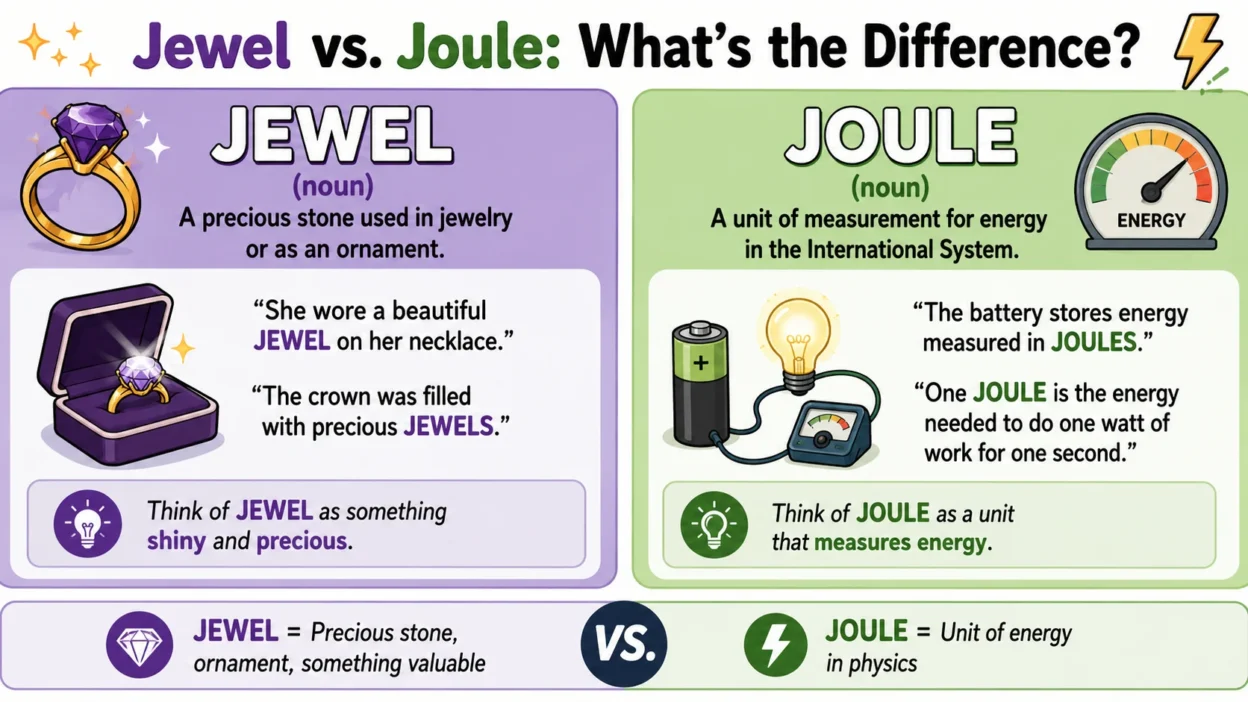
- Jewel is a noun that refers to a precious gemstone, ornament, or something highly valuable.
- Joule is a noun that refers to the SI unit of energy, work, or heat in physics.
Although they sound identical, they belong to completely different fields.
| Feature | Jewel | Joule |
| Meaning | Precious gem or valuable object | SI unit of energy |
| Field | Jewelry, fashion, literature | Physics, engineering, science |
| Part of Speech | Noun | Noun |
| Pronunciation | /ˈdʒuːəl/ | /ˈdʒuːl/ or /ˈdʒuːəl/ |
| Plural | Jewels | Joules |
| Example | She wore a beautiful jewel. | The battery stored 5,000 joules of energy. |
When to Use “Jewel”
Use jewel whenever you’re talking about:
- Gemstones
- Precious ornaments
- Fine jewelry
- Something treasured or valuable
- A remarkable person or thing
Examples
- The necklace contains a rare jewel.
- That castle is the jewel of the region.
- Her grandmother left her a priceless jewel.
When to Use “Joule”
Use joule whenever you’re discussing:
- Energy
- Work
- Heat
- Electricity
- Physics
- Engineering
Examples
- The experiment required ten joules of energy.
- One joule equals one newton-meter.
- Scientists measure energy in joules.
Why Do People Confuse Jewel and Joule?
Many English homophones cause confusion, but jewel vs. joule stands out because the words appear in completely different subjects. Unless you’ve studied physics or frequently read about gemstones, you may not encounter both words often enough to remember which is which.
Let’s look at the reasons behind the confusion.
They Sound Exactly the Same
Both words are pronounced almost identically in everyday English.
- Jewel → JOO-ul
- Joule → JOOL or JOO-ul
Because pronunciation offers almost no clue, you must rely on the context of the sentence.
For example:
- She bought a beautiful jewel.
- The machine released 200 joules of energy.
Although both words sound alike, replacing one with the other makes the sentence incorrect.
Similar Spelling, Completely Different Meanings
At first glance, the spellings don’t seem dramatically different.
Compare them:
- Jewel
- Joule
Only two letters change, yet the meanings have nothing in common.
That’s why proofreading is important. Spell-check software may not catch the mistake because both words are correctly spelled English words.
Why Context Is the Key
Context tells you immediately which word belongs in the sentence.
Ask yourself these questions:
- Is the sentence about jewelry, beauty, value, or treasures?
- Use jewel.
- Is the sentence about energy, science, electricity, work, or heat?
- Use joule.
This simple habit eliminates nearly every mistake.
What Does “Jewel” Mean?
The word jewel has been part of English for centuries. Most people immediately associate it with diamonds, rubies, sapphires, and emeralds. However, its meaning extends well beyond expensive gemstones.
Today, jewel can describe both physical objects and people or things considered exceptionally valuable.
Dictionary Definition of Jewel
A jewel is:
A precious stone, gemstone, ornament containing valuable stones, or something regarded as especially valuable or beautiful.
In everyday English, people often use the word interchangeably with gem, although a jewel usually refers to the finished ornament or an object containing gemstones.
Literal Meaning: Gemstones and Valuable Objects
The most common meaning refers to precious stones used in jewelry.
Examples include:
- Diamonds
- Rubies
- Emeralds
- Sapphires
- Opals
- Pearls
- Garnets
Jewels often appear in:
- Rings
- Necklaces
- Bracelets
- Earrings
- Crowns
- Brooches
- Watches
Some jewels have enormous historical significance.
For example:
- The British Crown Jewels include hundreds of historic gemstones.
- Ancient Egyptian pharaohs wore elaborate jeweled ornaments.
- Royal families around the world preserve priceless jewels as national treasures.
Many famous jewels have become symbols of wealth, power, and history.
Figurative Meaning: A Person or Thing of Great Value
English frequently uses jewel as a metaphor.
Instead of referring to gemstones, it describes someone or something precious.
Examples include:
- She’s a real jewel.
- That little café is a hidden jewel.
- The library is the jewel of the university.
This figurative use appears often in journalism, literature, travel writing, and everyday conversation.
For instance, a travel magazine might describe a small island as:
“A hidden jewel of the Mediterranean.”
No gemstones are involved. The phrase simply means the place is exceptionally beautiful.
Common Situations Where “Jewel” Is Used
You’ll regularly encounter jewel in many contexts.
Jewelry
- Diamond jewel
- Ruby jewel
- Gold jewel
- Family jewel
- Antique jewel
Fashion
Luxury fashion brands often emphasize handcrafted jewels as symbols of elegance and craftsmanship.
Literature
Authors use jewel to symbolize:
- Love
- Hope
- Beauty
- Purity
- Wisdom
- Rare qualities
Travel
Cities, beaches, and landmarks often receive descriptions such as:
- Hidden jewel
- Cultural jewel
- Architectural jewel
- Natural jewel
Sports
Commentators occasionally call talented athletes:
“The jewel of the team.”
The phrase emphasizes exceptional value rather than literal gemstones.
Synonyms and Related Words
Depending on the context, jewel has several useful synonyms.
| Word | Meaning |
| Gem | Precious stone |
| Gemstone | Mineral used in jewelry |
| Ornament | Decorative object |
| Treasure | Valuable possession |
| Precious stone | High-value mineral |
| Jewelery piece | Decorative accessory |
| Heirloom | Valuable family possession |
Remember that these words aren’t always interchangeable. A gemstone becomes a jewel only after it’s incorporated into jewelry or considered a valuable object.
Example Sentences Using “Jewel”
Understanding real-world examples helps reinforce the correct usage.
Everyday Conversation
- She found a beautiful jewel at the antique market.
- My grandmother owned a collection of vintage jewels.
- He bought a sapphire jewel for their anniversary.
Business
- The company displayed rare jewels during the exhibition.
- Insurance companies carefully evaluate expensive jewels before issuing policies.
Travel
- Kyoto is often called a cultural jewel of Japan.
- The waterfall remains one of the country’s hidden jewels.
Literature
- Kindness is the greatest jewel anyone can possess.
- Her smile became the jewel of the evening.
History
- Archaeologists uncovered several gold jewels inside the ancient tomb.
- Museums preserve priceless jewels from royal dynasties.
These examples show how flexible the word has become over time. It can describe something tangible, symbolic, historical, or deeply personal.
Conclusion
Understanding the difference between jewel and joule becomes simple once you connect each word to its real-world use. A jewel belongs to beauty, luxury, and physical objects like gemstones and jewelry, while a joule belongs to science and measures energy. Even though they sound alike, their meanings are far apart. With regular practice, clear context, and a few memory tricks, you can avoid confusion and use both words correctly in writing and conversation. Over time, this small distinction can make your communication more accurate and professional.
FAQs
Q1. What is the main difference between jewel and joule?
A jewel is a precious stone used in jewelry, while a joule is a scientific unit used to measure energy.
Q2. Why do people confuse jewel and joule?
People confuse them because they are homophones—they sound the same but have different meanings and spellings.
Q3. Can jewel and joule be used interchangeably?
No, they cannot be used interchangeably because they belong to completely different contexts—one is related to jewelry, the other to physics.
Q4. What is an easy way to remember the difference?
Think of a jewel as something you can wear or see, and a joule as something related to energy and science.
Q5. Where is the word joule commonly used?
The word joule is commonly used in physics, engineering, and scientific measurements involving energy, work, and heat.