Understanding Years of Experience or Years helps you choose the correct phrase in resume writing because detail can improve clarity and confidence. Many writers experience confusion when deciding between years of experience and years’ experience, as both forms look similar at first glance. However, the right word choice creates a more natural, formal, and precise impression. In professional writing, even a small detail can carry weight, especially when preparing a resume, updating LinkedIn profiles, or presenting your background to potential employers, clients, and colleagues.
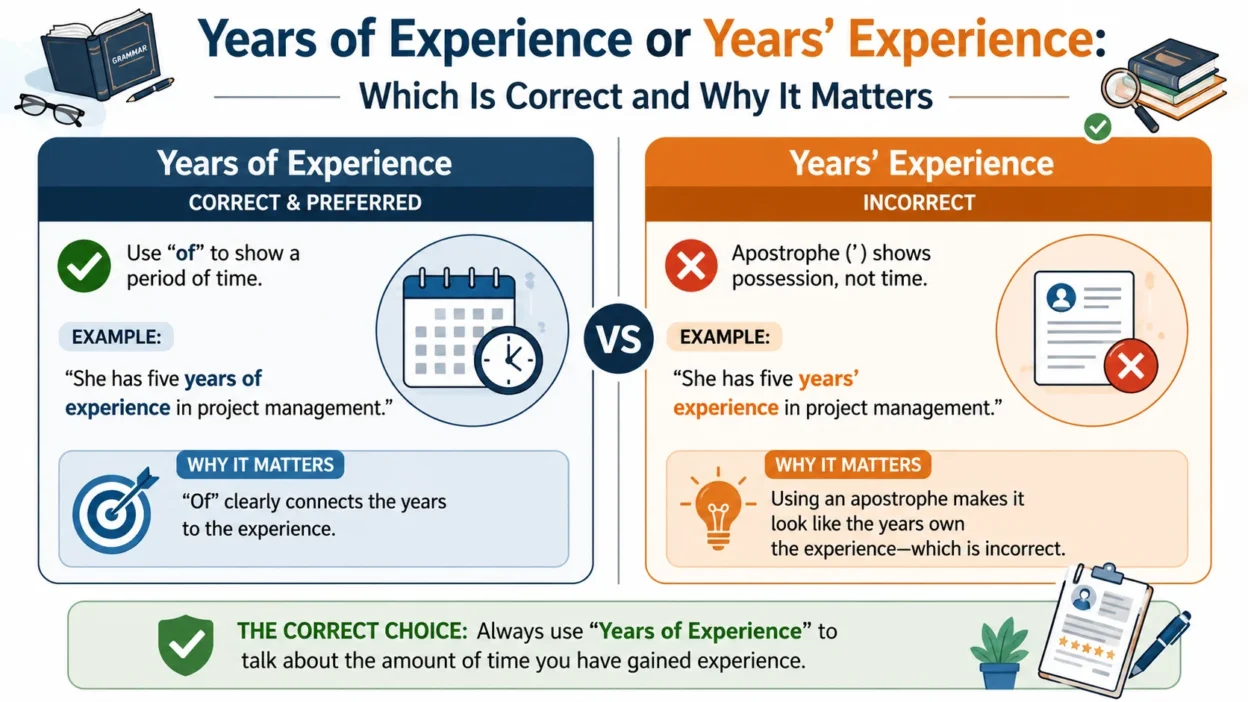
The difference between these expressions comes from grammar and usage. Years of experience clearly explains the amount of time someone has spent working in a particular field, building skills, and gaining expertise in an area. On the other hand, years’ experience uses a possessive apostrophe and plural possessive structure that may create uncertainty because it can imply ownership. Understanding this distinction, context, and grammatical nuance helps you make the correct choice with greater accuracy and correctness.
Good writing confidence comes from understanding how language works rather than simply memorising rules. When you know why one expression fits better, you can write more clearly and confidently every time. Whether you are talking about a long career, describing your professional achievements, or reviewing a sentence, choosing the best version improves your overall style. This knowledge helps you avoid being confused and allows you to make better choices in writing, usage, and everyday communication.
Quick Answer: Years of Experience or Years’ Experience
Here’s the simple truth:
- “Years of experience” is the most common and safest choice
- “Years’ experience” is grammatically correct but more formal
- Both work, but context decides which sounds better
Quick Examples
- “I have 5 years of experience in marketing” ✔
- “I have 5 years’ experience in marketing” ✔
Best Rule
If you want clarity and universal acceptance, go with:
years of experience
What Does “Years of Experience” Actually Mean?
This phrase answers a simple question:
How long have you been doing something professionally?
You’ll see it everywhere:
- Job descriptions
- Resumes and CVs
- LinkedIn profiles
- Freelance portfolios
Plain Meaning
“Years of experience” refers to the total time you’ve spent working in a specific field or role.
Real-Life Examples
- “She has 8 years of experience in software development”
- “We need candidates with at least 3 years of experience in sales”
- “I bring over 10 years of experience in project management”
Why It Matters
Employers use this phrase to:
- Compare candidates quickly
- Estimate skill level
- Filter applications efficiently
It’s more than wording. It’s a signal of capability.
Breaking Down the Grammar Behind the Phrase
The difference between the two phrases comes down to structure. Once you understand that, everything clicks.
What Is a Possessive Form in English?
A possessive shows ownership or association.
- “The teacher’s book” → the book belongs to the teacher
- “A day’s work” → the work belongs to the day
So when you write “years’ experience,” you’re saying:
The experience belongs to the years
Singular vs. Plural Possessive Explained Clearly
Let’s simplify it with patterns:
| Time Unit | Singular Form | Plural Form |
| Year | year’s experience | years’ experience |
| Day | day’s work | days’ work |
| Week | week’s salary | weeks’ salary |
Examples
- “One year’s experience” → singular
- “Five years’ experience” → plural
Why “Years’ Experience” Uses an Apostrophe After “S”
Because “years” is already plural.
Simple Logic
- Start with “years”
- Make it possessive
- Add apostrophe after “s” → years’
Memory Trick
If the word ends in s, just add an apostrophe at the end.
Years of Experience vs. Years’ Experience: Key Differences
Let’s compare them clearly.
| Feature | Years of Experience | Years’ Experience |
| Structure | Uses “of” | Uses apostrophe |
| Tone | Neutral and modern | Formal and traditional |
| Usage | Very common | Less common |
| Clarity | Very clear | Slightly technical |
| Best Use | Resumes, profiles | Formal writing |
Key Insight
One focuses on simplicity. The other shows grammatical precision.
Which One Should You Use in a Resume?
When you’re applying for jobs, clarity wins every time.
What Recruiters Actually Want
Recruiters scan resumes quickly. They don’t stop to analyze grammar deeply.
They look for:
- Clear language
- Easy readability
- Relevant keywords
That’s why:
“Years of experience” works better in most cases
ATS (Applicant Tracking Systems) Considerations
Many companies use software to filter resumes.
Important Point
These systems look for exact phrases.
Since job descriptions usually say “years of experience,” you should match that wording.
Real Resume Examples
Incorrect
- “5 years experience in marketing”
- “5 year’s experience in marketing”
Correct
- “5 years of experience in marketing”
- “5 years’ experience in marketing”
Best Practice
Use:
“5+ years of experience in [field]”
It’s clear and widely accepted.
Common Mistakes People Make (and How to Avoid Them)
Even strong writers make these errors.
Common Errors
- Missing apostrophe
- “Years experience” ❌
- Wrong possessive
- “Year’s experience” (for plural) ❌
- Incorrect plural
- “Years of experiences” ❌
Quick Fix Table
| Incorrect | Correct |
| 5 years experience | 5 years of experience |
| 3 year’s experience | 3 years’ experience |
| many years of experiences | many years of experience |
Easy Shortcut
If you’re unsure, always use:
years of experience
It’s the safest option.
Formal vs. Informal Usage: Does It Matter?
Yes, tone shapes how your writing feels.
Use “Years’ Experience” When
- Writing formal reports
- Using traditional style
- Following British English conventions
Use “Years of Experience” When
- Writing resumes
- Updating LinkedIn
- Sending emails
- Applying for jobs
Regional Preference
| Region | Common Usage |
| United States | Years of experience |
| United Kingdom | Years’ experience |
| Global business | Years of experience |
Bottom Line
Choose what your audience expects.
Real-World Usage Examples You Can Copy
Let’s make this practical.
Resume Examples
- “Over 7 years of experience in digital marketing”
- “10+ years of experience managing teams”
- “3 years of experience in customer support”
LinkedIn Examples
- “I bring 8 years of experience in product design”
- “With over a decade of experience in finance, I help businesses grow”
Cover Letter Examples
- “I have 5 years of experience in software engineering”
- “My 6 years of experience in sales helped me exceed targets”
Why This Small Grammar Choice Impacts Your Professional Image
It may seem minor. It’s not.
First Impressions Count
Hiring managers notice details.
A small mistake can suggest:
- Carelessness
- Weak communication skills
What Correct Grammar Shows
- Attention to detail
- Professionalism
- Confidence
Simple Truth
Clear writing builds trust.
Easy Rule to Remember
Here’s the simplest way to decide.
Quick Guide
- Want clarity → use years of experience
- Want formal tone → use years’ experience
- Not sure → choose years of experience
One-Line Rule
When in doubt, keep it simple.
Related Grammar Patterns You Should Know
This pattern shows up in many places.
Examples
| Phrase | Meaning |
| A day’s work | Work done in one day |
| Two days’ leave | Leave for two days |
| A week’s salary | Salary for one week |
| Three weeks’ notice | Notice lasting three weeks |
Pattern to Remember
- Singular → ’s
- Plural → s’
Case Study: Resume Impact in Hiring
Let’s look at a real-world scenario.
Two Candidates
Candidate A
“5 years experience in marketing”
Candidate B
“5 years of experience in marketing”
Recruiter Reaction
Candidate A:
- Feels incomplete
- Looks rushed
Candidate B:
- Clear
- Professional
- Easy to read
Result
Candidate B stands out immediately.
Not because of grammar alone. Because clarity creates confidence.
Practical Writing Checklist
Before sending your resume, check this:
- Did you use consistent phrasing?
- Did you avoid missing apostrophes?
- Did you match job description wording?
- Did you keep it simple and clear?
Conclusion
Choosing between years of experience and years’ experience may seem like a small grammar issue, but it can influence the clarity, correctness, and professionalism of your writing. Years of experience is the most commonly accepted and natural choice when describing the time someone has spent building skills, gaining expertise, or working in a specific field. Using the correct expression in your resume writing, professional documents, and everyday communication helps you present your background with more confidence and accuracy.
FAQs
Q1. Which is correct: “years of experience” or “years’ experience”?
Years of experience is the preferred and most commonly used phrase in modern English. It clearly shows the amount of time someone has spent gaining skills or working in a specific area.
Q2. Is “years’ experience” grammatically wrong?
No, years’ experience is not always considered completely wrong, but it is less common and may sound less natural to many English speakers. Years of experience is usually the safer choice for professional writing.
Q3. Why do people confuse “years of experience” and “years’ experience”?
The confusion happens because both phrases describe a similar idea, but they follow different grammar structures. The apostrophe in years’ experience suggests possession, which can make the meaning less clear.
Q4. Should I use “years of experience” on my resume?
Yes. Using years of experience on a resume makes your qualifications easier to understand and creates a more professional impression for employers and recruiters.
Q5. Can “years of experience” be used for skills and careers?
Yes. You can use years of experience when describing professional skills, careers, industries, training, or any activity where you want to show how much time you have spent developing expertise.