Many English learners become confused when they see In the Same Day or On the Same Day because both phrases appear similar, but they are used in different ways. The correct choice depends on context, time, and the meaning of the sentence. On the same day connects events, activities, or tasks with a specific calendar date, while in the same day focuses on completing actions within a single 24-hour period. This difference helps learners choose the right prepositions and understand how small grammar choices affect clear English writing and speaking.
During my experience teaching grammar, I noticed that practice with real-life situations improves language skills, clarity, and accuracy. When learners study these expressions through examples, they can recognise how native speakers use them in conversations, emails, and professional communication. Understanding the proper usage of these phrases helps avoid common mistakes, improves sentence structure, and builds stronger writing ability and speaking fluency.
Learning these prepositions requires attention to contextual meaning, grammar rules, and correct sentence construction. A simple guide can help learners master these time-related expressions by showing when to use each form naturally. With continuous practice, learners gain confidence, strengthen their communication skills, and develop a more effective and precise approach to everyday English.
In the Same Day vs. On the Same Day: The Short Answer
The simplest way to understand the difference is this:
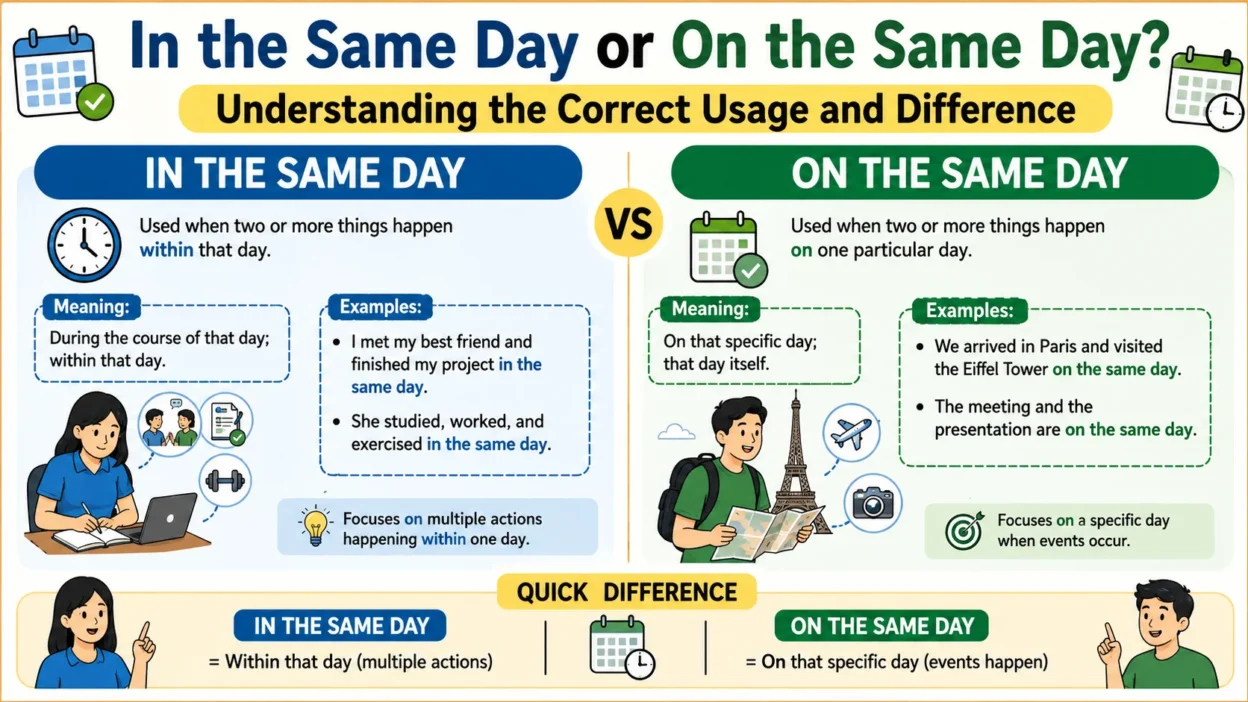
- On the same day = refers to a specific day or date when something happened.
- In the same day = refers to events, actions, or achievements completed during the time span of one day.
Most of the time, native English speakers use “on the same day” because they are usually talking about a shared point on the calendar.
For example:
✅ The two meetings happened on the same day.
This means both meetings took place on one identical date.
However:
✅ He traveled to three different cities in the same day.
This means he completed all three trips within one day. The sentence highlights speed, effort, or the amount accomplished.
The difference may seem small, but the meaning changes depending on whether you focus on the calendar or the duration of time.
Quick Comparison: In the Same Day vs. On the Same Day
| Phrase | Main Meaning | Focus | Example |
| On the same day | Two or more events happen on one particular day | The date or occasion | “They started their jobs on the same day.” |
| In the same day | Multiple actions happen within one day | The amount of activity or time used | “She finished two assignments in the same day.” |
A helpful way to remember the difference:
On = a point on the calendar
In = inside a period of time
Think about a calendar hanging on your wall. You can point to a specific square and say “on that day.” However, when you imagine a day as a container holding hours and activities, you can say something happened “in that day.”
What Does “On the Same Day” Mean?
“On the same day” means that two or more events happened on the exact same day, date, or occasion.
The word “on” connects an event with a specific day. English commonly uses on before days and dates:
- on Monday
- on Friday
- on July 14
- on my birthday
- on the same day
For example:
“The package arrived on the same day that I placed the order.”
This sentence tells us that the arrival date matched the ordering date.
The phrase does not necessarily mean the events happened at the same time. They could happen hours apart.
Example:
“The accident happened in the morning, and the rescue operation began in the evening on the same day.”
The accident and rescue operation were separated by several hours, but they happened within the same calendar date.
Why Native Speakers Prefer “On the Same Day”
Native speakers naturally follow a simple pattern:
Days and dates usually take “on.”
This rule applies in everyday conversations, professional writing, journalism, academic papers, and formal documents.
Compare these examples:
✅ Natural:
“The conference started on the same day as the election.”
❌ Unnatural:
“The conference started in the same day as the election.”
The second sentence sounds unusual because the writer is treating the day as a container rather than a specific date.
English speakers usually think of days as locations on a timeline:
- Monday is a point on the calendar.
- July 14 is a point on the calendar.
- The same day is a point on the calendar.
That is why “on the same day” feels natural.
Common Situations Where “On the Same Day” Is Used
“On the same day” is commonly used when talking about events, actions, or situations that happen within the same calendar date. It often appears when comparing two or more activities, describing schedules, or emphasizing that something was completed without waiting for another day. For example, you might say, “The package was delivered and signed for on the same day,” to show that both actions happened on one specific date.
Comparing Two Events
When you compare events that happened on an identical date, “on the same day” is the correct choice.
Examples:
- The two athletes broke records on the same day.
- They received their graduation certificates on the same day.
- The companies released competing products on the same day.
The phrase clearly shows that the events share one date.
Talking About Schedules
Schedules depend heavily on dates, so “on the same day” appears frequently in workplace and personal planning.
Examples:
- The interviews were scheduled on the same day.
- Both appointments are on the same day.
- The meetings cannot happen on the same day.
In these situations, the speaker cares about avoiding conflicts or identifying a shared date.
Describing Historical Events
Historians, journalists, and researchers often use this expression when connecting events.
Examples:
- The two countries signed agreements on the same day.
- The announcements were made on the same day.
- Several important events occurred on the same day in history.
The phrase helps readers understand the timeline.
Discussing Personal Experiences
People often use “on the same day” when sharing memories.
Examples:
- My brother and I started school on the same day.
- We moved into our new house on the same day.
- They met for the first time on the same day they began their new jobs.
The focus remains the date, not the length of time.
Examples of “On the Same Day”
Here are more examples showing natural usage:
| Situation | Example Sentence |
| Travel | “Our flights arrived on the same day.” |
| Work | “The two projects were completed on the same day.” |
| Education | “The students submitted their papers on the same day.” |
| Business | “The companies announced their partnerships on the same day.” |
| Personal life | “They celebrated their birthdays on the same day.” |
What Does “In the Same Day” Mean?
Although “on the same day” is much more common, “in the same day” has a valid use.
The phrase emphasizes that something happened within one day’s timeframe. It focuses on the amount of time available rather than the specific date.
For example:
“She answered 200 customer emails in the same day.”
The important information is not which date this happened. The important point is that she completed a large amount of work within one day.
Why “In the Same Day” Sounds Different
The reason “in the same day” sounds less common is because English usually uses in with longer periods:
- in a year
- in a month
- in a week
- in the future
A day is shorter than these periods, so using in before “day” changes the meaning.
Compare:
“He finished the project in a week.”
This focuses on the amount of time needed.
Similarly:
“He finished the project in the same day.”
This focuses on completing it within that day.
However:
“He started and finished the project on the same day.”
This focuses on the shared date of two events.
When “In the Same Day” Can Be Correct
“In the same day” can be correct when you are talking about something happening within the limits or duration of a particular day, rather than pointing to a specific time. It often emphasizes that an event occurs during that day’s period. For example, “The package was delivered twice in the same day” highlights that both deliveries happened within one 24-hour period. However, in most everyday situations, “on the same day” is the more natural choice when referring to events occurring on a specific calendar date.
Emphasizing Accomplishment
When someone completes several tasks quickly, “in the same day” works naturally.
Examples:
- She visited five museums in the same day.
- He completed the training and passed the test in the same day.
- They repaired the entire system in the same day.
The phrase highlights achievement.
Highlighting Intensity
Sometimes writers use “in the same day” to show that many things happened within a short period.
Example:
“The company faced a lawsuit, changed leadership, and announced new policies in the same day.”
The sentence creates a feeling of rapid change.
Showing Rapid Progress
The phrase works well when describing fast improvement or unexpected results.
Examples:
- The student learned the basics in the same day.
- The team solved problems that had existed for months in the same day.
- The artist created several designs in the same day.
The focus is the impressive amount completed.
Examples of “In the Same Day”
| Situation | Example Sentence |
| Work | “He handled several important meetings in the same day.” |
| Travel | “They visited multiple locations in the same day.” |
| Learning | “She learned the new software basics in the same day.” |
| Projects | “The team fixed several issues in the same day.” |
| Personal goals | “He completed all his errands in the same day.” |
Key Difference Between “In the Same Day” and “On the Same Day”
The biggest difference comes down to meaning and focus.
| Question | Correct Phrase |
| Which day did it happen? | On the same day |
| How much happened during that day? | In the same day |
Consider these two sentences:
Example One:
“The two celebrities announced their marriages on the same day.”
Meaning:
- Both announcements happened on one identical date.
Example Two:
“The celebrity attended three events in the same day.”
Meaning:
- The person completed several activities within one day.
The words are similar, but the purpose changes.
Think of It This Way: Calendar vs. Clock
A simple memory trick can make this difference easier.
“On” Works Like a Calendar
When you use on, imagine pointing to a specific date.
Examples:
- on Monday
- on Christmas Day
- on the same day
You are identifying where something sits on the calendar.
“In” Works Like a Container
When you use in, imagine placing something inside a time period.
Examples:
- in a year
- in three months
- in the same day
You are describing what fits inside that period.
Remember:
If you are naming the day, use “on.” If you are measuring what happens during the day, “in” may work.
Conclusion
Understanding the difference between “in the same day” and “on the same day” helps English learners communicate more clearly and avoid common grammar mistakes. Although both phrases discuss time, they focus on different ideas. “On the same day” is used for events happening on one specific calendar date, while “in the same day” highlights actions completed within one 24-hour period. Learning these small differences in prepositions improves writing accuracy, speaking fluency, and overall confidence in English communication. With regular practice and attention to context, choosing the correct phrase becomes natural and easier.
FAQs
Q1. What is the difference between “in the same day” and “on the same day”?
“On the same day” refers to events that happen on the same specific date, while “in the same day” focuses on multiple actions completed during one day or within a 24-hour period.
Q2. Is “on the same day” more common than “in the same day”?
Yes, “on the same day” is much more common and widely accepted in everyday English, formal writing, emails, and professional communication when talking about a shared date.
Q3. Can I use “in the same day” in English sentences?
Yes, you can use “in the same day” when you want to emphasise that several tasks or activities were completed within one day. For example: “I finished three assignments in the same day.”
Q4. Why do English learners confuse these two phrases?
Learners often become confused because both phrases contain similar words, but the prepositions “in” and “on” create different meanings. The correct choice depends on whether you are focusing on a specific date or a time period.
Q5. How can I remember when to use “in” and “on” with the same day?
Remember that “on” connects with a specific day or date, while “in” usually focuses on a period of time. If you are talking about when an event happened on a calendar, use “on the same day.” If you are describing completing actions during a day, “in the same day” may be suitable.