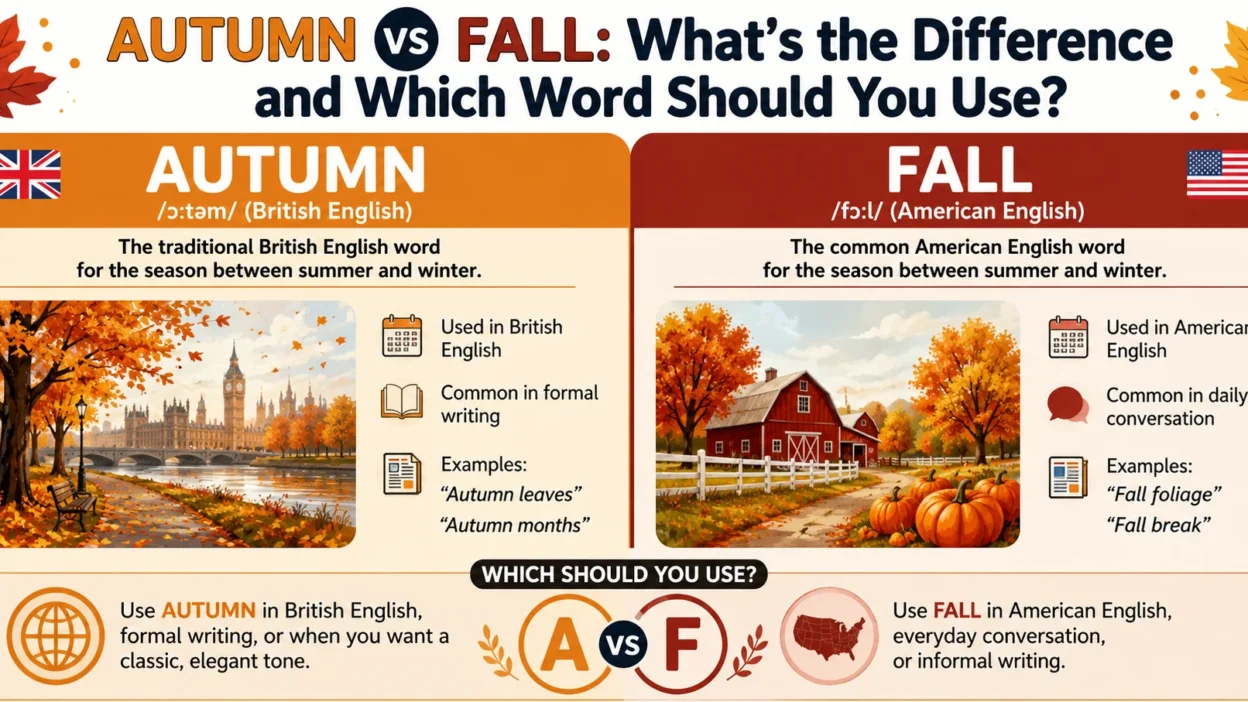
The Autumn vs Fall debate is a common English question that often creates confusion among writers and learners because both words describe the same season. The good news is that both terms are correct and have an identical meaning, but their usage depends on region, audience, and writing style. In British English, autumn is the preferred term, while American English commonly uses fall. Understanding this difference helps people make the right word choice in different situations, whether they are reading British books, watching American movies, or improving their English vocabulary and communication skills.
The history of these seasonal terms shows how language evolves through different cultures and regions. Autumn entered English from the French word automne, which came from the Latin word autumnus. Meanwhile, fall developed from older English expressions such as fall of the leaf and fall of the year. Historical evidence from the 1300s and the 18th century shows that both terms became established in English. Although some critics called fall an American barbarism, historical records reveal that it has deep linguistic roots and was not an exclusively American invention. These origins help remove confusion and show how history, culture, and language together shaped the names people continue to use today.
The season between summer and winter brings recognisable transitions like crisp air, colourful foliage, changing leaves, cooler weather, and shorter days. Different English-speaking communities including the United States, Canada, Australia, and the United Kingdom recognise both terms, but regional traditions, local traditions, and usage patterns influence the commonly chosen word. The autumn season and fall season represent the same seasonal transition filled with harvest celebrations, harvest festivals, pumpkin spice treats, pumpkin spice, hot cider, and a coy atmosphere. In everyday conversations, formal writing, and creative expressions, both words remain grammatically correct and continue to shape modern English vocabulary.
Autumn vs Fall — Side-by-Side Comparison
Here’s a clear breakdown so you can see the differences instantly:
| Feature | Autumn | Fall |
| Meaning | Season between summer and winter | Season between summer and winter |
| Region | UK, global English | United States |
| Tone | Formal, poetic | Casual, conversational |
| Formality | Higher | Lower |
| Common Usage | Literature, branding, global content | Daily speech, media, U.S. writing |
Key takeaway:
The difference isn’t about correctness. It’s about context and audience.
What Do “Autumn” and “Fall” Mean?
At their core, both words describe the same natural shift. Days get shorter. The air turns crisp. Leaves change color and drop.
But language isn’t just about meaning. It’s also about feeling.
- “Autumn” feels elegant. It carries a slightly refined tone. You’ll often see it in poetry or descriptive writing.
- “Fall feels direct. It sounds natural in everyday conversation.
Consider this:
- “The autumn breeze carried golden leaves across the quiet road.”
- “We’re going hiking this fall.”
Same season. Different moods.
Why Are There Two Words for the Same Season?
English loves duplicates. It’s a language built from layers of history. Instead of replacing words, it often keeps them both.
That’s exactly what happened here.
The existence of autumn vs fall comes from:
- Borrowed words from other languages
- Native English expressions
- Cultural shifts over time
English didn’t choose one word and discarded the other. It kept both. Then usage split based on geography and tone.
This pattern appears everywhere in English:
- Begin vs start
- End vs finish
- Purchase vs buy
So “autumn vs fall” isn’t unusual. It’s classic English behavior.
The Origin of “Autumn”
The word “autumn” has deep historical roots. It traveled across languages before settling into English.
Here’s the journey:
- Latin: autumnus
- Old French: automne
- Middle English: autumn
It entered English through French influence after the Norman Conquest. That matters because French vocabulary often carries a sense of prestige and formality.
That’s why even today, “autumn” feels slightly more refined.
Interesting fact:
Before “autumn” became common, English speakers used the word “harvest” to describe the season.
Over time, “harvest” narrowed in meaning. “Autumn” stepped in as the general seasonal term.
The Origin of “Fall”
Unlike “autumn,” the word “fall” is purely English.
It comes from the phrase:
“fall of the leaf”
This phrase described exactly what people observed. Leaves fall from trees. The name was simple and visual.
Eventually, the phrase shortened to just “fall.”
Here’s what makes this interesting:
- “Fall” was widely used in England before it became associated with America
- It wasn’t originally informal or incorrect
- It was just… practical
Over time, British English moved away from “fall.” American English kept it.
Autumn vs Fall — Which Word Came First?
This question surprises many people.
You might assume “autumn” came first because it sounds older. That’s not entirely accurate.
Here’s a simplified timeline:
| Period | Common Term |
| Old English | Harvest |
| 16th Century | Fall and Autumn both used |
| 17th Century | Autumn becomes dominant in Britain |
| Modern English | Fall in U.S., Autumn in UK |
So which came first?
- “Harvest” was the earliest
- “Fall” and “autumn” appeared around the same time
Key insight:
The difference today is not about age. It’s about which version each region kept.
Why Do Americans Say “Fall” and Brits Say “Autumn”?
This split didn’t happen randomly. It followed cultural and linguistic trends.
Language Shift in Britain
British English gradually favored “autumn.”
Why?
- French influence carried prestige
- Formal writing preferred Latin-based vocabulary
- Standardization pushed toward one “refined” term
So “autumn” became the dominant choice.
Language Evolution in America
American English developed differently.
When settlers left England, they brought the language with them. At that time, both “fall” and “autumn” were in use.
However:
- Americans kept the simpler term “fall”
- The language leaned toward clarity and practicality
- Everyday speech shaped the standard
So “fall” stayed.
Where Things Stand Today
- Americans mostly say fall
- Brits mostly say autumn
- Global audiences recognize both
No confusion. No conflict. Just variation.
Does “Autumn” Sound More Formal Than “Fall”?
Yes. And you can feel it instantly.
Let’s compare:
- “Autumn leaves painted the hills in shades of gold.”
- “Fall leaves are everywhere right now.”
Same idea. Different tone.
Tone Breakdown
| Aspect | Autumn | Fall |
| Style | Literary | Casual |
| Mood | Romantic | Practical |
| Usage | Writing, branding | Speech, media |
When tone matters:
- Writing a novel? Use autumn
- Talking to friends? Use fall
- Writing for a global audience? Lean toward autumn
Autumn vs Fall — When Should You Use Each?
This is where most readers hesitate. The good news? The rules are simple.
Use “Fall” When
- You’re writing for an American audience
- You want a casual tone
- You’re speaking or writing informally
Examples:
- Fall semester
- Fall break
- Fall weather
Use “Autumn” When
- You want a polished or descriptive tone
- You’re writing for international readers
- You’re creating artistic or emotional content
Examples:
- Autumn collection
- Autumn evening
- Autumn landscape
When Using the Wrong Word Feels Awkward
Using the wrong term won’t break grammar rules. However, it can feel off.
Here’s when it happens:
- Mixing “fall” and “autumn” in the same article
- Using “autumn” in casual slang-heavy content
- Using “fall” in poetic descriptions
Example of inconsistency:
“The autumn breeze was calm. Fall leaves covered the ground.”
That switch feels jarring. Pick one. Stick with it.
Common Mistakes in Using Autumn vs Fall
Even simple topics can trip people up.
Mistake One: Thinking One Word Is More Correct
Both are correct. Always.
Mistake Two: Mixing Both Without Purpose
Consistency matters more than choice.
Mistake Three: Overthinking the Difference
This isn’t a technical grammar rule. It’s a stylistic decision.
Real-Life Usage of Autumn vs Fall
Let’s move beyond theory and look at real-world usage.
In Everyday Conversation
People in the U.S. say:
- “Fall is my favorite season”
- “I love fall weather”
In the UK:
- “Autumn is beautiful this year”
- “Autumn mornings feel colder now”
Simple. Natural. Region-based.
In Media and Writing
Headlines reflect audience:
- U.S.: “Best Fall Travel Destinations”
- UK: “Top Autumn Escapes”
Writers adjust based on readers.
In Marketing and Branding
This is where word choice becomes strategic.
Brands don’t choose randomly. They choose based on:
- Target audience
- Brand tone
- Emotional appeal
Case Study: How Brands Use Autumn vs Fall
Let’s break this down.
U.S. Retail Brands
They prefer “fall.”
Examples include:
- Fall sale
- Fall collection
- Fall deals
Why?
Because it feels direct and familiar.
Luxury and Global Brands
They often use “autumn.”
Examples:
- Autumn winter collection
- Autumn campaign
Why?
Because “autumn” sounds refined and international.
Key Insight
Word choice influences perception.
- “Fall” = accessible
- “Autumn” = sophisticated
Autumn vs Fall Around the World
Most languages don’t have this problem. They use one word.
Examples:
| Language | Word |
| French | Automne |
| Spanish | Otoño |
| German | Herbst |
| Italian | Autunno |
Notice something?
Most resemble “autumn.”
That’s because they share Latin roots.
Autumn vs Fall in Search Trends (SEO Insight)
If you’re writing online, this matters.
Search behavior differs by region.
- U.S. users search for “fall” more often
- Global users search for “autumn” more frequently
Smart Strategy
- Use both naturally
- Target your audience
- Avoid keyword stuffing
For example:
“Autumn vs fall can confuse writers. In the U.S., fall is more common.”
This approach improves reach without hurting readability.
Myths About Autumn vs Fall (Debunked)
Let’s clear up the confusion.
Myth: “Fall” Is Incorrect
False. It’s widely accepted and historically valid.
Myth: “Autumn” Is More Educated
Not true. It just sounds more formal.
Myth: They Mean Different Seasons
Completely false. They refer to the same period.
Final Verdict: Autumn vs Fall
Here’s the simple truth.
You’re not choosing between right and wrong. You’re choosing between style and audience.
Remember This Rule
- Use fall for American casual writing
- Use autumn for formal or global content
That’s it. No confusion needed.
Quick Recap
- Autumn vs fall refers to the same season
- The difference is regional and stylistic
- “Fall” is common in the U.S.
- “Autumn” is common in the UK and formal writing
- Both are correct. Consistency matters most
Conclusion
Autumn vs Fall is not a battle between two different meanings but a comparison of two words that describe the same season. Both terms are correct, and the main difference comes from regional usage, writing style, and language preferences. Fall is more common in American English, while autumn is widely preferred in British English and more formal contexts. Understanding the history, origin, and context of these words helps writers, learners, and readers choose the term that best fits their audience and communication style. Whether you say autumn or fall, you are referring to the beautiful transition between summer and winter.
FAQs
Q1. Are autumn and fall the same thing?
Yes, autumn and fall describe the exact same season between summer and winter. There is no difference in meaning; the difference is mainly based on region, tone, and usage.
Q2. Which word is more common: autumn or fall?
Fall is more common in American English, while autumn is more common in British English, Australian English, and formal writing. Both words are widely understood.
Q3. Why do Americans say fall instead of autumn?
Americans use fall because the word developed from older English expressions like fall of the leaf and fall of the year. Over time, it became a common seasonal term in the United States.
Q4. Is autumn more formal than fall?
Yes, autumn often sounds more formal, traditional, or literary. However, fall is also completely correct and can be used in professional and everyday writing, especially in American English.
Q5. Can I use autumn and fall interchangeably?
Yes, you can use autumn and fall interchangeably because they have the same meaning. The best choice depends on your audience, location, and the writing style you want to create.