On a Wing and Prayer is an English idiom that uses figurative language and rich imagery to express a powerful meaning in just a few words, making the expression easy to remember. On a Wing and Prayer has a simple definition, yet its deep roots, origin, history, and fascinating story have turned it into a popular saying that continues to capture big ideas through a vivid picture.
From my own experience, learning the context, language, expression meaning, and phrase meaning made it much easier to understand and naturally use in everyday communication. Even today, many people continue to unfold its background with surprise, and it often appears in movie reviews and previews to add dramatic effect.
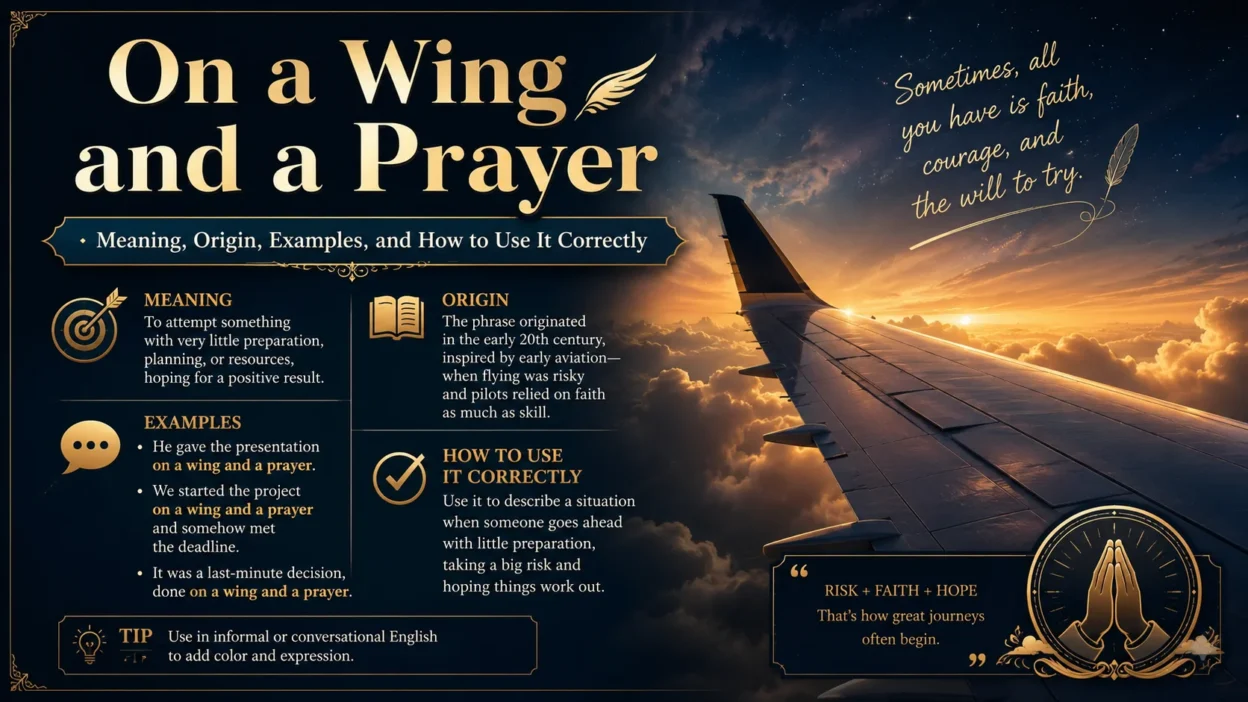
The meaning of this phrase is attempting an attempt with very little or little chance of success. Instead of depending on careful planning, a person is relying on hope, hoping for good luck, luck, faith, divine help, or even a miracle, rather than trusting solid preparation, being prepared, or having enough resources.
There may be some confidence in a positive outcome, but the situation is still uncertain, filled with uncertainty, unlikely possibilities, risk, probability, expectation, fortune, and perseverance. It often describes a risky situation that feels as though everything is barely holding together, yet people continue doing their best, push forward, and hope things will work or work out.
A simple example is someone who launched a project or decided to launch an old car on a long road trip. The vehicle may not be in the best condition, but the journey and travel continue because everyone hopes it will make it. Even with concerns about reliability, poor mechanical condition, breaking down, or a complete breakdown, they keep moving ahead. In simple terms, this saying reminds us that sometimes everything depends on determination instead of certainty, and people move fully ahead because they choose to rely on optimism when the odds are against them.
The Real Meaning of “On a Wing and a Prayer”
Literal vs Figurative Meaning
At first glance, the phrase sounds aviation-related. And that’s no accident.
- Literal sense: A damaged airplane flying with barely one wing functioning.
- Figurative meaning: Moving forward in a risky situation with almost no support.
However, in everyday language, no one uses it to talk about actual planes. Instead, it paints a vivid picture of survival against the odds.
Core Idea Behind the Idiom
This idiom revolves around three key ideas:
- Limited resources – You don’t have enough tools, money, or preparation.
- High risk – The chance of failure is significant.
- Hope and faith – You keep going anyway.
It blends desperation with optimism. That mix makes it powerful.
Think of it like trying to finish a major task the night before a deadline. You’re not ready. Still, you try.
Origin and History of “On a Wing and a Prayer”
World War II Background
The phrase dates back to World War II.
Pilots often returned from missions in severely damaged aircraft. Sometimes, only one wing functioned properly. Engines failed. Systems broke.
Yet, they still made it back.
They flew “on a wing and a prayer”—depending on whatever remained and a lot of hope.
The Song That Made It Famous
In 1943, a popular song titled “Comin’ in on a Wing and a Prayer” spread the phrase worldwide.
The song told the story of a damaged bomber returning home safely.
Key impact:
- It turned military slang into everyday language
- It connected the phrase with courage and survival
- It made the idiom emotionally powerful
How the Meaning Evolved Over Time
After the war, people began using the phrase in daily life.
It shifted from:
- Literal aviation danger
to - Any risky situation with uncertain outcomes
Today, you’ll hear it in business, school, sports, and personal life.
When and How to Use “On a Wing and a Prayer”
Common Situations Where It Fits Naturally
You can use this idiom in many real-world situations:
- Starting a business without funding
- Preparing for an exam at the last minute
- Launching a project without planning
- Trying to meet a tight deadline
- Fixing something temporarily without proper tools
Example:
The startup began on a wing and a prayer, but it eventually grew into a successful company.
Tone and Context
This idiom is:
- Informal but widely accepted
- Suitable for conversation and storytelling
- Occasionally used in business writing for emphasis
However, avoid it in:
- Academic essays
- Legal documents
- Technical writing
Why? Because idioms can reduce clarity in formal contexts.
Real-Life Examples of “On a Wing and a Prayer”
Everyday Conversation Examples
- I went into the interview on a wing and a prayer.
- We planned the trip on a wing and a prayer.
- He fixed the car on a wing and a prayer.
Workplace and Business Examples
- The company survived its early days on a wing and a prayer.
- We pushed the product launch on a wing and a prayer.
- The team completed the project on a wing and a prayer.
Story-Based Example (Mini Scenario)
Imagine this:
A small team launches an online store. They have no marketing budget. Their website has bugs. Orders are slow.
Still, they keep going.
Every sale feels like a miracle.
That’s a business running on a wing and a prayer.
Synonyms and Similar Expressions
Close Synonyms
Here are phrases with similar meanings:
- Against all odds
- By the skin of your teeth
- Running on luck
- Barely holding together
- Taking a long shot
Subtle Differences in Meaning
Each phrase carries a slightly different tone:
| Phrase | Meaning | Key Focus |
| On a wing and a prayer | Risk + hope | Uncertainty |
| Against all odds | Success despite difficulty | Outcome |
| By the skin of your teeth | Narrow escape | Survival |
| Running on luck | Dependence on chance | Luck |
Common Mistakes and Misuse
Using It in the Wrong Context
Avoid using this idiom when:
- There’s no real risk involved
- The situation is well planned
- The outcome is predictable
Incorrect:
I completed my routine task on a wing and a prayer.
This doesn’t work because there’s no uncertainty.
Overuse in Formal Writing
Using idioms too often can:
- Reduce clarity
- Sound unprofessional
- Confuse non-native readers
Stick to plain language in formal settings.
“On a Wing and a Prayer” vs Similar Idioms
Here’s a clear comparison:
| Idiom | Meaning | When to Use | Example |
| On a wing and a prayer | Risk + hope | Uncertain efforts | We launched on a wing and a prayer |
| Against all odds | Success despite difficulty | After success | They won against all odds |
| By luck | Pure chance | Random outcomes | I found it by luck |
Why This Idiom Still Matters Today
Relevance in Modern Life
This phrase feels more relevant than ever.
Think about:
- Startups with limited funding
- Freelancers starting from scratch
- Students managing deadlines
- People switching careers
Many situations involve uncertainty. That’s where this idiom fits perfectly.
Emotional Appeal
People connect with this phrase because it reflects real life.
It captures:
- Fear
- Hope
- Determination
That emotional depth makes it memorable.
Case Study: A Startup Built on a Wing and a Prayer
Let’s look at a real-world scenario.
A small tech startup launched with:
- $500 in savings
- No investors
- Basic tools
- A small remote team
They faced:
- Technical issues
- Low traffic
- Financial pressure
Still, they kept improving.
After one year:
- Revenue crossed $50,000
- Customer base grew steadily
- Brand awareness increased
Key takeaway:
They started on a wing and a prayer, but persistence turned uncertainty into success.
Tips to Remember and Use It Correctly
Here are simple ways to master this idiom:
- Think of risk + hope
- Use it only when uncertainty exists
- Avoid formal contexts
- Practice with real-life examples
Quick Memory Trick
Imagine a plane flying with one wing.
It shouldn’t work.
But somehow, it does.
That image helps lock in the meaning.
Practice Section
Fill-in-the-Blank
- We launched the event on a ______ and a ______.
- He entered the competition on a ______ and a ______.
Rewrite the Sentence
Original:
We had no plan, but we continued anyway.
Improved:
We moved forward on a wing and a prayer.
Conclusion
The idiom On a Wing and a Prayer reminds us that people sometimes move forward even when success is far from certain. Instead of having complete confidence, they continue with hope, faith, and a willingness to face risk despite limited resources or preparation.
Whether it is used in everyday conversation, writing, or storytelling, the expression creates a clear picture of determination during uncertain times. Understanding its meaning, origin, and practical use helps English learners recognize when this classic phrase fits naturally and accurately in real-life situations.
FAQs
Q1.What does “On a Wing and a Prayer” mean?
On a Wing and a Prayer means attempting something with very little chance of success while relying mainly on hope, luck, or faith rather than certainty.
Q2.Is “On a Wing and a Prayer” a common English idiom?
Yes. On a Wing and a Prayer is a well-known English idiom that is still used in everyday communication, books, articles, and media to describe risky situations with uncertain outcomes.
Q3.Where did the phrase “On a Wing and a Prayer” come from?
The phrase became widely known during World War II and is linked to a famous song about damaged aircraft returning safely against the odds. Today, its history and origin continue to interest many people.
Q4.Can I use “On a Wing and a Prayer” in everyday conversation?
Yes. You can use this expression whenever someone moves forward with limited resources, little preparation, or low confidence, while depending on hope that everything will work out.
Q5.What is an example sentence using “On a Wing and a Prayer”?
A simple example is: “We launched our small project on a wing and a prayer, hoping our hard work and faith would help everything work out.”