Favourite’ or ‘Favorite explains English spelling choices, where writers compare regional forms, meanings, and usage across countries today. The difference between Favourite and Favorite is a simple spelling difference that often creates questions for English learners, writers, and native speakers. Both word forms share the same meaning and describe something people have liked or loved more than others. The main difference appears in regional spelling choices, as British English uses favourite while American English uses favorite. Through the history of the English language, different countries developed their own habits, expressions, and spelling preferences. After exploring dictionaries and encyclopedia resources, it becomes clear that both versions are correct spelling choices depending on the audience, context, and writing style.
The English language contains a rich tapestry of English variations across the globe and the world. These language variations developed through history, cultural differences, and language evolution. British English standards and American spelling follow different paths, creating unique regional forms. For example, the British spelling of colour keeps an older letter pattern connected to word formation, while American spelling changed it to colour through language reforms. The missing u in favorite represents a separate spelling style rather than a change in meaning. These English variants, including international English, show how language habits and cultural influence continue shaping modern vocabulary.
When creating a blog post, academic paper, professional email, or using online communication, choosing a consistent preferred spelling improves clarity, confidence, and consistent writing. A writer should consider an American audience, UK audience, or wider international audience before selecting a version. Many people become confused when a spelling looks different, but the answer is straightforward: both forms are accepted, and the choice depends on the style of English being used. Understanding grammar, pronunciation, linguistics, orthography, dialect, and spelling rules helps prevent common mistakes and supports better professional writing. Whether someone writes favourite flavor or favorite flavor for a chocolate flavor, the noun, adjective, and grammatical function remain unchanged.
Favourite or. Favorite: The Short Answer
The quickest answer is this:
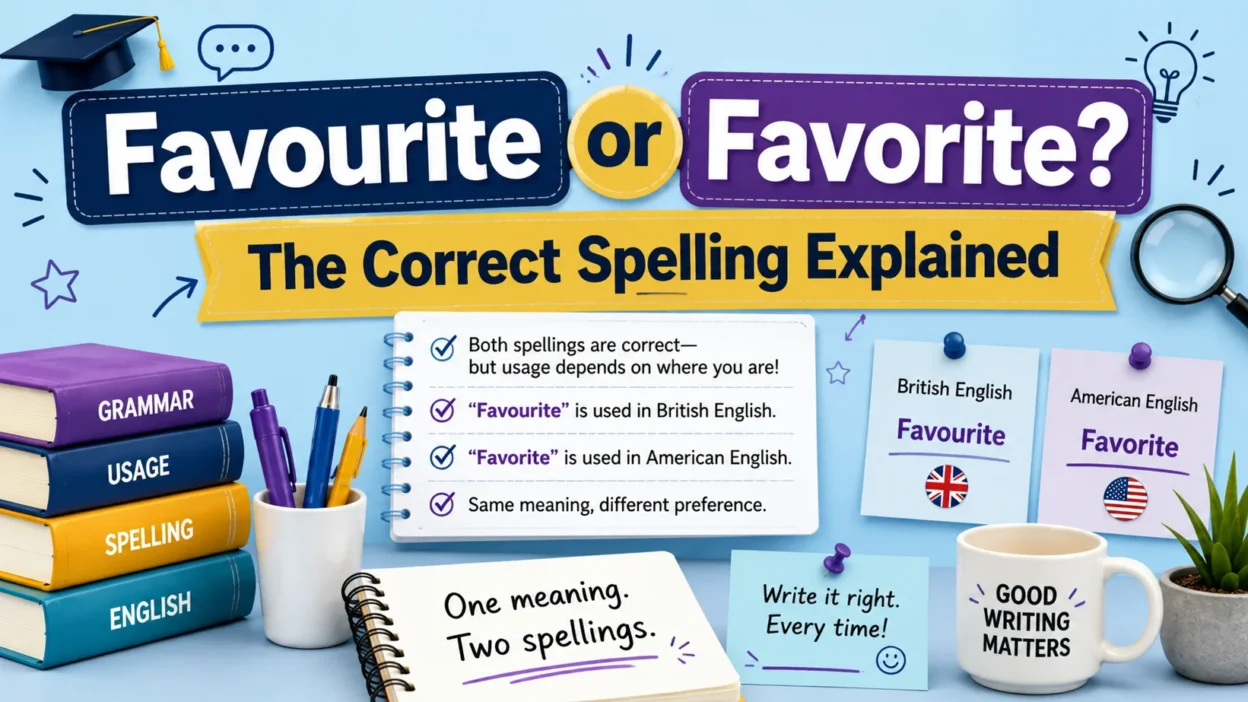
“Favourite” and “favorite” are both correct spellings. The choice depends on the type of English you are using.
- Favourite = British English spelling
- Favorite = American English spelling
Both words describe something or someone that you like more than others.
For example:
- British English: “Chocolate cake is my favourite dessert.”
- American English: “Chocolate cake is my favorite dessert.”
The meaning does not change. The pronunciation does not change. Only the spelling differs.
This difference often appears in words ending with “-our” in British English and “-or” in American English.
Examples:
| British English | American English |
| Favourite | Favorite |
| Colour | Color |
| Honour | Honor |
| Flavour | Flavor |
| Behaviour | Behavior |
Which Spelling Is Correct: Favourite or Favorite?
Many people ask whether one spelling is more correct than the other. The answer depends on the English variety you follow.
If you write for readers in the United Kingdom, Australia, New Zealand, or many Commonwealth countries, favourite is usually the expected spelling.
If your audience lives in the United States, favorite is the standard choice.
Neither version is considered a spelling mistake.
Think of it like different names for the same thing. Americans might say “apartment,” while British speakers often say “flat.” Neither word is wrong. They simply belong to different language traditions.
The important rule is consistency.
A professional writer should avoid mixing styles in the same piece of content.
Incorrect mixed example:
“My favourite color is blue because it is my favorite shade.”
This sentence combines British favourite with American color and favorite.
A consistent version would be:
British style:
“My favourite colour is blue because it is my favourite shade.”
American style:
“My favorite color is blue because it is my favorite shade.”
Favourite or. Favorite: Quick Comparison Table
| Category | Favourite | Favorite |
| English style | British English | American English |
| Main users | UK, Australia, New Zealand, Ireland, Commonwealth regions | United States |
| Meaning | A preferred person, thing, or choice | A preferred person, thing, or choice |
| Pronunciation | Same | Same |
| Spelling difference | Keeps the letter “u” | Removes the letter “u” |
| Example | “This is my favourite song.” | “This is my favorite song.” |
What Does “Favourite” or “Favorite” Mean?
The word favourite/favorite describes something that a person likes more than other choices.
It can describe:
- A person
- A place
- A food
- A hobby
- A book
- A movie
- A color
- A memory
- An activity
The word expresses personal preference.
For example:
- “Pizza is my favorite food.”
- “The blue dress is her favourite outfit.”
- “That restaurant became our favorite place to visit.”
The word can also describe someone who receives special attention or approval.
Example:
“The coach’s favorite player worked hard throughout the season.”
Here, favorite means the person who receives the most admiration or preference.
Definition of Favourite and Favorite
According to common dictionary definitions, favourite/favorite means:
A person, thing, or choice that someone prefers above others.
The word can function in two main ways:
As an Adjective
An adjective describes a noun.
Examples:
- “My favorite movie is a comedy.”
- “Her favourite teacher inspired her.”
- “This is my favorite restaurant.”
In these examples, the word tells you which person or thing someone prefers.
As a Noun
A noun names the preferred person or thing itself.
Examples:
- “Chocolate is my favorite.”
- “The blue team is the crowd’s favourite.”
- “That song remains a fan favorite.”
The noun form often appears when the listener already understands the topic.
Examples of Favourite and Common Favorite
The words favourite and favorite appear in everyday conversations when people talk about their preferred choices. For example, someone might say, “Chocolate is my favourite dessert,” in British English or “Chocolate is my favorite dessert,” in American English. The spelling changes depending on the region, but the meaning stays the same. These words can describe foods, movies, places, hobbies, people, or personal choices that someone likes the most.
Food Examples
- “Pasta is my favorite meal after a long day.”
- “Apple pie has always been my favourite dessert.”
Entertainment Examples
- “That movie became my favorite because of its powerful story.”
- “This novel is one of my favourite books.”
Personal Choices
- “Summer is my favorite season.”
- “Walking by the beach is my favourite activity.”
Professional Examples
- “The company’s favorite product became its best seller.”
- “The employee was the manager’s favourite because of her dedication.”
Synonyms for Favourite and Favorite
Although favourite/favorite is common, English offers several alternatives.
| Synonym | Meaning |
| Preferred | Chosen over other options |
| Beloved | Loved deeply |
| Best-loved | Loved more than others |
| Top choice | The first option selected |
| Favorite pick | A preferred selection |
| Cherished | Highly valued emotionally |
However, these words do not always have the exact same feeling.
For example:
- Favorite sounds are casual and everyday.
- Beloved sounds more emotional.
- Preferred sounds more formal.
Compare:
“This is my favorite book.”
This sounds natural in conversation.
“This is my most beloved book.”
This sounds deeper and more emotional.
“This is my preferred book.”
This sounds more formal and analytical
Why Do British and American English Spell It Differently?
The difference between favourite and favorite did not appear randomly. It developed through centuries of language change.
English has borrowed words from many languages, including:
- French
- Latin
- Greek
- Germanic languages
Because English grew across different regions, spelling rules changed depending on local traditions.
The word favourite comes from the French influence on English vocabulary.
During the Middle Ages and later periods, English borrowed thousands of French words. Many of these words kept spelling patterns that reflected French origins.
The ending “-our” became common in British English because of this historical influence.
The Historical Development of English Spelling
Before dictionaries and formal spelling rules existed, English spelling was flexible.
A single word could appear in several different forms.
For example, writers might spell the same word differently depending on:
- Their region
- Their education
- Their personal preference
- The influence of other languages
The invention and popularity of printing helped create more consistent spelling.
As books became widely available, publishers and scholars began establishing preferred forms.
However, English-speaking countries did not all follow the same path.
The United States developed its own spelling identity, while Britain maintained many traditional forms.
English Before Standardization
Before English spelling became standardized, variation was normal.
A person writing a letter hundreds of years ago might spell words differently from someone living in another town.
There were no universal spelling rules.
For example:
- Dictionaries were not widely available.
- Education systems varied.
- Regional accents influenced writing.
Over time, English speakers created more organized spelling systems.
However, British and American English developed separate preferences because they standardized their languages differently.
The French Connection Behind “Favourite”
The spelling favourite reflects historical French influence.
The French word “favori” influenced English vocabulary, and English writers traditionally kept forms connected to French spelling patterns.
The same pattern appears in:
- Colour
- Honour
- Labour
- Flavour
British English generally preserved the “u” because it reflected older spelling traditions.
American English later removed the extra letter as part of a movement toward simpler spelling.
The American Spelling Reform Movement
The spelling difference between favourite and favorite became clearer during the American spelling reform movement. In the late 18th and early 19th centuries, some American language experts wanted to simplify English spelling. They believed that removing unnecessary letters would make writing easier, faster, and more logical.
Instead of keeping traditional spellings that reflected French origins, American reformers preferred shorter versions. This change created differences between British and American English that still exist today.
For example:
| Traditional British Spelling | American Simplified Spelling |
| Favourite | Favorite |
| Colour | Color |
| Honour | Honor |
| Labour | Labor |
| Centre | Center |
These changes did not happen overnight. They developed gradually through dictionaries, education systems, newspapers, and government documents.
Noah Webster’s Influence on American Spelling
One of the most important figures in American spelling history was Noah Webster, an American lexicographer and educator. His work played a major role in shaping modern American English.
Webster believed that the United States should have its own language identity. He wanted American English to become more independent from British English traditions.
His famous dictionary, An American Dictionary of the English Language, published in 1828, helped establish many spelling differences used in the United States today.
Webster’s goals included:
- Making spelling easier to learn
- Creating a more logical writing system
- Reducing unnecessary letters
- Developing a distinct American identity
His influence helped popularize shorter spellings like favorite instead of favourite.
Examples of Webster’s Spelling Reforms
Webster introduced or supported many spelling changes. Some became widely accepted, while others never gained popularity.
| British English | American English |
| Favourite | Favorite |
| Colour | Color |
| Honour | Honor |
| Defence | Defense |
| Centre | Center |
| Theatre | Theater |
| Catalogue | Catalog |
These changes show a broader pattern: American English often removes letters that are considered unnecessary, while British English often keeps traditional forms.
However, not every suggested reform succeeded. Some of Webster’s ideas were too radical for everyday speakers, so they never became common.
Where Is “Favourite” Used?
The spelling favourite remains widely used in countries that follow British English traditions. These regions usually keep the “-our” ending because of historical spelling patterns.
Countries that commonly use favourite include:
- United Kingdom
- Ireland
- Australia
- New Zealand
- South Africa
- Many Commonwealth countries
Although English is spoken worldwide, spelling choices often depend on education systems, government standards, and local publishing practices.
Countries That Prefer “Favourite”
In the United Kingdom, favourite is the standard spelling used in schools, newspapers, books, and official communication.
Examples:
- “What is your favourite football team?”
- “This is my favourite restaurant in London.”
- “She is my favourite author.”
British dictionaries and writing guides recognize favourite as the correct form.
Ireland
Irish English generally follows many British spelling conventions, including the use of favourite.
Although Ireland has its own unique English expressions and pronunciation patterns, many traditional spellings remain connected to British English.
Example:
“My favourite memory from childhood is visiting the countryside.”
Australia
Australian English usually follows British spelling rules. Australian schools, media outlets, and government documents commonly use favourite.
Examples:
- “Summer is my favourite season.”
- “This beach is my favourite holiday destination.”
However, American influence through technology, movies, and online platforms has introduced some variation.
New Zealand
New Zealand English also commonly uses favourite.
The spelling appears in:
- Educational materials
- Newspapers
- Professional documents
- Online content
Example:
“The movie became one of New Zealand’s favourite films.”
South Africa and Commonwealth Nations
Many Commonwealth countries continue using British spelling patterns.
Countries may prefer favourite because of:
- Historical connections with Britain
- Education systems based on British English
- Local style guides
However, spelling choices can vary depending on the organization or audience.
Examples of Favourite in British English Sentences
Here are some natural examples:
- “My favourite book is a mystery novel because I enjoy solving puzzles.”
- “Chocolate cake has always been my favourite dessert.”
- “The museum became my favourite place to visit during the trip.”
- “Her favourite hobby is painting landscapes.”
The meaning remains focused on personal preference. The only difference is the spelling style.
Where Is “Favorite” Used?
The spelling favorite is mainly used in American English. It appears throughout the United States in everyday conversations, education, media, business, and online communication.
Americans use favorite in:
- School assignments
- Newspapers
- Websites
- Books
- Marketing materials
- Business documents
Examples:
- “My favorite movie is a classic comedy.”
- “Blue is my favorite color.”
- “This restaurant is my favorite place for dinner.”
Countries That Prefer “Favorite”
The United States uses favorite as the standard spelling.
American dictionaries, including major publishing references, recognize this form.
The spelling appears everywhere:
- “Favorite foods”
- “Favorite songs”
- “Favorite places”
- “Customer favorites”
For American readers, favourite may look unusual or foreign even though it is not incorrect
American Publications and Brands
Most American newspapers, websites, and companies follow American spelling rules.
Consistency matters because readers expect familiar language patterns.
For example:
A US website would normally write:
“Discover our customers’ favorite products.”
A UK website would usually write:
“Discover our customers’ favourite products.”
Both sentences are correct. The difference comes from the target audience.
Examples of Favorite in American English Sentences
Common examples include:
- “Pizza is my favorite food after a busy week.”
- “That movie became my favorite because the story was inspiring.”
- “She shared her favorite travel destinations online.”
- “This song is one of my favorite memories from childhood.”
American speakers use favorite naturally in both casual and professional communication.
Is Canada “Favourite” or “Favorite”?
Canada has a unique position because Canadian English sits between British and American English traditions.
Canadian spelling often keeps British forms but also accepts some American influences.
This means Canadians may use:
- Favourite
- Color
- Centre
- Defense
Canadian English does not always follow one single pattern.
The Unique Canadian Situation
Canada’s location and history influence its spelling choices.
The country has strong connections with:
- British language traditions
- American media
- International business
Because of this mix, Canadian English developed its own style.
For example:
A Canadian writer may use:
“My favourite colour is blue.”
This follows British spelling.
However, they may also write:
“The color center provides information.”
This reflects American influence.
Traditional Canadian Preference
Historically, Canadian English leaned toward British spelling.
Many Canadian schools and official documents traditionally preferred:
- Favourite
- Colour
- Honour
- Centre
These forms remain common today.
Modern Canadian Usage Trends
Modern communication has increased American influence.
The internet, software programs, streaming services, and international companies often use American spelling by default.
As a result, some Canadians now use mixed spelling patterns.
The best approach is not choosing one “perfect” version. Instead, writers should follow the style guide required by their school, workplace, or publication.
Conclusion
The choice between Favourite and Favorite depends on the region, audience, and writing style, not on a difference in meaning. Both spellings are correct and represent the same idea of something that is liked or loved more than others. British English follows favourite, while American English uses favorite because of different spelling rules and language evolution. Understanding these small English variations helps writers create clear, accurate, and professional communication. Whether you are writing for a local audience or an international audience, choosing one spelling style and using it consistently improves your overall writing quality.
FAQs
Q1. Is Favourite and Favorite the same word?
Yes, Favourite and Favorite are the same word with the same meaning. Both describe something that a person likes or prefers more than other things. The only difference is the spelling used in different regions.
Q2. Which spelling is correct, Favourite or Favorite?
Both Favourite and Favorite are correct spellings. Favourite is commonly used in British English, while Favorite is preferred in American English.
Q3. Why does British English use Favourite with a “u”?
The British spelling keeps the letter “u” because of historical language patterns and traditional spelling rules. American English later removed the “u” in some words to create a simpler spelling style.
Q4. Should I use Favourite or Favorite in professional writing?
You should choose based on your audience and maintain consistent writing. Use Favourite for UK audiences and Favorite for American audiences or follow the required spelling style for your professional writing.
Q5. Does Favourite or Favorite change the pronunciation?
No, Favourite and Favorite have the same pronunciation and meaning. The difference only appears in the written spelling, not in how people say the word.