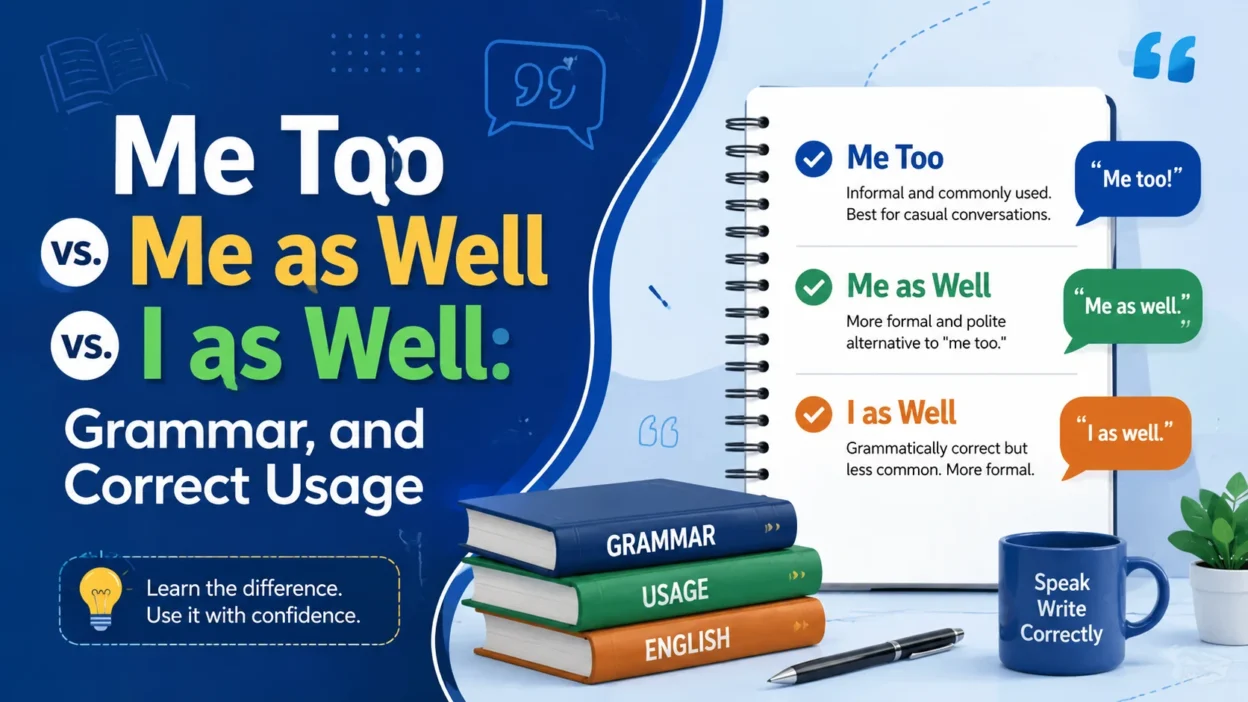
When you compare Me Too vs. Me as Well vs. I as Well: Grammar, and Correct Usage, the main difference becomes clearer when you focus on grammar, usage, tone, and context. English learners often feel confused because these expressions have a similar meaning, yet native speakers use them in different ways. In everyday conversation and everyday speech, speakers naturally shorten sentences, use ellipsis, and leave parts of a phrase unstated. For example, after someone says they love chocolate, Me too sounds natural as a reply in casual conversation. Me as well is another common alternative, while I as well is less common and can sound more formal or slightly unusual depending on the context. This difference comes partly from the object pronoun me and the subject pronoun I, but real communication also depends on the speaker, situation, and tone. Most people choose Me too without a second thought, while learners who are trying to sound educated may overthink the pronoun swap and create an error.
From my experience with teaching grammar, I find that learners make faster progress when they study these distinct comparisons through simple sentences, real examples, and real context instead of relying only on rigid rules from grammar books. In casual texts, professional emails, workshops, meetings, and other everyday situations, the right form depends on the level of formality, politeness, and purpose of the agreement expression. Me too remains a widely accepted and natural choice for relaxed speech, while Me as well offers a slightly more polished alternative. I as well can be correct when I function as the subject, but forcing it into a short reply may make the sentence sound slightly off.
As you practice, hear more conversations, and recognise familiar expressions, your understanding grows over time. You begin to notice what works, what feels right, and what sounds natural without constant guessing. This kind of linguistic intelligence develops through exposure to real life, where speakers may drop words, use shortened forms, or change their replies while still providing meaning. Although these forms may seem to break normal rules or break down structure, they often work because communication depends on shared context. A useful guide should therefore help learners see that grammar, correctness, communication, and natural English work together. The more you learn, practice, and keep seeing examples, the easier it becomes to choose the right phrase for each situation.
Quick Answer: Me Too vs. Me as Well vs. I as Well
“Me too” is the most common and natural short response when you want to say that the same thing is true for you.
“Me as well” can also mean “me too.” It works as a shortened response and is perfectly understandable, although it is generally less common in casual conversation.
“I as well” usually shouldn’t be used as a standalone response. When you use I, you normally need a verb or auxiliary verb to complete the structure.
| Expression | Correct? | Typical Use | Example |
| Me too | Yes | Quick agreement | “I love tea.” → “Me too.” |
| Me as well | Yes | Agreement | “I love tea.” → “Me as well.” |
| I as well | Usually not alone | Requires a larger structure | “I do as well.” |
| I do too | Yes | Agreement with an action | “I love tea.” → “I do too.” |
| I am too | Yes | Agreement with a state | “I am tired.” → “I am too.” |
| I will too | Yes | Agreement about the future | “I will go.” → “I will too.” |
The easiest rule is:
Use “me too” for a quick agreement. If you use “I,” give it a verb.
Why “Me Too,” “Me as Well,” and “I as Well” Get Confused
All three expressions seem to communicate the same basic idea: the same thing applies to me.
Consider this conversation:
Emma: I love Italian food.
Noah: Me too.
Noah is essentially saying:
I love Italian food too.
The longer sentence doesn’t need to be repeated because the meaning is already obvious. English speakers do this constantly.
For example:
“Are you hungry?”
“Yes.”
The answer isn’t a complete sentence such as “Yes, I am hungry.” However, everyone understands it.
The same principle applies to “Me too.”
This is called ellipsis, which means that words can be left out when the listener can easily understand them from context. Everyday speech relies heavily on this kind of shortening.
Why “Me” Doesn’t Make “Me Too” Incorrect
Some learners assume that because I is the subject pronoun, the correct expression must be “I too.”
That isn’t how “me too” works.
Compare:
I like coffee too.
Here, I is the subject.
Now compare:
Me too.
This is a shortened conversational response. It isn’t structured like a traditional subject-and-verb sentence.
That’s why “me too” sounds natural even though me normally functions as an object pronoun.
“Me Too” — Meaning, Grammar, and Usage
“Me Too” is a common expression used to show that you share the same feeling, experience, opinion, or situation as someone else.
What Does “Me Too” Mean?
“Me too” means that you share the same feeling, opinion, experience, preference, action, or situation.
Depending on the context, it can mean:
- I feel the same way.
- I agree.
- I have the same experience.
- I want that too.
- I like that too.
- The same thing is true for me.
For example:
“I’m really tired today.”
“Me too.”
The complete meaning is:
“I’m really tired today too.”
Another example:
“I’ve visited Chicago twice.”
“Me too.”
The speaker means that they have also visited Chicago twice.
When Should You Use “Me Too”?
“Me too” works especially well in everyday conversations.
You can use it to agree about:
- Feelings
- Preferences
- Experiences
- Plans
- Habits
- Opinions
- Desires
- Shared situations
For example:
“I love rainy weather.”
“Me too.”
“I’m nervous about the interview.”
“Me too.”
“I want to watch that movie.”
“Me too.”
“I’ve been there before.”
“Me too.”
The expression is short because the previous sentence supplies the missing information.
Is “Me Too” Formal or Informal?
“Me too” is mainly conversational.
It sounds perfectly natural in:
- Friendly conversations
- Text messages
- Casual emails
- Social media
- Informal workplace discussions
- Everyday speech
For highly formal writing, however, a complete sentence may be better.
Instead of:
“Me too.”
you might write:
“I agree.”
or:
“I share the same opinion.”
or:
“I have had the same experience.”
The expression isn’t wrong because it’s casual. It simply belongs more naturally to conversational English.
“Me as Well” — Meaning, Grammar, and Usage
“Me as well” is a common expression used to agree with someone and say that the same thing is true for you.
What Does “Me as Well” Mean?
“Me as well” generally means the same thing as “me too.”
The phrase as well means also or too.
For example:
“I’m going to the conference.”
“Me as well.”
The intended meaning is:
“I’m going to the conference as well.”
The expression is also completely natural inside a full sentence:
“The new policy affects me as well.”
Here, me is clearly the object of affects, while as well adds the meaning of “also.”
Is “Me as Well” Correct as a Standalone Response?
Yes, it can be used as a shortened response.
However, “me too” is usually more natural in casual conversation.
Compare:
“I love summer.”
“Me too.”
This sounds effortless.
Now:
“I love summer.”
“Me as well.”
The meaning is clear, but the second response can sound slightly more deliberate.
That doesn’t make it incorrect. It simply isn’t usually the first choice for a very casual conversation.
Examples of “Me as Well”
Shared experience:
“I had trouble finding parking.”
“Me as well.”
Shared preference:
“I prefer working in the morning.”
“Me as well.”
Complete sentence:
“The decision affected me as well.”
Another object construction:
“They contacted me as well.”
In complete sentences, me as well often feels especially natural because its grammatical role is obvious.
Me Too vs. Me as Well: What’s the Difference?
The two expressions usually have the same basic meaning. The main difference is usage and conversational feel.
| Feature | Me Too | Me as Well |
| Meaning | Same applies to me | Same applies to me |
| Casual conversation | Very common | Less common |
| Short response | Excellent choice | Possible |
| Complete sentences | Common | Common |
| Tone | Casual and natural | Neutral or slightly deliberate |
| Basic grammar | Correct | Correct |
It’s tempting to think that “me as well” is simply the formal version of “me too.” That’s not quite accurate.
If you want to sound more formal, replacing too with as well isn’t always enough. A complete sentence may be better:
“I agree with this assessment.”
That sounds more professional than either:
“Me too.”
or:
“Me as well.”
“I as Well” — Is It Grammatically Correct?
This is the expression that causes the most trouble.
Why “I as Well” Usually Doesn’t Work Alone
I is a subject pronoun. It normally appears with a verb:
- I work.
- I agree.
- I understand.
- I am tired.
- I have finished.
- I will attend.
Now look at:
“I as well.”
Something is missing.
The listener expects a verb or another part of the sentence.
Compare:
“I love jazz.”
“Me too.” ✅
“I love jazz.”
“I do too.” ✅
“I love jazz.”
“I do as well.” ✅
“I love jazz.”
“I as well.” ❌
The problem isn’t that I am somehow less appropriate than me. The problem is that I as well don’t provide a complete grammatical structure.
When Can “I as Well” Appear?
It would be too broad to say that the words “I as well” can never occur.
For example:
“I as well as my brother, enjoy hiking.”
Here, as well as forms part of a larger grammatical construction.
Another example is:
“I would like to attend as well.”
In this sentence, I has a complete verb phrase, and as well adds the meaning of “also.”
So the useful rule is not:
“Never use I as well.”
Instead, remember:
Don’t use “I as well” by itself as a replacement for “me too.”
Better Alternatives to “I as Well”
If you want to begin with I, choose a structure that includes the appropriate verb.
I Do Too
Use this when agreeing with an action or preference:
“I enjoy classical music.”
“I do too.”
I Do as Well
This has the same basic function:
“I enjoy classical music.”
“I do as well.”
I Am Too
Use am when the original sentence uses am:
“I am exhausted.”
“I am too.”
I Will Too
Use will for a future action:
“I will attend the meeting.”
“I will too.”
I Have Too
Use have when it is the appropriate auxiliary:
“I have finished the assignment.”
“I have too.”
The key is to match the grammatical structure of the original statement.
Why the Verb Changes the Correct Response
Don’t simply look at whether the other person started their sentence with I.
Look at the verb.
The verb determines which response sounds natural.
After “I Am”
“I am nervous.”
“I am too.”
After “I Do”
“I enjoy reading.”
“I do too.”
After “I Have”
“I have visited Boston.”
“I have too.”
After “I Will”
“I will join you.”
“I will too.”
This is why “I as well” cannot simply replace “me too” in every situation.
Me Too vs. Me as Well vs. I as Well: Comparison Table
| Expression | Standalone Response | Meaning | Naturalness | Example |
| Me too | Yes | Same applies to me | Very natural | “I like tea.” → “Me too.” |
| Me as well | Yes, in shortened use | Same applies to me | Natural but less common | “I like tea.” → “Me as well.” |
| I as well | Usually no | Intended agreement | Unnatural alone | “I like tea.” → “I as well.” |
| I do too | Yes | Same action applies | Very natural | “I like tea.” → “I do too.” |
| I do as well | Yes | Same action applies | Natural | “I like tea.” → “I do as well.” |
| I am too | Yes | Same state applies | Natural | “I am tired.” → “I am too.” |
| I will too | Yes | Same future action | Natural | “I will go.” → “I will too.” |
Common Mistakes With “Me Too” and “Me as Well”
Mistake: Thinking “I” Is Always More Correct Than “Me”
I and me aren’t at different levels of formality.
They perform different grammatical jobs.
I called Sarah.
But:
Sarah called me.
You shouldn’t choose I simply because it sounds more formal.
Mistake: Treating “I as Well” as a Formal “Me Too”
This is another common assumption.
The progression:
“Me too” → “Me as well” → “I as well”
doesn’t work.
“I as well” isn’t a formal replacement for “me too.”
If you want a more polished response, use:
“I agree as well.”
“I feel the same way.”
“I share that opinion.”
Mistake: Using the Wrong Auxiliary
Consider:
“I am tired.”
The natural response is:
“I am too.”
Not:
“I do too.”
Now consider:
“I enjoy swimming.”
The natural response is:
“I do too.”
Not:
“I am too.”
The auxiliary must match the grammatical structure.
Me Too vs. Me as Well in Different Situations
This section explains when to use “Me Too” and “Me as Well” based on the situation, tone, and context.
Casual Conversation
“Me too” is usually the best option.
“I’m hungry.”
“Me too.”
It’s short, familiar, and natural.
Workplace Conversation
Both expressions can appear in spoken workplace English:
“I think we should review the report.”
“Me too.”
However, a complete response may sound more professional:
“I agree. I think we should review the report as well.”
Academic Writing
Academic writing generally favors complete sentences.
Instead of:
“Me too.”
you might write:
“I agree with this interpretation.”
or:
“I reached the same conclusion.”
Texting and Social Media
“Me too” is especially useful in informal digital communication.
“I need coffee.”
“Me too.”
The short expression fits the relaxed nature of texting.
Practical Examples: Choosing the Right Response
| Someone Says | Natural Response | Another Correct Option |
| “I love coffee.” | Me too. | I do too. |
| “I am exhausted.” | Me too. | I am too. |
| “I want to leave.” | Me too. | I do too. |
| “I have finished the work.” | Me too. | I have too. |
| “I will attend the meeting.” | Me too. | I will too. |
| “I enjoy hiking.” | Me too. | I do as well. |
| “The decision affected me.” | — | The decision affected me as well. |
| “They invited me.” | — | They invited me as well. |
Real-Life Case Studies
Real-life case studies show how the concept works in practical, everyday situations.
Case Study: Friends Talking
Sam: “I can’t believe how cold it is today.”
Jordan: “Me too.”
Because this is a casual conversation, “me too” is the most natural response.
Case Study: Workplace Discussion
Manager: “I think we should review these numbers.”
Employee: “I agree. I think we should review the projections as well.”
A complete sentence gives the response a more professional tone.
Case Study: Classroom Discussion
Student A: “I found the final chapter confusing.”
Student B: “I did too.”
Here, did represents the earlier verb and creates a complete grammatical structure.
Case Study: Customer Support
Customer: “I haven’t received the confirmation email.”
Agent: “I haven’t received it either.”
Notice the use of either with a negative statement. English commonly uses either rather than too for negative agreement.
Case Study: Group Discussion
Speaker A: “I think the proposal needs more research.”
Speaker B: “I do as well.”
This sounds more deliberate than “Me too,” while still expressing the same basic agreement.
A Simple Rule for Remembering the Difference
If you need a quick response, use:
Me too.
If you want another short expression of agreement, use:
Me as well.
If you want to begin with I, include the appropriate verb:
I do too.
I am too.
I have too.
I will too.
The central lesson is simple:
“Me too” is the easiest natural response. “Me as well” can also work. “I as well” usually needs a verb or a larger grammatical structure.
Conclusion
Understanding “Me too,” “Me as well,” and “I as well” becomes easier when you focus on context, grammar, and tone. “Me too” is the most common choice in casual conversation, while “Me as well” can sound slightly more polished. “I as well” is grammatically possible in the right structure but isn’t usually the most natural choice for a short agreement. Once you notice how native speakers use these expressions in everyday English, choosing the right phrase becomes much easier.
FAQs
Q1. Is “Me too” grammatically correct?
Yes. “Me too” is a standard and very common expression of agreement, especially in casual conversation.
Q2. Is “Me as well” correct?
Yes. “Me as well” is correct and can be used to agree with a previous statement. It may sound slightly more formal or polished than “Me too.”
Q3. Is “I as well” correct?
Yes, but its use depends on the sentence structure. “I as well” is less common as a short reply and can sound unnatural when used simply instead of “Me too.”
Q4. What is the difference between “Me too” and “Me as well”?
Both express agreement. “Me too” is more common and natural in casual speech, while “Me as well” can have a slightly more formal or polished tone.
Q5. Should I use “Me too” or “I as well”?
In most casual situations, “Me too” is the safest and most natural choice. Use “I as well” when the surrounding sentence specifically requires I as the subject.