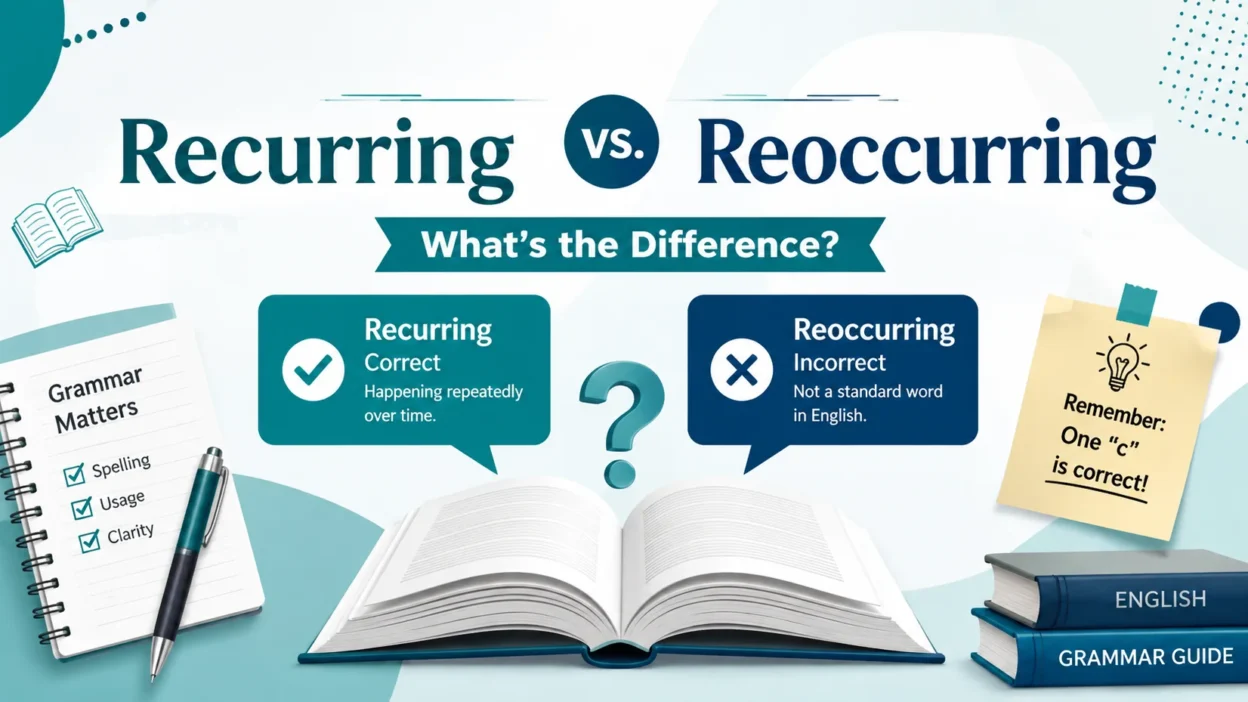
Recurring vs. Reoccurring can seem confusing because the two words look and sound similar, but their meaning, context, and usage are not always the same. In professional writing, formal writing, email writing, and report writing, recurring is usually the better choice when something follows a regular pattern or predictable schedule. For example, recurring meetings, recurring payments, and recurring events happen at expected intervals. A meeting every Monday at 10 AM has a clear rhythm and predictability, making recurring the natural word. This key difference helps writers, students, and professionals make the correct word choice without confusion.
Reoccurring is useful when something simply happens again, especially when the event isn’t part of a fixed or predictable pattern. For example, a reoccurring issue may appear again after someone tries to fix it, and the problem may return unexpectedly. In contrast, a problem that appears every month has a more regular pattern and may be described as recurring. The distinction involves a subtle semantic nuance and linguistic nuance. Both words are legitimate, and their meanings have some overlap, but recurring has broader word usage and is the more widely accepted standard form in most English language contexts. Reoccurring is less common, although it can still be appropriate when the main idea is simply another occurrence.
When selecting the right word, consider the overall usage, broader context, and intent of the sentence instead of assuming that similar words have identical meanings. If something follows an ongoing or repeated pattern and keeps coming back at expected intervals, recurring is usually the best choice. If you want to emphasise that something has happened again, reoccurring may be more suitable. This simple useful guide can help you avoid confusion, improve clarity and accuracy, and strengthen your writing precision. Whether you’re editing documents, emails, reports, or online content, understanding these subtle differences makes your word choice more precise and reduces second-guessing. With practice, you can choose the right term with greater confidence and communicate your ideas more clearly.
Quick Answer: Recurring vs. Reoccurring
Recurring means happening repeatedly or appearing again over time, often as part of an established pattern.
Reoccurring means happening again or occurring another time. It can describe a repeated event without suggesting that the event follows a regular pattern.
For example:
- The company charges a recurring monthly fee.
- The software has a reoccurring error that keeps appearing after updates.
Both words relate to repetition. However, recurring is generally more common and often sounds more natural when you’re describing an ongoing pattern, repeated activity, or regular occurrence.
| Word | Basic meaning | Common implication |
| Recurring | Happening repeatedly | An ongoing or repeated pattern |
| Reoccurring | Happening again | Another occurrence or repeated event |
The distinction isn’t an ironclad grammatical rule. Context matters.
What Does “Recurring” Mean?
Recurring describes something that happens repeatedly or comes back over time.
The word comes from the verb recur, which means to happen again or happen repeatedly. Because of that connection, recurring often carries the sense of something returning as part of a continuing pattern.
For example:
She has recurring nightmares about the same place.
The nightmares don’t simply happen once more. The sentence presents them as a repeated experience.
You can also use recurring for things that happen according to a schedule:
The customer has a recurring payment every month.
Here, the repetition is predictable. The payment comes back at a known interval.
However, recurring doesn’t always mean perfectly regular. A recurring problem might happen several times without following a calendar.
The team continues to deal with a recurring technical problem.
The problem keeps coming back. The sentence doesn’t tell you whether it happens every Monday, every three months, or at completely unpredictable times.
Common Uses of “Recurring”
You’ll frequently see recurring in phrases such as:
- recurring payment
- recurring charge
- recurring expense
- recurring revenue
- recurring meeting
- recurring appointment
- recurring problem
- recurring issue
- recurring symptom
- recurring dream
- recurring theme
- recurring event
These combinations have become especially established in modern English.
For instance, businesses routinely talk about recurring revenue because customers generate revenue repeatedly through subscriptions or ongoing services.
Likewise, writers often discuss a recurring theme when an idea appears multiple times throughout a story.
What Does “Reoccurring” Mean?
Reoccurring means happening again or occurring another time.
It comes from the verb reoccur. The word emphasizes the fact that an event has occurred again.
Consider this sentence:
The same error is reoccurring after every software update.
The writer wants to point out that the error has appeared again.
Another example:
The reoccurring issue delayed the project.
The issue has happened before, and now it’s happening again.
Unlike many examples of recurring, reoccurring doesn’t automatically suggest a fixed schedule. The event could happen twice, several times, or repeatedly without a predictable interval.
That’s an important point because a common oversimplification says that recurring means “regular” while reoccurring means “irregular.” That’s too strict.
The meanings overlap.
Recurring vs. Reoccurring: The Main Difference
The easiest way to understand the distinction is to focus on pattern versus another occurrence.
Recurring often highlights repetition as an ongoing phenomenon.
Reoccurring often highlights the fact that something has happened again.
For example:
The company has recurring meetings every Friday.
The meetings follow a recognizable pattern.
Now consider:
A reoccurring error appeared during the test.
The emphasis falls on the error appearing again.
But here’s where English gets interesting: the second sentence could also use recurring.
A recurring error appeared during the test.
That sentence is perfectly natural. It simply emphasizes the repeated nature of the problem.
So the distinction isn’t a brick wall. It’s more like a sliding scale.
Side-by-Side Comparison
| Feature | Recurring | Reoccurring |
| Root verb | Recur | Reoccur |
| Basic idea | Happens repeatedly | Happens again |
| Emphasis | Repetition or pattern | Another occurrence |
| Fixed schedule required? | No | No |
| Suggests an ongoing pattern? | Often | Sometimes |
| Common in business writing? | Very common | Less common |
| Common in everyday English? | Very common | Less common |
| Correct English? | Yes | Yes |
The most important takeaway is simple: don’t treat reoccurring as an incorrect version of recurring.
Does “Recurring” Always Mean Regular?
No.
This is one of the biggest misconceptions surrounding these words.
A recurring event can happen regularly:
We have a recurring meeting every Tuesday.
But it can also happen without a precise schedule:
The neighborhood has a recurring flooding problem.
The flooding may happen several times a year, but not necessarily on a predictable date.
Likewise:
He has recurring doubts about his decision.
Those doubts return repeatedly, but nobody expects them to appear according to a timetable.
Therefore, it’s better to think of recurring as describing repetition rather than automatically defining a specific frequency.
A pattern can be predictable, somewhat predictable, or simply persistent.
When Should You Use “Recurring”?
In many situations, recurring is the safest and most natural choice.
Use it when you’re describing something that repeatedly happens, returns, or appears over time.
Recurring Payments
This is one of the strongest examples.
Your recurring payment will be processed on the first of each month.
A recurring payment repeats according to an established billing arrangement.
You’ll commonly see phrases such as:
- recurring payment
- recurring billing
- recurring charge
- recurring subscription
- recurring fee
- recurring expense
These expressions are deeply established in business and financial English.
Recurring Meetings
A meeting that happens repeatedly can be described as recurring.
The department has a recurring staff meeting every Monday morning.
The meeting doesn’t exist as an isolated event. It’s part of an ongoing schedule.
Recurring Problems
You can also describe problems that repeatedly return.
The company has a recurring problem with delayed shipments.
This doesn’t necessarily mean the delays happen at the same time every week. It simply means the problem keeps returning.
Recurring Symptoms
In health-related writing, recurring symptoms is a common expression.
The patient reported recurring symptoms over several months.
Again, the symptoms return. The phrase doesn’t necessarily tell us exactly when they’ll appear.
Recurring Themes
In literature, film, art, and communication, recurring themes are especially useful.
Freedom is a recurring theme throughout the novel.
The theme appears repeatedly in different parts of the story.
When Should You Use “Reoccurring”?
Use reoccurring when you want to emphasize that something has happened again.
It can work especially well when you’re discussing an event, incident, error, or situation that has returned.
For example:
The reoccurring error caused another delay.
The sentence highlights another appearance of the error.
You might also write:
The manager was concerned about the reoccurring complaints.
The complaints have happened before and have surfaced again.
Reoccurring Errors
Technical and workplace contexts can provide natural examples.
The development team couldn’t identify the cause of the reoccurring error.
The error has appeared before and has appeared again.
Reoccurring Incidents
You can use the word for repeated incidents:
The school introduced new procedures after several recurring incidents.
The focus is on incidents happening again.
Reoccurring Situations
You can also describe a situation that keeps resurfacing:
They wanted to prevent the reoccurring conflict from damaging the relationship.
The conflict has returned more than once.
Recurring vs. Reoccurring Examples
Seeing the words in context makes the distinction much easier.
Examples of “Recurring”
- The subscription includes a recurring monthly charge.
- She has a recurring appointment with her dentist.
- The novel contains several recurring themes.
- The team needs to solve this recurring problem.
- He experiences recurring dreams about his childhood home.
- The company reduced its recurring expenses.
- Recurring delays have affected production.
- The software has a recurring performance issue.
- The character becomes a recurring figure throughout the series.
- Recurring meetings help the team stay organized.
Each sentence presents repetition as an important part of the situation.
Examples of “Reoccurring”
- The reoccurring error appeared during testing.
- The manager investigated the reoccurring complaint.
- The team couldn’t explain the reoccurring failure.
- Several recurring incidents prompted a policy review.
- The reoccurring issue caused another deadline to slip.
- They developed a plan to address the reoccurring problem.
- The technician noticed a reoccurring fault in the system.
- The reoccurring dispute created tension within the group.
- The company tracked the reoccurring delays.
- The reoccurring event raised concerns among residents.
These examples emphasize something occurring again.
Conclusion
Recurring vs. Reoccurring may seem interchangeable, but the difference becomes clearer when you consider the pattern and meaning behind the event. Recurring usually describes something that happens repeatedly in a regular, predictable way, such as recurring meetings, payments, or events. Reoccurring focuses more on something happening again, particularly when it doesn’t follow a fixed schedule. Although both words are correct, recurring is more common and generally the better choice in professional and formal writing. Understanding this distinction can help you choose the right word, avoid confusion, and make your writing more precise.
FAQs
Q1. What is the difference between recurring and reoccurring?
Recurring usually describes something that happens repeatedly according to a pattern or schedule, while reoccurring emphasizes something happening again, especially without a predictable pattern.
Q2. Is recurring or reoccurring more common?
Recurring is much more common in everyday, professional, and formal English. It’s also generally the safer choice when you’re describing something that happens repeatedly.
Q3. Is reoccurring the correct word?
Yes. Reoccurring is a legitimate English word. It isn’t simply a misspelling of recurring, although the two words have overlapping meanings.
Q4. Should I use recurring for regular events?
Yes. Recurring is usually the best choice for events that happen at predictable intervals. For example, you can say, “We have a recurring meeting every Monday.”
Q5. Can recurring and reoccurring be used interchangeably?
Sometimes, but not always. Their meanings overlap, so either word may work in some situations. However, recurring is better when you want to emphasize repetition or a regular pattern, while reoccurring can emphasize that something has happened again.