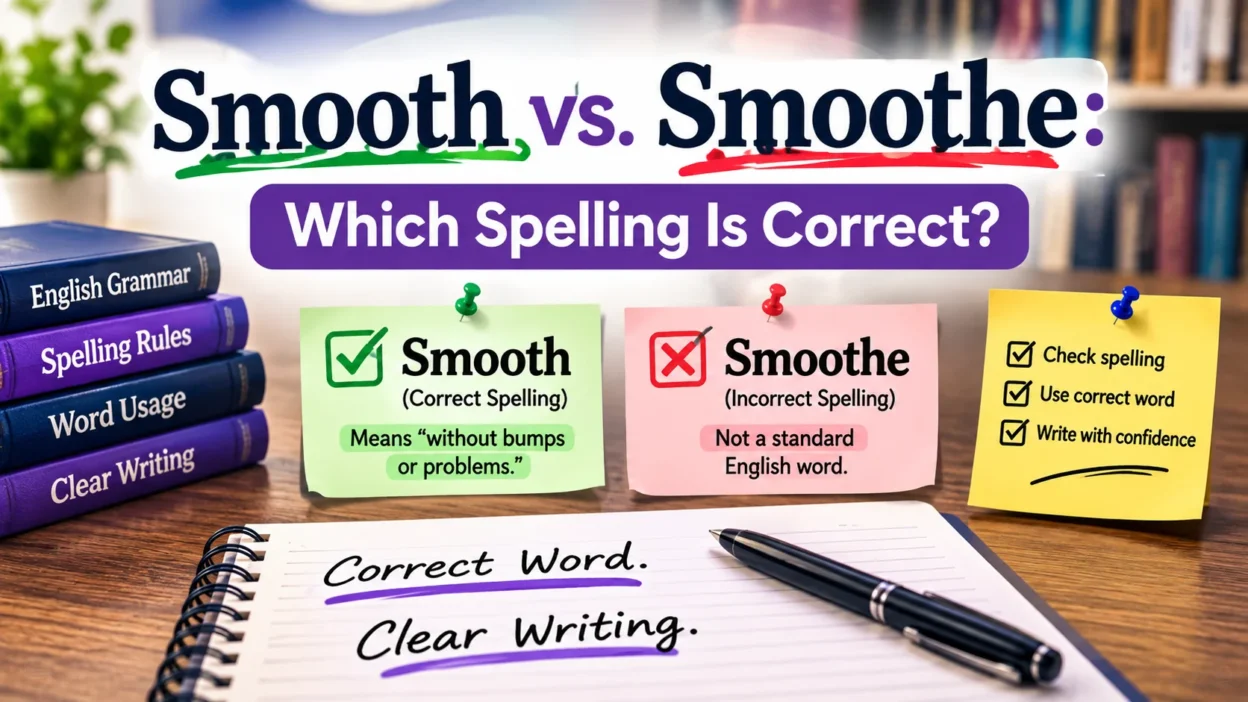
The phrase Smooth vs. Smoothe often causes spelling confusion because English has many familiar spelling patterns. The correct spelling is smooth, while smoothe is an incorrect spelling and nonstandard spelling. The standard spelling in standard English is smooth, a word that has different word forms and grammatical roles. English words such as breathe, clothe, and bathe contain a silent e, which can make you expect an extra e after smooth. However, that spelling pattern doesn’t apply here. The word ending, ending with silent e, silent letters, pronunciation, and pronunciation patterns can all contribute to the confusion, but they don’t change the accepted spelling distinction.
The difference becomes easier to understand when you focus on meaning, usage, and grammatical function. Smooth works as both an adjective and a verb. As an adjective, it can describe a smooth surface, smooth ride, or smooth fabric, including a surface, fabric texture, or ride experience. As a verb, smooth functions as an action verb, as in smooth a piece of fabric. These examples show smooth as an adjective, smooth as a verb, and how smooth works as both an adjective and a verb. In a noun phrase, expressions such as smooth surface, smooth ride, and smooth fabric show normal adjective usage, while an action such as smoothing fabric shows verb usage and action word use. No extra letter or letter e is needed.
The confusion can also come from exposure to nonstandard forms in online communication and everyday English. A useful spelling rule is to avoid assuming that every familiar pattern works the same way in every English word. The standard usage is smooth, and the correct usage keeps the spelling simple. In my experience, it’s easier to remember the written form by linking it with familiar examples such as smooth surface, smooth ride, and smooth fabric. Once you understand the semantic context, spelling exposure, grammatical distinction, and spelling distinction, you can recognise the difference, write with confidence, and avoid confusion more easily.
Quick Answer: Smooth vs. Smoothe
Smooth is the standard and correct spelling. Smoothe is not the standard spelling for ordinary modern English.
You can use smooth as an adjective:
The table has a smooth surface.
You can also use smooth as a verb:
Please smooth the paper before folding it.
Its other forms include:
- smooth
- smooths
- smoothed
- smoothing
- smoothly
- smoothness
The basic rule is simple: don’t add an e to smooth.
| Word | Correct Standard Form? | Example |
| smooth | Yes | The fabric feels smooth. |
| smoothed | Yes | She smoothed the wrinkles. |
| smoothing | Yes | He is smoothing the surface. |
| smoothly | Yes | The machine runs smoothly. |
| smoothness | Yes | I like the smoothness of the material. |
| smoothen | Yes, but less common | The process may smoothen the surface. |
| smoothe | No as the standard spelling | Use smooth instead. |
Smooth vs. Smoothe: What’s the Difference?
The main difference is straightforward: smooth is the established standard spelling, while smooth isn’t the form you should normally use in standard English.
Smooth has several meanings. It can describe something physically even, such as skin, glass, paper, or wood. It can also describe movement that doesn’t involve sudden changes, such as a smooth landing or smooth acceleration.
The word goes beyond physical descriptions, too. You can have a smooth process, a smooth conversation, or a smooth transition. In these cases, the word suggests that something happens easily and without unnecessary interruptions.
As a verb, smooth means to make something even, flat, calm, or easier. For example, you can smooth fabric, smooth your hair, or smooth over an argument.
The spelling doesn’t change to smooth simply because you’re using the word as a verb.
The Correct Spelling: Why “Smooth” Is the Standard Form
The word smooth already functions naturally as a verb.
Consider these examples:
- Smooth the edges.
- Smooth the paper.
- Smooth your hair.
- Smooth the surface.
- Smooth over the disagreement.
Adding an e doesn’t make any of these sentences more correct.
This is an important point about English spelling. A verb doesn’t need a final e simply because other English verbs have one.
Compare:
- smooth
- help
- wash
- clean
- paint
- fold
These are all verbs. Some end with e, while others don’t.
English spelling contains many historical patterns and exceptions. You can’t always create a new spelling by copying the structure of another word.
Why English Doesn’t Add a Silent E Here
The spelling confusion becomes understandable when you compare smooth with words such as breathe, clothe, and bathe.
These words do have a final e. However, English spelling isn’t built from one universal formula. A spelling pattern that works for one group of words may not apply to another.
For example:
- breathe comes from breath
- clothe relates to cloth
- bathe relates to bath
The final e has a role in these established spellings. That doesn’t mean you should attach e to every word that looks vaguely similar.
Smooth has its own standard spelling. The word has been used without a final e for centuries, and modern English has retained that form.
A useful way to think about it is this: English spelling is more like a historical map than a perfectly engineered road system. Some paths make sense because of old language changes rather than modern logic.
Where the Confusion Comes From
Several things can make smooth look convincing.
One reason is analogy. You may know words such as breathe and clothes, so your brain naturally looks for the same pattern smoothly.
Another reason is the role of verbs. Many familiar verbs end in e, including move, write, close, and change. That can create the impression that adding e makes a word look more like an action.
It doesn’t.
Online exposure can also reinforce unusual spellings. If you see smoothed repeatedly in informal writing, advertising, social media, or product names, the form may begin to look familiar. Familiarity isn’t proof of standard usage.
Finally, some businesses and brands intentionally alter ordinary words to create distinctive names. A stylized spelling can exist as a name without becoming the standard spelling in general English.
What Does “Smooth” Mean?
The word smooth has a broad range of meanings. Most of them connect to a central idea: something is even, flowing, effortless, or free from roughness and interruption.
That basic idea works in both physical and figurative situations.
Smooth as an Adjective
As an adjective, smooth can describe a physical object, movement, process, personality, sound, taste, or experience.
Smooth Physical Texture or Surface
The most familiar meaning describes something that feels even rather than rough.
Examples include:
- smooth skin
- smooth glass
- smooth wood
- smooth paper
- smooth fabric
- a smooth stone
- a smooth road
If you touch a polished table and don’t feel bumps or rough patches, you can describe its surface as smooth.
For example:
The carpenter sanded the wood until it felt smooth.
The opposite of smooth in this sense is usually rough.
A surface doesn’t have to be perfectly flawless to be called smooth. In everyday language, the word simply tells the reader that the texture feels even and relatively free from roughness.
Smooth Movement or Motion
Smooth can also describe movement that happens without sudden jerks, bumps, or interruptions.
Think about a car that accelerates gradually instead of suddenly. You might call its movement smooth.
Common examples include:
- a smooth ride
- a smooth landing
- smooth acceleration
- smooth movement
- a smooth transition
- smooth motion
For example:
The pilot made a smooth landing despite the strong wind.
The word describes the quality of the action rather than the physical texture of an object.
Smooth Process or Experience
Now the meaning becomes more abstract.
A process can be smooth when it happens easily and without major problems. You might describe a trip, project, application, meeting, or business transaction as smooth.
For example:
The move went smoothly because everyone followed the plan.
You could also say:
- The hiring process was smooth.
- The transition was smooth.
- The project had a smooth launch.
- The conversation was smooth.
- The handoff was smooth.
Here, smooth suggests a lack of friction. Nothing significant gets in the way.
Smooth Style, Quality, or Performance
The word can describe something that feels polished or well controlled.
You might hear:
- a smooth performance
- a smooth presentation
- a smooth voice
- smooth writing
- a smooth musical arrangement
- a smooth delivery
For example:
Her presentation was smooth and confident.
This doesn’t mean the presentation had a physical texture. Instead, it means the speaker moved through the material naturally without awkward pauses or obvious difficulty.
Smooth Social Behavior
Smooth can describe a person who seems confident, charming, persuasive, or socially skilled.
For example:
He’s a smooth talker who knows how to make people feel comfortable.
This meaning can carry either a positive or slightly negative tone.
Calling someone smooth may suggest that they’re charming and confident. In another context, it may imply that they’re overly practiced or even somewhat manipulative.
Context does the heavy lifting.
Smooth as a Verb
As a verb, smooth means to make something smooth or smoother.
You can use it for physical surfaces:
Smooth the edges with sandpaper.
You can also use it for clothing:
She smoothed the wrinkles from her dress.
The verb has several figurative uses, too. You can smooth out a problem, smooth a process, or smooth over a disagreement.
This flexibility makes smooth a particularly useful English word.
Common Verb Uses of “Smooth”
Here are some common constructions:
- smooth the surface
- smooth the edges
- smooth the fabric
- smooth your hair
- smooth the paper
- smooth out a problem
- smooth out differences
- smooth the process
- smooth someone’s path
- smooth over an argument
Notice something important: none of these requires smoothe.
How to Conjugate “Smooth” as a Verb
Once you understand that smooth is the verb, its forms are easy to remember.
| Verb Form | Correct Form | Example |
| Base form | smooth | Please smooth the surface. |
| Third-person singular | smooths | She smooths the fabric. |
| Past tense | smoothed | He smoothed the paper. |
| Past participle | smoothed | The surface has been smoothed. |
| Present participle | smoothing | They are smoothing the edges. |
Why “Smoothing” and “Smoothed” Don’t Become “Smoothe”
The spelling becomes even clearer when you look at the related forms.
The pattern is:
smooth → smoothed → smoothing
Not:
smoothe → smoothed → smootheing
The base form remains smooth.
When you add -ed, you get smoothed. When you add -ing, you get smoothing.
This gives you a useful spelling shortcut. If you’re unsure whether the base verb needs an e, look at its common forms. The standard family consistently points back to smooth.
Conclusion
The correct spelling is smooth, not smoothe. Smooth can work as both an adjective and a verb, so you don’t need to add an extra e. Although words such as breathe, clothe, and bathe use a silent e, smooth follows a different spelling pattern. Remembering the standard form will help you avoid common spelling mistakes and write more confidently.
FAQs
Q1.Is smooth or smoothe correct?
Smooth is the correct standard spelling. Smooth is generally considered a nonstandard or incorrect spelling.
Q2.Is smooth a word?
Smoothe may appear in nonstandard writing or as an uncommon historical form, but you should use smooth in modern standard English.
Q3.Can smooth be a verb?
Yes. Smooth can be a verb meaning to make something even, flat, or less rough. For example: “She smoothed the fabric.”
Q4.Can smooth be an adjective?
Yes. Smooth is commonly used as an adjective to describe something even, soft, flowing, or without roughness. For example: “The table has a smooth surface.”
Q5.Why do people spell smooth as smoothe?
The mistake often comes from familiar English spelling patterns. Words such as breathe, clothe, and bathe end in silent e, which can make smooth look logical. However, the standard spelling is smooth.