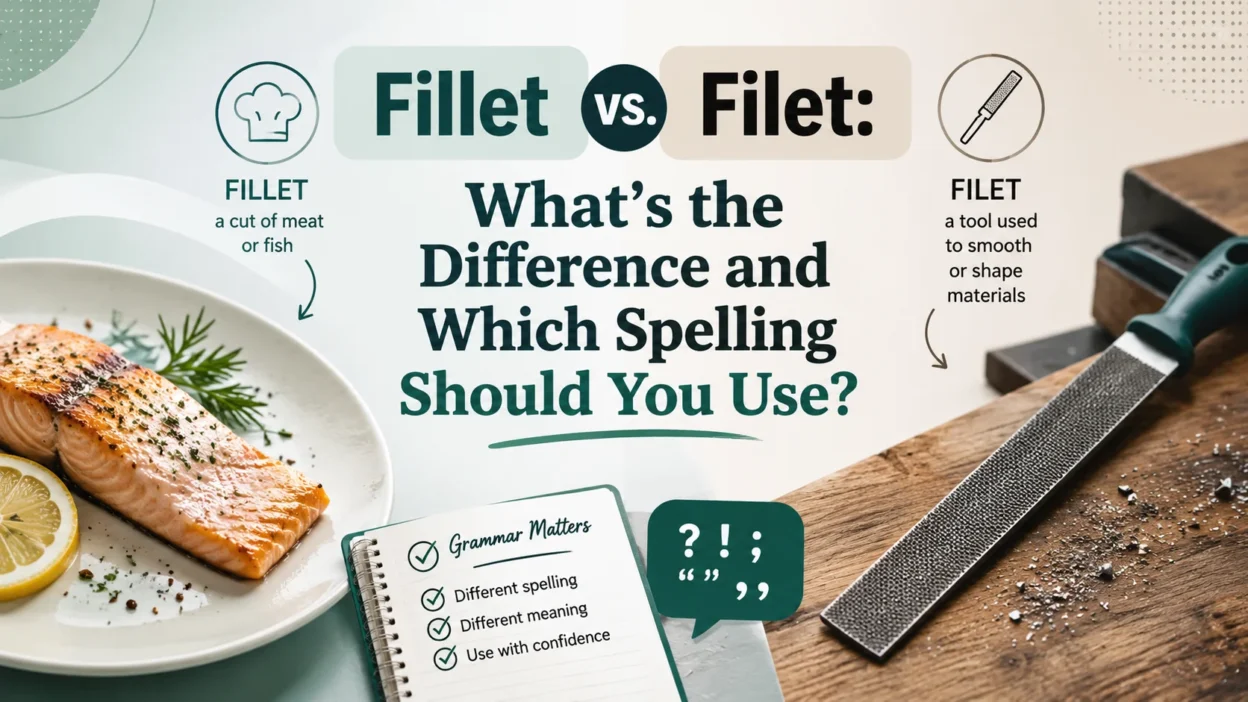
The difference between Fillet vs. Filet becomes easier to understand when you focus on pronunciation, regional spelling, and established culinary usage instead of searching for a strict grammar rule. In British English, fillet is the standard form for a piece of meat or piece of fish, while American English commonly favours filet in several culinary contexts. Although both forms have overlapping meanings, the regional difference affects everyday English, particularly when people discuss different cuts, fish fillets, a fish fillet, or filet magnon. In the UK, fillet is pronounced “FILL-it,” whereas filet in the US is commonly pronounced “phi-LAY.” This difference may appear in everyday cooking, a grocery store, or an American steakhouse, where filet is a familiar American culinary term.
The main differences become clearer when you consider how each culinary term appears in real situations. Fillet can describe a boneless cut of meat or fish, referring to a piece from which the bones have been removed. Filet, meanwhile, is particularly familiar as an American culinary term, especially in names such as filet magnon. You might see filet on a menu, in a recipe, or at an American steakhouse, while British English generally uses fillet for the same general idea. This regional pattern makes the spelling easier to remember because the use depends largely on where you are and what kind of cooking you are discussing. A short answer to many spelling questions is to favour the form your audience expects instead of trying to follow a rigid grammar rule.
Both forms are accepted, and you can write naturally by choosing the spelling that fits your variety of English and the culinary context. The words fillet and filet may sound alike, but their meaning is generally understood from context. Words can act like keys that unlock different meanings and nuances in the vast world of language, and this pair shows how similar terms can develop different usage without becoming completely unrelated. Their use across casual conversations, professional settings, and different culinary traditions explains why the distinction matters when ordering food at a restaurant, writing a recipe, or speaking with a native speaker. Understanding the difference can improve your vocabulary and communication skills while helping you avoid a culinary mix-up or misunderstanding. It isn’t about impressing dinner guests or winning a spelling bee; it is about keeping your writing clear and simple. When talking about a boneless piece of meat or fish, remember that fillet is especially common in British usage, while filet is strongly associated with American usage. Preferred usage ultimately depends on your audience and context.
What Does “Thanks for Letting Me Know” Mean?
“Thanks for letting me know” means “Thank you for telling me” or “I appreciate you giving me this information.”
The expression focuses on the act of communicating information rather than the information itself.
For example:
“The store closes at 5 today.”
“Thanks for letting me know. I’ll go before then.”
The speaker appreciates being informed because the information helps them decide what to do next.
You can use the phrase when someone:
- Gives you an important update
- Tells you about a schedule change
- Warns you about a problem
- Shares new information
- Explains something you didn’t know
- Informs you about a delay
- Gives you advance notice
What “Thanks for Letting Me Know” Conveys
The phrase usually communicates three ideas:
- Acknowledgment — You received the information.
- Appreciation — You’re grateful that the person told you.
- Awareness — You now know something you didn’t know before.
That’s why it often works better than simply saying “Okay.”
Compare:
“The deadline has changed to Friday.”
“Okay.”
This acknowledges the message.
Now compare:
“The deadline has changed to Friday.”
“Thanks for letting me know.”
The second response acknowledges the information while also showing appreciation.
Why Is “Thanks for Letting Me Know” Grammatically Correct?
The grammar becomes easy to understand when you break the expression into parts:
Thanks + for + letting me know
The word “for” is a preposition. In this construction, it is followed by the -ing form of the verb.
That gives you:
- Thanks for helping me.
- Thanks for calling.
- Thanks for waiting.
- Thanks for checking.
- Thanks for letting me know.
You wouldn’t say:
“Thanks for help me.”
Likewise, “Thanks for let me know” isn’t correct.
The phrase “letting me know” functions as a gerund phrase that explains what you’re thankful for.
Why Is It “Letting Me Know” and Not “Letting Me Knew”?
This is another common point of confusion.
The correct version is:
Thanks for letting me know.
Not:
Thanks for letting me know.
The reason comes from the structure let + object + base verb.
Examples include:
- Let me know.
- Let her choose.
- Let him go.
- Let them decide.
The verb following the object remains in its base form.
Therefore:
let + me + know
is correct.
Even when the action happened in the past, know doesn’t become knew:
She let me know yesterday.
Not:
She let me know yesterday.
The word “yesterday” establishes the past tense. It doesn’t change the base verb inside the expression “let me know.”
Is “Thanks for Letting Me Know” Formal or Informal?
“Thanks for letting me know” is generally casual to neutral. It isn’t slang, and it isn’t considered unprofessional simply because it uses “thanks.”
However, “Thank you for letting me know” sounds slightly more formal.
Compare:
Thanks for letting me know. I’ll update my calendar.
and:
Thank you for letting me know. I’ll update my calendar accordingly.
Both are correct. The second simply has a more polished tone.
When to Use “Thanks for Letting Me Know”
The phrase works particularly well with:
- Friends
- Family
- Coworkers
- Familiar clients
- Workplace messaging
- Casual emails
- Text messages
- Everyday conversations
For example:
“The manager moved our meeting to Friday.”
“Thanks for letting me know. I’ll change it on my calendar.”
That’s completely natural.
When “Thank You for Letting Me Know” Is Better
Use “Thank you for letting me know” when you want to sound more formal, respectful, or professional.
It can work well when speaking with:
- Clients
- Customers
- Supervisors
- Teachers
- Unfamiliar professional contacts
- People you’re addressing in a formal setting
For example:
Thank you for letting me know. I’ll review the updated schedule and follow up tomorrow.
This sounds professional without being unnecessarily stiff.
Can “Thanks for Letting Me Know” Be Used for Bad News?
Absolutely.
This is one of the most useful features of the expression.
You’re thanking someone for communicating the information, not necessarily for the news itself.
For example:
“Unfortunately, your order won’t arrive until next week.”
“Thank you for letting me know. I’ll make other arrangements.”
The speaker isn’t happy about the delay. They’re simply acknowledging that the other person provided useful information.
The same principle works with workplace problems:
“The report has an error that needs to be corrected.”
“Thanks for letting me know. I’ll fix it this afternoon.”
The expression remains polite because it recognizes the value of being informed.
“Thanks for Letting Me Know” vs. “Thanks for the Update”
These expressions overlap, but they’re not always interchangeable.
“Thanks for letting me know” focuses on the act of telling you something.
“Thanks for the update” usually focuses on new information about an ongoing situation.
For example:
“The meeting is now at 3 p.m.”
Thanks for letting me know.
But:
“The project is 70% complete, and we’re starting testing next week.”
Thanks for the update.
The difference is subtle. Both expressions are natural, but the context determines which sounds better.
“Thanks for Letting Me Know” vs. “Thanks for Telling Me”
Both phrases are correct.
However, “let me know” often sounds a little softer and more conversational than “tell me.”
Compare:
Thanks for telling me what happened.
with:
Thanks for letting me know what happened.
Both work perfectly well.
Similarly:
Tell me when you’re ready.
can sound more direct than:
Let me know when you’re ready.
That’s one reason “let me know” appears so frequently in friendly and professional communication.
Common Mistakes to Avoid
This section highlights the most common errors people make and explains how to avoid them for clearer, more accurate writing.
“Thanks for Let Me Know”
Incorrect:
Thanks for letting me know.
Correct:
Thanks for letting me know.
After for, this construction requires the -ing form.
“Thanks for Letting Me Knew”
Incorrect:
Thanks for letting me know.
Correct:
Thanks for letting me know.
After let + object, English uses the base form of the verb.
“Thanks for Letting I Know”
Incorrect:
Thanks for letting me know.
Correct:
Thanks for letting me know.
I is a subject pronoun, while me is an object pronoun.
Compare:
I know the answer.
but:
Please let me know the answer.
The same principle applies to “letting me know.”
Alternatives to “Thanks for Letting Me Know”
Different situations call for different levels of formality.
| Expression | Tone | Best use |
| Thanks for letting me know. | Casual/neutral | Everyday communication |
| Thank you for letting me know. | Neutral/professional | Emails and workplace communication |
| Thanks for the update. | Neutral | New information |
| Thanks for telling me. | Casual | Direct conversations |
| Thanks for the heads-up. | Informal | Warnings or advance notice |
| I appreciate you letting me know. | Warm | Important information |
| Thank you for informing me. | Formal | Formal correspondence |
| Thank you for bringing this to my attention. | Professional | Problems or concerns |
| Thanks for keeping me posted. | Friendly | Ongoing updates |
The most natural alternative isn’t always the most formal one. Good communication depends on matching the wording to the relationship and situation.
Is “Thanks for Letting Me Know” Professional?
Yes. “Thanks for letting me know” can be completely professional.
For example:
Thanks for letting me know. I’ll review the document and send the corrected version this afternoon.
There’s nothing unprofessional about this sentence.
However, if you’re writing to a client or someone you don’t know well, you may prefer:
Thank you for letting me know. I’ll review the document and follow up shortly.
The difference is mainly tonal.
Professional writing doesn’t require unnecessarily complicated language. In many cases, clear and natural wording sounds more confident than stiff formal language.
Can “Thanks for Letting Me Know” Sound Sarcastic?
Yes, but the phrase itself isn’t sarcastic.
Context can change how the reader interprets it.
For example:
“The restaurant is closed.”
“Oh, thanks for letting me know after we drove an hour to get here.”
Here, the speaker probably isn’t expressing genuine gratitude. They’re criticizing the fact that the information came too late.
If you want to avoid any possible misunderstanding in writing, add context:
Thanks for letting me know. I’ll take care of it.
Or:
Thank you for the update. I appreciate you keeping me informed.
The additional wording makes the intended tone clearer.
Examples of “Thanks for Letting Me Know”
Examples of “Thanks for Letting Me Know” show how this polite and natural phrase is used in everyday conversations, emails, and professional situations to acknowledge information with appreciation.
Workplace
“The client moved tomorrow’s meeting to 2 p.m.”
“Thanks for letting me know. I’ll update the calendar.”
“Thanks for letting me know. I’ll review the revised schedule and confirm my availability tomorrow.”
Text Message
“We’re running about 20 minutes late.”
“Thanks for letting me know. I’ll wait here.”
Schedule Change
“The appointment has been moved to Wednesday.”
“Thank you for letting me know. Wednesday works for me.”
Important Information
“The deadline has been extended until Friday.”
“Thanks for letting me know. I’ll submit everything by Thursday.”
These examples show an important communication habit: acknowledge the information and, when necessary, explain what you’ll do next.
Final Verdict
“Thanks for letting me know” is correct, natural, and polite.
It’s one of the most useful expressions for acknowledging information in American English.
The grammar follows two important patterns:
Thanks + for + -ing
and:
let + object + base verb
Together, they produce:
Thanks for letting me know.
Remember these common distinctions:
- Thanks for letting me know — casual to neutral
- Thank you for letting me know — neutral to professional
- Thanks for the update — useful for new information
- Thanks for the heads-up — informal and useful for warnings
- I appreciate you letting me know — warmer and more appreciative
- Thank you for informing me — more formal
Most importantly, don’t overthink the phrase. When someone gives you information, “Thanks for letting me know” is a natural way to show that you’ve heard them and appreciate the communication.
Conclusion
The difference between fillet and filet is mainly a matter of regional spelling, pronunciation, and culinary usage. Fillet is more common in British English, while filet is widely used in American English, especially in terms such as filet magnon. Both words can refer to a boneless piece of meat or fish, so neither spelling is automatically wrong. When writing or speaking, simply choose the form that fits your audience, region, and context.
FAQs
Q1. What is the main difference between fillet and filet?
The main difference is regional usage and pronunciation. Fillet is more common in British English and is usually pronounced “FILL-it,” while filet is common in American English and is often pronounced “phi-LAY.”
Q2. Is fillet or filet correct?
Both are correct. The preferred spelling depends on the variety of English and the culinary context. British English generally favours fillet, while American English often uses filet.
Q3. Is filet only used for steak?
No. Filet can refer to a boneless cut of meat or fish. However, American culinary usage makes the word especially familiar in filet magnon, which refers to a particular cut of beef.
Q4. Why does British English use fillet while American English uses filet?
The two spellings developed through different patterns of English and French influence. Over time, fillet became the usual British form, while filet became common in American culinary vocabulary.
Q5. How do you pronounce fillet and filet?
In common British usage, fillet is pronounced “FILL-it.” In common American usage, filet is pronounced “fi-LAY.” The pronunciation can help you identify which regional form is being used.