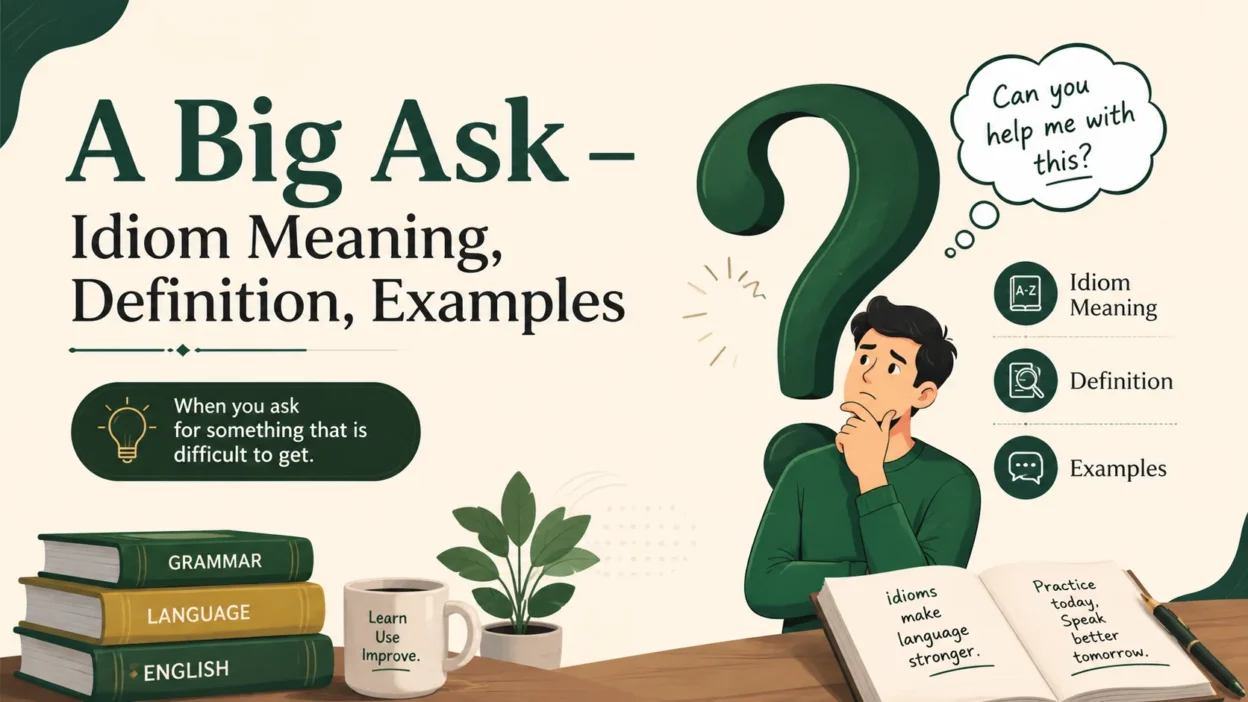
A Big Ask describes a request that may seem simple at first but becomes difficult when you consider what is involved. For example, a coworker may ask you to check a paragraph, which is usually easy, but asking you to rewrite an entire report overnight is a different story. The expression is an idiom used for a demand or expectation that requires a lot from someone. It can describe something difficult to achieve, such as a major favour, an ambitious deadline, an unlikely result, or a heavy responsibility placed on a person. The phrase is common in everyday conversations, workplaces, sports, and business discussions, especially when something feels challenging, demanding, inconvenient, ambitious, or even impossible.
For example, John and his project team may have a deadline just around the corner, so he could propose that everyone double their efforts to meet the target. That tough request might create mixed reactions in the room, because the big ask could involve a large favour or a difficult task that cannot be accomplished easily. If a friend asks you to help move their entire house in one day, the job may seem small, but the significant effort and sacrifice can make it a big ask. From my experience with everyday English, this is where you can recognise the difference between an ordinary favour and something very difficult. The task may require a lot of effort, be not easily accomplished, or be too hard to handle.
When requesting something large, it helps to believe the other person can do it while being honest that it won’t be easy. A favour can be large without being impossible, and a task can be difficult without being impossible to achieve. What matters is whether the expectation can be fulfilled and what the request may entail. Calling something a big ask does not always mean refusing it; instead, it signals that the task is quite demanding, that the person may need to make a significant effort, and that the result may not be easily achieved.
What Does “A Big Ask” Mean?
“A big ask” describes a request that requires significant effort, time, help, or sacrifice from someone. It’s often used to politely acknowledge that a favor or task may be difficult or inconvenient. For example, asking a coworker to finish an important project over the weekend could be a big ask.
The Basic Definition of the Idiom
A big ask means a difficult request or a demanding expectation. It describes something that requires considerable effort, time, sacrifice, skill, money, or commitment from someone.
In simple terms, if you ask someone to do something that is a lot to expect, you can call it a big ask.
For example:
“I know it’s a big ask, but could you finish the presentation by tomorrow morning?”
The speaker isn’t necessarily saying the task is impossible. Instead, they’re admitting that the deadline is tight and the other person will have to make a serious effort.
The expression can describe both requests made to people and outcomes that seem difficult to achieve.
| Situation | Example | Why It’s a Big Ask |
| Work | Finish a 30-page report overnight | Requires significant time and effort |
| Friendship | Drive several hours to help someone | Requires time and inconvenience |
| Sports | Overcome a large deficit | Requires an unlikely comeback |
| Business | Launch a product in two weeks | Requires fast execution |
| Personal goals | Learn a complex skill in a few days | Requires more time than usual |
| Negotiation | Accept a major concession | Demands a lot from the other side |
The key idea is scale. The request may be reasonable in theory, yet unusually demanding in practice.
What Does “That’s a Big Ask” Mean?
When someone says “That’s a big ask,” they’re usually commenting on the size or difficulty of a request.
Consider this conversation:
Maya: “Could you drive me to the airport at 3 a.m. and pick me up again Sunday night?”
Jordan: “That’s a big ask.”
Jordan isn’t necessarily refusing. The response simply acknowledges that the favor requires a substantial commitment.
Depending on the speaker’s tone, “That’s a big ask” can communicate several things:
- Recognition: “I understand that this is difficult.”
- Hesitation: “I’m not sure I can do this.”
- Polite resistance: “You’re asking more than I’m comfortable giving.”
- Surprise: “I didn’t expect you to ask for something this demanding.”
- Respect for the challenge: “This will be difficult, but it might be possible.”
Context matters. A friendly smile can make the phrase sound lighthearted. A serious tone can make it sound like a polite warning that the request may be rejected.
“A Big Ask” vs. “A Difficult Request”
These expressions overlap, but they don’t always carry the same feeling.
A difficult request focuses directly on the difficulty of what someone wants. A big ask often adds a sense that the request places a substantial burden on the person being asked.
Compare these examples:
- “That’s a difficult request.” — More formal and direct.
- “That’s a big ask.” — More conversational and natural.
- “That’s a lot to ask.” — Similar meaning with a slightly more personal feel.
- “That’s a tall order.” — Emphasizes that the task is especially demanding.
For everyday conversations, “a big ask” and “a lot to ask” often sound more relaxed than “a difficult request.”
Is “A Big Ask” Positive, Negative, or Neutral?
The expression itself is neutral, but the context and tone determine its emotional effect.
A person might say:
“Winning the championship after losing the first three games is a big ask, but this team has done it before.”
Here, the phrase acknowledges a serious challenge without ruling out success.
In another situation:
“Asking employees to work every weekend for three months is a big ask.”
This sentence sounds more critical. The speaker suggests that the demand may be unreasonable or unfair.
So, a big ask doesn’t automatically mean a bad request. It simply tells the listener that the request requires more than usual.
“A Big Ask” Meaning in Different Contexts
The expression becomes clearer when you see how people use it in different situations. The same phrase can describe a favor between friends, a workplace deadline, or a difficult sporting challenge.
When Someone Requests Too Much
Imagine that your friend asks to borrow your car for two weeks while they’re away. If you depend on that car every day, you might say:
“That’s a big ask. I need my car for work.”
The phrase doesn’t necessarily accuse your friend of being unreasonable. It simply recognizes that the request creates a significant burden.
The same idea applies to requests involving:
- Money
- Time
- Transportation
- Personal commitments
- Professional responsibilities
- Emotional support
- Physical effort
The larger the sacrifice, the more naturally a big ask fits.
When a Request Requires Significant Time or Effort
Some requests become big asks because of the work involved.
For example:
“Could you review all 200 pages before the meeting tomorrow?”
That’s clearly more demanding than:
“Could you check this one-page summary?”
The first request may require hours of concentrated attention. Calling it a big ask signals that the speaker understands the effort involved.
This is one reason the phrase works well in professional communication. It allows someone to acknowledge the burden without immediately rejecting the request.
When Someone Wants an Unlikely Favor
A request can also become a big ask because it requires someone to make a major personal sacrifice.
For example:
“I’m asking my brother to move across the country to help with the family business. I know that’s a big ask.”
The challenge isn’t simply the number of hours involved. The request could affect the person’s career, relationships, home, and long-term plans.
Here, a big ask captures the seriousness of the situation in just three words.
When a Goal Is Difficult but Still Possible
The expression can describe an expected result rather than a direct request.
For example:
“The team needs to score four goals in the final ten minutes. That’s a big ask.”
Nobody may have formally asked the players to do this. Instead, the speaker is describing the difficult outcome they need to achieve.
This broader use is important because a big ask doesn’t always mean someone is literally asking a question or making a favor request.
It can also mean a demanding expectation or difficult objective.
Examples of “A Big Ask” in Everyday Conversations
The best way to understand an idiom is to watch it work in natural sentences.
Asking a Friend for a Major Favor
“I know it’s a big ask, but could you watch my dog for two weeks?”
“Moving all my furniture in one afternoon is a big ask.”
“It might be a big ask, but could you pick me up from the airport?”
These examples show how the phrase can soften a request. By admitting that the favor is substantial, the speaker shows awareness of the other person’s time and effort.
Making a Request at Work
“I know it’s a big ask, but can we have the final numbers by Friday?”
“Asking the design team to finish everything today is a big ask.”
“It’s a big ask for one person to manage both projects.”
Workplace conversations often involve competing priorities. Someone may need to acknowledge that a deadline is demanding while still explaining why the task matters.
In that situation, a big ask can sound more tactful than saying:
“You’re asking too much.”
The second version sounds more confrontational. The first leaves room for discussion.
Asking Someone for Extra Time or Help
“Could you stay late tonight? I know that’s a big ask.”
“I’m sorry to make such a big ask at the last minute.”
“It would be a big ask to expect you to solve this problem alone.”
Notice the pattern. The expression often appears alongside phrases such as:
- I know
- I realize
- It might be
- It’s quite
- That’s
- It’s a
These combinations help speakers recognize the difficulty of a request.
Talking About a Difficult Goal
“Winning three games in five days is a big ask.”
“Reaching that target this quarter will be a big ask.”
“Turning the company around in six months is a big ask.”
Here, the phrase focuses on the challenge itself rather than the person making the request.
“A Big Ask” Examples in Sentences
Here are more examples that show how naturally the expression fits different situations:
- It’s a big ask, but we need everyone to meet the deadline.
- Asking her to relocate for the job would be a big ask.
- That was a big ask for a team playing with only ten players.
- I know it’s a big ask, but could you help me move this weekend?
- Expecting the project to succeed without additional funding is a big ask.
- That’s a big ask from someone who has already worked twelve hours today.
- Finishing the entire renovation before the holidays will be a big ask.
- It may be a big ask, but the goal isn’t impossible.
- Asking customers to pay more without adding value is a big ask.
- Coming back from a four-goal deficit is certainly a big ask.
“That’s a Big Ask” – Meaning and Usage
The sentence “That’s a big ask” is one of the most common forms of the expression.
It usually appears as a reaction to something someone has requested or proposed.
What “That’s a Big Ask” Really Implies
When you hear “That’s a big ask,” don’t automatically interpret it as “No.”
The speaker may be saying:
“I understand what you’re asking, but this will require a lot from me.”
That distinction matters.
For example:
Manager: “Could you prepare the report by Monday?”
Employee: “That’s a big ask, but I’ll see what I can do.”
The employee recognizes the difficulty without refusing.
However:
Manager: “Could you prepare the report by tonight?”
Employee: “That’s a big ask.”
Here, the same words might imply that the deadline is unrealistic.
The expression therefore leaves some room for interpretation. Tone, facial expression, and context do much of the heavy lifting.
How the Phrase Can Sound Depending on Tone
| Tone | Possible Meaning |
| Friendly | This is difficult, but let’s see what we can do. |
| Concerned | I’m worried this may be unrealistic. |
| Sarcastic | You’re asking for far too much. |
| Respectful | I understand the sacrifice involved. |
| Hesitant | I’m not sure I can agree. |
| Critical | This expectation is unreasonable. |
Because of this flexibility, a big ask works in casual conversations as well as professional discussions.
Polite Ways to Respond to a Big Ask
If someone makes a substantial request, you have several options.
If you agree:
“It’s a big ask, but I’ll do my best.”
If you need more information:
“That’s a big ask. Can we talk about what’s involved?”
If you need more time:
“I understand the urgency, but that’s a big ask on such short notice.”
If you can’t help:
“I know this is important, but that’s more than I can take on right now.”
If you want to negotiate:
“That’s a big ask. Could we extend the deadline by a few days?”
These responses show why the idiom is useful. It doesn’t force the conversation into a simple yes-or-no situation.
How to Say “No” to a Big Ask Without Sounding Rude
Sometimes the best response is a polite refusal.
Instead of:
“You’re asking too much.”
Try:
“I understand why you need help, but that’s a big ask for me right now.”
Or:
“I’d like to help, but I don’t have the time to take that on.”
This approach separates the request from the person. You aren’t attacking the person for asking. You’re explaining why you can’t meet the request.
That’s especially useful at work, where direct communication matters but relationships still count.
“A Big Ask” Examples in the Workplace
The workplace provides plenty of situations where this expression fits naturally.
Requests From a Manager or Coworker
A manager might say:
“I know it’s a big ask, but could you lead the client presentation tomorrow?”
This wording acknowledges that the employee may need to prepare quickly.
A coworker might say:
“It’s a big ask, but could you cover my shift this weekend?”
Again, the speaker recognizes that the request creates an inconvenience.
The phrase can therefore function as a kind of social cushion. It shows that the speaker understands the size of the favor.
Asking for a Tight Deadline
Deadlines are another common setting.
Suppose a team normally needs two weeks to complete a project. A client suddenly asks them to finish in three days.
Someone might say:
“Finishing this in three days is a big ask.”
That sentence doesn’t necessarily reject the deadline. It highlights the gap between the usual workload and the new expectation.
The phrase can encourage a realistic conversation about:
- Available staff
- Project scope
- Quality expectations
- Resources
- Priorities
- Risks
- Deadlines
In other words, it can open the door to negotiation.
Requesting Extra Work or Responsibility
Consider an employee who already manages several accounts. Their manager asks them to take on another major client.
The employee might respond:
“I can take it on, but that’s a big ask given my current workload.”
This response is more measured than:
“That’s impossible.”
It communicates concern without closing the discussion.
Asking for a Major Business Favor
Businesses also make big asks of customers, investors, suppliers, and partners.
For example:
“Asking customers to sign a long-term contract after only one meeting is a big ask.”
Or:
“Getting investors to fund the expansion without a proven market is a big ask.”
In these cases, the phrase points to risk and uncertainty as well as effort.
A request becomes a big ask when the other side has to give up something valuable or accept significant uncertainty.
“A Big Ask” in Sports and Competition
Sports commentators use a big ask frequently because competitions often involve difficult targets and unlikely outcomes.
Imagine a soccer team losing 3–0 at halftime. A commentator might say:
“A comeback from this position is a big ask.”
The team still has a chance. The phrase simply recognizes that the odds are against them.
You might also hear:
- “It’s a big ask for the rookie to win against the defending champion.”
- “Chasing that target in the final five overs will be a big ask.”
- “Winning three away games in a week is a big ask.”
- “Keeping a clean sheet against this attack is a big ask.”
The expression fits sports particularly well because the outcome is often uncertain. A difficult task isn’t necessarily an impossible task.
A Simple Sports Case Study
Imagine a basketball team entering the final quarter down by 20 points.
The situation looks like this:
| Factor | Situation |
| Deficit | 20 points |
| Time Remaining | 12 minutes |
| Required Result | Win the game |
| Difficulty | Very high |
| Possibility | Still possible |
A commentator might say:
“Coming back from 20 points down is a big ask, but the game isn’t over.”
That sentence captures the exact meaning of the idiom. The goal is difficult, yet the speaker doesn’t claim it’s impossible.
“A Big Ask” in American English
“A Big Ask” in American English is a common expression used to describe a request that is difficult, demanding, or requires a significant favor or effort from someone.
Is “A Big Ask” Common in American English?
Yes. A big ask is widely understood and used in American English, particularly in sports, business, media, and everyday conversation.
You may encounter it in:
- Workplace conversations
- Sports commentary
- News coverage
- Business writing
- Interviews
- Political discussions
- Personal conversations
- Online communication
It’s especially natural in spoken and informal language.
Is “A Big Ask” Formal or Informal?
A big ask is generally informal to conversational.
It’s perfectly natural in sentences such as:
“That’s a big ask.”
“I know it’s a big ask.”
“Winning this match will be a big ask.”
However, if you’re writing a highly formal document, you might choose a significant request, a substantial demand, or a considerable challenge instead.
The best choice depends on your audience.
| Context | Natural Choice |
| Text to a friend | A big ask |
| Casual workplace conversation | A big ask |
| Sports commentary | A big ask |
| Business meeting | A big ask |
| Formal legal document | A substantial request |
| Academic paper | A considerable challenge |
| Official report | A significant demand |
Still, formal writing doesn’t automatically make the phrase wrong. It simply has a more conversational flavor.
Synonyms and Similar Expressions for “A Big Ask”
Several phrases carry a similar meaning, although each has its own shade of meaning.
A Lot to Ask
A lot to ask is perhaps the closest everyday alternative.
“I know it’s a lot to ask, but could you help me move?”
This sounds personal and direct.
A Tall Order
A tall order describes something difficult to accomplish or achieve.
“Finishing the entire project in one week is a tall order.”
This phrase often focuses more on the difficulty of the task than the burden placed on a person.
A Huge Favor
A huge favor emphasizes the size of a personal favor.
“Could you do me a huge favor and pick up my kids?”
Unlike a big ask, it often sounds warmer and more personal.
A Difficult Request
This is a straightforward and more formal alternative.
“The client made a difficult request.”
It’s clear, but less idiomatic.
A Tough Request
This phrase is conversational and emphasizes difficulty.
“That’s a tough request given the deadline.”
Asking Too Much
This expression is stronger.
“You’re asking too much from the team.”
Unlike a big ask, it can sound openly critical.
A Major Challenge
This focuses on the difficulty of achieving something rather than the act of requesting it.
“Reaching that target will be a major challenge.”
“A Big Ask” vs. Similar Idioms and Phrases
Knowing the differences between similar expressions helps you choose the right one.
| Expression | Main Meaning | Example |
| A big ask | A demanding request or difficult expectation | “Finishing today is a big ask.” |
| A lot to ask | A request requiring significant sacrifice | “It’s a lot to ask of her.” |
| A tall order | A difficult task or demand | “Winning the final will be a tall order.” |
| A long shot | Something unlikely to succeed | “Winning now is a long shot.” |
| Asking too much | Demanding more than is reasonable | “You’re asking too much.” |
“A Big Ask” vs. “A Tall Order”
These phrases often overlap.
“Getting the project done in two days is a big ask.”
“Getting the project done in two days is a tall order.”
Both sentences describe a difficult situation.
The difference is subtle. A big ask often highlights the request or expectation. A tall order usually emphasizes more strongly the difficulty of the task itself.
“A Big Ask” vs. “A Long Shot”
These aren’t interchangeable.
A big ask means something is demanding.
A long shot means something has a low chance of success.
For example:
“Winning the tournament after losing the first two matches is a big ask.”
The goal is difficult.
“Winning the tournament from this position is a long shot.”
The speaker believes success is unlikely.
Something can be both a big ask and a long shot, but the two expressions focus on different aspects of the situation.
“A Big Ask” vs. “Asking Too Much”
The difference often comes down to tone.
“That’s a big ask.”
This sounds relatively diplomatic.
“You’re asking too much.”
This sounds more direct and potentially confrontational.
If you want to raise concerns without creating unnecessary tension, a big ask is often the softer option.
Common Mistakes When Using “A Big Ask”
People often misuse “a big ask” by treating it as a synonym for any ordinary request. The phrase usually suggests that something requires extra effort, time, commitment, or sacrifice. Another common mistake is assuming it always means an unreasonable request; it can simply describe something challenging or demanding.
Confusing a Difficult Request With an Impossible Request
One of the most important points is that a big ask doesn’t necessarily mean an impossible task.
If something is a big ask, it may still be achievable.
“Winning the game from five goals down is a big ask, but it’s not impossible.”
The phrase leaves the door open.
Using the Phrase in the Wrong Context
Because the expression is informal, it may sound out of place in some highly formal writing.
For example, this sounds conversational:
“Completing the investigation in 24 hours is a big ask.”
A formal report might instead say:
“Completing the investigation within 24 hours presents a significant challenge.”
Both are grammatically sound. The difference lies in the register.
Misunderstanding “Ask” as a Noun
In a big ask, the word ask functions as a noun meaning something requested, required, or expected.
Compare:
“I ask you to help.” — Ask is a verb.
“That’s a big ask.” — Ask is a noun.
This distinction is worth remembering because English learners often first encounter ask as a verb. In this idiom, however, it works as a noun.
Overusing the Expression in Formal Writing
If every difficult task becomes a big ask, the phrase can quickly lose its punch.
Use it when the request genuinely involves:
- Significant effort
- A serious time commitment
- A major sacrifice
- A difficult target
- An ambitious expectation
- An unusual level of responsibility
For smaller requests, simpler language works better.
“Could you pass me the salt?”
Calling that a big ask would usually sound humorous or sarcastic because the request is so minor.
The History and Evolution of “A Big Ask”
The exact history of modern idiomatic expressions can be difficult to pin down because spoken language often develops before dictionaries record it.
The word ask, however, has a much older history as a noun. English has long used ask to refer to something requested or demanded. Over time, the expression a big ask developed into a familiar way to describe a request that is unusually demanding.
The phrase is now widely understood in English-speaking contexts and has become especially common in areas where people regularly discuss ambitious goals and difficult expectations.
Sports and business provide natural environments for expression. Sports involve difficult targets, tight deadlines, and unlikely comebacks. Business involves major investments, challenging objectives, and substantial requests. In both settings, a big ask offers a quick way to acknowledge difficulty without declaring failure.
The evolution of the phrase also reflects a broader pattern in English: ordinary words often gain new grammatical roles. Here, ask shifts from a familiar verb to a noun describing the thing being requested.
That gives English speakers a compact expression that communicates a surprisingly large idea.
Why “A Big Ask” Works So Well in Conversation
Language often favors expressions that communicate several ideas at once.
A big ask does exactly that.
When someone says:
“I know it’s a big ask, but I need your help.”
They’re communicating at least two things:
- The request is demanding.
- The speaker knows it’s demanding.
That second point matters.
The speaker isn’t blindly making a request. They’re showing awareness of the other person’s situation.
This is why the expression can sound more considerate than a blunt command:
“Finish this tonight.”
Compare that with:
“I know it’s a big ask, but could we finish this tonight?”
The second version recognizes the burden. It doesn’t guarantee that the listener will agree, but it creates a more respectful starting point.
The phrase also leaves room for negotiation. Perhaps the deadline can move. Maybe the scope can shrink. Additional help might make the task manageable.
In this way, a big ask doesn’t just describe a difficult situation. It can also encourage people to discuss what would make the request realistic.
A Big Ask: Real-World Case Studies
Real-world situations make the meaning of a big ask easier to understand because the phrase often appears when someone faces a demanding request or difficult goal. Whether it’s meeting a tight deadline, helping a friend during a crisis, or making an unlikely comeback in sports, a big ask describes something that requires extra effort, sacrifice, or commitment.
Case Study: The Impossible Deadline That Isn’t Quite Impossible
A marketing team normally needs ten working days to produce a campaign. A client suddenly asks for everything within 48 hours.
The project manager says:
“It’s a big ask, but we can meet the deadline if we reduce the campaign scope.”
Here, the phrase does three jobs.
First, it acknowledges the difficulty. Second, it avoids an immediate refusal. Third, it creates space for negotiation.
The team doesn’t pretend the deadline is normal. Instead, they identify what must change to make the big ask manageable.
Lesson: A big ask often signals that something needs to be adjusted—time, scope, resources, or expectations.
Case Study: The Major Personal Favor
A close friend asks someone to look after their children for an entire week while they deal with an emergency.
The person responds:
“That’s a big ask, but I understand why you need help.”
This example shows the emotional side of the phrase.
The request is substantial, but the relationship and circumstances may make the person willing to help.
Lesson: Calling something a big ask doesn’t always mean rejection. It can express empathy and recognition before offering support.
Case Study: The Sporting Comeback
A team enters the final period of a match far behind its opponent. The players need a remarkable turnaround to win.
A commentator says:
“It’s a big ask from here, but they’ve come back from worse.”
The phrase works perfectly because the team faces a difficult target without being completely eliminated.
Lesson: In sports, a big ask often means a challenging but still possible outcome.
How to Use “A Big Ask” Correctly
The simplest formula is:
It is + a big ask + to + verb
Examples:
“It’s a big ask to finish everything today.”
Another common structure is:
It is + a big ask + for + person or group + to + verb
Examples:
“It’s a big ask for one employee to manage three departments.”
You can also use:
“That’s a big ask.”
Or:
“I know it’s a big ask, but…”
Or:
“That would be a big ask.”
Or:
“It’s a pretty big ask.”
Or:
“It’s a very big ask.”
These structures are natural and flexible.
Quick Usage Guide
| Structure | Example |
| That’s a big ask. | That’s a big ask given the deadline. |
| It’s a big ask to… | It’s a big ask to finish this overnight. |
| It’s a big ask for someone to… | It’s a big ask for her to relocate. |
| I know it’s a big ask, but… | I know it’s a big ask, but could you help? |
| That would be a big ask. | Asking them to change the contract would be a big ask. |
| A big ask from… | That’s a big ask from a new employee. |
Conclusion
“A Big Ask” is a simple way to describe a request that requires a lot of effort, time, responsibility, or sacrifice. You can use it when something feels difficult, demanding, or unlikely to happen easily. Whether the situation involves work, friendships, sports, or everyday conversations, the phrase helps you clearly show that a request is more than an ordinary favour.
FAQs
Q1. What does “a big ask” mean?
“A big ask” means a request that is difficult, demanding, or requires significant effort from someone.
Q2. Is “a big ask” an idiom?
Yes. “A big ask” is a common English expression used to describe a difficult request, favor, or expectation.
Q3. How do you use “a big ask” in a sentence?
You can say, “Finishing the entire project by tomorrow is a big ask.” This means the task is difficult to complete within that time.
Q4. Is “a big ask” positive or negative?
It can be either. The phrase usually highlights that something is difficult, but it does not necessarily mean the request is unreasonable or impossible.
Q5. What is another way to say “a big ask”?
Depending on the context, you can use phrases such as difficult request, major favour, challenging task, demanding request, or significant expectation.