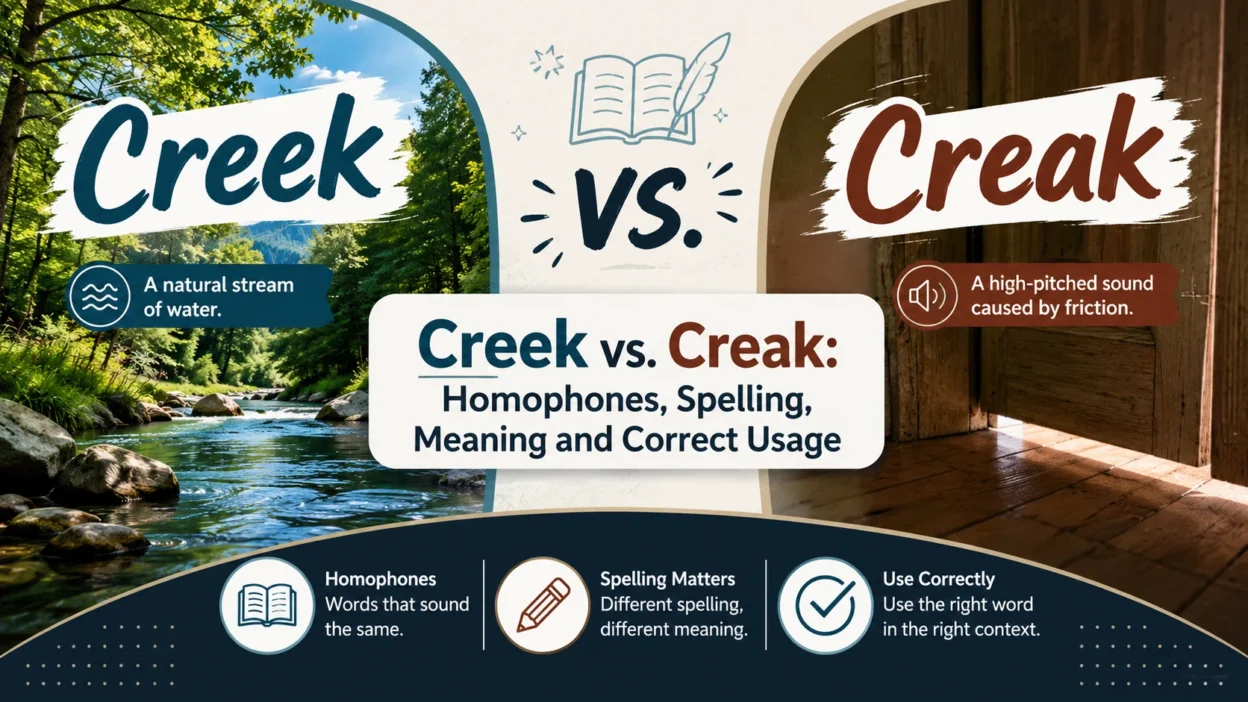
The phrase Creek vs. Creak explains how two words with similar pronunciation can have different meanings and spellings, creating confusion in English language learning. Many writers, students, and English learners struggle with these homophones because they share a similar sound but represent different ideas. A creek describes a natural feature and water source, while a creak refers to a noise or sound effect produced by an object. Learning this word distinction improves vocabulary, grammar, and writing clarity.
A creek connects with nature, flowing water, and a small stream that moves through a landscape. It may appear near a quiet forest, trail, or wooden bridge, creating a peaceful environment with a gentle water stream. In contrast, a creak describes a sharp or squeaky sound caused by movement, pressure, or age. An old structure, old wooden door, or floor surface may create this groaning noise when it experiences strain. Understanding these different uses makes it easier to choose the correct word in writing.
A helpful guide with clear examples explains the difference between creek and creak, including their definitions, parts of speech, and common uses. Knowing when to write creek and when to use creak prevents common confusion and improves accurate writing. These practical examples strengthen communication skills, support language learning, and help readers understand how context, pronunciation, and spelling influence correct word usage in everyday communication.
Creek vs. Creak at a Glance
Before looking at the details, here’s the quickest comparison:
| Word | Pronunciation | Part of Speech | Main Meaning | Example |
| Creek | /kriːk/ | Noun | A small stream or waterway | We walked beside the creek. |
| Creak | /kriːk/ | Verb, noun | A squeaky, harsh, or groaning sound | The old door began to creak. |
In many varieties of American English, creek and creak are homophones. That means they have the same pronunciation but different spellings and meanings.
The spelling is the key. If you’re talking about flowing water, you need creek. If you’re talking about a noise, you need creak.
Think of it this way:
Creek = water.
Creak = sound.
That tiny distinction can save you from a surprisingly common spelling mistake.
Understanding Creek vs. Creak Homophones
Creek and creak are homophones, which means they generally sound the same but have different spellings and meanings. Creek is a noun that usually refers to a small stream or narrow waterway, while creak can be a verb or noun connected to a sharp, squeaky, or harsh sound. For example, you might walk beside a creek, but an old wooden door might creak when you open it.
The easiest way to remember the difference is to connect each word with its meaning: creek = water and creak = sound. Although you can’t always tell the words apart by listening, the surrounding context usually makes the correct spelling clear. If you’re talking about flowing water, choose creek. If you’re describing a noise made by a door, floorboard, staircase, or another object, choose creak.
What Is a Homophone?
A homophone is a word that sounds the same as another word but has a different meaning and often a different spelling.
English has many familiar homophone pairs:
- to / too / two
- there / their / they’re
- right / write
- flower / flour
- sea / see
- brake / break
- creek / creak
Homophones can be tricky because spoken English doesn’t always give you enough information to identify the correct word. When someone says, “I heard a creak,” you can’t determine the spelling from the sound alone. You have to understand the meaning and context.
The same problem appears with creek. If someone says, “We crossed a creek,” the word’s meaning tells you that they are talking about a waterway.
This is why context matters so much when dealing with homophones.
Creek vs. Creak Pronunciation
In standard American English, creek and creak are generally pronounced /kriːk/.
Both words begin with the /k/ sound and contain the long ee vowel sound before ending with another /k/ sound.
You can think of the pronunciation as:
CREEK
Even though the words sound alike, their spellings point to entirely different ideas.
| Word | Sound | Meaning |
| Creek | CREEK | A small stream |
| Creak | CREEK | A squeaky or harsh sound |
Regional accents can affect pronunciation, particularly with the word creek. In some dialects, especially in parts of the United States, creek may be pronounced differently from the standard /kriːk/ form. However, the two words are commonly treated as homophones in American English.
Definitions and Origins of Creek and Creak
The words creek and creak have different histories and developed around different meanings.
Creek refers to a watercourse. In American English, it commonly means a small stream, although its exact size can vary. The word became especially common in North American place names and geographical descriptions.
The term creek also has a regional history. In some parts of the United States, especially areas influenced by local geographical traditions, people use creek for waterways that might elsewhere be called streams or even larger watercourses.
Creak, by contrast, is connected to the idea of producing a sharp or squeaky noise. It commonly describes the sound made by old wood, hinges, floorboards, doors, stairs, and other objects that move or bear weight.
The difference becomes clear when you picture the two words:
- A creek flows through the landscape.
- A door creaks when you open it.
- You might walk beside a creek.
- You might hear a floorboard creak beneath your feet.
The words sound alike, but their meanings live in completely different worlds.
Definition and Usage of Creek
Creek is a noun that usually means a small stream or narrow natural waterway. It carries flowing water and may run through a forest, field, town, or residential area. For example, you might say, “We walked along the creek,” or “The children played near the creek.” The word often appears in conversations about nature, hiking, fishing, geography, and outdoor activities.
The exact size of a creek isn’t fixed. In American English, the term can describe waterways of different sizes, and local usage sometimes determines whether people call a waterway a creek or a stream. You may also see creek in place names such as Mill Creek or Clear Creek. Remember the simple distinction: if you’re talking about flowing water or a small waterway, creek is the correct word—not creak.
What Does Creek Mean?
A creek is generally a small stream or narrow natural waterway.
It usually contains flowing water and may run through a forest, valley, field, town, or residential area. Depending on the region, a creek may be permanent or seasonal.
For example:
We followed the creek through the woods.
Here, creek refers to a natural watercourse.
Another example:
The children spent the afternoon playing beside the creek.
Again, the word describes a small body of flowing water.
In everyday American English, creek often brings to mind a relatively small stream that people might encounter while hiking, camping, fishing, or exploring the outdoors.
However, there isn’t one universal rule that says exactly how wide or deep a creek must be. Geography uses several overlapping terms, including stream, brook, rivulet, and river. The distinctions between these terms can depend on local usage, geography, and tradition.
Creek as a Geographical Term
A creek is usually smaller than a river, but size alone doesn’t always determine the name.
For example, one community might call a particular waterway a creek, while another might describe a similar waterway as a stream.
That’s because geographic naming isn’t always based on strict scientific measurements. Historical usage and local tradition often play a major role.
A creek may:
- Flow into a river.
- Flow into a lake.
- Connect with another stream.
- Run through woodland.
- Pass through farmland.
- Serve as a local landmark.
- Provide habitat for fish, insects, birds, and other wildlife.
Some creeks flow throughout the year. Others depend heavily on rainfall, snowmelt, or seasonal conditions.
The important point for English learners is this: when you use creek as a noun to describe flowing water, the spelling is always creek.
Examples of Creek in Sentences
Here are several natural examples:
- We sat beside the creek and listened to the water.
- The hikers crossed the creek using a wooden bridge.
- A narrow creek runs behind our house.
- The children caught small fish in the creek.
- Heavy rain caused the creek to rise quickly.
- We followed the creek until it reached the river.
- The old trail winds along the edge of a creek.
- Wildflowers grow along the banks of the creek.
- The dog jumped into the creek to cool off.
- After the storm, the normally shallow creek was moving fast.
Notice that every example involves water or a waterway.
Other Meanings and Uses of Creek
The most common meaning of creek is a small stream. That’s the meaning most readers will encounter.
However, the word can have broader geographical applications depending on regional English.
In American English, the term often appears in place names:
- Pine Creek
- Mill Creek
- Clear Creek
- Rock Creek
These names don’t necessarily tell you the exact size of the waterway. They simply reflect established local naming traditions.
The word also appears in compound terms and descriptive phrases:
- creek bed
- creek bank
- creek water
- creek crossing
- creek fishing
In each case, the word relates to a watercourse.
A useful rule is:
If you could reasonably replace the word with stream, creek is probably the correct spelling.
For example:
We walked beside the creek.
You could also say:
We walked beside the stream.
That substitution works because both words refer to flowing water.
What Does Creak Mean?
Creak describes a sharp, squeaky, or harsh sound, especially one produced when something moves, bends, rubs, or carries weight.
It often brings an old-fashioned or slightly eerie image to mind. Picture an old wooden staircase at night. You step on one of the boards.
Creak.
That’s a classic example of the word.
You might hear:
- A door creak.
- A floorboard creak.
- A wooden staircase creak.
- A chair creak.
- A bed frame creak.
- A gate creak.
- Old hinges creak.
The sound often comes from friction, pressure, movement, or the age of the object.
Creak as a Verb
As a verb, creak means to make a creaking sound.
The word can appear in several forms:
| Form | Example |
| Creak | The door began to creak. |
| Creaks | The floorboard creaks whenever I step on it. |
| Creaked | The old gate creaked in the wind. |
| Creaking | We heard the stairs creaking upstairs. |
The verb often describes an action that happens gradually or repeatedly.
For example:
The door creaked open.
Here, the door made a creaking sound as it opened.
You can also use the verb without describing exactly what caused the sound:
Something was creaking in the hallway.
The listener understands that an object or structure is producing the noise.
Creak as a Noun
Creak can also function as a noun. In this form, it refers to the sound itself.
For example:
We heard a loud creak from upstairs.
Here, creak is the name of the sound.
Compare the two uses:
Verb:
The old floorboards creaked.
Noun:
We heard a strange creak.
The first sentence tells you what the floorboards did. The second identifies the sound that someone heard.
Examples of Creak in Sentences
Here are some common examples:
- The old door began to creak as I opened it.
- I heard the floorboards creak behind me.
- The wooden stairs creaked under his weight.
- The rusty gate creaked in the wind.
- Her chair creaked when she leaned back.
- The old bed frame creaked whenever someone moved.
- A loud creak came from the attic.
- We heard a strange creak in the hallway.
- The door hinge gave a sharp creak.
- The wooden bridge creaked as we crossed it.
The surrounding context makes the meaning obvious. None of these sentences involves water.
Figurative and Metaphorical Uses of Creak
Creak can also appear in figurative language.
The physical idea behind the word is simple: something makes a strained sound because it is under pressure, moving awkwardly, or becoming old.
Writers can extend that idea to describe systems, organizations, or structures.
For example:
The aging healthcare system is beginning to creak under pressure.
The system isn’t literally making a wooden noise. Instead, the writer uses creak metaphorically to suggest that the system is struggling to cope with increasing demands.
Another example:
The old political alliance began to creak as disagreements grew.
Again, the alliance isn’t physically producing a sound. The metaphor suggests that the relationship has become strained and unstable.
This figurative use works because readers already understand what a physical object sounds like when it struggles under pressure.
Common Figurative Patterns With Creak
You may encounter expressions such as:
- creak under pressure
- creak with age
- begin to creak
- start to creak
- an aging system creaks
- an old institution creaks
These expressions often describe something that is old, strained, overloaded, or no longer working smoothly.
The metaphor is particularly common in journalism, commentary, and descriptive writing.
Conclusion
Understanding the difference between creek and creak helps you avoid common spelling mistakes and improve your English writing. Although both words have a similar sound and are considered homophones, their meanings, uses, and contexts are completely different. A creek refers to a natural waterway or small stream, while a creak describes a sound made by an object because of pressure, movement, or age.Learning this simple word distinction improves your vocabulary, grammar, and communication skills. When you understand the correct word usage, you can write with better clarity and choose the right expression in every situation. Remembering that a creek carries water and a creak makes a sound is an easy way to keep these two words separate.
FAQs
Q1.Are creek and creak the same word?
No, creek and creak are different words. They are homophones, meaning they have a similar sound but different spellings and meanings.
Q2.What does creek mean?
A creek is a small stream or natural waterway where water flows through a landscape. It can connect with larger bodies of water like a river, sea, or ocean.
Q3.What does creak mean?
A creak is a noise or sharp sound usually made by an object such as an old wooden door, floorboards, or furniture because of age, pressure, or movement.
Q4.Why do people confuse creek and creak?
People confuse these words because they have a similar pronunciation and belong to homophones. The different spellings and contexts help identify the correct word.
Q5.How can I remember the difference between creek and creak?
A simple memory trick is: creek carries water, while creak creates a sound. Thinking about their meanings helps you choose the correct word in writing.