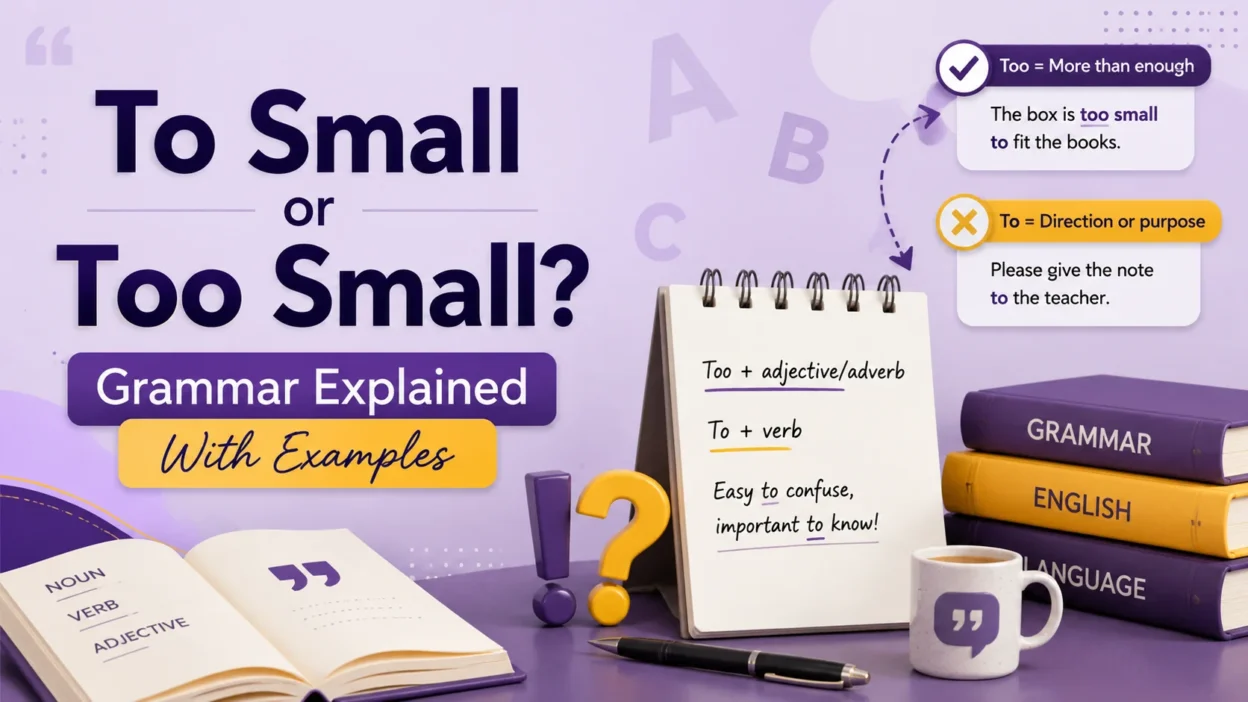
The phrase “To Small or Too Small” often creates confusion for learners because both words have a similar sound, but their meaning and usage are different. Understanding this small difference helps you choose the correct phrase in every sentence. The word too shows something is more than needed or excessively small, while to usually connects ideas, shows direction, or introduces an action. Using the wrong word can create a common mistake in English grammar and affect clear communication.
The main grammar rule is easy to remember. Too means extra, more than enough, or beyond the limit, while to has a different purpose in English language structure. Many English learners make this error because they focus on how words sound when spoken instead of checking their written form. Improving your vocabulary, language skills, and regular learning habits can strengthen your writing, speaking, and overall communication skills. For example, “The shoes are too small” is correct usage because the size is not enough, while “The shoes are to small” is an incorrect word choice.
Strong sentence structure depends on selecting the right word for the right context. Reviewing examples, using a comparison approach, and studying a grammar guide can help you notice the distinction between similar words. These common mistakes become easier to avoid when you understand their meaning and practice proper phrases. Better writing requires careful attention to spelling, accurate word choice, and clear English grammar. With time, this knowledge builds confidence and improves written communication with greater clarity.
The Basic Difference Between “To” and “Too”
The fastest way to understand small vs too small is to look at the role each word plays in English.
To is usually a preposition or part of an infinitive verb. It often shows direction, purpose, or relationship.
Too is an adverb. It usually means more than enough, excessively, or also.
Here is the key point:
- to does not mean “excessively”
- too does mean “excessively” or “more than needed”
So if you want to say something is more than the correct size, you need too small, not to small.
“Too” adds the idea of excess. “To” does not.
“To” as a Directional Preposition
The word too often shows movement or direction.
Examples:
- I went to the store.
- She gave the book to her brother.
- We are heading to the airport.
In each sentence, to connect one idea to another. It does not describe size, amount, or intensity.
That is the problem with to small. The word to does not carry the meaning the sentence needs.
The Excessive Nature of “Too”
The word too signals excess. It means something crosses the limit.
Examples:
- The box is too small for the laptop.
- This shirt is too tight.
- The soup is too hot to eat right now.
Each sentence, too tells you that there is too much of a quality. The room, size, heat, or tightness goes beyond what works.
That is exactly the idea needed in too small.
Why “To Small” Causes Confusion
People confuse to and too for a few simple reasons:
- They sound the same in speech.
- Fast typing leads to mistakes.
- Autocorrect does not always catch the error.
- Learners often focus on meaning before spelling.
The sentence may still look understandable, but grammar matters. In writing, especially in school, business, or publishing, the correct form shows care and clarity.
Is “To Small” Ever Correct?
In normal English, to small is not correct when you mean excessively small.
However, to can still appear next to small in a sentence if the structure is different.
Examples:
- I need to make the room small enough for the stage setup.
- We plan to keep the package small.
- She wants to choose a small apartment.
In these examples, to belongs to another part of the sentence. It is not describing size. It is part of an infinitive verb phrase such as to make, to keep, or to choose.
So the rule is simple:
- Too small = correct when you mean excessively small
- To small = incorrect in that meaning
When to Use “Too Small” Correctly
Use “too small” when you want to describe something that is smaller than needed, expected, or suitable. The word “too” means excessively, showing that the size creates a problem or limitation. For example, you can say, “This backpack is too small for my laptop,” or “The meeting room is too small for everyone.” Whenever you mean that the size is not sufficient for a particular purpose, “too small” is the correct and grammatically accurate choice.
Expressing Excess or Lack of Fit
Use too small when something does not fit or does not meet a requirement.
Examples:
- The shoes are too small for me.
- The box is too small for the gift.
- The apartment is too small for a family of five.
- That font is too small to read comfortably.
Notice how each sentence shows a problem caused by size. The object is not just small. It is too small for the situation.
Using “Too Small” Before Adjectives and Phrases
You can use too small before an adjective phrase or with an infinitive phrase.
Examples:
- The table is too small for dinner guests.
- The screen is too small to view clearly.
- This budget is too small for the project.
- The jar is too small to hold all the coins.
This structure is very common in everyday English.
Using “Too Small” in Professional Writing
In professional writing, clear wording matters. Too small may appear in reports, product reviews, workplace notes, and customer feedback.
Examples:
- The storage unit is too small for bulk inventory.
- The label text is too small for easy reading.
- The conference room is too small for the expected audience.
In business settings, this wording is direct and useful. It tells the reader there is a practical problem.
“To Small” or “Too Small”: Side-by-Side Comparison Table
| Phrase | Correct? | Meaning | Example |
| to small | No, in this context | Incorrect spelling for excess size | This shirt is to small. |
| too small | Yes | More than small enough to be a problem | This shirt is too small. |
| to | Yes, in other structures | Direction, purpose, infinitive marker | I want to buy a small shirt. |
| too | Yes | Excessively or also | This shirt is too small for me. |
This table shows the core idea clearly. The right word depends on the job it does in the sentence.
Sentence Examples of “Too Small”
The phrase “too small” is used when something is not large enough for its intended purpose. For example, “These shoes are too small for my feet,” “The box is too small to hold all the books,” and “The text is too small to read without glasses.” In each sentence, “too small” shows that the size is insufficient and causes a practical problem.
Everyday Examples
- My bag is too small for all these books.
- The cup is too small for a large coffee.
- The jacket is too small after the wash.
- The room feels too small with all these people inside.
School and Study Examples
- The text on the worksheet is too small to read from the back row.
- The notebook space is too small for a full answer.
- The diagram is too small to show the details clearly.
Workplace Examples
- The desk is too small for two monitors.
- The storage drawer is too small for all the files.
- The meeting room is too small for the entire team.
Shopping and Product Examples
- These jeans are too small in the waist.
- The box is too small to hold the item safely.
- That charger pouch is too small for my cables.
Common Grammar Mistakes Related to “Too Small”
One of the most common grammar mistakes is writing “to small” instead of “too small” because both words have the same pronunciation. “Too” means excessively or more than needed, while “to” is used as a preposition or before a verb. Another frequent error is confusing “to,” “too,” and “two,” even though each word has a different meaning and grammatical function. Remember that if you mean something is smaller than it should be, “too small” is always the correct phrase.
Mixing Up “To,” “Too,” and “Two”
These three words sound the same, but they do different jobs.
- to = direction or infinitive
- too = also or excessively
- two = the number 2
Examples:
- I walked to the station.
- This chair is too small.
- I bought two notebooks.
A sentence like “This chair is to small” usually happens because the writer hears the sound, not the spelling.
Typing Too Fast
Fast typing causes simple errors. The brain knows the meaning, but the fingers miss the extra o in too.
That tiny slip can weaken your writing. In casual text messages, people may not notice. In formal writing, the mistake stands out.
Trusting Autocorrect Too Much
Autocorrect helps, but it is not perfect. It may not always catch the wrong word if the sentence still looks valid.
A quick proofread helps a lot. Read the sentence slowly. Ask a basic question:
Does this word mean direction or excess?
If the meaning is excess, use too.
Simple Rules to Remember the Difference
Remember this simple rule: “too” has an extra “o,” and that extra letter reminds you of something extra or excessive. Use “too small” whenever something is smaller than needed or not big enough for its purpose. Use “to” when showing direction or before a verb, such as “go to the store” or “to learn.” If you can replace “too” with “excessively” and the sentence still makes sense, then “too” is the correct choice.
The Extra O Rule
Think of the extra o in too as an extra amount.
- one o in to = normal movement or purpose
- two o’s in too = extra, more than enough
This is a simple but effective trick.
The Replacement Test
Try replacing the word with very or excessively.
- This box is too small.
- This box is very small.
- This box is excessively small.
If the sentence still works with that meaning, too is the right choice.
The Direction Test
Try replacing the word with toward or in the direction of.
- I went to the store.
- I went toward the store.
If that works, you need to, not too.
Two Mini Case Studies
A customer left an online review saying, “The shirt was to small for me.” Although the meaning was clear, the sentence contained a grammar mistake. The correct version is “The shirt was too small for me,” because “too” shows that the shirt was smaller than needed.
In another example, a teacher wrote, “The font on the worksheet is too small to read from the back of the classroom.” Here, “too small” is used correctly because it explains that the text is so small that it creates a problem for students.
Case Study: A Clothing Review
A shopper writes, “The jacket was to small for me.”
That sentence contains the right idea, but the wrong word. The writer means the jacket did not fit. The correct version is:
The jacket was too small for me.
Here, too shows excess. The size falls below what the person needs.
Case Study: A Classroom Note
A student says, “The letters on the projector are to small to see.”
Again, the meaning is clear. The letters are hard to read. But the grammar is off.
The correct version is:
The letters on the projector are too small to see.
This form is cleaner, more accurate, and more natural in English.
Related Words and Phrases You Should Know
Once you learn too small, other size-related phrases become easier too.
- too big
- too loud
- too heavy
- too late
- too expensive
- too close
These all use too in the same way. The idea is always excess.
Examples:
- The shoes are too big.
- The music is too loud.
- The package is too heavy to lift.
When you see this pattern, the grammar starts to feel natural.
A Quick Practice Check
Choose the correct word in each sentence:
- This cup is ___ small for the soup.
- I went ___ the park.
- The box is ___ heavy to carry alone.
- She bought ___ apples.
Answers:
- too
- to
- too
- two
This little exercise shows the difference in action.
Conclusion
Knowing the difference between to small and too small makes your English grammar clearer and more accurate. Although these words have the same sound, they have completely different meanings and uses. Use too small when something is excessively small or not large enough for a specific purpose. Use only when it shows direction, connection, or an action. By practising the correct word choice, improving your vocabulary, and paying attention to sentence structure, you can avoid this common mistake and communicate with more confidence.
Faqs
Q1.Is “to small” correct English?
No, “to small” is usually incorrect when you mean something is not large enough. The correct phrase is “too small” because too means more than needed or excessively.
Q2.Why do people confuse “to small” and “too small”?
People often confuse these phrases because to and too have the same pronunciation. The mistake happens when writers focus on the sound instead of the spelling and grammar rule.
Q3.When should I use “too small”?
Use too small when something does not meet the required size. For example, “This box is too small for the books” means the box cannot hold all the books.
Q4.What is the difference between “to” and “too”?
To usually shows direction, purpose, or connection, such as “go to school.” Too means extra, also, or more than enough, such as “The room is too small.”
Q5.How can I remember the difference between “to small” and “too small”?
A simple trick is to remember that too has an extra “o,” and that extra letter represents something extra or excessive. If something is more than needed, choose too.