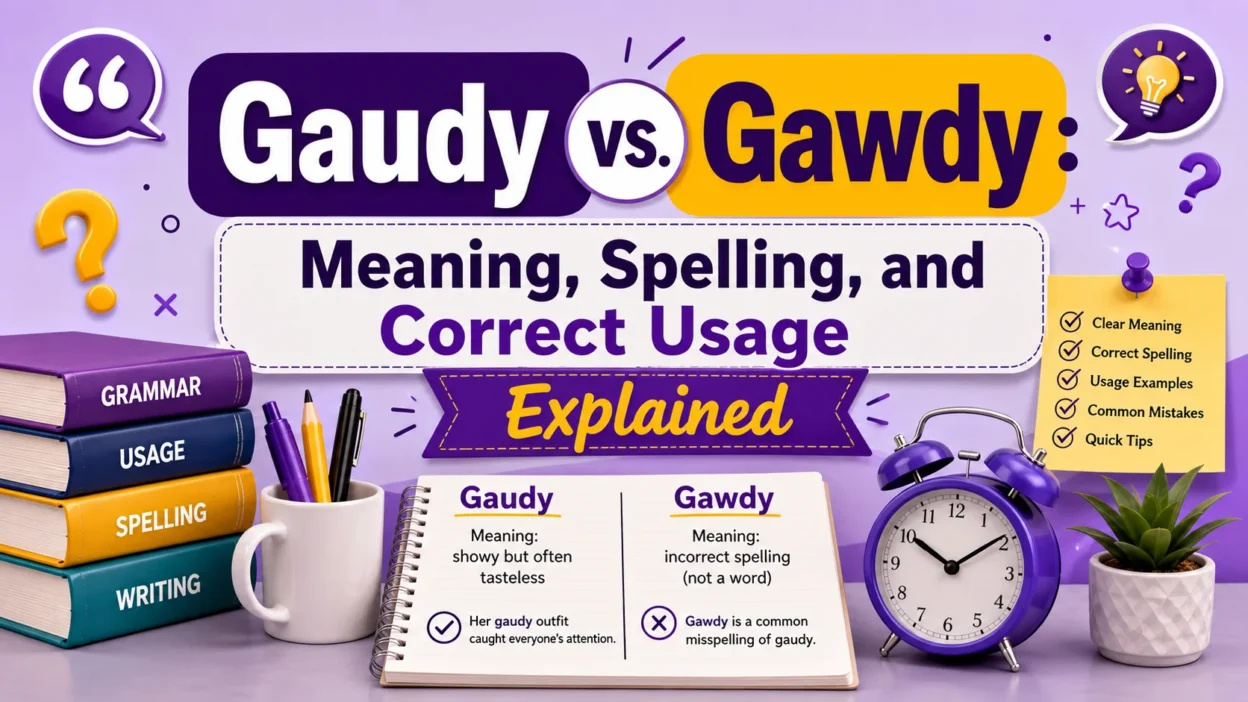
Gaudy vs. Gawdy explains a common spelling confusion where similar sounds and spelling patterns create questions about correct English usage for writers and learners. Gaudy and gawdy may appear almost identical, but their meanings and usage are completely different. Gaudy is a legitimate word in the English language and works as an adjective describing something extravagant, bright, colorful, showy, or sometimes tasteless. On the other hand, gawdy is a common misspelling and an incorrect form that is not accepted in standard English. Understanding this spelling difference helps improve language skills, prevents spelling errors, and supports more accurate communication.
The meaning and definition of gaudy describe an appearance, style, or decoration that is extremely noticeable because of its excessive visual impact. For example, bright neon lights outside a casino may be seen miles away, creating a gaudy display. A large gaudy necklace at a party can also represent a decorative design that attracts attention but may seem too excessive or unattractive. Using gawdy necklace is a wrong form because it creates a spelling error. Learning grammar, vocabulary, English rules, and standard usage helps writers choose the correct form in different contexts, whether they are creating a blog post, school assignment, resume, or professional document.
A deeper close look at Gaudy and Gawdy through comparison, practical examples, and usage tips helps build stronger writing quality and confidence. A useful spelling guide shows that gaudy means something flashy, excessive, or sometimes vulgar, while gawdy appears only as an incorrect spelling. Exploring word history, definitions, and practical examples can improve knowledge, strengthen communication skills, and help writers avoid embarrassing errors. Using the correct word choice with proper context creates a clean finish and a more confident finish in professional and everyday writing.
Gaudy vs. Gawdy at a Glance
Here is the simplest way to separate the two spellings.
| Feature | Gaudy | Gawdy |
| Standard spelling | Yes | No |
| Dictionary word | Yes | Usually no |
| Part of speech | Adjective | Misspelling of gaudy |
| Main meaning | Showy, flashy, overly bright, or tasteless | A common spelling error |
| Formal writing | Correct and acceptable | Not recommended |
| Example | A gaudy outfit | A gawdy outfit |
A quick rule helps here: gaudy is the real word. Gawdy is the spelling many people guess, but it is not the form you should use in polished writing.
Is “Gawdy” a Real Word?
This is the first question most readers ask, and the answer is straightforward.
In standard English, gawdy is not the accepted spelling of the adjective people usually mean. Most of the time, it is simply a misspelling of gaudy. You may see it in search queries, casual typing, drafts, or social posts. But that does not make it standard.
Why people spell it as “gawdy”
A few reasons explain the mistake:
- The word sounds like it might contain an awful spelling.
- People often spell words the way they hear them.
- The correct spelling is not common in everyday conversation.
- Fast typing leads to small but visible errors.
That is why gaudy vs. gawdy gets searched so often. People are not usually looking for two equal words. They are trying to confirm which spelling is right.
What dictionaries and standard usage show
In formal English, style guides and dictionaries support gaudy. That means it is the version you should use in essays, articles, classroom work, professional communication, and editorial content.
Using gawdy in those settings weakens your writing, even if the meaning is still obvious.
What Does “Gaudy” Mean?
The word gaudy describes something that is too bright, too flashy, too ornate, or too attention-grabbing. It usually suggests that the style goes past good taste and into excess.
That negative edge is important. Gaudy is not the same as colorful or decorative. It often implies that the design tries too hard.
Core meanings of gaudy
- Showy
- Flashy
- Overly decorated
- Cheap-looking because of excess
- Visually loud in a way that feels unrefined
Simple examples of the meaning
- A shirt covered in neon stripes and glitter may look gaudy.
- A room with too much gold, too many patterns, and no balance may feel gaudy.
- A sign with flashing lights and clashing colors may seem gaudy.
The word usually describes appearance, but it can also describe style, presentation, or even behavior if someone is being overly dramatic.
Origin and Feel of the Word Gaudy
Words carry history, and gaudy has always had a strong connection to display and excess.
Its modern meaning centers on something that is meant to attract attention. Over time, the word became linked with things that appear too loud or too decorated. That is why it often carries a critical tone.
Why the tone matters
When you call something gaudy, you are not just describing how it looks. You are also suggesting that the look is excessive or lacks taste.
That makes the word powerful in review writing, commentary, and creative description. It can add sharpness without needing a long explanation.
How to Pronounce “Gaudy” Correctly
The correct pronunciation is GAW-dee.
That pronunciation often leads people to assume the spelling should be gawdy. But English does not always follow sound in a neat way. The pronunciation may feel intuitive while the spelling still needs to be memorized.
Pronunciation breakdown
- Gaudy = GAW-dee
- The first syllable rhymes with law or saw
- The second syllable is short and light
Common pronunciation mistakes
Some speakers overemphasize the second syllable. Others stretch the vowel in a way that makes the word sound awkward. The best approach is simple and natural: GAW-dee.
Easy memory trick
Think of it like this:
“Gaudy sounds loud, but the spelling stays standard: g-a-u-d-y.”
That one line can save you from a common spelling slip.
Meaning and Definition of Gaudy in Real Usage
In real-life usage, gaudy describes something that is extremely showy, flashy, or decorated with too many bright details. People often use the word when an object, outfit, or design attracts attention but feels excessive rather than elegant. For example, a gaudy necklace may have too many sparkling stones, while a gaudy advertisement may use overwhelming colors and effects. The word usually expresses a negative opinion, but it can sometimes describe something bold, dramatic, or intentionally eye-catching.
What gaudy usually describes
- Fashion that is too loud
- Jewelry that feels overly flashy
- Décor that lacks balance
- Packaging that uses too many bright elements
- Public displays that seem showy or overdone
Everyday examples
- The gaudy jacket stood out in the crowd.
- The restaurant’s gaudy neon sign made the street look busier than it was.
- Her gaudy accessories drew attention from across the room.
- The ad looked gaudy because it used too many colors and effects.
These sentences show the same basic idea: something catches the eye, but not always in a good way.
Common Uses and Contexts of Gaudy
The word gaudy commonly appears when describing things that look too flashy, overly colorful, or excessively decorated. People often use it for fashion, jewelry, home décor, artwork, and designs that attract attention but may feel lacking in taste or balance. For example, a gaudy outfit might include too many bright colors and decorations, while a gaudy room may have excessive patterns, gold accents, and bold designs. The word usually carries a critical tone, suggesting that something has gone beyond stylish and become overdone.
Fashion and clothing
This is one of the most common uses. A gaudy outfit might include bright colors, too much shine, clashing prints, or too many decorative details.
Example:
The dress was so gaudy that it distracted people from the event itself.
Interior design and decor
People use the word for rooms or items that feel overloaded.
Example:
The living room looked gaudy with its gold frames, mirrored tables, and loud wallpaper.
Advertising and branding
A campaign can look gaudy when it relies on too many effects to grab attention.
Example:
The billboard felt gaudy because it used flashing colors, bold fonts, and a cluttered layout.
Jewelry and accessories
Large, sparkling pieces can be called gaudy if they seem excessive rather than elegant.
Example:
The ring was expensive, but its gaudy design made it look less refined.
Architecture and public spaces
The word also appears in comments about buildings, signs, and public design.
Example:
The hotel’s gaudy exterior clashed with the quiet street around it.
Examples of Gaudy in Sentences
The word gaudy works best when describing something that feels overly flashy, bright, or excessively decorated. For example, you might say, “The gaudy jacket attracted attention because of its bright colors and glittering design.” Another example is, “The room looked gaudy with its gold furniture, colorful walls, and heavy decorations.” These sentences show how gaudy describes something that stands out because it feels like too much rather than simply beautiful.
Everyday sentences
- The gaudy curtains made the room feel smaller.
- He wore a gaudy tie that nobody missed.
- The shop window had a gaudy display of bright lights and shiny props.
- She prefers simple style and avoids gaudy jewelry.
More formal examples
- The article criticized the building’s gaudy design and lack of visual balance.
- The brand shifted away from gaudy packaging and moved toward a cleaner look.
- The critic described the performance as energetic but slightly gaudy.
Creative writing examples
- The ballroom glittered under a gaudy storm of lights and gold trim.
- His gaudy smile looked rehearsed, like a costume he wore for strangers.
These examples show how flexible the word can be when you want to describe something that is visually too much.
Why People Misspell Gaudy as Gawdy
Many people write gawdy instead of gaudy because the pronunciation can make the spelling feel natural. The “aw” sound in gaudy often leads writers to replace “au” with “aw”. This mistake usually comes from spelling words by sound rather than remembering the correct written form.
Another reason is that gaudy is not a word people use every day, so its unusual spelling may look unfamiliar. Learning that gaudy is the only standard form helps you avoid this common mistake in professional writing, articles, and formal communication.
Sound-based spelling
English speakers often spell words the way they hear them. Since gaudy sounds like it should have an aw, many people write gawdy by instinct.
Rare use in speech
The word is not used constantly in daily conversation. That means people may hear it once and never see it often enough to lock in the spelling.
Typing shortcuts and assumptions
Fast typing makes small spelling errors more likely. A writer may also assume the wrong version is correct because it looks more natural.
Memory confusion
When a word has an uncommon spelling, the brain may store the sound instead of the written form. That is one reason spelling mistakes can keep repeating.
Gaudy vs. Gawdy: Key Differences Explained
This comparison makes the issue even clearer.
| Aspect | Gaudy | Gawdy |
| Status | Standard English | Nonstandard spelling |
| Meaning | Showy, flashy, overly ornate | Usually none on its own |
| Part of speech | Adjective | Not normally treated as a separate word |
| Use in writing | Correct in formal and informal contexts | Best avoided |
| Reader impression | Clear and polished | Looks like an error |
Best takeaway
If you want the correct word for “too flashy” or “too decorative,” always choose gaudy. There is no practical reason to use gawdy in standard writing.
Common Misconceptions and Mistakes
Many people mistakenly believe that gawdy is an acceptable alternative spelling of gaudy, but only gaudy is correct in standard English. Another common misconception is that gaudy simply means colorful, when it actually describes something that is overly flashy, excessively decorated, or lacking good taste. Understanding this distinction will help you use the word more accurately in both formal and informal writing.
Misconception: gawdy is an alternate spelling
It is not a standard alternative spelling in modern English. It is usually just a typo or spelling guess.
Misconception: gaudy only means ugly
Not exactly. Gaudy usually carries a negative judgment, but it focuses more on excessive showiness than plain ugliness.
Misconception: gaudy and colorful mean the same thing
They do not. Something can be colorful and beautiful. Gaudy suggests too much color, too much shine, or too much decoration.
Mistake: using gawdy in professional writing
That mistake can weaken credibility. Even if readers understand your meaning, they may notice the spelling problem first.
Practical Tips for Correct Usage
To use gaudy correctly, remember that it describes something overly flashy, bright, or excessively decorated, often with a negative tone. Avoid using gawdy, as it is a common misspelling and is not accepted in standard English. When you’re unsure, think about whether the object looks stylish or simply overdone. If it feels excessive rather than elegant, gaudy is the correct word to use.
Use the u in your memory
The real word is gaudy, not gawdy. The u is part of the correct spelling, and that detail matters.
Link it to the idea of style excess
Think: gaudy = too much style. The spelling is the standard one, just like the meaning is standard.
Read the sentence out loud
When you hear the word in speech, pause and picture the written form. That can reduce spelling mistakes.
Check it before publishing
If the word appears in a title, headline, product description, or essay, scan it one more time. Small spelling errors stand out more in important text.
Words Commonly Associated With Gaudy
People often pair gaudy with words that describe bright colors, flashy designs, or over-the-top style. Common associations include garish, showy, tacky, ornate, glittery, bold, sparkly, colorful, extravagant, and overdecorated. These related words help paint a clear picture of something that stands out because it looks excessive rather than refined.
Synonyms
Some words can overlap with gaudy, depending on context:
- Flashy
- Showy
- Loud
- Garish
- Tacky
- Ornate
- Overdecorated
Antonyms
These words often point in the opposite direction:
- Tasteful
- Elegant
- Simple
- Understated
- Refined
- Subtle
- Clean
Related words and collocations
You may often see gaudy with nouns like:
- Clothes
- Colors
- Jewelry
- Decor
- Lights
- Design
- Display
- Style
That pairing helps the word feel natural in sentences.
Gaudy in Literature, Media, and News
The word gaudy appears regularly in literature, movie reviews, fashion articles, and news reports to describe things that are overly flashy, ornate, or attention-grabbing. Writers often use it to criticize clothing, interior design, architecture, or public displays that seem excessive rather than elegant. Its vivid meaning makes gaudy a popular choice whenever bold style crosses the line into poor taste.
In literature
Writers use gaudy when they want to describe a scene, costume, room, or character with sharp visual detail. It can suggest both brightness and excess.
In media reviews
Critics may use it to talk about fashion, film sets, advertising, or stage design.
Example:
The set looked bold but a little gaudy, especially under the bright stage lights.
In news and commentary
Journalists may use the word when describing style choices, public displays, or architectural features that feel too flashy for the setting.
Why it works well in these settings
Gaudy is short, vivid, and opinionated. That makes it useful when a writer wants to communicate not just what something looks like, but how that look feels.
A Short Case Study on Gaudy vs. Gawdy
Imagine two writers describing the same costume.
Writer A:
The costume was gawdy and hard to ignore.
Writer B:
The costume was gaudy and hard to ignore.
Writer B uses the correct spelling and keeps the sentence clean. Writer A may still communicate the idea, but the mistake distracts from the message.
Now imagine the same error in a magazine article, job application, or school paper. The issue becomes more serious, because readers expect correct spelling in polished work.
That is the practical value of learning gaudy vs. gawdy. It is not just about one word. It is about building trust in your writing.
A Useful Quote About Style
“Style is a way to say who you are without having to speak.”
— Rachel Zoe
That idea fits this topic well. Style can be tasteful, bold, or loud. But when it becomes excessive, gaudy becomes the perfect word.
Best Practices for Highlighting the Correct Usage
Here are a few practical habits that make the word easier to remember.
- Use gaudy when describing something too flashy or overly decorated.
- Avoid gawdy in essays, articles, and formal messages.
- Pair the word with clear visual details.
- Keep tone in mind, because gaudy usually sounds critical.
- Double-check the spelling in titles, headings, and final drafts.
Conclusion
Understanding the difference between Gaudy and Gawdy helps improve your English writing, vocabulary, and communication skills. Gaudy is the correct English word used to describe something bright, showy, extravagant, or sometimes tasteless, while gawdy is only a common misspelling that should be avoided. Although both words may have a similar sound and similar spelling, their correct usage is different. Learning these small spelling differences helps writers create clearer sentences, avoid mistakes, and use the English language with more confidence.
FAQs
Q1. Is Gaudy a correct English word?
Yes, Gaudy is a correct English word and is commonly used as an adjective. It describes something that is extremely bright, flashy, showy, or overly decorative in appearance.
Q2. Is Gawdy a real word in English dictionaries?
No, Gawdy is not considered a standard English word. It is a misspelling of Gaudy and should be avoided in professional writing, academic work, and formal communication.
Q3. What is the meaning of Gaudy?
Gaudy means something that attracts attention because it is very bright, colourful, extravagant, or sometimes lacking good taste. For example, an overly decorated room may be described as gaudy.
Q4. Why do people confuse Gaudy and Gawdy?
People often confuse Gaudy and Gawdy because they have a similar sound and almost the same spelling pattern. However, only Gaudy has a recognised meaning and correct usage in the English language.
Q5. How can I remember the correct spelling of Gaudy?
You can remember that Gaudy is the correct spelling because it begins with “gay” and appears in trusted dictionaries. Checking the spelling before writing can help prevent common mistakes.