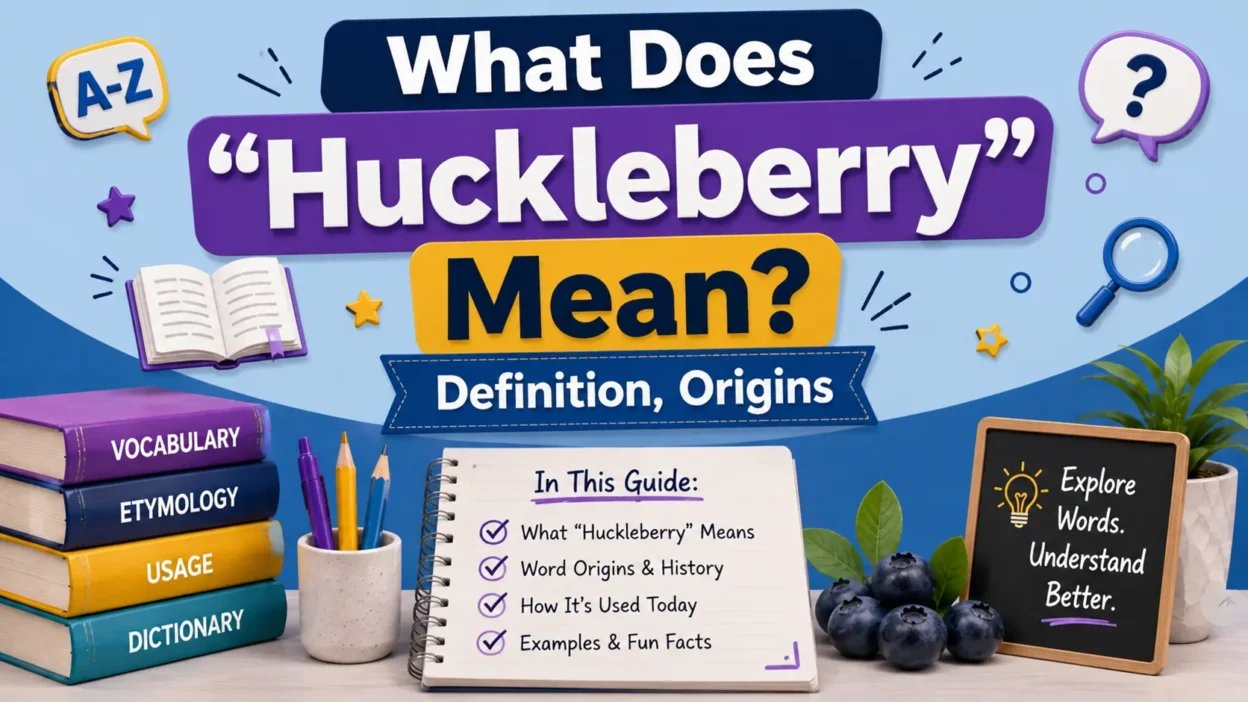
Huckleberry is a word with several meanings. The term changes with the context, but most people in everyday everyday language usually think of a small, edible berry. From my own experience, I first came across it in literature, where figurative language and expressions suggest the right person for a job.
The name has a wider use and many uses than many expect. In its literal sense, the plant grows on certain shrubs and bushes, producing berries and fruit similar to a blueberry. It is native to North America and is known for its sweet, slightly tart flavour. The fruit appears in blue, black, and red colours, depending on the species, with various forms. It is rich in antioxidants and vitamins, contributes to health, offers many health benefits, and is popular in desserts and jams. This interesting variety gives the word extra personality, history, and cultural value through folklore, speech, and memorable phrases.
As you explore definitions, examples, and sentences, you quickly grasp and understand what the article refers to. One point that caught my attention is the flexibility of the word because its attitude depends, or depending on the situation, it can describe a round berry or, colloquially, an inspired way to describe the right person for a job. That mix of learning, journey, surprise, qualities, variety, and benefits makes the simplest way to remember it, whether you see it as a worthy match, the best fit for a task or challenge, or notice how older and old sayings are almost dead while the tradition still carries forward.
What is a huckleberry?
A huckleberry is a small berry that grows on wild shrubs in North America. It often looks similar to a blueberry, and people sometimes confuse the two. The berries can be red, blue, or dark purple depending on the species.
In practical terms, huckleberries are known for:
- Their small size
- Their sweet-tart flavor
- Their use in pies, jams, syrups, and desserts
- Their connection to wild landscapes
Unlike many store-bought fruits, huckleberries are often foraged rather than farmed on a large scale. That wild character gives them a bit of a rugged reputation. They are not polished. They are not overly sweet. They taste like something that came from the woods, not from a plastic clamshell.
A quick comparison
| Feature | Huckleberry | Blueberry |
| Size | Small | Small to medium |
| Flavor | Sweet-tart, often stronger | Sweet, milder |
| Growth | Often wild | Commonly cultivated |
| Use | Jams, pies, syrups, fresh eating | Fresh eating, baking, smoothies |
| Common confusion | Often mistaken for blueberries | Often mistaken for huckleberries |
That table helps because many people know the word from fruit first. Once you see the fruit clearly, the rest of the word becomes easier to understand.
The origin and history of the word “huckleberry”
The history of huckleberry is tied to older English plant names and regional American usage. The exact path of the word is not always simple, but the term has long been linked to small wild berries.
Words like this often survive because people use them in daily life before dictionaries fully settle the meaning. In other words, the word lived in speech first. It later found its way into printed books, regional dialects, and popular stories.
Why the word stuck around
A few things helped the word last:
- It names a real plant and fruit
- It sounds distinct and memorable
- It fits both literal and figurative use
- It appears in well-known American literature
That last point matters a lot. Once a word becomes part of a famous story, it gains a second life. It stops being only a plant name and starts becoming part of culture.
Huckleberry as a fruit
When people use the word in its most direct sense, they mean the fruit. Huckleberries grow on shrubs and appear in forests, mountain areas, and other wild places. They can be eaten fresh, but they are also popular in cooked dishes.
Common uses of the fruit
- Huckleberry pie
- Huckleberry jam
- Huckleberry syrup
- Huckleberry muffins
- Huckleberry sauce
The flavor usually leans toward bright and tangy rather than flatly sweet. That makes the fruit useful in recipes that need a little punch.
What huckleberries are not
People often mistake them for blueberries, but the two are not identical. They may look alike at a glance, yet they do not grow or taste exactly the same. That is a good reminder that English words often carry small but important distinctions.
Huckleberry vs. blueberry
This is one of the most useful comparisons for understanding the word. A lot of confusion comes from the fact that both fruits are small, round, and edible. But the differences matter.
Main differences
- Growth pattern: Huckleberries are more commonly wild. Blueberries are often cultivated.
- Flavor: Huckleberries often taste stronger and more tart.
- Appearance: Both can be blue or dark purple, but the exact look varies by species.
- Availability: Blueberries are easier to find in grocery stores.
Why the comparison matters
The comparison helps readers understand that huckleberry is not just a cute old-fashioned word. It names a real fruit with a real identity. That literal meaning gives the figurative meanings more depth. A word feels richer when it has roots in the physical world.
Meaning and symbolism of huckleberry
Beyond the fruit, the word can carry symbolic weight. When people hear huckleberry, they may think of:
- Smallness
- Wildness
- Simplicity
- Rural life
- American folk culture
- Readiness for action
Those ideas are not built into the dictionary definition alone. They come from the way the word has been used in stories, speech, and memory.
What the symbolism suggests
A huckleberry can suggest something humble but valuable. It is not flashy. It does not try to be glamorous. It grows in the wild and gives off a kind of natural charm.
That is one reason the word works so well in fiction and idioms. It feels earthy. It feels direct. It has a bit of grit.
Why do people call someone a “huckleberry”?
This is where the word becomes especially memorable. In American English, the phrase “I’m your huckleberry” became famous through popular culture, especially through its association with Doc Holliday in Western storytelling.
In modern interpretation, the phrase usually means:
- I am the right person for the job
- I am the one you need
- I am willing to take on the challenge
That makes the phrase feel confident, almost like a verbal challenge. I am not shy. It steps forward with purpose.
A simple example
If someone says, “We need somebody who can fix this problem,” and another person replies, “I’m your huckleberry,” the meaning is roughly:
“I’m the one who can do it.”
That is the practical idea behind the phrase. It is short, bold, and memorable.
“I’m your huckleberry” explained
This phrase has been repeated so often that many people know it without fully knowing what it means. The line is famous because it sounds unusual. At first, it seems playful. Then it reveals a layer of challenge.
The phrase is often interpreted as a way of saying:
- I accept the match
- I am available
- I am the correct choice
- I am not afraid to step up
It has a confident edge, which is why it stuck in memory.
Why it sounds so strong
The phrase works because it combines a familiar name with an unexpected meaning. You do not expect a berry word to signal readiness or toughness. That surprise gives it power.
Language often becomes memorable for exactly that reason. The more unexpected the phrase, the easier it is to remember.
Confidence, readiness, and identity in the phrase
The figurative use of huckleberry is more than slang. It carries a certain attitude. It says not only “I can do it” but also “I know exactly where I fit.”
That makes the phrase useful in situations where you want to signal competence without sounding formal.
The tone of the phrase
- Confident
- Slightly playful
- Old-fashioned
- Strong
- Distinctive
Not every phrase can do that. Some expressions sound generic. This one does not. It has personality baked into it.
How to use “huckleberry” in everyday language
You can use huckleberry in everyday conversations to describe yourself as the right person for a job or to refer to something that is a perfect match. For example, you might say, “I’m your huckleberry if you need help with the project,” to show you’re willing and capable. While the expression is less common today, it still adds a friendly, confident, and slightly old-fashioned touch to casual speech.
Literal use
You might hear it when someone talks about food, nature, or foraging:
- “We picked huckleberries on the trail.”
- “This pie has fresh huckleberries.”
- “Huckleberries are hard to find in some regions.”
Figurative use
You might hear it in a confident phrase:
- “You need someone who can handle the pressure? I’m your huckleberry.”
- “He was the huckleberry for that job.”
That said, the figurative use is less common in daily conversation than the literal fruit meaning. It appears more often in storytelling, quotation, jokes, or cultural references.
Cultural references tied to huckleberry
The word has a strong place in American culture because of literature, film, and repeated speech. Once a word enters storytelling, it becomes more than a dictionary entry. It becomes a reference point.
Why culture matters here
Culture gives the word extra weight. A reader may not think about fruit at all when hearing huckleberry. Instead, they may think of a classic novel, a Western character, or a famous line.
That is why context matters so much. The same word can feel like a fruit salad in one moment and a challenge in the next.
Modern examples of huckleberry in speech
Although huckleberry is not a word you hear every day, people still use it to express confidence, friendship, or the idea of being the perfect fit. You may hear someone say, “I’m your huckleberry,” meaning they’re ready to help or are exactly the right person for the task. In casual conversations, the word also appears in movie quotes, pop culture references, and playful expressions that give it a confident and memorable tone.
You might hear it in these places
- Cooking and food writing
- Nature guides
- Historical discussions
- Movie references
- Playful conversation
- Brand names and product labels
Example sentences
- “We bought huckleberry jam at the local market.”
- “The trail was full of wild huckleberries.”
- “That old line, ‘I’m your huckleberry,’ still gets quoted today.”
- “She used the phrase with a grin, like she knew exactly how old-school it sounded.”
These examples show the word in action without forcing it. That is important. Good word use feels natural, not staged.
A closer look at the tone of the word
The tone of the word depends on the situation and the way you use it in a sentence. In casual conversations, it often feels friendly, warm, or even playful, making the message sound more natural. However, in a formal setting, the same word may carry a neutral or descriptive tone, so understanding the context helps you choose the right expression.
Tone by context
| Context | Tone |
| Fruit | Natural, earthy, homey |
| Food recipes | Warm, comforting |
| Literature | Classic, memorable |
| Phrase “I’m your huckleberry” | Confident, challenging |
| Casual speech | Old-fashioned, playful |
That tone shift is one of the reasons the word is worth studying. It gives you a small lesson in how English adapts words to different situations.
Literary examples of huckleberry
The word became especially well known through literature. Once writers use a word in a strong character or setting, the word often travels farther than its original meaning.
In stories, huckleberry can suggest:
- A rural setting
- A youthful or innocent feel
- A connection to nature
- A sense of Americana
Mark Twain’s Huckleberry Finn is the best-known literary example. The character’s name is not just a label. It brings up ideas of freedom, youth, adventure, and life on the margins of society.
Why literature gave the word power
Literature gives words emotional life. A berry becomes a symbol. A name becomes a cultural marker. A simple word starts carrying memory.
That is exactly what happened here.
Everyday sentences using “huckleberry”
In everyday English, huckleberry usually refers to the small wild fruit, but it can also appear in the famous expression “I’m your huckleberry,” which means “I’m the right person for the job.” Although the word isn’t common in everyday conversations, you’ll often hear it in discussions about food, nature, classic literature, and American culture. Understanding the context helps you know whether someone is talking about the fruit or using the term as a figurative expression.
Literal examples
- “We found huckleberries near the mountain trail.”
- “My grandmother made huckleberry pie every summer.”
- “The huckleberry bushes were heavy with fruit.”
Figurative examples
- “If you need someone calm under pressure, she’s your huckleberry.”
- “He stepped in and said, ‘I’m your huckleberry.’”
- “That phrase sounds old, but it still has energy.”
These examples show how the word can live in both the kitchen and the conversation.
Common phrases containing “huckleberry”
The most famous phrase is still “I’m your huckleberry.” It is the one most people recognize. Outside of that, the word does not appear in many everyday idioms. That makes this phrase especially important.
Why this phrase survives
- It is unusual
- It sounds dramatic
- It is easy to remember
- It has a clear meaning in context
- It has been repeated in popular culture
Some phrases survive because they are useful. Others survive because they are fun to say. This one does both.
A small case study: why one phrase lasts
Consider how people use memorable lines from movies or stories. They repeat them because the wording has rhythm, personality, and a strong emotional shape.
“I’m your huckleberry” works for the same reason. It has a direct meaning, but it also has style. It sounds like a line a character would say right before action, not a line from a textbook.
That makes it sticky. And in language, sticky usually means lasting.
Common misunderstandings about huckleberry
People often assume huckleberry only means fruit. That is understandable, but incomplete. Others assume the figurative phrase must be modern slang, when in fact it has older roots in American speech and storytelling.
Common mistakes
- Thinking it only means a berry
- Confusing it with blueberry in every case
- Using the phrase without understanding the tone
- Treating it like a casual word for any situation
Better approach
Use the word carefully and let the setting guide the meaning. If the discussion is about food, it almost certainly means fruit. If the context is a challenge or a confident reply, it may be the figurative expression.
Quick reference: meanings of huckleberry
| Meaning | Best use case | Example |
| Fruit | Food, nature, recipes | “Huckleberry pie” |
| Figurative phrase | Confidence, readiness | “I’m your huckleberry” |
| Cultural reference | Literature, film, history | “Huckleberry Finn” |
That table gives a clean summary of the word’s core uses. It is simple, but useful.
Why the word still matters today
Some old words fade because they stop feeling useful. Huckleberry did not disappear because it still does real work. It is named after a fruit. It carries a cultural reference. It survives in a famous phrase. That is a lot of mileage for one word.
It also sounds memorable. That helps. People like words that feel a little different. They stop you for half a second. Then they stay in your memory.
And that is the charm of huckleberry. It is small, wild, and a little unexpected. Just like the berry itself.
Transition to the rest of the topic
The next part of the article would naturally move into the famous literary example of Huckleberry Finn, the deeper history behind the phrase “I’m your huckleberry,” and more detailed sentence examples that show the word in real use. Those sections help complete the picture, because the meaning of huckleberry is easiest to understand when you see both its literal and cultural lives side by side.
Conclusion
Huckleberry is more than just a berry; it is a word with a rich history, different meanings, and a unique place in language, literature, and everyday expressions. Whether it refers to a small fruit that grows on shrubs in North America or describes the right person for a job, its meaning depends on the context. Understanding its literal and figurative uses helps you appreciate how a simple word can carry culture, personality, and lasting value.
FAQs
Q1. What does huckleberry mean?
Huckleberry can refer to a small, edible berry similar to a blueberry. It can also be used colloquially to describe the right person or a suitable match for a particular task or job.
Q2. Where do huckleberries grow?
Huckleberries grow on small shrubs and bushes, mainly in North America. Different species produce berries in blue, black, or red colours.
Q3. What does “I’m your huckleberry” mean?
The phrase “I’m your huckleberry” means “I am the right person for this” or “I am the person who can handle this challenge.” It is a figurative expression showing confidence and readiness.
Q4. Are huckleberries healthy?
Yes, huckleberries are considered nutritious because they are rich in antioxidants and vitamins. They can contribute to overall health and are often used in desserts and jams.
Q5. Are huckleberries and blueberries the same?
No, huckleberries and blueberries are not exactly the same. They are similar fruits, but they come from different species and have differences in taste, growth patterns, and appearance.