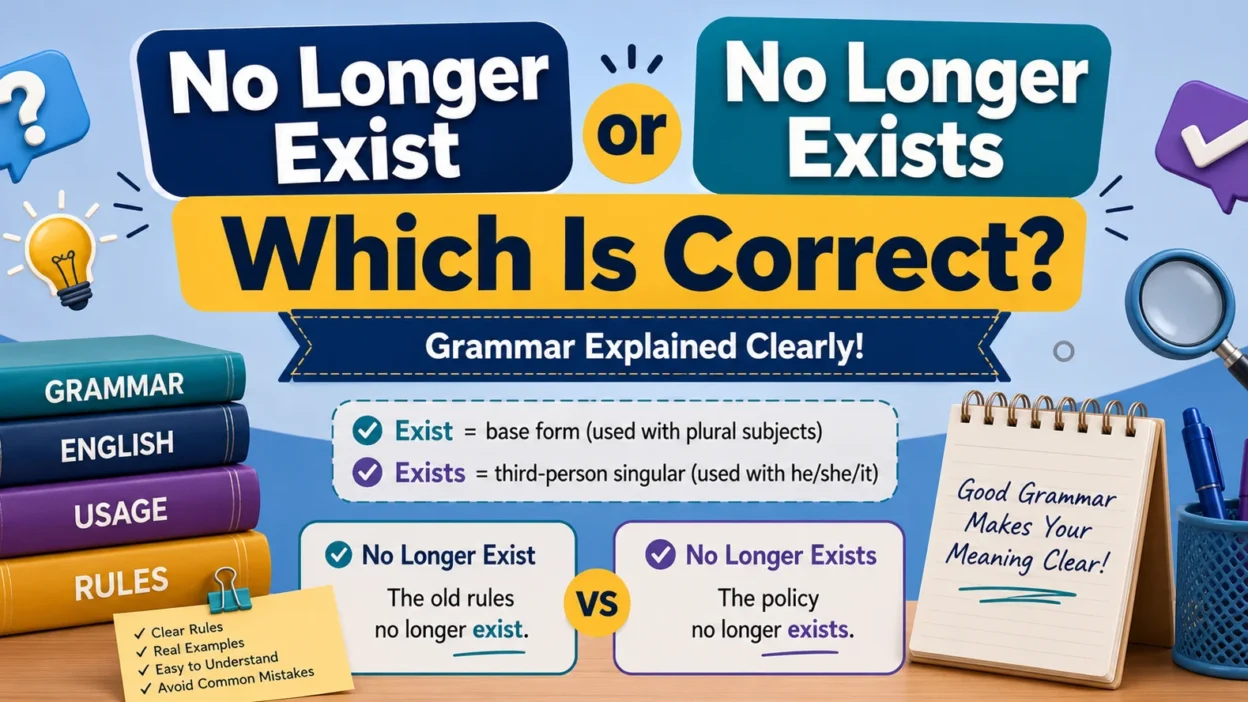
No Longer Exist or No Longer Exists becomes easy to use once you know that the subject controls the verb, not the words around it. Many writers find English grammar confusing because a tiny ending can completely change a sentence from correct to wrong. The good news is that the rule is simple. A singular subject takes exists, while a plural subject takes exist. In real writing, the real subject may hide in the middle of longer sentences, making the sentence look right at first glance even though it breaks subject-verb agreement. Learning this difference in plain English helps you choose the form that fits best in exact situations.
After editing hundreds of sentences, I have noticed that even native speakers struggle with this tricky part of grammar. The English language is full of complex rules, endless exceptions, and puzzling rules, so choosing the correct verb form is not always easy. The biggest challenge comes from matching verbs with subjects, especially when extra words make confident speakers second-guess themselves. The correct choice always depends on the subject’s number. A single item, single person, or old building exists, while multiple items, multiple people, and traditions exist. This habit improves correct usage, grammatical accuracy, sentence structure, verb agreement, and overall writing.
A quick example makes the pattern clear. “The old building no longer exists” is correct because the subject is singular. “The traditions no longer exist” is correct because the subject is plural. Remembering this simple rule reduces confusion and helps you use each phrase correctly in everyday language. Whether you are checking a grammar rule, improving your English, or writing for other speakers, paying attention to the number of the subject and the verb form will make your sentences more natural and accurate.
The Short Answer: Which Phrase Is Grammatically Correct?
Both forms can be correct. The right one depends on the subject.
- Use no longer exist with a plural subject.
- Use no longer exists with a singular subject.
Here are the cleanest examples:
- These records no longer exist.
- The old bridge no longer exists.
The first sentence uses exist because records is plural. The second use exists because bridge is singular.
That is the core rule. Everything else grows from it.
Grammar rule: the verb must match the subject, not the nearest noun.
That single idea solves most confusion.
Quick Examples You Can Copy
Here are some simple models you can use in your own writing:
- The files no longer exist.
- The company no longer exists.
- Those traditions no longer exist.
- This option no longer exists.
- The ruins no longer exist.
- The route no longer exists.
A fast way to check yourself is to ask: Am I talking about one thing or more than one?
Subject-Verb Agreement Behind “Exist” and “Exists”
The difference between “exist” and “exists” comes down to subject-verb agreement, one of the most important rules in English grammar. The verb must always match the number of the subject, not the noun closest to it. Use exists with a singular subject and exist with a plural subject. Before choosing either form, identify the true subject of the sentence. Once you know whether you’re referring to one thing or more than one, selecting the correct verb becomes simple.
How Singular Subjects Change the Verb
A singular subject exists.
Examples:
- The museum no longer exists.
- The island no longer exists.
- The policy no longer exists.
- This street no longer exists.
In each sentence, the subject is one thing. So the verb takes the singular form.
A useful test: replace the subject with it. If it exists sounds right, then exists is usually the form you need.
- The museum → it exists → the museum no longer exists
- The policy → it exists → the policy no longer exists
That quick substitution works surprisingly well.
How Plural Subjects Change the Verb
A plural subject takes exist.
Examples:
- The files no longer exist.
- The roads no longer exist.
- The documents no longer exist.
- These customs no longer exist.
Here the subject refers to more than one item, so the verb stays plural.
A useful test here is to replace the subject with they. If they exist sounds right, then exist is the form you want.
- The files → they exist → the files no longer exist
- These customs → they exist → these customs no longer exist
How Uncountable Nouns Affect Verb Choice
Uncountable nouns can cause trouble because they do not follow a simple singular-or-plural count. Words like information, equipment, furniture, and research often behave like singular nouns in English.
Examples:
- The information no longer exists in the database.
- The equipment no longer exists in usable form.
- The evidence no longer exists.
Even though these words may refer to many pieces or parts, English treats them as singular in grammar.
That means the verb stays singular: exists.
When to Use “No Longer Exist”
plural, meaning it refers to more than one person, place, thing, or idea. Plural subjects always take the base form of the verb exist, regardless of the words that come between the subject and the verb. A quick way to check is to replace the subject with they. If “they exist” sounds correct, then “no longer exist” is the proper choice. This form is commonly used when referring to documents, buildings, traditions, species, records, or other plural nouns that have disappeared or are no longer present.
With Plural Nouns
Plural nouns need the plural verb.
Examples:
- The buildings no longer exist after the earthquake.
- The notes no longer exist in the archive.
- The results no longer exist in the current version.
- The rumors no longer exist after the correction.
Each subject refers to multiple items. So exist is correct.
With Compound Subjects Joined by “And”
A compound subject often takes a plural verb when two or more things are joined by and.
Examples:
- The policy and the contract no longer exist in their original form.
- The road and the bridge no longer exist.
Why? Because the subject is now two things, not one.
Here is the simple rule:
- One subject → exists
- Two or more subjects → exist
That rule helps more than any memorized trick.
With Group Nouns That Act Plural in Context
Some collective or group expressions can behave like plural subjects when the focus is on individual members.
Examples:
- The staff no longer exist as separate departments.
- The participants no longer exist in isolated groups.
These examples are less common in everyday writing, but they show an important point: context matters. Grammar follows the subject’s meaning, not just the shape of the word.
Sentence Examples in Everyday English
Here are natural examples you might actually write:
- The old maps no longer exist.
- Those copies no longer exist.
- The spare keys no longer exist.
- The original files no longer exist.
Notice how the sentences feel normal once the subject is clearly plural. Nothing fancy is needed.
When to Use “No Longer Exists”
Use “no longer exists” when the subject is singular or refers to one person, place, thing, organization, or idea. In English, singular subjects take the singular verb exists, even if the sentence contains additional words or phrases that might distract you. A simple way to check is to replace the subject with it. If “it exists” sounds correct, then “no longer exists” is the right choice. This form commonly appears when talking about a company, building, law, website, tradition, or concept that has ceased to exist.
With Singular Nouns
Singular nouns take the singular verb.
Examples:
- The old theater no longer exists.
- The website no longer exists.
- The first version no longer exists.
- The opportunity no longer exists.
These all refer to one thing, so exists is correct.
With Abstract Nouns
Abstract nouns often refer to ideas, states, or conditions. They usually act as singular nouns.
Examples:
- That misunderstanding no longer exists.
- The fear no longer exists.
- The gap no longer exists.
- The problem no longer exists.
These sentences sound natural because the subject is singular in meaning.
With Collective or Organizational Subjects
Some nouns look plural in meaning but act as singular subjects in grammar.
Examples:
- The company no longer exists.
- The institution no longer exists.
- The organization no longer exists.
- The nation no longer exists.
Each one refers to a single entity. So the singular verb is right.
Sentence Examples in Everyday English
These examples show how exists works in context:
- The shop no longer exists on that corner.
- The old rule no longer exists in this version.
- The earlier system no longer exists.
- The route no longer exists after the roadwork.
If the subject is one thing, use exists. Simple as that.
Side-by-Side Comparison of “No Longer Exist” and “No Longer Exists”
A comparison table makes the pattern easier to remember.
| Subject Type | Correct Verb | Example |
| Singular noun | exists | The bridge no longer exists. |
| Plural noun | exist | The bridges no longer exist. |
| Uncountable noun | exists | The evidence no longer exists. |
| Compound subject with and | exist | The map and the notes no longer exist. |
| Collective noun treated as singular | exists | The company no longer exists. |
This table shows the rule in its most useful form.
Why People Confuse “No Longer Exist” and “No Longer Exists”
Many people confuse “no longer exist” and “no longer exists” because both phrases sound natural in everyday conversation. The real difference comes down to subject-verb agreement, not the phrase itself. In longer sentences, the true subject can be easy to miss, which leads writers to choose the wrong verb form. The confusion also grows because some collective, uncountable, and abstract nouns don’t always appear clearly singular or plural, making it important to identify the actual subject before deciding between exist and exists.
The Real Subject Is Not Always the Nearest Noun
In longer sentences, the verb does not always agree with the noun closest to it. It agrees with the actual subject.
Example:
- The remains of the building no longer exist.
The noun remains is plural, so exist is correct. The word building sits after of, but it does not control the verb.
This mistake is easy to make because the eye often jumps to the closest noun. Grammar does not care about that. It cares about the real subject.
Sentence Structure Can Hide the Rule
Longer sentences can bury the subject.
Example:
- The documents from the old case no longer exist.
The subject is documents, not case. Because documents are plural, exist is correct.
This kind of sentence trips up even strong writers. The solution is to slow down and find the true subject before choosing the verb.
Spoken English Sometimes Masks the Error
In casual speech, people often rush through sentences. The wrong form may sound acceptable in conversation because the listener understands the meaning.
Writing is less forgiving.
A spoken sentence can survive a small grammar slip. A written sentence has no such mercy. That is why careful editing matters.
A Small Case Study: Editing a Sentence for Accuracy
Here is a simple editing example.
Original sentence:
- The old records no longer exists.
At first glance, this looks almost right. But records is plural, so the verb must also be plural.
Corrected sentence:
- The old records no longer exist.
That one-letter change fixes the agreement.
Now try another one:
Original sentence:
- The archive no longer exist.
The subject is archive, which is singular. So the correct version is:
- The archive no longer exists.
This is the kind of error that slips into drafts when you move too fast. A quick subject check catches it.
A Simple Memory Trick
Here is an easy way to remember the rule:
- One thing exists.
- More than one thing exist.
Or even shorter:
- Singular = exists
- Plural = exist
That tiny formula handles most cases.
Fast Self-Check Before You Hit Send
Before you publish or submit a sentence, ask yourself:
- What is the subject?
- Is it one thing or more than one?
- Does the verb match that number?
- Did a nearby noun distract me?
This quick scan takes only a few seconds and can prevent a lot of mistakes.
Common Mistakes to Avoid
Even though the rule is straightforward, many writers still make mistakes because they focus on the wrong noun instead of the actual subject. Most errors happen in longer sentences, where extra words make it harder to identify whether the subject is singular or plural. Another common mistake is assuming that every noun ending in -s is plural, even though words like news are grammatically singular. Before choosing exist or exists, always identify the true subject and make sure the verb agrees with it.
Do Not Match the Verb to the Wrong Word
Wrong:
- The pile of papers no longer exist.
Right:
- The pile of papers no longer exists.
Why? Because the subject is pile, not papers.
This is one of the most common grammar traps in English. A phrase after of often tempts people into choosing the wrong verb.
Do Not Rely on Sound Alone
Wrong:
- The news no longer exist.
Right:
- The news no longer exists.
News is singular in English, even though it ends in -s. The spelling can fool you, so treat the noun by grammar, not by appearance.
Do Not Guess When the Subject Is Abstract
Wrong:
- The danger no longer exist.
Right:
- The danger no longer exists.
Abstract nouns usually behave like singular subjects. When in doubt, treat them as singular unless the sentence clearly shows otherwise.
What This Means for Clear Writing
Using the correct form is not just about grammar rules. It also improves clarity.
A sentence with the right verb feels smooth and trustworthy. A sentence with the wrong form can interrupt the reader’s flow.
That matters in:
- academic writing
- business writing
- content writing
- editing
- everyday communication
Clean grammar helps your message land faster. And when the subject and verb match, the sentence feels stable.
As one editing principle puts it:
Good grammar disappears into the message. Bad grammar pulls the reader out of it.
That is exactly why these small choices matter.
Where the Topic Goes Next
So far, the rule is clear:
- No longer exist → plural subject
- No longer exists → singular subject
The next part of the article should cover the real-life edge cases, common mistakes, side-by-side examples, and related expressions that readers often confuse with this phrase.
That is where the finer details live, and that is where many grammar guides fall short.
Conclusion
Choosing between “no longer exist” and “no longer exists” comes down to one simple grammar rule: match the verb to the subject. A singular subject takes “no longer exists,” while a plural subject takes “no longer exist.” Once you identify the real subject in the sentence, even longer or more complex sentences become much easier to write correctly. Keep this rule in mind, and you’ll avoid one of the most common subject-verb agreement mistakes in English.
FAQs
Q1. Is it “no longer exist” or “no longer exists”?
Use “no longer exists” with a singular subject and “no longer exist” with a plural subject.
Q2. Why do people confuse these two phrases?
The confusion usually happens because the real subject is separated from the verb by extra words, making it harder to identify whether the subject is singular or plural.
Q3. Which is correct: “The building no longer exist” or “The building no longer exists”?
“The building no longer exists” is correct because building is a singular noun.
Q4. Which is correct: “These traditions no longer exist” or “These traditions no longer exists”?
“These traditions no longer exist” is correct because traditions is a plural noun.
Q5. How can I avoid making this grammar mistake?
Find the sentence’s main subject first, then match the verb to it. If the subject is singular, use “exists.” If it’s plural, use “exist.”