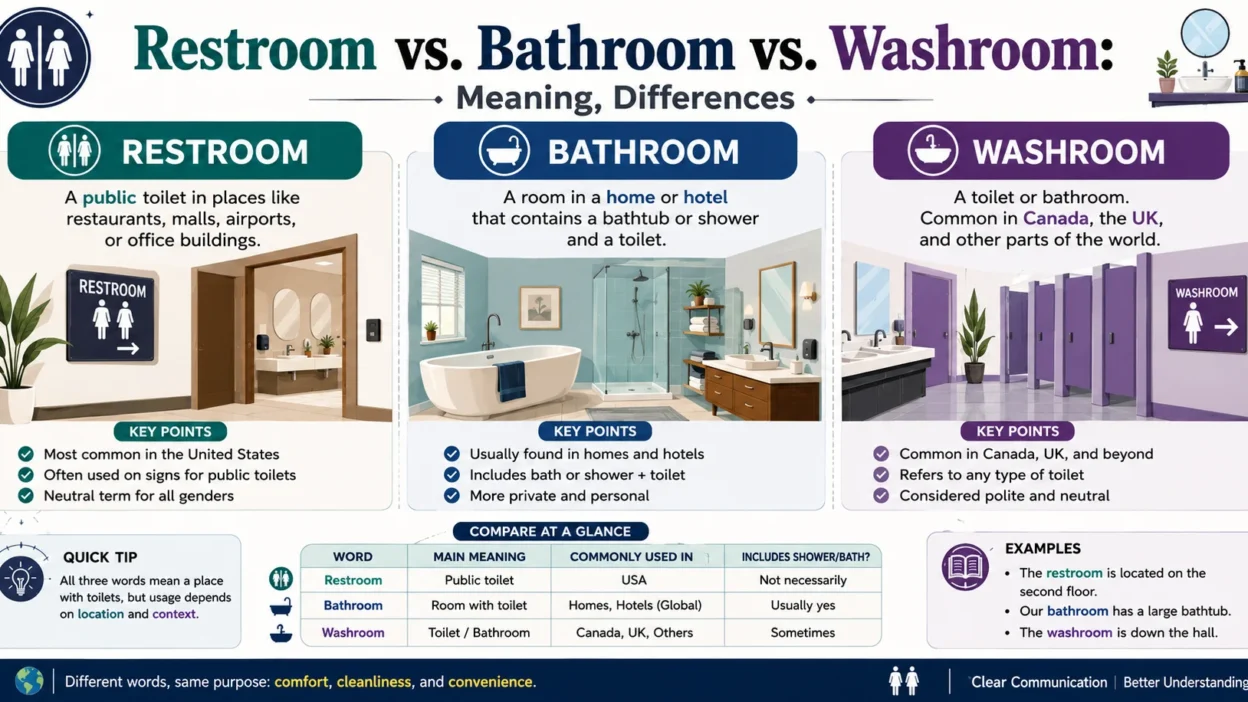
When you travel or speak with people from different regions, Restroom vs. Bathroom vs. Washroom can seem confusing, but the choice usually depends on culture, setting, and everyday language. In American English, bathroom commonly refers to a private room in a home, often containing a bathtub, shower, and toilet. Restroom is more common for public facilities in malls, offices, restaurants, and airports. In Canada, washroom is widely used for public spaces and some private settings. British English often uses toilet, WC, or lavatory, showing that the same basic function can have different names depending on the region, culture, and audience.
Imagine arriving at a new place, such as a shopping mall, busy airport, or friend’s house abroad, and suddenly needing to ask for directions. You might hesitate over which word to use, even though people will usually understand you. This small linguistic choice can carry surprising weight because terms can reflect politeness, geography, and social habits. Knowing these differences helps you communicate clearly, avoid awkward moments, and sound more culturally aware when you travel or interact with people globally. The important point is to consider whether you mean a private room or a public facility, as well as which term fits the regional context best.
In everyday usage, bathroom generally points to a home or private setting and its bathing fixtures, while restroom commonly identifies public facilities. Washroom is particularly common in Canada, although local customs, habits, and settings can vary. A foreign airport may even display signs using different labels for the same place, showing why these terms can have slightly different meanings. Across English-speaking countries, including the United States and Canada, the preferred word depends on context and usage. Americans may consider restroom more polite in formal settings, while washroom may be preferred in certain countries or official spaces. Understanding these distinctions makes it easier to choose the right word for each situation and speak more confidently.
Restroom vs. Bathroom vs. Washroom: The Quick Answer
Let’s start with the simplest explanation.
Bathroom, restroom, and washroom can all refer to a room or facility containing a toilet and facilities for personal hygiene. However, their preferred use varies by region and situation.
In American English:
- Bathroom is extremely common in homes and everyday conversation.
- Restroom is especially common for public facilities.
- Toilet usually refers to the actual fixture.
In Canadian English:
- Washroom is a standard everyday term.
- Bathroom is also widely understood and used, particularly in residential settings.
In British English:
- Toilet is generally the most natural everyday term for the room or facility.
- Bathroom more often suggests a room associated with bathing, although actual usage varies.
Here’s the basic picture:
| Term | Common regional association | Typical use |
| Bathroom | United States and broader North American English | Homes, everyday conversation, some public facilities |
| Restroom | United States | Public and commercial facilities |
| Washroom | Canada | Public and private toilet facilities |
| Toilet | United Kingdom and many other varieties | The fixture or the room, depending on region |
The important thing to remember is that these aren’t strict categories.
A public facility in the United States could be called a bathroom or restroom. The same kind of facility in Canada could be called a washroom.
The room may look almost identical.
The vocabulary changes.
Bathroom, Restroom, and Washroom at a Glance
The easiest way to understand the distinction is to compare the terms directly.
| Feature | Bathroom | Restroom | Washroom |
| Common in US English | Yes | Yes | Less common |
| Common in Canadian English | Yes | Sometimes | Yes |
| Common in British English | Yes, but usage differs | Uncommon | Uncommon |
| Common for homes | Yes | Less common | Yes in Canada |
| Common for public facilities | Yes | Very common | Very common in Canada |
| Requires a bathtub? | No | No | No |
| Usually associated with a toilet? | Yes | Yes | Yes |
| Can refer to a public facility? | Yes | Yes | Yes |
| Strong regional association | Moderate | Strong | Very strong |
One detail deserves special attention: a bathroom doesn’t have to contain a bathtub.
That’s especially important in American English.
A room with a toilet and sink but no bathtub or shower can still be called a bathroom. A half-bath is a familiar example.
Likewise, a restroom doesn’t need a special type of toilet, and a washroom doesn’t have to contain anything that makes it physically different from a bathroom.
The terminology is largely about what speakers call the room, not what the room physically contains.
What Does “Bathroom” Mean?
The word bathroom originally has an obvious literal meaning: a room associated with bathing.
Modern English, however, has expanded the word far beyond that narrow idea.
In American English, bathroom commonly means a room containing a toilet and sink. It may also contain a shower or bathtub, but those features aren’t required.
Bathroom as a Room With a Bath or Shower
The word can create a misleading impression if you interpret it too literally.
You might think:
“If there’s no bathtub, how can it be a bathroom?”
American English doesn’t work that way.
A bathroom can contain:
- A toilet
- A sink
- A shower
- A bathtub
- A combination of these
- Or simply a toilet and sink
For example:
“The guest bathroom doesn’t have a shower.”
That sentence sounds completely normal.
So does:
“There’s a small bathroom next to the kitchen.”
The word bathroom has become a conventional name for the room rather than a precise description of every fixture inside it.
How Americans Use “Bathroom”
For Americans, bathroom is one of the most flexible terms available.
You might use it when talking about:
- Your home
- An apartment
- A hotel room
- A school
- An office
- A restaurant
- A shopping center
- An airport
Consider these sentences:
“The bathroom is upstairs.”
“I need to clean the bathroom.”
“Is there a bathroom nearby?”
“The hotel bathroom has a large shower.”
All of them are natural American English.
The word doesn’t require the speaker to explain whether the room has a tub, shower, or only a toilet.
Bathroom vs. Toilet as Terms
The difference becomes more noticeable when comparing American English with British English.
In American English, toilet most commonly refers to the fixture.
For example:
“The toilet is clogged.”
Here, nobody means the entire room.
By contrast:
“The bathroom is clogged.”
would sound strange because the room itself isn’t normally what becomes clogged.
Americans therefore often use bathroom when referring to the room and the toilet when referring to the fixture.
That distinction isn’t universal across English-speaking countries.
In British English, toilet can naturally refer to the entire facility.
That’s one reason regional vocabulary matters so much.
What Does “Restroom” Mean?
Restroom is another common American English term for a toilet facility.
It has an interesting quality: the word doesn’t directly mention toilets, bathing, or bodily functions.
Instead, it uses a more indirect expression.
The Meaning Behind “Restroom”
The term restroom is essentially a euphemistic expression.
A euphemism replaces a potentially blunt or uncomfortable expression with something softer.
People don’t normally interpret restroom literally as a room where they go to rest.
Nobody expects a recliner and a cup of tea.
The word simply became an accepted, polite way to refer to a facility used for personal needs.
That makes it particularly useful in public settings.
A hotel employee might say:
“The restrooms are just past the lobby.”
That sounds professional and neutral.
Where “Restroom” Is Common
In the United States, restroom is especially common in public and commercial settings.
You may encounter the word in:
- Restaurants
- Airports
- Hotels
- Shopping malls
- Department stores
- Theaters
- Offices
- Schools
- Government buildings
- Public venues
A sign reading RESTROOMS is immediately understandable to most American English speakers.
The term works well because it’s short, familiar, and polite.
Restroom vs. Bathroom in American English
The difference between restroom vs. bathroom is mostly about context rather than physical structure.
Both can refer to the same facility.
However, some situations favor one term.
| Situation | Common choice |
| Talking about a home | Bathroom |
| Talking about a hotel room | Bathroom |
| Asking for a facility in a restaurant | Restroom or bathroom |
| Public building signage | Restroom |
| Talking casually with family | Bathroom |
| Customer-service language | Restroom |
There’s no grammatical rule that says Americans must use restroom in public places.
Someone can easily ask:
“Is there a bathroom here?”
That’s perfectly understandable and natural.
The point is that restroom have a stronger public-setting association.
What Does “Washroom” Mean?
If restroom sounds particularly American, washroom sounds particularly Canadian.
The term is widely recognized throughout Canada and is a normal word for a facility containing toilets and handwashing facilities.
Washroom in Canadian English
A Canadian might say:
“Where’s the washroom?”
That sentence is completely ordinary.
A sign might say:
WASHROOM
You could see it in:
- Restaurants
- Shopping centers
- Airports
- Schools
- Offices
- Hotels
- Public buildings
For many Canadian speakers, washroom is simply the normal word.
It doesn’t necessarily sound formal or unusual.
Why “Washroom” Doesn’t Mean Only a Place to Wash
The word can seem confusing if you interpret it literally.
A washroom isn’t merely a room with sinks.
It normally provides facilities for both toileting and washing.
A typical washroom might contain:
- Toilets
- Urinals
- Sinks
- Soap
- Mirrors
- Hand dryers
- Paper towels
- Accessible stalls
- Changing tables
So when a Canadian says:
“I need to use the washroom.”
they aren’t saying they only need to wash their hands.
The term refers to the entire facility.
Washroom vs. Bathroom and Restroom
The most useful distinction is regional.
Bathroom is strongly associated with American residential English.
Restroom is strongly associated with American public English.
Washroom is strongly associated with Canadian English.
The physical room can be exactly the same.
Imagine an identical facility containing three toilets, two sinks, mirrors, and hand dryers.
An American sign might say:
RESTROOM
A Canadian sign might say:
WASHROOM
Another American speaker might simply call it:
BATHROOM
The facility hasn’t changed.
Only the regional vocabulary has.
Where Did These Terms Come From?
The history of these words reveals an important feature of English: people often use indirect language for private bodily functions.
That’s why several different terms can exist for the same facility.
The History of “Bathroom”
The original meaning of bathroom is closely connected to bathing.
Over time, particularly in American English, the term broadened.
It became a common name for a room associated with several personal functions, including toileting, washing, bathing, and grooming.
The modern meaning doesn’t require a bathtub.
This is a normal kind of semantic change. Words often develop broader meanings through everyday use.
Today, an American isn’t normally thinking:
“This room must contain a bath because the word says bathroom.”
Instead, bathroom is simply the conventional name for the room.
The History of “Restroom”
Restroom developed as an indirect expression for a facility used for personal needs.
Its wording is softer than explicitly naming the toilet or the bodily functions performed there.
This makes it especially suitable for public communication.
Businesses, institutions, and public venues often want language that is clear without sounding overly direct.
Restroom fits that purpose.
The History of “Washroom”
Washroom focuses on the washing and hygiene side of the facility.
The word became strongly established in Canadian English.
Although it emphasizes washing, it doesn’t exclude toilets. In modern usage, washroom refers to the complete facility.
Why Euphemisms Became Important
English has a long history of replacing direct references to bodily functions with more polite or indirect terms.
That’s why you may encounter expressions such as:
- Restroom
- Powder room
- Ladies’ room
- Men’s room
- Facilities
- Lavatory
- Washroom
These words aren’t necessarily identical in tone or regional usage.
Some sound formal.
Some sound old-fashioned.
Some are strongly regional.
Others are common in everyday speech.
The important point is that social expectations influence vocabulary.
Restroom vs. Bathroom vs. Washroom: Are They Actually Different Rooms?
In most everyday situations, no.
A restroom, bathroom, and washroom can refer to essentially the same type of facility.
The terminology doesn’t automatically tell you the room’s layout.
A bathroom might contain:
- A toilet
- A sink
- A bathtub
- A shower
A restroom might contain:
- Toilets
- Urinals
- Sinks
- Mirrors
A washroom might contain:
- Toilets
- Sinks
- Soap dispensers
- Hand dryers
- Accessible stalls
But these aren’t strict definitions.
A bathroom can lack a bathtub.
A restroom can contain exactly the same fixtures as a washroom.
A washroom can look identical to an American restroom.
That’s why trying to define the words based entirely on physical features leads to confusion.
The more reliable distinction is regional and contextual usage.
What Facilities Can You Find in Each?
Although the terminology varies, modern facilities tend to share many features.
Toilets
Toilets are the central fixture associated with these facilities.
However, the toilet itself has regional differences.
In American English, it usually refers specifically to the fixture.
In British English, it can refer to the entire room.
That difference can create amusing misunderstandings for English learners.
Urinals
Public men’s facilities may include urinals in addition to enclosed toilet stalls.
The presence of a urinal doesn’t determine whether the facility is called a:
- Bathroom
- Restroom
- Washroom
- Toilet
Regional vocabulary still determines the preferred label.
Sinks and Handwashing Stations
Sinks are standard features in most modern facilities.
You may find:
- Faucet controls
- Soap dispensers
- Paper towels
- Hand dryers
- Mirrors
- Accessible sinks
These features support personal hygiene, which is one reason washroom is such an intuitive term.
However, the presence of a sink doesn’t make a facility a washroom.
Showers and Bathtubs
Showers and bathtubs are much more strongly associated with private bathrooms.
A typical residential bathroom may have:
- A bathtub
- A shower
- A toilet
- A sink
- Storage cabinets
Public restrooms generally don’t include showers or bathtubs.
That’s a difference in facility design, not a strict linguistic rule.
Other Common Features
Modern facilities may also contain:
- Mirrors
- Changing tables
- Sanitary-product disposal units
- Grab bars
- Privacy partitions
- Hand dryers
- Paper-towel dispensers
- Accessible stalls
- Emergency assistance features
These features tell you much more about how a facility is designed than its name does.
Public vs. Private Use Changes the Word Choice
The setting can strongly influence which word sounds most natural.
At Home
For most Americans, bathroom is the obvious choice.
You might say:
“The bathroom is at the end of the hallway.”
Or:
“I’m cleaning the bathroom this afternoon.”
The word works whether the room has a shower, bathtub, or neither.
In Public Places
In American English, restroom becomes particularly natural in public settings.
For example:
“The restrooms are near the elevators.”
A restaurant employee might say:
“The restroom is through that door.”
The term feels neutral and professional.
Still, bathroom isn’t wrong.
You might ask:
“Is there a bathroom nearby?”
Nobody would misunderstand you.
In Canada
In Canada, washroom frequently fill the same role.
You might see:
WASHROOM →
on a sign at a shopping center.
An American visitor will understand the word, but may be more accustomed to restroom or bathroom.
Regional Differences in English-Speaking Countries
English isn’t one uniform language.
Vocabulary changes from country to country, sometimes dramatically.
United States
The most common terms include:
- Bathroom
- Restroom
- Toilet, especially for the fixture
American speakers commonly use bathroom in homes and restroom in many public settings.
The two overlap considerably.
Canada
Washroom is one of the most recognizable Canadian terms.
You may hear:
“Where’s the washroom?”
in ordinary conversation.
Bathroom is also common, particularly when discussing a home.
United Kingdom
British English commonly uses a toilet for the room or facility.
For example:
“Where are the toilets?”
sounds perfectly natural.
You may also see:
- Public toilets
- Ladies
- Gents
- WC
- Lavatory
These terms differ in formality and setting.
Australia and New Zealand
Australian and New Zealand English also use terms such as toilet and bathroom, with the exact choice depending on context.
The broader lesson is important:
English-speaking countries don’t share every vocabulary preference.
A word can be perfectly ordinary in one place and noticeably foreign in another.
Why “Toilet” Can Sound Different Depending on Where You Are
Here’s one of the easiest ways to see regional variation in action.
A British person might say:
“Where’s the toilet?”
That sounds completely normal in Britain.
An American might instead say:
“Where’s the bathroom?”
or:
“Where’s the restroom?”
The American speaker isn’t necessarily avoiding the word toilet because it’s grammatically incorrect.
Rather, toilets have a different conversational role in American English.
It usually names the fixture:
“The toilet won’t flush.”
So if you’re traveling, don’t assume that a word’s social tone remains unchanged across borders.
Regional context matters.
Gender, Accessibility, and Inclusive Terminology
Modern facilities involve more than basic plumbing.
Design also considers privacy, accessibility, family needs, and gender access.
Men’s and Women’s Facilities
Common labels include:
- Men
- Women
- Men’s Room
- Women’s Room
- Men’s Restroom
- Women’s Restroom
These labels can vary by building and country.
The purpose is straightforward: tell visitors who the facility is intended for.
Gender-Neutral Restrooms
You may also encounter:
- Gender-neutral restroom
- All-gender restroom
- Unisex restroom
These terms describe access, not the physical plumbing.
For example:
“The building has an all-gender restroom on the first floor.”
The phrase all-gender explains who can use it.
The word restroom identifies the facility.
Accessibility
Accessibility is separate from terminology.
An accessible facility may provide:
- Wider doors
- Adequate maneuvering space
- Grab bars
- Accessible toilet placement
- Accessible sinks
- Appropriate turning space
- Clear signage
- Emergency assistance features
In the United States, public accessibility is governed in important respects by federal requirements including the Americans with Disabilities Act and its accessibility standards.
The terminology doesn’t determine accessibility.
A bathroom, restroom, or washroom can be accessible if it has been designed appropriately.
Family and Changing Facilities
Modern public buildings may also offer:
- Family restrooms
- Parent-and-child facilities
- Baby-changing stations
- Adult changing facilities
These facilities address practical needs that aren’t captured simply by the words bathroom, restroom, or washroom.
Bathroom, Restroom, and Washroom in Signs and Formal Writing
The choice becomes especially noticeable on signs.
Signs need to be short and instantly recognizable.
In American Public Spaces
RESTROOM is extremely familiar on signs in the United States.
You may find it in:
- Airports
- Hotels
- Restaurants
- Shopping centers
- Theaters
- Offices
BATHROOM is also widely understood.
In Canada
WASHROOM is a natural choice for Canadian public signage.
A Canadian building can therefore use:
WASHROOM
where an American building might use:
RESTROOM
In Britain
TOILETS are common on public signs.
That difference illustrates a useful rule for writers:
Don’t assume the vocabulary of one English-speaking country represents all English.
When writing for a specific audience, match the terminology to that audience.
Common Mistakes and Misunderstandings
These terms cause several predictable errors.
Assuming a Bathroom Must Have a Bathtub
This is false in modern American English.
A bathroom can contain only a toilet and sink.
A half-bath is a good example.
Thinking a Restroom Is a Place to Rest
Don’t interpret restroom literally.
It’s a conventional euphemism for a facility used for personal needs.
The name doesn’t imply that the room contains seating or a place to relax.
Assuming Washroom Means There Is No Toilet
A washroom normally includes toilet facilities.
The word emphasizes washing and hygiene, but it describes the whole room.
Treating Regional Terms as Universal
This is where many English learners get tripped up.
Restroom sounds very natural in the United States.
Washroom sounds particularly natural in Canada.
Toilet sounds completely ordinary in Britain.
None is universally superior.
Confusing “Toilet” With “Bathroom”
In American English:
“The toilet is clogged.”
usually means the fixture.
“The bathroom is dirty.”
usually means the room.
In British English, toilet can refer to the entire room.
Context does the heavy lifting.
Restroom vs. Bathroom vs. Washroom: Side-by-Side Examples
Real-life situations make these differences easier to understand.
| Situation | Natural term | Example |
| US home | Bathroom | “The bathroom is upstairs.” |
| US restaurant | Restroom | “Where’s the restroom?” |
| US apartment | Bathroom | “The apartment has two bathrooms.” |
| Canadian restaurant | Washroom | “Where’s the washroom?” |
| Canadian office | Washroom | “The washroom is beside the elevator.” |
| British train station | Toilet / Toilets | “Where are the toilets?” |
| Any English variety | Toilet | “The toilet is clogged.” |
Case Study: One Facility, Three Different Names
Imagine a public facility with:
- Three enclosed toilets
- Two urinals
- Four sinks
- Mirrors
- Soap dispensers
- Hand dryers
- An accessible stall
- A changing table
Now imagine placing that exact same facility in three countries.
In the United States, the sign could say:
RESTROOM
In Canada, it could say:
WASHROOM
In Britain, it could say:
TOILETS
The fixtures haven’t changed.
The room hasn’t changed.
The regional vocabulary has changed.
That’s why restroom vs. bathroom vs. washroom is primarily a question of language and context rather than architecture.
Which Term Should You Use?
When you’re unsure, consider region, setting, and audience.
If You’re Speaking American English
Use bathroom when referring generally to a private facility.
“The bathroom is down the hall.”
Use restroom when referring to a public facility, especially in customer-facing situations.
“The restroom is near the entrance.”
Both are correct.
If You’re Speaking Canadian English
Washroom is a natural choice for public facilities.
“Excuse me, where’s the washroom?”
Bathroom also work, particularly in residential contexts.
If You’re Speaking British English
Toilet is generally the straightforward everyday choice.
“Where’s the toilet?”
On signs, you may see:
TOILETS
That’s completely normal British usage.
If You’re Writing for an International Audience
Choose terminology according to your audience.
For American readers, bathroom and restroom will be immediately familiar.
For Canadian readers, washroom deserves special attention.
For British readers, the toilet is usually more natural.
If the audience is international, briefly explaining the regional differences can eliminate confusion.
Bathroom vs. Restroom vs. Washroom: A Practical Comparison
| Question | Bathroom | Restroom | Washroom |
| Is it correct English? | Yes | Yes | Yes |
| Common in US English? | Yes | Yes | Less common |
| Common in Canada? | Yes | Sometimes | Yes |
| Requires a bathtub? | No | No | No |
| Can you describe a public facility? | Yes | Yes | Yes |
| Common for a home? | Yes | Less common | Yes in Canada |
| Strongly associated with Canada? | No | No | Yes |
| Strongly associated with US public facilities? | Somewhat | Yes | No |
| Can refer to the same physical facility? | Yes | Yes | Yes |
Quick Decision Guide
Need the answer quickly?
Use this practical guide:
At home in the United States?
→ Bathroom
Looking for a public facility in the United States?
→ Restroom or bathroom
In Canada?
→ Washroom
In Britain?
→ Toilet
Talking about the actual fixture?
→ Toilet
Talking about a room containing bathing facilities?
→ Bathroom
These aren’t rigid rules.
They’re useful patterns that reflect common usage.
Conclusion
The difference between Restroom, Bathroom, and Washroom mainly comes down to region, setting, and cultural usage. Bathroom is common for a private room at home, restroom is widely used for public facilities in American English, and washroom is especially common in Canada. While these terms often mean the same basic space, choosing the word that matches the local context can make your communication sound more natural and culturally aware.
FAQs
Q1. What is the main difference between restroom, bathroom, and washroom?
All three terms can refer to a room containing a toilet and other hygiene facilities, but their usage varies by region and setting. Bathroom is common in homes, restroom is common for public facilities in the United States, and washroom is especially common in Canada.
Q2. Is “bathroom” used only for a room with a bathtub?
No. Bathroom can refer to a room with a toilet, sink, shower, bathtub, or a combination of these. In everyday American English, people commonly use bathroom even when the room does not contain a bathtub.
Q3. Is “restroom” more polite than “bathroom”?
In American English, restroom can sound more polite or formal when referring to a public facility. However, bathroom is also perfectly natural and widely accepted in everyday conversation.
Q4. Why do Canadians say “washroom”?
Washroom is a common Canadian term for a toilet or public bathroom. The word emphasises the room’s connection with washing and personal hygiene, although it can refer to essentially the same type of facility as a restroom or bathroom.
Q5. Which word should I use when traveling?
The best choice depends on the country and setting. In the United States, restroom works well for public places, while bathroom is common in homes and casual speech. In Canada, washroom is a natural choice, especially for public facilities.