Prove vs Proof becomes much easier when you learn how each word works in everyday English, and this simple difference improves your writing. Many people learning the language stop after they have typed a sentence, paused, and started to wonder which word to write. These two words look similar, have a related sound, and share the same root, so they often confuse both native and non-native speakers alike. From my own experience helping learners, I have found that this common confusion usually comes from not understanding the grammatical role of each word. Prove is a verb that describes an action, while proof is a noun referring to evidence. Once you understand this difference, the meaning becomes clear, and your writing feels more natural.
Think of prove as the function used to demonstrate truth, while proof is the confirmation, verification, or demonstration that confirms a point. This simple concept makes communication stronger because the correct form, forms, and sentence structure create more precise, accurate, and easier-to-read sentences. Good instructional materials, educational guidance, teachers, writers, and professionals often rely on examples, comparison tables, and reference materials to clarify this distinction. Paying attention to grammar, semantics, lexical category, usage, context, and different contexts helps improve confidence, fluency, and everyday and professional language skills.
As you apply these practical tips, the correct application of each word becomes more intuitive. Over time, you stop mixing the two, avoid sloppy or unclear writing, and remember useful memory tricks that help you use them confidently. This guide breaks down everything you need to know, making the understanding of their different roles much easier. Better readability, stronger correctness, and strengthening your skills happen naturally when you choose the right word in the right place.
Prove vs Proof: The Quick Difference
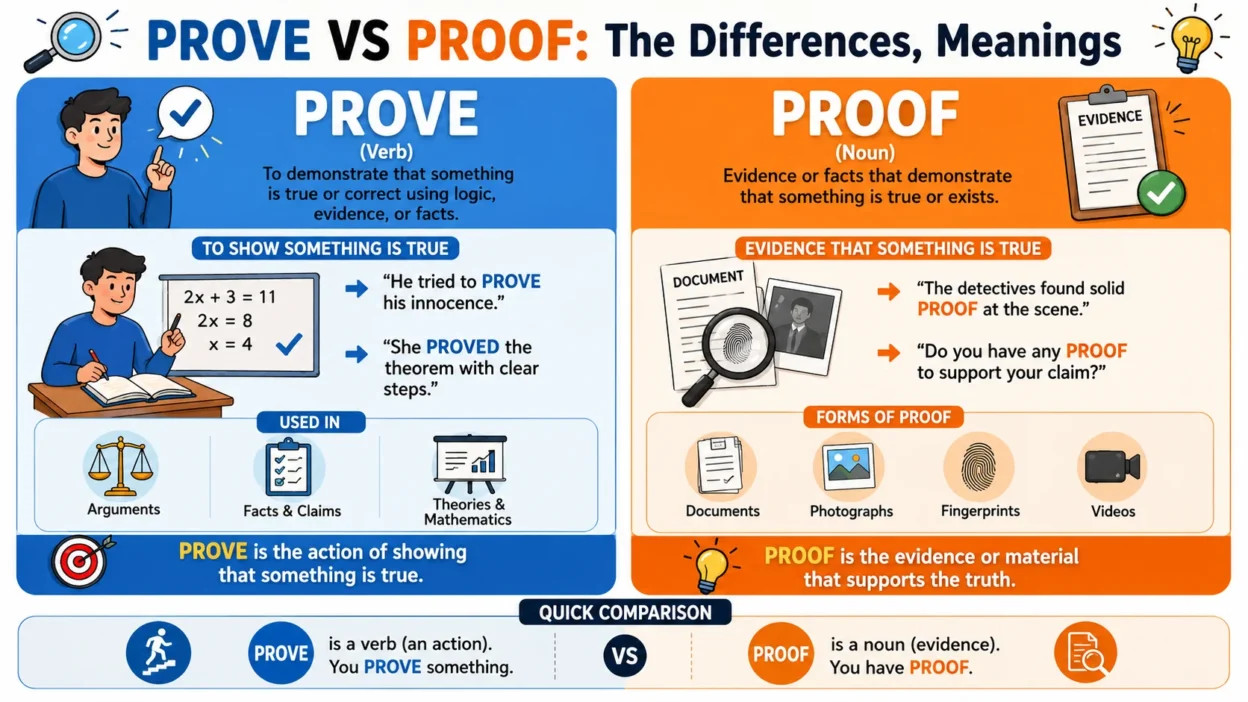
At the most basic level, prove means to demonstrate that something is true, real, or valid. Proof means the evidence, fact, or support that helps establish that truth.
Here is the simplest way to think about it:
- Prove is something you do
- Proof is something you have
That distinction is easy to remember because it matches how the words behave in real English. You prove a claim, a theory, a point, or a case. You have proof of a claim, a theory, a point, or a case.
Prove at a glance
- Part of speech: verb
- Main job: to show that something is true
- Common use: action, process, demonstration
- Example: She proved her argument with solid data.
Proof at a glance
- Part of speech: noun
- Main job: evidence or confirmation
- Common use: result, support, verification
- Example: The report provided proof of the error.
Prove vs proof in one table
| Feature | Prove | Proof |
| Part of speech | Verb | Noun |
| Main meaning | To show something is true | Evidence that shows something is true |
| Grammar role | Action word | Thing word |
| Example use | Prove a theory | Proof of a theory |
| Common sentence pattern | subject + prove + object | proof of + noun |
This table captures the main difference, but the real picture gets richer once you see how each word works in context. English is full of words that look neat in a chart and then behave more flexibly in real life. Prove and proof are no exception.
What Does “Prove” Mean?
Prove is a verb. It describes the act of showing that something is true or valid. That may sound simple, but the word appears in many different settings. People use it in science, law, everyday conversation, academic writing, and even emotional situations.
Definition and part of speech
As a verb, prove means to establish the truth of something through evidence, reasoning, testing, or experience.
For example:
- The experiment proved the hypothesis.
- Her actions proved her loyalty.
- The documents proved the company’s ownership.
In each sentence, prove carries movement. Something is being shown, tested, or confirmed. It is active, not static.
Verb forms of prove
The word prove changes form depending on tense and sentence structure:
- prove — base form
- proves — third-person singular present
- proved — simple past
- proven — past participle in many modern uses
- proving — present participle
Examples:
- They prove their point with facts.
- He proves himself under pressure.
- The results proved the method effective.
- The theory has been proven over time.
- She is proving her skill every day.
A small note matters here. Many style guides accept both proved and proven as past participles in different contexts, though usage varies by region and style preference. In many American English contexts, proven is common as an adjective-like past participle in phrases such as proven results or a proven strategy. In strict verb usage, proved is often the safer choice in formal writing. That distinction becomes more important in the later grammar section.
Common meanings of prove
Prove does not only mean “show that something is true.” It also appears in a few related ways.
Show that something is true
This is the most common use.
- The witness proved the defendant’s location.
- The data proved the point beyond doubt.
Demonstrate ability or worth
People often use prove when talking about performance, character, or skill.
- She wanted to prove herself in the new role.
- He proved he could lead the team.
Turn out to be true
Sometimes prove means that reality confirms a belief or prediction.
- The warning proved accurate.
- Their concerns proved justified.
That last use is especially common in formal writing. It sounds polished because it compresses a lot of meaning into a small space. Instead of saying “Their concerns were shown to be justified,” you can say, “Their concerns proved justified.”
What Does “Proof” Mean?
Proof is usually a noun. It refers to evidence, confirmation, or support that helps establish truth. If prove is the action, proof is the result or the material that supports the result.
Definition and part of speech
As a noun, proof means evidence that shows something is true, correct, or valid.
Examples:
- The police found proof of fraud.
- She asked for proof of payment.
- We need proof before making a decision.
Notice how the word acts here. You can touch it in a sentence, almost like a thing you place on the table. It is the evidence itself, not the act of showing the evidence.
Different meanings of proof
The word proof can refer to several related ideas.
Evidence
This is the most common meaning.
- Do you have proof of identity?
- The email served as proof of the agreement.
Confirmation
Sometimes proof means a final sign that something is true.
- His promotion was proof that hard work pays off.
- The silence felt like proof that the message had landed.
Mathematical proof
In mathematics, proof means a logical argument that establishes a statement as true.
- The theorem required a formal proof.
- The professor explained the proof step by step.
This use is precise and technical. In math, a proof is not just “some evidence.” It is a structured chain of logic. Every step must support the next one.
Legal proof
In legal contexts, proof refers to evidence strong enough to satisfy the required standard.
- The prosecution did not have enough proof.
- The court reviewed the proof carefully.
Legal proof and everyday proof are related, but the legal meaning is stricter. In court, not every clue counts. The law cares about standards, admissibility, and burden of proof.
Proof as an adjective
This is where English gets a little sneaky. Proof also appears in compounds that behave like adjectives.
Examples:
- waterproof
- fireproof
- bulletproof
- proofreading
- proof of concept
In these cases, proof helps describe resistance, protection, or testing. A waterproof jacket resists water. A bulletproof plan is being described as highly secure, though in real life that phrase is often figurative rather than literal.
There is also the phrase proof of concept, which is very common in business and technology. It means an early demonstration that a product, method, or idea can work in practice.
Side-by-Side Comparison: Prove vs Proof
The easiest way to avoid mistakes is to compare them directly in real use.
| Feature | Prove | Proof |
| Word type | Verb | Noun |
| Main role | Action | Evidence |
| Core idea | To show truth | What shows truth |
| Common pattern | prove something | proof of something |
| Example | They proved the claim. | They gave proof of the claim. |
This table shows the grammar clearly, but sentence rhythm matters too. English speakers rarely stop to label grammar in daily conversation. They just know what sounds right. That is why examples help more than rules alone.
Compare these:
- Correct: She proved her ability during the interview.
- Correct: Her ability was proof that she belonged there.
- Incorrect: She proved her ability during the interview.
- Incorrect: Her ability was prove that she belonged there.
The first two sound natural. The last two do not. That is because the words are being used in the wrong grammatical roles.
When to Use “Prove”
Use prove when you need to describe an action, a demonstration, or a confirmation process. It is the word you choose when something is being established or shown.
Showing evidence through action
This is the most direct use.
- The scientist proved the theory through repeated tests.
- The manager proved the value of the new process.
Here, the emphasis is on the act of showing. The subject does something that leads to certainty.
Demonstrating skill or character
This use appears often in personal and professional writing.
- He proved himself as a reliable teammate.
- She proved her leadership in a difficult moment.
These sentences do more than say someone performed well. They suggest that action settles a question about the person’s ability or character.
Showing something turned out to be true
This form is common in polished writing.
- The forecast proved accurate.
- Their concerns proved valid.
In these examples, the result confirms the earlier idea. The sentence often feels more elegant than a longer alternative.
Common sentence patterns with prove
These patterns show up again and again:
- prove that + clause
- The report proved that the system failed.
- prove something
- The trial proved his innocence.
- prove to be + adjective
- The new strategy proved to be effective.
- prove oneself
- She proved herself under pressure.
Once you notice these patterns, your ear starts to improve fast. That is one reason good writers read carefully. Patterns train memory.
When to Use “Proof”
Use proof when you need to talk about evidence, support, or confirmation. If the sentence asks for a thing, a piece of evidence, or a sign that something is true, proof is usually the right word.
Talking about evidence
This is the most common everyday use.
- I need proof of address.
- They asked for proof of purchase.
These are practical phrases people use all the time. Forms, receipts, IDs, and records often count as proof in daily life.
Academic and scientific writing
In academic settings, proof can refer to evidence or logical support, especially in math and formal argument.
- The study presented proof of a correlation.
- The theorem required a proof.
In science and research writing, the word should be used carefully. Strong claims need strong support. That is why writers often distinguish between evidence and proof. Evidence can be partial or suggestive. Proof implies a much firmer conclusion.
Legal and business contexts
In law and business, proof matters because decisions often depend on documents, records, and standards.
- We need proof of insurance.
- The lawyer requested proof of delivery.
These phrases are common because they point to something concrete. A company may not just want your word. It wants proof.
Everyday conversations
People also use proof in casual speech when they want to sound certain.
- That was proof enough for me.
- His smile was proof that he understood.
These uses are softer and more conversational. They often describe an impression rather than a legal standard.
Common sentence patterns with proof
Here are the most useful structures:
- proof of + noun
- proof of identity
- proof of income
- proof of concept
- proof that + clause
- The evidence was proof that the rumor was false.
- proof for + purpose
- They asked for proof for the application.
The phrase proof of is especially common. It sounds natural in nearly every context where a document, record, or fact is needed.
A practical way to choose between them
Ask yourself one simple question:
Am I talking about the action of showing something, or the evidence that supports it?
If you are talking about the action, use prove.
If you are talking about the evidence, use proof.
That question solves many problems quickly.
- Can you prove it?
You are asking someone to demonstrate the truth. - Can you show me proof?
You are asking for evidence.
The difference is subtle, but it is real. In strong writing, small differences matter. They shape tone, clarity, and trust.
A quick real-life example
Imagine a customer claims a package never arrived.
- The delivery company may prove the package was delivered by showing tracking records and a signature.
- The customer may ask for proof that the package reached the correct address.
Both words belong in the same situation, but they do different jobs. One is the act. The other is the evidence.
That is the heart of the difference.
Summary so far
At this point, the rule should feel much clearer:
- Prove is a verb.
- Proof is usually a noun.
- You prove a claim.
- You ask for proof of a claim.
- Prove describes action or confirmation.
- Proof describes evidence or support.
This is the foundation. In the next section, the grammar gets more detailed. That is where things like proven vs proved, common collocations, and confusing edge cases start to matter.
Conclusion
Understanding Prove vs Proof is easier once you remember that prove is an action word and proof is the evidence that supports that action. Although the two words look and sound similar, they serve different purposes in English grammar. Using the correct word makes your writing clearer, more professional, and easier to understand. With regular practice and by paying attention to the context, choosing between prove and proof will soon become a natural habit.
FAQs
Q1.Is “prove” or “proof” correct in a sentence?
It depends on the sentence. Use prove when you mean to show that something is true. Use proof when you mean the evidence that shows it is true.
Q2.What is the main difference between “prove” and “proof”?
Prove is a verb, so it describes an action. Proof is a noun, so it refers to the evidence or facts that support a claim.
Q3.Can “proof” be used as a verb?
Yes, but only in specific contexts. In publishing, proof can mean to check written material for errors before publication. In everyday English, it is most commonly used as a noun.
Q4.How can I remember when to use “prove” and “proof”?
A simple trick is to remember that prove is something you do, while proof is something you have. If you’re talking about taking action, use prove. If you’re talking about evidence, use proof.
Q5.Why do people confuse “prove” and “proof”?
People often confuse them because they share the same root, have similar spellings, and are closely related in meaning. However, they belong to different parts of speech and have different grammatical functions.