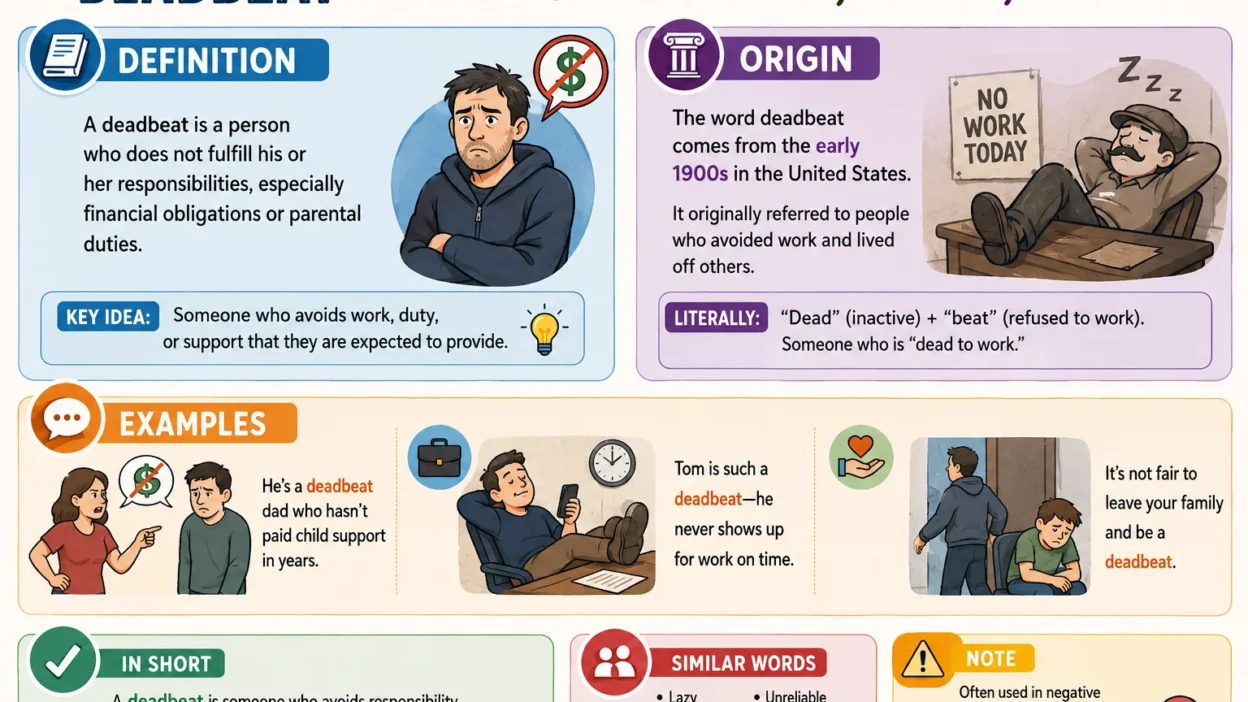
Deadbeat is a word that may seem simple, but it carries serious meaning in real life. People use the term to describe a person who avoids responsibility, ignores commitments, and leaves others to handle the burden. In everyday speech, calling someone a deadbeat suggests they are unreliable, lazy, unwilling to do their part, and often fail to meet basic family or financial duties. From what I have seen while editing language content, this label is usually based on a repeated pattern of behaviour, not one bad day or a single missed payment. It is a judgement-heavy description that often appears in financial conversations because people feel it reflects a lack of reliability, accountability, and dependability.
A deadbeat debtor is a debtor who refuses to pay what is owed, while a deadbeat parent is a parent who fails to provide support, care, and attention for children. The same idea can appear in the workplace or other workplaces, where someone avoids effort, keeps relying on coworkers to finish the job, and shows a poor work ethic. Because the term has a strong emotional edge, it often signals frustration, disappointment, and anger. Although it appears sparingly in formal writing, it is used more freely in casual conversation and other casual use, where the harsh expression is sometimes thrown around without much thought. The phrase is rarely meant as a neutral description, since it often points to careless actions, dodging obligations, and leaving others to carry the load.
Over time, the meaning of deadbeat has expanded beyond its originally technical use as a type of watch escapement in the late 1800s. Today, the term commonly refers to people whose actions imply they fail to meet what is expected of adults, whether through debt, financial responsibility, family responsibility, support payments, unpaid bills, unpaid debt, unpaid support, neglect, avoidance, failure, broken trust, or other consequences. The negative sense of the word also appears in names like deadbeat dad and deadbeat mo. Learning this history gives a clearer picture of why the article is useful, what comes to mind when you hear the term, and the different ways people use it in conversation, writing, and speech.
Deadbeat Meaning in Everyday Language
In everyday speech, deadbeat often works as a shortcut for several ideas at once. It can mean someone is lazy, unreliable, selfish, broke, or all of these together. Context decides the exact meaning. That is why the word can shift from one situation to another without losing its negative tone.
For example, if a friend says, “He’s a deadbeat and never pays his share,” the focus is money. If someone says, “She had a deadbeat boyfriend who never helped with anything,” the focus is on effort and responsibility. If a person says, “That company is full of deadbeats,” the meaning may point to poor work ethic or people who avoid accountability.
The word is mostly informal. You will hear it in conversation, opinions, complaints, gossip, and commentary. It is less common in careful professional writing unless the topic is legal, social, or financial. Even then, it usually appears with explanations because the term can sound insulting.
One reason the word stays popular is that it is short, punchy, and easy to understand. People do not need a long explanation when they hear it. The label carries its own meaning. However, that convenience comes with a downside. Because it is so loaded, it can sometimes oversimplify a person’s situation. Someone may be struggling, overwhelmed, or unable to keep up for reasons that are more complex than a rude label suggests.
Common Deadbeat Usage Examples
Here are a few natural examples of how people use the word:
- “He’s a deadbeat who never pays his bills on time.”
- “Her ex was a deadbeat parent who disappeared for years.”
- “Don’t expect help from him. He acts like a deadbeat.”
- “The landlord called the tenant a deadbeat for missing rent again.”
These examples show how the word usually points to repeated failure, not a one-time mistake.
Figurative Meanings and Connotations of Deadbeat
Although deadbeat often refers to responsibility, the term can also carry figurative meaning. Sometimes it describes someone who seems to have no energy, no ambition, or no drive. In that sense, it overlaps a little with words like lazy or unmotivated, but it still feels harsher.
It also suggests moral failure in many contexts. That is a key difference. A person can be lazy without being cruel. A person can be tired without being irresponsible. But deadbeat often implies that someone is knowingly letting others down.
The emotional tone behind the word matters. Calling someone a deadbeat is rarely a compliment. It implies disappointment and disapproval. In social settings, it can damage reputation fast. In family settings, it can deepen conflict. In money matters, it can become a label that follows a person for years.
The Origin and History of Deadbeat
The history of deadbeat is more interesting than many people expect. The word did not begin as a direct insult. Like many English terms, it developed over time and picked up sharper meanings as people kept using it.
Where Did Deadbeat Come From?
The word has older roots in 19th-century American English. Originally, deadbeat described something that had stopped moving or something that had no energy left. It was used in technical and descriptive ways before becoming slang. Over time, the word picked up the sense of someone who was completely worn out or inactive.
That early meaning eventually blended with social ideas about laziness, failure, and avoidance. Once that happened, the word moved from describing a condition to describing a person’s character. That shift is important. It shows how language can change from plain description to moral judgment.
How Deadbeat Changed Over Time
As the word became more common in daily speech, it started to focus less on physical exhaustion and more on stubborn avoidance. A deadbeat was no longer just someone who lacked energy. The word now suggested someone who could act but chose not to.
That change helped the term settle into its modern meaning. Today, most English speakers do not think of the original technical sense at all. Instead, they hear a person who avoids responsibility, ignores obligations, or takes advantage of others.
This is a good example of semantic drift, the process where a word’s meaning changes over time. English is full of these shifts. A term can begin as neutral and later become harsh, or begin as literal and end up figurative. Deadbeat followed that path.
Deadbeat in Everyday Language Today
The modern use of deadbeat depends heavily on the setting. In casual speech, it is common and direct. In formal contexts, it can feel too personal or too judgmental unless it is clearly necessary.
Common Deadbeat Examples in Real Life
People often use the term in situations like these:
- Money problems: Someone keeps borrowing but never repays.
- Parenting: A parent ignores child support or disappears from a child’s life.
- Relationships: A partner avoids emotional, financial, or household responsibility.
- Work: A coworker repeatedly avoids tasks and expects others to cover for them.
The word gets stronger when the pattern is repeated. One mistake does not usually earn the label. A habit does.
Deadbeat and Emotional Tone
The tone of the word is often more important than the dictionary meaning. For example, two people could describe the same person differently. One might say, “He is struggling and behind on rent.” Another might say, “He’s a deadbeat.” Both may refer to missed payments, but only one adds strong blame.
That difference matters. It shows how language can frame a person either as someone in trouble or as someone unworthy of sympathy.
Different Types of Deadbeats
Not every deadbeat looks the same. The word can apply to different forms of responsibility failure. Each type has its own pattern.
Financial Deadbeats
A financial deadbeat is someone who avoids paying money they owe. This can include rent, loans, debts, borrowed cash, or bills. In many cases, the person has the means to pay but still refuses. That makes the behavior especially frustrating to others.
Financial deadbeats often damage trust in a big way. Money is personal. When someone borrows and does not repay, the relationship can change quickly. People may stop lending, stop trusting, and stop defending the person’s character.
Deadbeat Parents
The phrase deadbeat parent is widely used in everyday speech, legal discussions, and media reports. It usually refers to a parent who does not provide steady emotional or financial support. That can mean missing child support payments, disappearing from a child’s life, or avoiding day-to-day care.
This phrase is powerful because parenting carries clear expectations. A parent is supposed to show up. When they do not, the social judgment tends to be severe.
Still, it is worth separating neglect from difficulty. A parent who is trying but temporarily unable to provide support is not the same as someone who deliberately refuses to help. The label should reflect conduct, not just hardship.
Deadbeat Partners
In relationships, a deadbeat partner is someone who avoids effort and leaves the other person to do nearly everything. That might involve money, chores, planning, emotional support, or family duties. The word can also apply when one partner keeps making promises but never follows through.
This kind of behavior often creates resentment. Relationships depend on balance. Once one side feels like they are doing all the work, frustration grows fast.
Workplace Deadbeats
At work, a deadbeat is someone who does the bare minimum and then some. They avoid deadlines, shift blame, and let others carry the load. In a team setting, that can be especially damaging because it lowers morale and slows progress.
A workplace deadbeat is not always the loudest problem in the room. Sometimes the person stays quiet, avoids responsibility, and lets others clean up the mess. That can be just as harmful as obvious conflict.
Deadbeat vs. Similar Words
People often confuse deadbeat with other negative labels. The words overlap, but they are not identical.
| Word | Core Meaning | Tone | Typical Use |
| Deadbeat | Avoids responsibility or obligations | Harsh, judgmental | Money, parenting, work, relationships |
| Lazy | Unwilling to exert effort | Negative but broader | General behavior |
| Irresponsible | Fails to act with care or duty | Formal and critical | Decisions, habits, conduct |
| Freeloader | Benefits from others without giving back | Strongly negative | Social and financial dependence |
| Failure | Does not succeed at a task or role | Very broad | Performance, outcomes |
Deadbeat vs. Lazy
A lazy person may dislike effort. A deadbeat often avoids responsibility altogether. That difference matters. Laziness can be temporary, but deadbeat behavior usually implies a pattern of neglect.
Deadbeat vs. Irresponsible
Irresponsible is broader and more formal. It can describe risky driving, poor planning, or bad decision-making. Deadbeat is more personal and more loaded, especially when the failure affects others directly.
Deadbeat vs. Freeloader
A freeloader takes without contributing. A deadbeat may do that too, but not always. The deadbeat label focuses more on failure to pay or fulfill duty.
Real-Life Deadbeat Behavior
Real-life deadbeat behavior usually appears through repeated actions rather than a single mistake. A person may avoid paying debts, ignore responsibilities, or depend on others while refusing to contribute. For example, someone who constantly borrows money without repayment or a worker who always lets teammates handle their tasks may earn this label. These patterns often damage trust because they show a lack of accountability over time.
Case Study: The Friend Who Never Pays Back
Imagine a person who borrows small amounts from friends every few weeks. At first, the excuses seem harmless. Then the pattern grows. Bills are “forgotten.” Payments are “coming soon.” Months pass.
At that point, the issue is not just about money. It is about trust. Friends stop lending because they no longer believe the promises. That person may be called a deadbeat because the pattern shows repeated avoidance, not a single setback.
Case Study: The Absent Parent
A parent leaves after a breakup and rarely calls, visits, or sends support. Another parent covers all costs and emotional labor alone. Over time, outsiders may describe the absent parent as a deadbeat parent.
That label is strong because it captures both neglect and broken responsibility. In family life, absence can hurt just as much as open conflict.
Case Study: The Worker Who Coasts
A team project starts with five people, but one person never contributes unless pressed. Others stay late to finish the work. The person still takes credit at the end.
That behavior often earns the deadbeat label in office talk. It is not simply a slow worker. It is someone who repeatedly avoids carrying their share.
The Social Impact of Being Labeled a Deadbeat
Being called a deadbeat can do real damage. The label affects more than reputation. It can change how people treat a person.
Social Stigma and Reputation Damage
Once the word sticks, it spreads fast. Friends may stop trusting the person. Relatives may stop defending them. Co-workers may avoid giving them important tasks. In some circles, the word can become a permanent mark.
That stigma can be hard to shake because the term implies character, not just behavior. People hear it and often assume the person will keep letting others down.
Emotional Effects
Even when the label fits, it can still hurt. Nobody likes being seen as selfish, useless, or irresponsible. That emotional sting can push some people to change. But it can also make others defensive, ashamed, or angry.
A blunt label is not always the best tool for change. Sometimes clear expectations and boundaries work better than insults.
A Useful Quote on Responsibility
As one common saying puts it: “Responsibility is the price of trust.” That idea fits the word deadbeat well. When someone stops showing responsibility, trust usually disappears with it.
Legal Consequences Connected to Deadbeat Behavior
The word deadbeat itself is not a legal category in most cases, but it appears often in legal talk, especially around child support and debt collection.
Deadbeat Parents and Child Support
The term deadbeat parent is commonly linked to unpaid child support. If a parent refuses to pay court-ordered support, the issue can move beyond social judgment and into legal enforcement. Courts may use wage garnishment, license suspension, tax refund interception, or other measures depending on the jurisdiction.
The exact legal process depends on local law. Still, the core issue is simple: support orders are not optional. Failing to follow them can bring serious consequences.
Financial Obligations and the Law
People sometimes use deadbeat to describe debtors who refuse to repay money. In legal settings, the actual consequences depend on the debt type and the agreement involved. Creditors may pursue collection, judgments, or other remedies available under the law.
It is important to separate being in debt from refusing to pay. Debt alone does not make someone a deadbeat. Deliberate evasion does a lot more damage.
Common Misunderstandings About Deadbeat
Many people misunderstand the term deadbeat and use it too quickly without knowing the full situation. A person facing financial struggles, temporary problems, or difficult circumstances is not automatically a deadbeat. The label usually applies to someone who repeatedly avoids responsibilities and refuses to make an effort. Understanding the difference between hardship and intentional neglect helps people use the word more accurately.
Not Every Struggling Person Is a Deadbeat
A person can be unemployed, sick, overwhelmed, or financially trapped without being a deadbeat. The word should not replace honest judgment. Struggle is not the same thing as avoidance.
One Mistake Does Not Create a Deadbeat
People miss payments. People make bad choices. People sometimes fail under pressure. That does not automatically make them deadbeats. The label makes the most sense when there is a repeated pattern of neglect.
The Word Can Be Used Unfairly
Sometimes people use deadbeat as a way to shame someone without understanding the full story. That can be unfair, especially when the person is dealing with hidden stress, injury, grief, or unstable work.
Careful language matters. A fair description tells the truth without exaggerating it.
How to Use Deadbeat Correctly in a Sentence
Using the word deadbeat correctly depends on the situation and the meaning you want to express. The term usually describes someone who repeatedly avoids responsibilities, fails to meet obligations, or takes advantage of others. For example, you can say, “He was called a deadbeat because he refused to pay his debts for years.” However, use this word carefully because it carries a strong negative meaning and can sound insulting.
Correct Uses
- “He became known as a deadbeat after skipping rent for months.”
- “She refused to keep helping a deadbeat brother who never paid back money.”
- “The article described the father as a deadbeat parent.”
- “Nobody wanted to work with the deadbeat employee again.”
When the Word Feels Too Harsh
The word may sound too strong in formal emails, neutral reports, or professional settings unless the context demands blunt language. In many cases, words like unreliable, irresponsible, nonpaying, or absent may fit better.
Better Alternatives Depending on Context
| Situation | Safer Alternative |
| Missed payments | nonpaying, delinquent, behind on payments |
| Poor effort at work | unreliable, unproductive, disengaged |
| Parenting absence | absent parent, noncustodial parent with no support |
| Avoiding responsibility | irresponsible, neglectful, inconsistent |
A Closer Look at Deadbeat in Modern Culture
The word shows up in books, movies, news reports, online arguments, and everyday talk. It remains popular because it is blunt and vivid. People understand it right away. That makes it useful, but also risky.
In culture, labels like deadbeat often reflect deeper social values. People admire responsibility, follow-through, and fairness. When someone breaks those expectations, the community reacts strongly. The word becomes a shortcut for that disappointment.
At the same time, modern conversations are more aware of mental health, financial stress, burnout, and unequal circumstances. That means the term can be questioned more often now than it was in the past. Some people use it only when the behavior is clearly deliberate. Others avoid it because it sounds too judgmental.
Both views make sense. Language should match the situation. A person who refuses to help is not the same as someone who cannot help.
Conclusion
The word deadbeat describes more than someone who misses a payment or makes a mistake. It usually refers to a person who repeatedly avoids responsibility, ignores obligations, and fails to meet expected commitments, especially in family or financial matters. Because of its strong negative meaning, it is best used carefully and only when it truly fits the situation.
FAQs
Q1.What does “deadbeat” mean?
A deadbeat is a person who regularly avoids responsibilities, especially financial ones such as paying bills, repaying debt, or providing financial support for family members.
Q2.Is “deadbeat” an offensive word?
Yes. Deadbeat is generally considered a judgement-heavy and negative label because it suggests someone is unreliable, lazy, or unwilling to meet their obligations. It should be used with care.
Q3.What is a “deadbeat parent”?
A deadbeat parent is a parent who fails to provide support, care, or required financial support for their children, despite having that responsibility.
Q4.What is a “deadbeat debtor”?
A deadbeat debtor is a debtor who refuses to pay money that is owed, even when they are expected to do so.
Q5.Where did the word “deadbeat” come from?
The term originally referred to a type of watch escapement in the late 1800s. Over time, its meaning changed, and today it is commonly used to describe a person who repeatedly avoids important responsibilities.