A Well Received message shows how careful word choice, respectful tone, and clear phrasing can create trust in professional communication. In professional emails, business writing, and business communication, the way you present an idea can influence how the reader responds. A message may look polished and formal, but poor wording can make it feel cold, awkward, or less personal. Choosing the right phrase, understanding the meaning and difference between expressions, and selecting a clear approach helps create communication that feels natural, professional, and effective.
A strong guide for writing better messages begins with knowing what works and what does not. The right alternatives allow you to communicate with more warmth, clarity, and sincerity when responding to a colleague, client, or stakeholder. A well-received email should show that an idea, report, or message was acknowledged, appreciated, and received successfully. Using effective phrasing, maintaining credibility, and choosing trustworthy language helps build better professional connections. Instead of repeating the same phrase, explore alternative expressions that add nuance, thoughtfulness, and a more meaningful response. Words that are positively reviewed, highly appreciated, or warmly welcomed can make ordinary communication feel more valuable.
From my experience, small improvements in communication often create noticeable results. Learning different alternatives, practising email etiquette, and understanding how language choices transform an ordinary correspondence into a meaningful message helps professionals communicate more effectively. Every communication should demonstrate acknowledgement, respect, and genuine appreciation while adding a personal touch. Showing recognition through a heartfelt message makes people feel valued and encourages stronger relationships. Whether you are expressing ideas in workplace or social communication, avoiding an overused phrase and choosing thoughtful synonyms creates a more human, nuanced, and engaging message that truly resonates with the audience.
What Does “Well Received” Mean in Professional Emails?
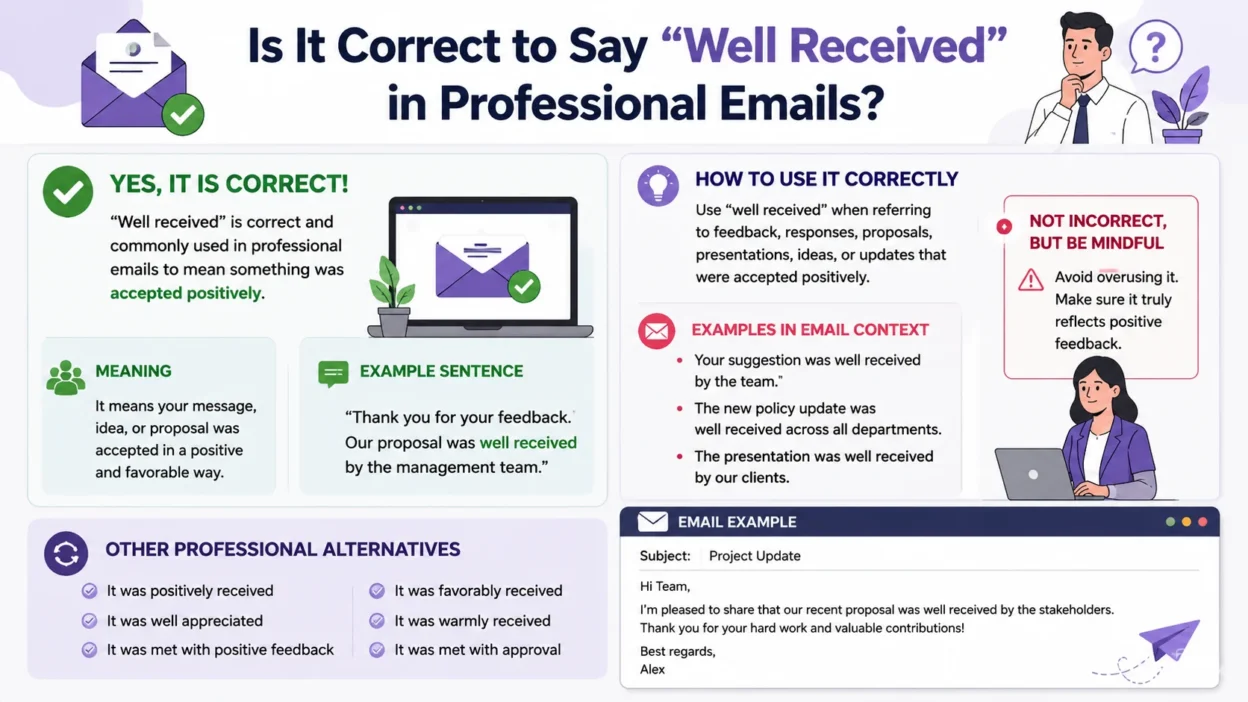
At its core, “well received” means that something got a positive reaction or was accepted favorably.
In business writing, it can refer to:
- an email
- a proposal
- a report
- an idea
- a message
- a presentation
- a request
For example:
- Your proposal was well received by the team.
- The update was well received by management.
In these sentences, the phrase means the message or idea was accepted positively.
A simple way to think about it
If something is well received, people do not just notice it. They responded to it in a favorable way.
That matters because in professional emails, you are often trying to do one of two things:
- acknowledge that you got the message
- say that the message or idea was positively accepted
Those are not the same thing.
A lot of confusion comes from mixing them up.
“Well received” is not always a full response by itself
This is where many people slip. They write something like:
- Well received.
- Your email was well received.
- Well received with thanks.
The problem is not grammar alone. The bigger issue is tone and completeness. In many email situations, these lines feel too short or too detached unless the context already makes everything clear.
A more natural business reply often sounds like this:
- Thank you for your email. I have received it and will review it shortly.
- Thanks for sharing this. I’ve noted your message and will follow up soon.
- I appreciate the update. The team has received it and will take it into account.
Those lines do more work. They sound human and professional at the same time.
Is “Well Received” Correct in Professional Communication?
Yes, “well received” is grammatically correct.
But grammar is only half the story.
A phrase can be correct and still be a poor choice in a real email. In business communication, people care about:
- clarity
- tone
- directness
- usefulness
- politeness
So while “well received” is correct, it is not always the most effective option.
When it sounds natural
It sounds natural when you use it to describe how a message, idea, or document was accepted.
Examples:
- The report was well received by the board.
- Her presentation was well received by the clients.
- The announcement was well received across the department.
These are clean and natural.
When it sounds awkward
It sounds awkward when you use it as a standalone acknowledgement in a reply.
Examples that can feel stiff:
- Well received, thank you.
- Your email is well received.
- Well received with thanks.
These are not always wrong, but they often feel old-fashioned or clipped.
In modern business English, people usually prefer something more direct:
- Received with thanks.
- Thank you, noted.
- I have received your message.
- Thanks for sending this over.
Those alternatives often sound smoother.
The Difference Between “Well Received” and “Well-Received”
This is one of the most common points of confusion.
“Well received” without a hyphen
Use well received when the phrase appears after a verb like was, were, has been, or is.
Examples:
- The proposal was well received.
- The memo has been well received.
- The update is well received by the team.
Here, well received works as part of a verb phrase.
“Well-received” with a hyphen
Use well-received when the phrase acts like an adjective before a noun.
Examples:
- a well-received proposal
- a well-received presentation
- a well-received email campaign
Here, the hyphen shows that the two words work together as one descriptive unit.
Easy rule
| Form | How it works | Example |
| well received | after a verb | The message was well received. |
| well-received | before a noun | It was a well-received message. |
That is the safest rule to remember.
When to Use “Well Received” in Professional Emails
This phrase fits best when you are describing a result, not just acknowledging receipt.
Use it when a message gets a positive reaction
Examples:
- Your proposal was well received by our leadership team.
- The client update was well received and sparked useful discussion.
- The training session was well received by attendees.
These sound professional and complete.
Use it in summaries, reports, and follow-ups
In written updates, you might say:
- The new process was well received by staff during the first week.
- The revised draft was well received and approved with minor edits.
This is a good fit because the phrase gives a clear outcome.
Use it when describing stakeholder response
Business writing often deals with reactions from:
- customers
- clients
- colleagues
- managers
- board members
- external partners
In that setting, well received is useful because it tells readers how something landed.
When Not to Use “Well Received” in Emails
This phrase is not the best choice in every email. In fact, using it at the wrong moment can make your writing feel wooden.
Avoid it when you only need to acknowledge receipt
If you just want to say that you got the message, shorter and clearer options often work better.
Better choices:
- Received, thank you.
- Thanks for sending this.
- I’ve received your email.
- Noted with thanks.
These options feel more natural in day-to-day business communication.
Avoid it when warmth matters
If you are replying to a client, colleague, or manager and want to sound approachable, well received may feel a little distant.
Compare these:
- Your email was well received.
- Thanks for the update. I’ve reviewed it and will follow up soon.
The second line feels more personal and practical.
Avoid it when it sounds like filler
Sometimes people use well received because it sounds formal. But formal does not always mean effective. In business emails, clarity usually beats decorative language.
A sentence should do a job. If well received does not add useful meaning, leave it out.
Common Misconceptions About “Well Received”
A lot of people assume this phrase is a polished email reply. That is not always true.
Misconception: It always works as a reply
It does not.
A reply like well received by itself can feel incomplete unless the context is very clear. If you are responding to a request, document, or update, people usually expect a fuller answer.
Misconception: It means “I read your email”
Not exactly.
Well received does not automatically mean someone read every word carefully. It often means the message or idea was accepted favorably. That is a different idea.
Misconception: It sounds modern and natural
Not always.
In some contexts, it sounds formal in an old-fashioned way. That is fine in a board memo or official message. It may feel too stiff in a routine workplace reply.
Misconception: It is the same as “received”
No.
- Received means the message arrived.
- Well received means it was accepted or responded to favorably.
That difference matters.
Better Alternatives to “Well Received” in Email Etiquette
The best alternative depends on your goal.
Are you acknowledging receipt? Expressing appreciation? Showing approval? Confirming understanding? Each situation needs a different line.
Clear alternatives for acknowledging receipt
Use these when you simply want to say you got the message:
- Received with thanks.
- Thank you, I’ve received your message.
- Noted with thanks.
- I’ve received this and will review it.
- Thanks for sending this through.
Alternatives for showing positive response
Use these when you want to say the message or idea landed well:
- The proposal was very well received.
- The update was positively received by the team.
- The presentation was warmly received by the client.
- The announcement was met with strong support.
Alternatives for a friendly professional tone
These work well when you want to sound human and polished:
- Thanks for sharing this.
- Appreciate the update.
- Thank you for the information.
- I appreciate you sending this over.
- Thanks, I’ve taken note of it.
Alternatives for formal business communication
These work in more official settings:
- Your message has been duly noted.
- We acknowledge receipt of your email.
- The document has been received and reviewed.
- Your submission has been received.
- We appreciate your communication and will respond shortly.
Best Practices for Email Acknowledgments in Business Settings
A good acknowledgment email does three things:
- confirms receipt
- shows courtesy
- states the next step
That is the sweet spot.
Keep it clear
Do not bury the main point under fancy wording. Say what happened and what comes next.
Example:
- Thank you for sending the revised contract. I’ve received it and will review the changes today.
That is simple and effective.
Match the tone of the other person
If someone writes in a warm, casual style, you do not need to sound like a legal memo. If the email is highly formal, then a polished response may fit better.
Add action when needed
If the email needs a response later, mention it.
Examples:
- I’ve received your report and will share feedback by Friday.
- Thanks for the update. I’ll speak with the team and get back to you tomorrow.
Avoid vague replies
A reply like well received does not tell the other person much. Professional email etiquette works better when your response gives them confidence and direction.
How “Well Received” Feels in Different Professional Settings
This phrase can sound different depending on the setting.
In internal workplace emails
It may sound acceptable, especially in formal or large organizations.
Example:
- Your update was well received by the department heads.
That sounds fine because it describes a result.
In client emails
Clients often prefer clarity over formality. A direct response usually works better.
Example:
- Thank you for the proposal. We have received it and will review it this week.
This feels more responsive than a bare well received.
In executive communication
In senior-level communication, well received can be useful if you are reporting reactions.
Example:
- The strategy deck was well received by the board.
That is concise and businesslike.
In customer support or service emails
Warmth and clarity matter more than formal wording.
Better options:
- Thanks for reaching out. We’ve received your message.
- Your request has been received and is being reviewed.
Case Study: Three Email Replies, Three Different Tones
Here is a simple comparison.
Case study one: too stiff
Email reply:
Well received.
Problem:
It feels too short and a little cold. It does not give the sender useful information.
Case study two: grammatically correct but awkward
Email reply:
Your email was well received.
Problem:
This tells the sender the email landed positively, but it does not always sound like a natural acknowledgement.
Case study three: clear and professional
Email reply:
Thank you for your email. I’ve received it and will review the details this afternoon.
Why it works:
It confirms receipt, sounds polite, and sets expectations.
That is the model many professionals should aim for.
A Practical Comparison Table
| Phrase | Best use | Tone | Natural in email replies? |
| Well received | describes positive reaction | formal | sometimes |
| Well-received | adjective before a noun | polished | yes, in descriptions |
| Received | confirms arrival | direct | yes |
| Noted | acknowledges information | brief | yes |
| Received with thanks | polite acknowledgment | professional | yes |
| We acknowledge receipt | official business tone | formal | yes |
| Thank you for your email | warm acknowledgment | friendly | yes |
This table shows the main point: “well received” is best when you describe a response, not when you simply confirm receipt.
Sample Email Replies Using Better Alternatives
Here are useful examples you can actually use.
Formal reply
Dear Ms. Ahmed,
Thank you for your email. I have received the attached proposal and will review it with the team this week. I appreciate you sending it over.
Best regards,
[Your Name]
Friendly professional reply
Hi Sarah,
Thanks for sharing this update. I’ve received it and will take a look today. I’ll get back to you once I’ve reviewed everything.
Best,
[Your Name]
Short business reply
Hello,
Received with thanks. I’ll review this and respond shortly.
Regards,
[Your Name]
Client-facing reply
Dear Mr. Khan,
Thank you for your message. We have received your request and our team will review it carefully. We appreciate your patience.
Sincerely,
[Your Name]
Team update reply
Hi everyone,
Thanks for the report. It has been received, and the findings were well received by leadership. We’ll discuss next steps in tomorrow’s meeting.
Regards,
[Your Name]
“Well Received” vs. Similar Email Expressions
A lot of professional phrases get mixed together. Here is how they differ.
“Duly noted”
This means you have understood or recorded the information.
- Your concern is duly noted.
It can sound firm or formal.
“Acknowledged”
This confirms that a message or instruction has been recognized.
- Your email has been acknowledged.
It is often used in internal or procedural communication.
“Received with thanks”
This is one of the cleanest and most polite options.
- Received with thanks.
It works well when you want short professionalism.
“Thank you for sending this”
This sounds warm and human.
- Thank you for sending this. I’ll review it shortly.
“Well received”
This should usually describe the reaction to the message.
- The proposal was well received by the client.
That is the best home for the phrase.
Is “Well Received” Polite or Too Formal?
It can be polite. It can also sound too formal.
That depends on context.
Polite use
If you write:
- Your proposal was well received.
you are giving positive feedback. That is polite and respectful.
Too formal use
If you reply:
- Well received, thank you.
that may feel stiff in a routine email thread.
The middle ground
Many professionals now prefer language that is:
- clear
- polite
- brief
- human
That is why phrases like received with thanks, thanks for the update, and I’ve reviewed it often win out.
A Simple Guide to Choosing the Right Phrase
Use this quick decision guide.
If you only want to confirm receipt
Use:
- Received with thanks
- I’ve received your email
- Thanks for sending this
If you want to say the message got a positive response
Use:
- The proposal was well received
- The presentation was well received
- The announcement was warmly received
If you want to sound formal and official
Use:
- We acknowledge receipt of your email
- Your submission has been received
- Your message has been duly noted
If you want to sound warm and professional
Use:
- Thanks for sharing this
- Appreciate the update
- Thank you for sending this over
Common Grammar Questions Around “Well Received”
Many writers have questions about how to use well received correctly in emails and everyday writing. Common concerns include whether it should be hyphenated, if it works as an adjective, and whether it’s appropriate in formal or informal communication. Understanding these grammar points helps you use well received naturally, professionally, and with confidence in any context.
Is “well received” one word or two?
It is two words.
Does it need a hyphen?
Only when it comes before a noun as a compound adjective.
- a well-received email
- the well-received proposal
Can I use it in a reply by itself?
You can, but it often sounds too thin for business email etiquette.
Is it wrong to say “well received with thanks”?
Not exactly wrong, but it can sound awkward or mechanical. Received with thanks is usually smoother.
Why Simpler English Often Works Better in Business Emails
A lot of people think formal emails need fancy language. In reality, the opposite is often true.
Simple English usually wins because it:
- saves time
- reduces misunderstanding
- feels more natural
- makes action easier
- sounds more confident
A clean email line like:
- Thanks for sending this. I’ve received it and will review it today.
often beats a polished but vague line like:
- Your communication has been well received and duly noted.
The first one feels direct. The second one can sound like it wandered in from another decade.
More Real-World Examples
Seeing how a word or phrase appears in everyday situations is one of the easiest ways to understand its correct usage. Real-world examples from conversations, emails, workplaces, schools, and social media show how native speakers naturally use the expression. By studying these examples, you can recognize the right context, avoid common mistakes, and use the phrase more confidently in your own writing and speech.
Example for a manager
Thank you for the update. I have received your notes and will work through the changes this afternoon.
Example for a client
We appreciate your message. Your proposal has been received and is under review.
Example for a colleague
Thanks for sending the draft. I’ve received it and will leave comments by noon.
Example for a vendor
Your invoice has been received. Our accounts team will process it shortly.
Example for a presentation follow-up
The presentation was very well received by the leadership team, especially the market overview.
These examples show the difference clearly. Use well received for reactions. Use other lines when you need acknowledgment.
Conclusion
Using the right words can make a message more well-received and create a stronger connection with the reader. Whether you are writing professional emails, handling business communication, or sharing ideas with others, thoughtful word choice, clear phrasing, and a respectful tone can improve how your message is understood. Simple changes, such as choosing better alternatives and avoiding repetitive phrases, help your communication feel more genuine, professional, and memorable. A message that shows appreciation, respect, and recognition can build trust and strengthen relationships in any professional environment.
FAQs
Q1. What does well-received mean?
Well-received means something is accepted, appreciated, or responded to positively by people. It is often used for messages, ideas, reports, feedback, or communication that creates a favourable reaction.
Q2. Can I use well-received in professional emails?
Yes, well-received is commonly used in professional emails and business writing. It helps describe ideas, suggestions, projects, or messages that were positively accepted by colleagues, clients, or stakeholders.
Q3. What are some alternatives to well-received?
Some useful alternatives include positively reviewed, highly appreciated, warmly welcomed, valued, acknowledged, and favourably accepted. The best choice depends on the context and the level of formality needed.
Q4. Why is word choice important in communication?
Word choice affects how people understand and feel about your message. The right words can make communication clearer, warmer, and more professional, while poor wording may make it seem cold, unclear, or unnatural.
Q5. How can I make my emails more well-received?
To create more effective emails, focus on a clear tone, thoughtful phrasing, genuine appreciation, and respectful language. Personalising your message and choosing expressions that match your audience can make your communication more engaging and successful.