In Fact, comma rules help writers understand punctuation because each punctuation mark adds clarity, accuracy, and meaning to real sentences. Learning comma usage becomes easier when you follow a clear punctuation guide instead of depending on guesswork. A writer can improve writing by understanding grammar rules, sentence structure, and sentence meaning. Every punctuation mark has a role, and a simple reference table or guidebook can help explain the correct usage pattern in plain English and plain language.
A sentence becomes stronger when commas are placed correctly. The right comma change can improve sentence clarity, flow, and accuracy while preventing confusion. Examples and case study situations show how a small punctuation decision can affect the entire message. By looking at side-by-side examples, a reader can see what works, when a mistake happens, and how proper comma placement helps ideas glide smoothly instead of making reading feel difficult.
The good news is that learning commas does not have to feel tedious or confusing. With understanding, knowing, and regular practice, you can fix mistakes and sharpen your writing skills. Grammar experts often focus on simple pattern rules, such as using commas before conjunctions like and, but, and so in a compound sentence. These basic rules help writers create clearer messages, organise items in a list, and make communication more effective.
What “In Fact” Means in English Grammar
Before talking about commas, it helps to know what in fact actually does.
Definition and purpose of “in fact”
In fact is a transitional phrase. Writers use it to add emphasis, correct an assumption, or strengthen a point. It often means something close to actually, really, or as a matter of truth.
It does not usually carry the main grammar job in a sentence. Instead, it works like a signal light. It tells the reader to slow down for a moment and pay attention to the next idea.
How “in fact” changes the tone
This phrase can make a sentence sound:
- more emphatic
- more formal
- more explanatory
- more corrective
Compare these two sentences:
- The report was accurate.
- The report was, in fact, accurate.
The second version feels a little more deliberate. It adds emphasis. It tells the reader that the point matters.
Common uses of “in fact”
Writers often use in fact in three ways:
- to correct a mistaken idea
- Many people think the rule is flexible. In fact, it is quite strict.
- to add emphasis
- The team was ready. In fact, it was more than ready.
- to strengthen an explanation
- The results were surprising. In fact, they changed the whole discussion.
A simple way to think about it
If in fact sounds like a brief pause that adds emphasis or correction, commas are probably involved. If it is glued tightly to the sentence in a rare fixed structure, punctuation may behave differently. In ordinary writing, though, in fact usually works as a parenthetical phrase or transition.
In Fact Comma Usage: Does It Always Need a Comma?
No. But it usually does.
That is the cleanest answer.
The main rule
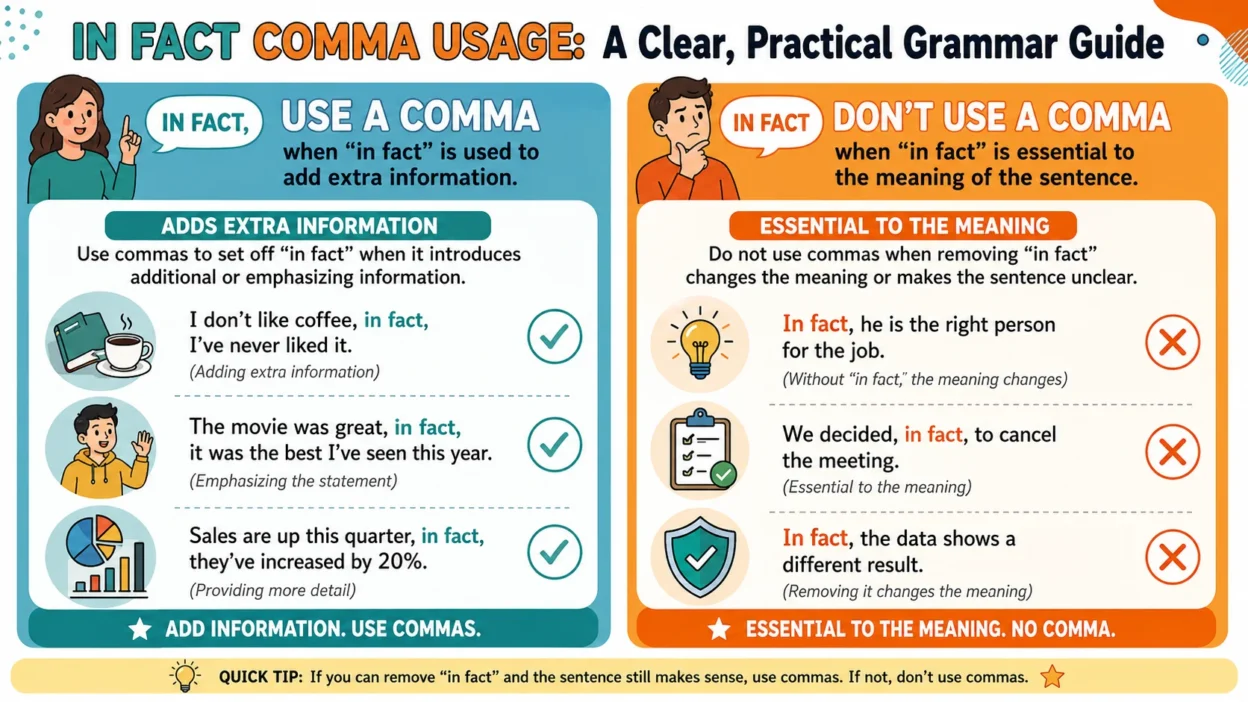
In standard modern writing, in fact often needs commas because it usually works as an interrupter or transition, not as an essential sentence part. The exact punctuation depends on where the phrase appears.
Here is the basic pattern:
- At the beginning of a sentence, use a comma after in fact.
- In the middle of a sentence, use commas on both sides if the phrase is parenthetical.
- At the end of a sentence, use a comma before in fact when it adds a trailing emphasis.
Why writers get confused
The confusion comes from two things:
- in fact can sound natural without much pause when spoken
- some writers treat it like a fixed phrase instead of a movable transition
But written English has to guide the eye. Commas help the reader hear the pause and understand the structure.
A practical rule of thumb
Ask this:
Could the sentence still work if I removed “in fact”?
- If yes, commas are usually needed.
- If no, check whether the phrase is doing something more structural, though that is uncommon.
In Fact Comma Usage at the Beginning of a Sentence
This is the easiest place to start, because the rule is very stable.
The rule for sentence-initial “in fact”
When in fact begins a sentence, place a comma after it.
Correct examples
- In fact, the answer was right there.
- In fact, the company had already changed the policy.
- In fact, the final version was stronger than the draft.
- In fact, few readers noticed the mistake.
Incorrect examples
- In fact the answer was right there.
- In fact the company had already changed the policy.
These are not impossible to understand, but they read more stiffly. The missing comma makes the sentence feel rushed.
Why the comma matters here
At the start of a sentence, in fact acts like a brief bridge from the previous idea to the new one. The comma gives the reader a small pause. Without it, the phrase can feel cramped.
That pause matters especially in formal writing, where clarity and rhythm both count.
When writers skip the comma on purpose
In very compressed writing, such as headlines, ad copy, or stylized dialogue, a writer may drop the comma for effect. Even then, that choice is stylistic, not standard grammar.
For normal prose, the safer and stronger choice is:
In fact, + main clause
Sentence-start examples in different tones
Formal
- In fact, the committee approved the proposal without revision.
Conversational
- In fact, I already finished the task yesterday.
Emphatic
- In fact, the opposite turned out to be true.
In Fact Comma Usage in the Middle of a Sentence
This is where most questions come up. The phrase can sit in the middle of a sentence and either act like a side comment or connect two ideas.
When “in fact” needs two commas
If in fact interrupts the flow but is not essential to the sentence’s grammar, place commas on both sides.
Correct examples
- The results, in fact, were better than expected.
- The project was, in fact, a complete success.
- Her response was, in fact, the most useful part of the meeting.
- The policy, in fact, had already changed twice.
In each case, the sentence still works if you remove in fact.
- The results were better than expected.
- The project was a complete success.
- Her response was the most useful part of the meeting.
- The policy had already changed twice.
That is the classic sign of a parenthetical phrase.
When “in fact” does not need commas in the middle
Sometimes a phrase that looks like in fact may be part of a tightly connected structure. But in ordinary usage, in fact is usually parenthetical, so commas are the norm.
That means the no-comma version is rare and often sounds awkward in polished writing.
- The results in fact were better than expected.
This sentence is understandable. It is just less natural than the comma version.
The easiest test
Read the sentence aloud and remove the phrase.
If the sentence still feels complete without in fact, then commas usually belong around it.
If removing it makes the sentence lose no essential grammar, it is probably parenthetical.
Side-by-side comparison
| Sentence | Punctuation | Effect |
| The plan, in fact, worked. | commas on both sides | smooth, explanatory |
| The plan in fact worked. | no commas | compressed, less natural |
| The plan worked. | phrase removed | still complete |
A useful nuance
Some writers overuse commas because they think any extra phrase must get fenced in. That is not always true. The real issue is whether the phrase interrupts the sentence.
With in fact, interruption is common. So commas are common too.
In Fact Comma Usage at the End of a Sentence
Sentence-final placement is less common, but it does happen.
The rule for sentence-final “in fact”
When in fact comes at the end of a sentence and acts as a trailing comment or emphasis, use a comma before it.
Correct examples
- The answer was obvious, in fact.
- She finished early, in fact.
- The change helped, in fact.
- The team was ready, in fact.
Why the comma goes before it
At the end of a sentence, in fact still acts like a brief afterthought or emphasis marker. The comma creates a pause before that final emphasis lands.
Without the comma, the sentence can feel unfinished or oddly fused.
- The answer was obvious in fact.
That version is harder to read and less polished.
Tone impact at the end
Ending with in fact can sound:
- reflective
- emphatic
- slightly dramatic
- conversational
It often gives the sentence a final nudge.
- He was right, in fact.
That sounds like the writer is closing the door on doubt.
When to avoid end placement
If the sentence sounds cleaner with in fact earlier, move it. End placement should feel natural, not forced.
In Fact Comma Usage: The Real Rule Behind the Phrase
The real rule is not “always comma” or “never comma.” It is this:
Punctuate “in fact” based on its job in the sentence.
Decision framework
Use this quick check:
- Is in fact at the beginning?
- Add a comma after it.
- Is in fact interrupting the sentence but not essential to grammar?
- Add commas on both sides.
- Is in fact at the end as a trailing emphasis?
- Add a comma before it.
- Does the sentence still read clearly without it?
- That is a strong clue that it is parenthetical.
A simple mental model
Think of in fact like a guest at the table.
- If it walks in at the start, it gets a small pause.
- If it interrupts the conversation, it gets commas on both sides.
- If it leaves with a final remark, it gets a pause before the exit.
That may sound playful, but it works. The phrase is usually not the main structure. It is the extra thought.
Why this matters for style
Comma decisions are not just about rules. They shape the reading experience. A well-placed comma can make a sentence feel calm and controlled. A missing comma can make it sound rushed or muddy.
In Fact Comma Usage and Parenthetical Expressions
This is the grammar idea that explains most of the punctuation.
What a parenthetical expression is
A parenthetical expression is a word or phrase that adds extra information but is not essential to the sentence’s core grammar.
Examples include:
- in fact
- however
- on the other hand
- of course
- in my opinion
These phrases often need commas when they appear inside a sentence.
Why “in fact” often behaves this way
In fact usually adds commentary rather than structure. It does not usually act as the subject, verb, object, or a required modifier. It adds emphasis or correction.
That is why commas are so common around it.
Parenthetical examples
- The plan, in fact, worked better than expected.
- The answer, in fact, was simple.
- He was, in fact, the first person to notice.
Non-parenthetical contrast
Compare that with a phrase that is essential to meaning:
- The book on the table is mine.
Here, on the table is not parenthetical. It identifies which book. No commas.
That is not how in fact usually works. It usually adds a note, not a restriction.
Quick takeaway
If the phrase feels like a side note, commas probably belong.
In Fact Comma Usage Compared With Similar Phrases
A lot of punctuation questions disappear when you compare in fact with nearby expressions.
In fact vs actually
These two are close, but not identical.
- Actually often sounds a little more direct and conversational.
- In fact often sounds a little more formal or emphatic.
Examples:
- Actually, I already sent the email.
- In fact, I already sent the email.
Both work. The tone shifts slightly.
In fact vs indeed
Indeed often sounds more formal and can reinforce a statement without sounding corrective.
- The results were good. Indeed, they were excellent.
In fact vs as a matter of fact
As a matter of fact is longer and more conversational.
- As a matter of fact, I was there yesterday.
It works in many of the same places as in fact, but it sounds more spoken and less compact.
In fact vs moreover
Moreover, it adds information. In fact often corrects or strengthens.
- The policy was unpopular. Moreover, it was expensive.
- The policy was unpopular. In fact, it triggered complaints from several departments.
The difference is subtle but important.
Best choice by tone
| Phrase | Typical tone | Main use |
| in fact | clear, emphatic | correction or emphasis |
| actually | direct, conversational | contrast or correction |
| indeed | formal, strong | reinforcement |
| as a matter of fact | spoken, expressive | emphasis or surprise |
| moreover | formal, additive | extra support |
Common Mistakes in In Fact Comma Usage
Small punctuation mistakes can make a sentence feel off even when the words are fine.
Missing commas where they belong
This is the most common problem.
- Wrong: In fact the results were strong.
- Better: In fact, the results were strong.
- Wrong: The results in fact were strong.
- Better: The results, in fact, were strong.
Adding commas where they do not help
Sometimes writers pepper the sentence with extra punctuation because they feel unsure.
- Awkward: The results, in fact were strong.
- Awkward: In fact, the results were strong.
Those versions break the rhythm and make the sentence look careless.
Using “in fact” too often
This is a style mistake, not just a grammar mistake.
If every paragraph contains in fact, the phrase loses force. It starts to sound repetitive.
Try rotating in other options when appropriate:
- actually
- indeed
- for example
- to be precise
- more specifically
Using “in fact” like a glue word
Some writers use in fact to connect every idea, even when another transition would work better.
That can weaken the writing. Choose the phrase only when it truly adds emphasis or correction.
Better alternatives when needed
- The truth is
- More importantly
- To be exact
- In other words
- For that reason
In Fact Comma Usage in Formal, Business, and Everyday Writing
The punctuation rule stays the same, but tone shifts depending on context.
Formal writing
In formal writing, in fact can sound polished and controlled.
- The committee, in fact, approved the proposal unanimously.
- In fact, the audit confirmed the original findings.
Formal writing usually benefits from clear punctuation because readers expect precision.
Business writing
In business email or reports, the phrase can soften a correction or strengthen a claim.
- The deadline, in fact, has already passed.
- In fact, the numbers support the proposal.
Business writing should stay lean. Use the phrase when it adds value. Do not pile it on just to sound smart.
Everyday writing
In everyday communication, in fact sounds natural when you want to correct someone gently or add emphasis.
- I thought the meeting was tomorrow. In fact, it’s today.
- The store is open, in fact, until nine.
Creative writing
In fiction or narrative nonfiction, punctuation can shape the voice.
- He smiled, in fact, the way people smile when they know more than they say.
That extra pause can add texture.
Quick Reference Table for In Fact Comma Usage
| Placement | Comma needed? | Example |
| Beginning of sentence | Yes, after the phrase | In fact, the answer was simple. |
| Middle of sentence, parenthetical | Yes, on both sides | The answer, in fact, was simple. |
| End of sentence | Yes, before the phrase | The answer was simple, in fact. |
| Tight, rare stylistic use | Sometimes omitted | The answer in fact was simple. |
Best practice
For standard writing, the first three rows are the ones that matter most. The last row exists, but it is less natural in polished prose.
Real-World Fixes: Before and After
This section shows how a few comma changes can improve clarity fast.
Example one
Before:
In fact the new policy reduced confusion.
After:
In fact, the new policy reduced confusion.
Why it works:
The pause makes the sentence smoother and easier to read.
Example two
Before:
The new policy in fact reduced confusion.
After:
The new policy, in fact, reduced confusion.
Why it works:
The phrase is extra information, so commas fit naturally.
Example three
Before:
The policy reduced confusion in fact.
After:
The policy reduced confusion, in fact.
Why it works:
The final emphasis now feels complete.
Example four
Before:
The report was in fact helpful and it clarified the issue.
After:
The report was, in fact, helpful and it clarified the issue.
Why it works:
The phrase interrupts the sentence, so it needs commas on both sides.
Mini Case Study: One Small Comma, Much Better Clarity
A freelance editor reviewed a draft for a small business newsletter. One sentence read:
The campaign in fact drove more traffic than expected.
The line was understandable. Still, it felt flat.
The editor changed it to:
The campaign, in fact, drove more traffic than expected.
That tiny change did three things:
- it added a pause
- it made the emphasis clearer
- it improved the rhythm of the sentence
The meaning did not change. The delivery did.
That is the real power of in fact comma usage. The comma does not just obey a rule. It shapes the sentence’s voice.
A Simple Checklist for Perfect In Fact Comma Usage
Use this checklist whenever you write in fact.
- Does the phrase begin the sentence?
- Add a comma after it.
- Does the phrase interrupt the sentence?
- Add commas on both sides.
- Does the phrase appear at the end with extra emphasis?
- Add a comma before it.
- Does the sentence still make sense without the phrase?
- That usually means the phrase is parenthetical.
- Does the sentence sound rushed or crowded without a comma?
- Add the comma.
- Does the sentence look overpunctuated?
- Read it aloud and simplify.
A fast final test
If the phrase sounds like a pause, punctuation probably belongs. If it sounds like a hard structural piece of the sentence, check the context carefully.
Pro Writing Tips to Master “In Fact” Naturally
Grammar is only part of the job. Style matters too.
Read your writing out loud
This is one of the fastest ways to spot awkward in fact comma usage.
If you naturally pause before or after the phrase, the comma often belongs there too.
Use it sparingly
In fact is useful. It is not magic.
If you use it in every paragraph, readers will notice. The sentence will start to feel repetitive.
Match the phrase to the tone
Use in fact when you want to:
- correct a misunderstanding
- add emphasis
- sharpen a point
- sound more deliberate
Do not use it just to fill space.
Prefer clarity over cleverness
A sentence does not become stronger because it uses a fancy transition. It becomes stronger because it is clear.
Sometimes the best version is the simplest one.
- In fact, the answer was simple.
- The answer was simple.
Both work. The right choice depends on the tone you want.
Remember the rhythm
Punctuation is partly about rhythm. A comma can create breathing room. A missing comma can squeeze the sentence. With in fact, rhythm matters because the phrase often works like a little beat in the middle of the line.
Quick Comparison Chart: In Fact Comma Usage in Action
| Sentence | Correct? | Comment |
| In fact, the answer was easy. | Yes | Standard sentence-initial use |
| The answer, in fact, was easy. | Yes | Parenthetical middle placement |
| The answer was easy, in fact. | Yes | Trailing emphasis |
| In fact the answer was easy. | Usually no | Missing comma after the opener |
| The answer in fact was easy. | Usually no | Missing commas around the interrupter |
Conclusion
Understanding comma usage is an important part of becoming a stronger writer. These small punctuation marks can greatly affect sentence meaning, clarity, and the overall flow of your writing. By learning basic grammar rules, recognising common patterns, and practising with real examples, you can use commas with more confidence. A well-placed comma does more than separate words; it helps your reader understand your ideas exactly as you intended.With regular practice, punctuation becomes less confusing and more natural. Whether you are writing an email, article, assignment, or professional document, knowing where and why to place a comma can make your writing clearer, smoother, and easier to read.
FAQs
Q1. Why are commas important in writing?
Commas are important because they help organise ideas, separate information, and improve sentence clarity. They guide readers through a sentence and make the intended meaning easier to understand.
Q2. How do I know where to put a comma?
You can place a comma by following basic punctuation rules, such as separating items in a list, using commas before certain conjunctions, and adding commas around non-essential information.
Q3. Can a comma change the meaning of a sentence?
Yes, a comma change can completely affect sentence meaning. A misplaced or missing comma can create confusion, while correct placement makes the message clear.
Q4. Do I always need a comma before “and”?
No, you do not always need a comma before and. Use it when joining two independent clauses in a compound sentence or when separating items in a list, depending on the writing style.
Q5. What is the easiest way to improve comma usage?
The easiest way is to practice with examples, study common grammar rules, and review your sentences to see whether commas improve flow, accuracy, and readability.