Simple Present Tense in American English builds clear everyday communication through simple rules that help learners express ideas naturally and confidently. From my teaching experience, I have seen that students improve faster when they first understand how this tense works before moving to more complex grammar. It gives every beginner, advanced learner, and English learner a strong grammar foundation for English grammar, language proficiency, and everyday English. With grammar practice, regular practice, grammar tools, teaching strategies, and clear steps, learners build understanding, mastering, confidence, grammar confidence, English fluency, writing fluency, accuracy, and lasting language mastery while using present tense, present simple tense, and simple present tense correctly.
I always explain the rules, sentence structure, sentence patterns, sentence building, verb forms, verb usage, verb agreement, subject verb agreement, auxiliary verbs, do, does, and -s before introducing positive, negative, questions, and question formation. Then I compare the tense with the present continuous, past tense, and future forms using comparison, examples, practical examples, real examples, and present tense examples. Learners quickly understand how the tense describes actions, regular actions, routine actions, habits, daily habits, routines, daily routines, schedules, general facts, universal facts, timeless truths, opinions, emotions, and reality. Familiar examples such as He writes, She goes, I play soccer, I work every day, She drinks coffee, and the fact that water boils at 100 degrees make the meaning easier to remember.
I encourage students, professionals, native speakers, second language learners, and travellers to use this tense in professional communication, academic writing, emails, social media, American conversations, daily conversations, and other real-life situations. Whether they speak, write, or join spoken English activities, they develop English speaking skills, English writing skills, effective communication, clear communication, natural communication, communication clarity, and better communication skills. As they express ideas about everyday life, daily life, work, schools, morning routines, coffee, water, and other common topics, they begin to communicate more clearly, confidently, and naturally, while avoiding common pitfalls and using the language correctly in American English.
Understanding the Simple Present Tense in American English
The simple present tense is one of the most common verb tenses in American English. It describes habits, routines, general facts, permanent situations, and scheduled events that happen regularly or are always true. Because native speakers use it every day in conversations and writing, understanding the simple present tense is essential for building clear and natural English sentences.
Definition and Purpose
The simple present tense in American English describes actions, states, and facts that are true now in a general or repeated sense. It does not always mean “right this second.” That is a common misunderstanding.
Look at these examples:
- I work from home.
- She lives in Texas.
- Water boils at 100°C.
- The train leaves at 7:30 a.m.
Each sentence uses the simple present tense differently. One shows a routine. One shows a permanent situation. One states a fact. One describes a schedule.
The tense is simple in form, but powerful in use.
When Native Speakers Use It Every Day
Native speakers use the simple present tense in American English for ordinary life all the time.
They use it when they talk about:
- habits
- routines
- general truths
- feelings and opinions
- directions
- schedules
- instructions
- sports commentary
- headlines
That wide reach makes the tense one of the most useful tools in English. In fact, if you learn only one tense well, this should be near the top of the list.
How It Differs From Other Present Tenses
Learners often mix up the simple present and the present continuous. The difference is small in form but big in meaning.
Here is the basic split:
| Tense | Main Use | Example |
| Simple present | Habits, facts, routines, schedules | She walks to school every day. |
| Present continuous | Actions happening right now or around now | She is walking to school right now. |
The simple present tense in American English stays stable and general. The present continuous feels temporary and active in the moment.
That difference will save you from many grammar errors.
Structure of the Simple Present Tense in American English
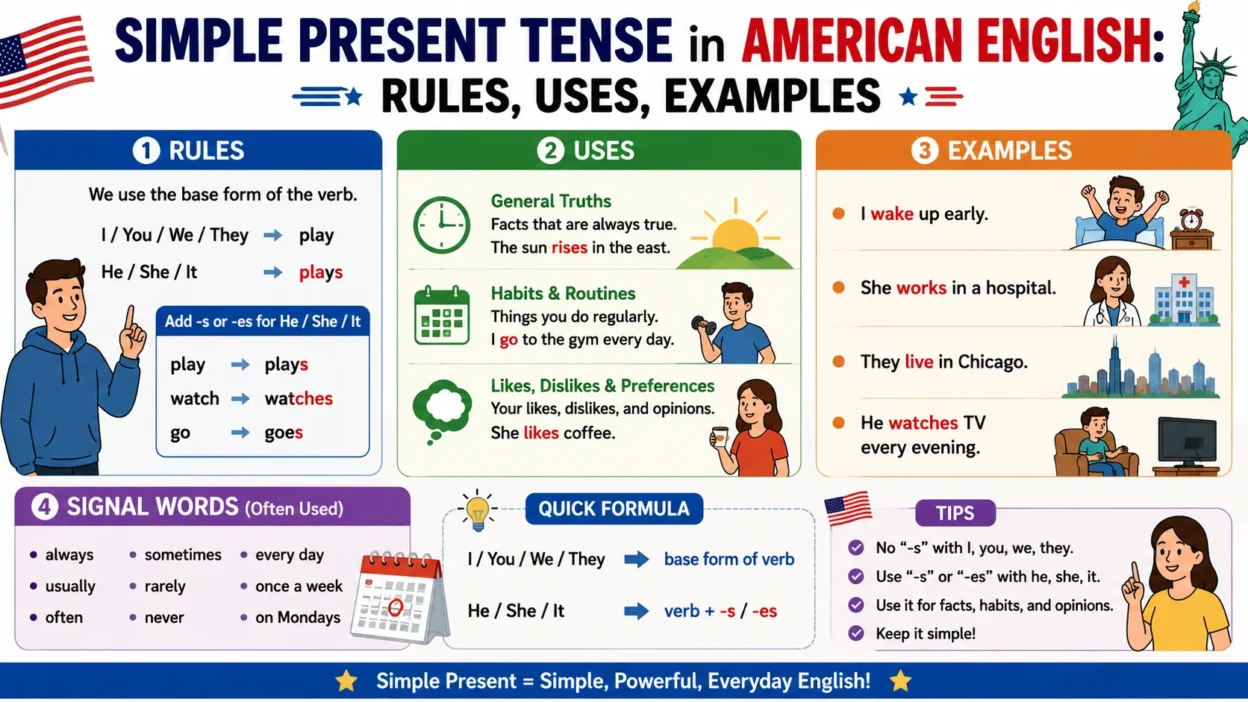
The structure of the simple present tense in American English is straightforward and follows a consistent pattern. The base form of the verb is used with I, you, we, and they, while he, she, and it take the verb with -s or -es. For negative sentences and questions, the helping verbs do and does are used, making the tense easy to recognize and apply in everyday communication.
Affirmative Sentences
Most simple present sentences follow a basic pattern:
Subject + base verb
For third-person singular subjects such as he, she, or it, the verb usually takes -s or -es.
Examples:
- I play tennis.
- You study hard.
- We live near the river.
- He plays tennis.
- She watches movies on Friday.
- It rains a lot in spring.
This is one of the most important rules in the simple present tense in American English. The subject controls the verb form.
Negative Sentences
In the negative form, you use do not or does not plus the base verb.
Pattern:
Subject + do/does not + base verb
Examples:
- I do not like spicy food.
- You do not need help.
- They do not work on Sundays.
- He does not know the answer.
- She does not drive at night.
A common mistake is adding -s to the main verb after does not. Don’t do that.
Correct:
- She does not like tea.
Incorrect:
- She does not like tea.
The auxiliary verb already carries the tense. The main verb stays in base form.
Yes/No Questions
Yes/no questions also use do or does.
Pattern:
Do/Does + subject + base verb?
Examples:
- Do you live here?
- Do they understand the rule?
- Does he speak Spanish?
- Does it work properly?
This pattern is clean and reliable. If you remember it, you avoid one of the most common grammar traps in the simple present tense in American English.
WH-Questions
WH-questions follow the same support structure, but start with a question word.
Pattern:
WH-word + do/does + subject + base verb?
Examples:
- Where do you work?
- Why does she leave early?
- When do they arrive?
- What does he want?
The question word comes first. Then do or does. Then the subject. Then the base verb.
That order matters. English likes structure here. If you scramble it, the sentence sounds off right away.
Sentence Formula With Easy Examples
Here is a quick reference table for the simple present tense in American English:
| Sentence Type | Formula | Example |
| Affirmative | Subject + verb | They live in Chicago. |
| Affirmative with third person singular | Subject + verb-s/es | She lives in Chicago. |
| Negative | Subject + do/does not + verb | They do not live in Chicago. |
| Yes/No question | Do/Does + subject + verb? | Do they live in Chicago? |
| WH-question | WH-word + do/does + subject + verb? | Where do they live? |
This table is worth saving. It gives you the core pattern in one glance.
Simple Present Tense Verb Rules in American English
The simple present tense follows clear verb rules in American English. With I, you, we, and they, use the base form of the verb, such as I work or They study. With he, she, and it, add -s or -es to the verb, such as She writes or He watches. These rules help you form grammatically correct sentences when talking about habits, routines, general facts, and repeated actions.
Base Form of the Verb
In most sentences, the simple present tense in American English uses the base form of the verb.
Examples:
- I eat breakfast early.
- We study grammar every week.
- They drive carefully.
The base form is the plain form you find in a dictionary. No -ing. No past ending. No extra markers.
Third-Person Singular Rules
This is where many learners make mistakes. When the subject is he, she, or it, the verb usually changes.
Rules:
- add -s to most verbs
- add -es after verbs ending in -s, -sh, -ch, -x, -z, -o
- change -y to -ies when a consonant comes before y
Examples:
- walk → walks
- play → plays
- watch → watches
- fix → fixes
- go → goes
- study → studies
Here is a useful table:
| Base Verb | Third-Person Singular | Rule |
| work | works | add -s |
| watch | watches | add -es |
| go | goes | add -es |
| study | studies | change y to ies |
| play | plays | add -s |
This rule is simple once you see it often enough. The hardest part is remembering it in real conversation.
Spelling Rules With Examples
A few spelling patterns matter in the simple present tense in American English.
Add -es
Use -es after certain endings:
- pass → passes
- miss → misses
- push → pushes
- watch → watches
Change -y to -ies
If a consonant comes before y, change y to ies:
- study → studies
- cry → cries
- hurry → hurries
If a vowel comes before y, just add -s:
- play → plays
- stay → stays
- enjoy → enjoys
Irregular Changes With Be
The verb be is special.
- I am
- you are
- he is
- she is
- it is
- we are
- they are
This verb does not follow the normal pattern. It behaves like its own little kingdom.
Common Irregular Verbs
Most verbs in the simple present tense in American English do not change much. A few important ones do.
Some of the most common are:
- be → am/is/are
- have → has
- do → does
- go → goes
Examples:
- She has two brothers.
- He does his homework at night.
- The bus goes downtown.
- I am ready.
These verbs show up constantly. Learn them early and you will notice a big improvement in both reading and speaking.
Using the Verb Be
The verb be deserves special attention because it works differently from other verbs.
Examples:
- I am tired.
- He is a doctor.
- They are busy.
Notice that he does not need to do or do in questions and negatives.
Correct:
- Are you okay?
- She is not here.
Incorrect:
- Are you okay?
- She is not here.
That mistake happens often, especially for learners who want every sentence to follow the same pattern. English does not always cooperate.
Every Use of the Simple Present Tense in American English Explained
The simple present tense is one of the most common verb tenses in American English because it describes facts, daily habits, routines, and general truths. It also appears in instructions, schedules, headlines, and certain future situations, making it an essential part of everyday communication. Understanding every use of the simple present tense helps you write and speak more naturally, accurately, and confidently in both formal and informal American English.
Daily Habits and Routines
One of the most common jobs of the simple present tense in American English is to talk about habits and routines.
Examples:
- I woke up at 6:30.
- She drinks coffee every morning.
- We go to the gym on Tuesdays.
These actions repeat. They are not one-time events. That repeated pattern is the signal.
Repeated or Regular Actions
The tense also covers repeated actions that may not happen daily.
Examples:
- He visits his grandparents once a month.
- They travel to Florida every winter.
- She calls her sister on weekends.
The key idea is regularity. The action happens again and again.
Permanent Situations
Use the simple present for facts that feel stable or lasting.
Examples:
- My office is near the station.
- He lives in New York.
- The store opens at 9 a.m.
These are not temporary events. They describe a steady state.
Facts and Universal Truths
The simple present tense in American English is the normal tense for facts that do not depend on time.
Examples:
- The sun rises in the east.
- Ice melts in heat.
- Birds have feathers.
These sentences stay true beyond the moment. That is why the simple present fits so well.
Scientific Facts
Scientific statements also use the simple present.
Examples:
- Water boils at 100°C.
- Plants need sunlight.
- The human heart pumps blood.
Science does not need drama. It needs clarity. The simple present gives that.
Feelings, Opinions, and States
Many state verbs appear in the simple present because they describe what someone feels, thinks, or knows.
Examples:
- I know the answer.
- She likes jazz.
- We believe the plan will work.
- He understands the lesson.
These verbs usually describe states rather than actions. That is why they often stay in the simple present.
Instructions, Directions, and Recipes
The simple present tense in American English often appears in instructions because it sounds direct and easy to follow.
Examples:
- Add two cups of flour.
- Turn left at the light.
- Press the red button.
- Mix the ingredients well.
This usage is everywhere in manuals, recipes, and step-by-step guides.
Scheduled Events and Timetables
You also use the simple present for fixed schedules.
Examples:
- The train leaves at 8:15.
- The class starts at noon.
- The plane lands at 4:40.
Even though these events happen in the future, the schedule is fixed. That is why the simple present works.
Sports Commentary and Live Narration
Sports reporters use the simple present to make the action feel immediate.
Examples:
- He passes the ball.
- She shoots from the corner.
- The crowd cheers loudly.
This style creates energy and makes the listener feel close to the moment.
Newspaper Headlines and Summaries
Headlines often use the simple present to sound sharp and direct.
Examples:
- President Signs New Bill
- Company Opens New Office
- Team Wins Championship
That style is short, crisp, and easy to scan.
Signal Words That Often Appear With the Simple Present
Certain time words often show up with the simple present tense in American English.
| Signal Word | Example |
| always | She always arrives early. |
| usually | I usually eat lunch at noon. |
| often | They often visit on Sundays. |
| sometimes | He sometimes works late. |
| never | We never skip breakfast. |
| every day | She studies every day. |
| on Mondays | He trains on Mondays. |
These words do not create the tense, but they often point to it.
A Quick Real-World Case
Imagine a customer service agent writing an internal note:
“Customers call twice a week. She asks about billing and prefers email follow-up.”
This is a perfect simple present use. The note describes a repeated pattern, not a one-time event.
That is the strength of the tense. It captures routine, fact, and structure without extra words.
Grammar tip: The simple present tense does not just describe now. It describes what stays true, what repeats, and what belongs to a pattern.
Conclusion
The Simple Present Tense in American English is one of the most useful grammar skills you can learn because you use it every day. It helps you describe habits, daily routines, general facts, opinions, schedules, and timeless truths with confidence. Once you understand the basic rules, verb forms, and sentence structure, speaking and writing become much more natural. Keep practising with real-life examples, and you’ll find that this tense becomes an easy and reliable part of your everyday English communication.
FAQs
Q1.What is the simple present tense in American English?
The simple present tense is used to talk about regular actions, habits, daily routines, general facts, universal truths, and schedules. It is one of the most common tenses in American English for both speaking and writing.
Q2.When do I use do and does in the simple present tense?
Use do with I, you, we, and they. Use it with he, she, and it when asking questions or making negative sentences. For example, “Do you work every day?” and “Does she drink coffee?”
Q3.Why do some verbs end with -s?
In the simple present tense, most verbs take -s when the subject is he, she, or it. For example, “He writes every morning” and “She goes to school every day.”
Q4.How is the simple present different from the present continuous?
The simple present tense describes habits, routines, and facts, while the present continuous describes actions happening right now. For example, “I work every day” uses the simple present, while “I am working now” uses the present continuous.
Q5. How can I improve my simple present tense?
Practice every day by writing short sentences, reading American English examples, listening to conversations, and speaking regularly. Focus on subject-verb agreement, common verb forms, and real-life situations to build confidence and accuracy.