Licence or License becomes much easier to understand when you focus on context instead of memorising every spelling rule. When I first began reviewing real writing, I saw many writers use license and licence as if they were the same, simply because they sound alike. The real difference depends on your audience, region, and the variety of English you are using. In American English and US English, license is the standard choice as both a noun and a verb. In British English and UK English, however, there is a clear split. Licence is the noun form, while license is the verb form. This spelling difference follows established language rules, spelling rules, and English grammar, making correct spelling an important part of English usage. Once you understand this distinction, choosing the right form becomes simple and easy, even if it feels like a moving target on your first day.
One habit that has helped me the most is checking the part of speech before writing a sentence. Paying attention to sentence structure, word choice, and meaning makes every comparison much clearer. A driver’s licence is a legal document or permit that gives permission to own or use something, while a government can license or licenses a business to operate under official authority. That action is different from the act of holding the document itself. Looking at examples and real examples, following a trusted writing guide, and improving your writing skills will help you remember the pattern. Small memory tricks, a practical trick, and a willingness to learn can prevent confusion, errors, and mixing, even though the words look similar, are almost identical, and sometimes seem interchangeable. Knowing exactly where each word belongs makes your writing stronger.
Your usage should always match your audience preference, country, or the part of the globe where your readers live. Whether your discussion, subject, or article is written for American or British readers, the correct choice reflects careful grammar and attention to detail. Many people think this guide belongs only on paper or in school, but it matters in every job and almost every works environment where clear communication is important. The good news is that regular practice builds understanding over time. Keep your preferences in mind, trust the roles of nouns and verbs, know exactly what matters, and do not let the discrepancy fool you. Before long, the rule will feel like a walk in the park, whether you are writing for the USA or another region, and you will naturally recognise how variations in language influence modern writing and English.
Licence or License: Quick Answer for Everyday Writing
Here is the simplest version:
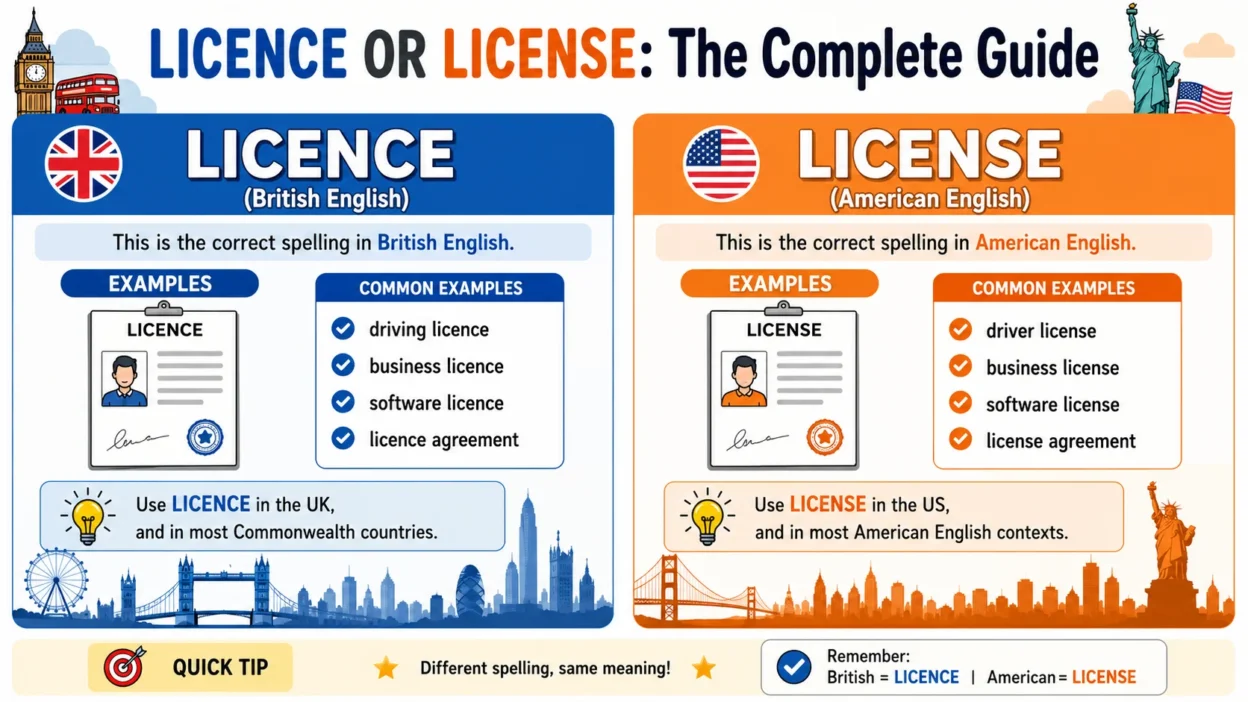
- American English uses license for both the noun and the verb.
- British English uses licence as the noun and license as the verb.
- If you are writing for a U.S. audience, license is usually the safe choice.
- If you are writing for a U.K. audience, use licence for the noun and license for the verb.
That is the core rule. Everything else builds from it.
The shortest rule to remember
Think of it this way:
- Noun = licence in British English
- Verb = license
- American English = license does both jobs
A quick example helps:
- The city requires a business license.
- The city may license new food trucks.
In British English, the noun changes to licence:
- The city requires a business licence.
- The city may license new food trucks.
That tiny letter difference can save you from looking careless in formal writing.
Licence or License: The Main Difference
The difference between licence and license is not random. It comes from a long history of English spelling, regional preference, and grammar tradition.
In practical terms, the words serve two roles:
- Noun: a legal or official permission
- Verb: to grant permission or authority
American English simplified the system and kept license for both roles. British English kept the older distinction between noun and verb.
License in American English
In the United States, license works as both a noun and a verb.
Examples:
- You need a driver’s license.
- The state will license your business.
- She has a professional license.
- The agency may license the software.
That consistency makes American English easier in this area. You do not need to switch spellings based on the part of speech.
This also shows up in official documents, state forms, legal writing, and everyday conversation. If you open a U.S. DMV website or read an American newspaper, license will almost always appear in both roles.
Licence and License in British English
British English keeps the distinction:
- licence = noun
- license = verb
Examples:
- He renewed his driving licence.
- The council will license the venue.
- The shop needs a trading licence.
- The authorities may license the event.
This system gives readers a quick visual cue. If they see licence, they know the word is being used as a noun. If they see license, they know the word is acting as a verb.
That pattern is especially common in the U.K., Ireland, Australia, New Zealand, and other places that follow British spelling norms.
Licence or License: Noun and Verb Use
The word pair becomes much easier once you focus on grammar. The noun and verb forms tell you the spelling.
License as a noun in American English
In American English, license often appears in these common phrases:
- driver’s license
- business license
- marriage license
- professional license
- liquor license
- hunting license
- software license
Each one names a permit, authorization, or legal right.
Examples in sentences:
- Please keep your license in your wallet.
- The contractor showed her business license.
- The company bought a software license for every employee.
The noun form often appears after words like:
- driver’s
- business
- marriage
- professional
- software
- hunting
- liquor
That pattern makes the noun easy to spot.
License as a verb in American English
As a verb, license means to give permission or formal approval.
Examples:
- The state licenses nurses.
- The agency licensed the new supplier last year.
- The city will license three more taxis.
- The studio licensed the song for use in the ad.
A useful test is this: if the word means “grant permission,” it is a verb. In American English, the spelling stays license.
Licence as a noun in British English
In British English, the noun becomes licence.
Examples:
- driving licence
- fishing licence
- television licence
- trade licence
- pistol licence
- premises licence
Notice how the spelling changes only in the noun form.
Example sentences:
- You must renew your driving licence.
- The restaurant needs a premises licence.
- She applied for a fishing licence.
The noun form appears often in government and legal documents, so this spelling matters in formal writing.
License as a verb in British English
British English still uses license as a verb.
Examples:
- The council will license the café.
- The government licenses broadcasters.
- The authority licensed the premises last month.
This split is the main reason British spelling sometimes feels harder for learners. One letter changes, but the grammar rule stays firm.
Licence or License: Etymology and Spelling History
The spelling difference did not appear by accident. It came from the history of English itself.
The word traces back through Latin and Old French. English absorbed many French-influenced spellings over centuries, and both licence and license developed from the same root. Over time, writers began treating the noun and verb differently.
American English later simplified many spellings. Noah Webster, the American lexicographer, pushed for more regular spelling patterns in the 18th and 19th centuries. His influence helped shape many American forms, including the preference for license across both noun and verb use.
British English kept more of the older distinction. That is why modern British writing still distinguishes between licence and license.
This history matters because it explains the rule. It is not a random inconsistency. It is a preserved pattern from earlier English.
A useful way to think about the history
Imagine English as a large house with two rooms:
- One room was remodeled in the United States.
- The other room kept the older furniture in the U.K.
Both rooms still belong to the same house. They just look a little different.
That is exactly how licence or license works.
Licence or License: Side-by-Side Comparison
A table makes the pattern easier to scan.
| Usage | American English | British English |
| Noun | license | licence |
| Verb | license | license |
| Driver document | driver’s license | driving licence |
| Business permit | business license | business licence |
| Form of permission | license | licence |
| Action of approving | license | license |
This table gives you the rule in one glance.
If you write for an international audience, this is the part to remember: American English prefers one spelling for both uses, while British English separates the noun and verb.
Licence or License: Real Examples in American English
Here are the kinds of sentences American readers expect.
Everyday examples
- I need to renew my driver’s license.
- The city issued a business license for the bakery.
- The nurse has an active professional license.
- The agency will license the new provider next month.
Legal and official examples
- The state suspended his license after the hearing.
- The department requires a license for this activity.
- The board may license applicants after review.
Business examples
- The company bought a software license for all users.
- The vendor must license the product before launch.
- The startup paid for a photo license.
Media and publishing examples
- The publisher purchased a license to use the image.
- The studio will license the film for streaming.
- The brand secured a music license for the campaign.
In American English, the spelling choice stays steady. That makes editing easier once you know the rule.
Licence or License: Real Examples in British English
British English keeps the noun form as licence.
Everyday examples
- I need to renew my driving licence.
- The pub needs a premises licence.
- He applied for a fishing licence.
- The council issued the trade licence.
Legal and public examples
- The authority revoked the licence.
- The board reviewed the application for a new licence.
- The law requires a licence for this activity.
Verb examples
- The council will license the café.
- The agency licensed the broadcaster.
- The government may license new operators.
Business and media examples
- The company bought a software licence.
- The studio licensed the song for a campaign.
- The publisher granted a licence to reuse the content.
The British pattern looks a little more old-fashioned to American eyes, but it is standard and correct in the regions that use it.
Licence or License: Common Phrases You Will See Often
The words licence and license are often used in everyday English, but their spelling depends on the type of English being used. In British English, licence is usually a noun and license is a verb, while in American English, license is commonly used for both forms.
Driver’s license or driving licence
This is one of the clearest regional differences.
- U.S.: driver’s license
- U.K.: driving licence
Both mean the same thing, but the spelling follows local rules.
Business license or business licence
Used for permits that allow a company to operate.
- U.S.: business license
- U.K.: business licence
Marriage license or marriage licence
Used for legal permission to marry.
- U.S.: marriage license
- U.K.: marriage licence
Software license or software licence
Used for the legal terms attached to software use.
- U.S.: software license
- U.K.: software licence
License agreement or licence agreement
This phrase often appears in contracts.
- U.S.: license agreement
- U.K.: licence agreement
The meaning stays the same. The spelling changes with the audience.
Licence or License: A Simple Memory Trick
A good memory trick should be fast and practical. Here is one that works:
If you are in America, use license for everything.
If you are in Britain, let the noun wear a “c” in licence.
You can also think of it this way:
- Licence has a c like noun? Not a perfect match, but it helps some writers.
- License has an s like verb and authorize? That can help too.
The strongest memory trick is still the regional rule:
- U.S. = license
- U.K. = licence noun / license verb
Mini cheat sheet
| Region | Noun | Verb |
| United States | license | license |
| United Kingdom | licence | license |
| Canada | usually licence in formal British-style writing | license |
| Australia | licence | license |
| New Zealand | licence | license |
This chart is useful when you are editing for different audiences.
Licence or License: Case Study in Editing
A simple case study shows how mistakes happen in real writing.
Case study: A small business website
A freelance writer drafted a service page for a company in London. The page said:
- “We help you apply for your business license.”
- “Our team can review your license documents.”
- “The council may require a new license.”
The content looked fine to an American reader. But for a British audience, the noun should have been licence.
The corrected version became:
- “We help you apply for your business licence.”
- “Our team can review your licence documents.”
- “The council may require a new licence.”
The verbs stayed the same in both versions, but the noun spelling changed.
Lesson from the case
The writer did not misunderstand the meaning. The issue was region and grammar. That is the real challenge with licence or license. The words are close enough to fool even careful writers.
Licence or License: Another Case Study from School Writing
Imagine a student in the UK writing, “I forgot my driving license at home.” While the meaning is clear, the correct noun in British English is driving licence, whereas license is the verb. In American English, license serves as both the noun and the verb. Understanding your audience and following the correct regional spelling helps make your school assignments, essays, and exams more accurate and professional.
Case study: A student paper
A student in Toronto wrote:
“The museum will license special exhibits for schools.”
That sentence was almost right, but the noun should have been licence if the sentence referred to a permit or formal permission. If the sentence meant the museum was granting permission, then license as a verb was correct.
So the corrected options were:
- If noun: “The museum will need a special licence.”
- If verb: “The museum will license special exhibits for schools.”
Lesson from the case
The spelling choice depends on part of speech first. Region comes second. Grammar leads the way.
Licence or License: Common Mistakes to Avoid
Even strong writers slip on this pair. Here are the mistakes that show up most often.
Mixing noun and verb forms
A frequent error looks like this:
- Incorrect: The shop needs a license in British English.
- Correct: The shop needs a licence in British English.
Using British noun spelling in American writing
- Incorrect for U.S. usage: driver’s licence
- Correct for U.S. usage: driver’s license
Using American noun spelling in British writing
- Incorrect for U.K. usage: driving license
- Correct for U.K. usage: driving licence
Forgetting the verb stays license in both systems
This one causes the most confusion.
- Correct: The city will license the venue.
- Correct: The city will license the venue.
Notice the verb spelling does not change between American and British English.
Overusing spell-check without checking region
Spell-check can be helpful, but it does not always match your audience. A tool may flag licence in an American document or license in a British one. That does not mean the word is wrong. It may only mean the style does not match the selected language setting.
Licence or License: Practical Tips for Fast Recall
Good spelling habits are built through repetition and context. Here are a few ways to make the distinction stick.
Tip for American English writers
Use license every time unless you are quoting a source that uses another spelling.
That means:
- driver’s license
- business license
- license to operate
- license agreement
Tip for British English writers
Use licence for the noun and license for the verb.
That means:
- driving licence
- TV licence
- to license a product
- to license a venue
Tip for editors
Read the sentence aloud and ask yourself:
- Is the word naming permission or authority? Then check the noun spelling.
- Is the word showing action? Then check the verb spelling.
- Does the audience follow American or British standards? Then match that system.
Tip for international content
When the audience includes both U.S. and U.K. readers, choose one style guide and stay consistent throughout the piece. Mixed spelling looks sloppy fast.
Licence or License: A Clear Comparison of Usage
This table gives a fuller view.
| Feature | License | Licence |
| Language system | American English | British English |
| Noun use | Yes | Yes |
| Verb use | Yes | Yes |
| Common in the U.S. | Yes | Rare |
| Common in the U.K. | Verb only | Noun |
| Meaning | Permission or approval | Permission or approval |
| Example | driver’s license | driving licence |
The table makes one thing obvious: the meaning stays the same, but the spelling follows the region and the part of speech.
Licence or License: Regional Differences Beyond the U.S. and U.K.
English is not limited to America and Britain. Other countries often lean toward one of those systems.
Canada
Canadian English often follows British spelling in many contexts, so licence is common as the noun. At the same time, some American influence appears in certain publications and institutions. Style can vary by organization, so consistency matters.
Australia
Australian English usually follows British conventions, so licence is standard for the noun and license is standard for the verb.
New Zealand
New Zealand English also tends to follow British spelling patterns, so the same rule usually applies.
Ireland
Irish English commonly follows British-style spelling too, so licence as the noun is standard in many settings.
Practical takeaway
If you are writing for a specific country, match the local standard. If you are writing for a mixed audience, choose one style and use it consistently.
Licence or License: Quotes That Capture the Rule
Sometimes a short line makes the rule easier to remember.
In American English, license does both jobs. In British English, licence and license split the work.
If the word names permission, check the noun spelling. If the word shows action, keep the verb spelling.
The meaning may stay the same, but the audience decides the spelling.
These short reminders can help during editing, especially when you are moving fast.
Licence or License: Common Questions in Real Writing
Below are the situations people ask about most often.
Driver’s license or driving licence
Use the form that matches the region.
- U.S.: driver’s license
- U.K.: driving licence
Business license or business licence
Same pattern.
- U.S.: business license
- U.K.: business licence
Software license or software licence
Again, the region decides.
- U.S.: software license
- U.K.: software licence
Can license ever be a noun in British English?
No, not in standard British usage when the word functions as the noun. The noun is licence.
Can licence ever be a verb in British English?
No, not in standard British usage when the word functions as the verb. The verb is license.
Does American English ever use licence?
Very rarely, and usually only in quoted text, titles, or materials that intentionally preserve British spelling.
Licence or License: Final Editing Checklist
Before you publish, run through this simple checklist.
- Is the audience American? Use license for both noun and verb.
- Is the audience British? Use licence as the noun and license as the verb.
- Is the word a noun or a verb?
- Are all related terms consistent, such as driver’s license or driving licence?
- Does the document follow one spelling system from start to finish?
That five-step check catches most mistakes in seconds.
Conclusion
Choosing between licence and license is easier once you know which version of English you are writing in. In British English, licence is the noun, while license is the verb. In American English, license works as both the noun and the verb. Matching your spelling to your audience and using each word in the right context will make your writing more accurate, professional, and consistent. With a little practice, the difference becomes second nature, and you will rarely need to stop and think about which spelling is correct.
FAQs
Q1.Is licence or license correct?
Both are correct, but they are used differently. In British English, licence is the noun and license is the verb. In American English, license is correct for both forms.
Q2.Why do licence and license have different spellings?
The difference comes from regional spelling conventions. British English keeps separate spellings for the noun and verb, while American English uses license for both.
Q3.Is a driver’s licence the same as a driver’s license?
Yes, they refer to the same legal document. Driver’s licence is the preferred spelling in British English, while driver’s license is the standard spelling in American English.
Q4.How can I remember the difference between licence and license?
A simple memory trick is to remember that in British English, licence ends in -Ce and is the noun, while license ends in -SE and is the verb. If you write in American English, simply use license for both.
Q5.Should I use licence or license in international writing?
Use the spelling that matches your audience. Choose license for American readers and licence (noun)/license (verb) for British readers. Staying consistent throughout your document is more important than mixing the two styles.