If you ask “Commensurate With or To?”, remember that commensurate with is the standard and most correct choice in English, especially in professional writing, business emails, and academic papers. From my experience editing documents, I have seen that using the right preposition improves clarity, grammar, and credibility, while the wrong one can make a sentence feel off even if the meaning is still understandable.
When I review content, I pay close attention to the context, phrases, correct prepositions, and proper usage because they shape natural communication. This is especially true when writing about salary, job responsibilities, qualifications, degree, size, proportion, balance, fairness, and precision, where commensurate with shows that one thing properly matches another. Looking at contextually, semantically, and NIP-related language also helps me connect ideas, improve communication skills, avoid grammar mistakes, fix errors, and guide new writers toward the correct form.
Over time, working on real projects and reviewing different types of writing strengthened my sense of grammar and usage. Watching people grow in confidence, write stronger sentences, make better usage-related choices, and understand the difference between what feels right and what is grammatically right has shown me that language evolves, keeps shifting, and follows new patterns, but the standard form still remains the safest choice for clear everyday communication.
What does “commensurate” mean?
The word commensurate means equal in size, amount, degree, importance, or value. It can also mean properly matched or proportionate.
In plain English, it usually means that two things go together in a fair or suitable way.
For example:
- A salary that is commensurate with experience means the salary matches the person’s experience level.
- A response that is commensurate with the threat means the response is suitable for that threat.
- A reward that is commensurate with the effort means the reward reflects the effort fairly.
The word sounds formal, but the idea behind it is simple. Something is commensurate when it is balanced, comparable, or appropriately matched.
Simple definition
Here is the clearest everyday definition:
Commensurate = matching in amount, level, or value.
That is why it often appears in serious writing. It lets people express fairness, proportionality, or equivalence in one compact word.
Origin and word history
“Commensurate” comes from Latin roots connected to measuring together. That older idea still lives in the word today. When something is commensurate, it has been “measured” against something else and found to be in step with it.
That history matters because the word naturally suggests relation and comparison. In other words, it is not usually followed by the same prepositions you would use with motion or direction. It behaves like an adjective that links one thing to another in a proportional way.
Modern usage
Today, commensurate appears most often in formal contexts. You will see it in:
- job descriptions
- salary discussions
- legal writing
- policy documents
- academic papers
- business reports
It is one of those words that can make writing sound precise, but only when used correctly. If you use the wrong preposition after it, the whole phrase can sound awkward.
Why “commensurate with” is correct
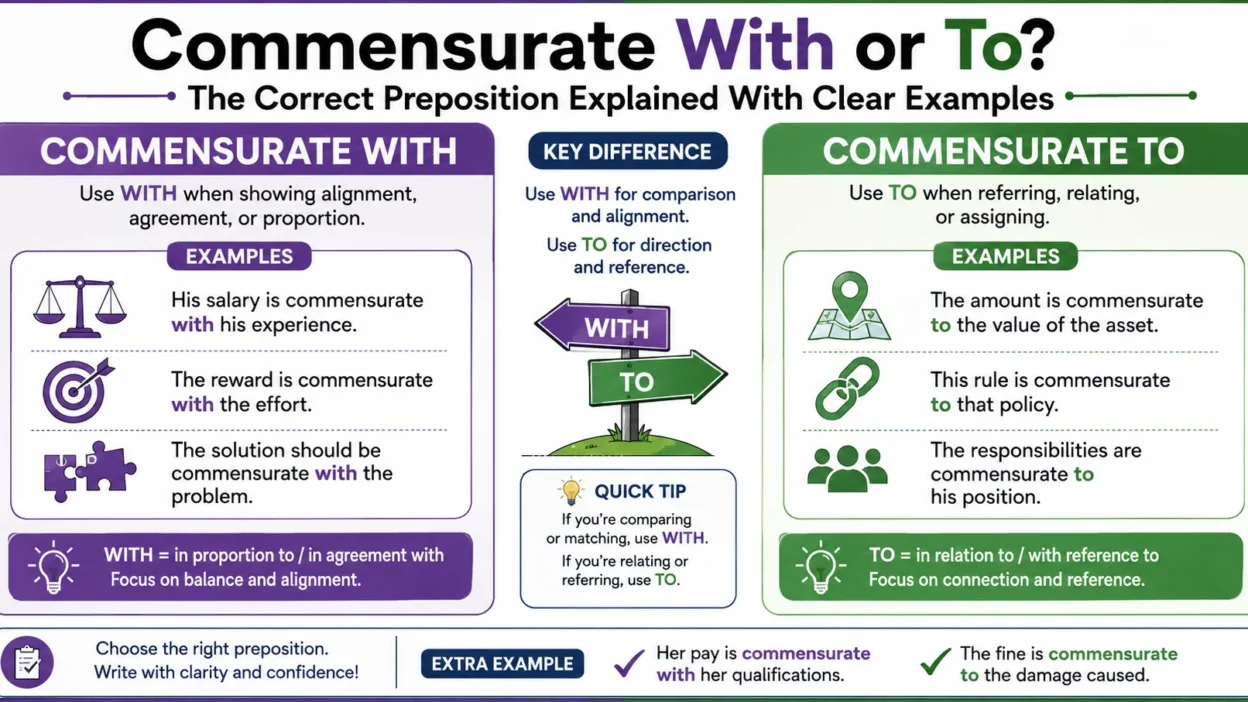
The phrase commensurate with is the standard and widely accepted form.
Why? Because English treats commensurate as an adjective that commonly takes with when it compares one thing to another. The preposition with signals the relationship the word needs: one thing is being measured against another.
That is the pattern native speakers expect.
The grammar pattern
Many adjectives pair naturally with specific prepositions. English does not always follow a single rule that works for every case. Instead, certain adjectives tend to “prefer” certain prepositions.
For commensurate, the accepted pairing is:
commensurate with + noun
Examples:
- commensurate with experience
- commensurate with responsibility
- commensurate with risk
- commensurate with skill level
This works because with introduces the thing being compared or matched.
Why “with” fits the meaning
The word itself carries a sense of comparison and balance. The preposition with supports that meaning better than to does.
Think of it this way:
- With feels relational.
- To often feels directional, target-based, or comparative in a different way.
Some adjectives work with to very naturally:
- similar to
- next to
- superior to
- opposed to
But commensurate does not fit that pattern as neatly. The normal, established phrase is commensurate with.
Correct examples
Here are natural examples of commensurate with in real sentences:
- Her salary is commensurate with her years of experience.
- The penalty should be commensurate with the seriousness of the violation.
- Your authority must be commensurate with your responsibility.
- The company offers bonuses commensurate with performance.
- The risk is commensurate with the potential return.
Each sentence sounds complete and professional because the preposition matches the word’s normal behavior.
A simple memory trick
A helpful way to remember it:
Commensurate with = matched with
If two things are being measured against each other, with is the preposition you want.
Is “commensurate to” ever correct?
In most standard writing, commensurate to is best avoided.
Some people use it, and you may even find it in edited text from time to time. But that does not mean it is the best choice. In careful English, the phrase is usually considered nonstandard or at least unnatural.
Why it sounds wrong
The problem is not that readers will always stop and say, “This is impossible.” The problem is subtler. The phrase sounds a little off. It does not match the normal English pattern most readers expect with this word.
A sentence like this:
- The bonus is commensurate with performance.
is likely to make a careful reader pause.
The natural version is:
- The bonus is commensurate with performance.
That small preposition change makes the sentence sound polished and familiar.
Why writers make this mistake
There are a few common reasons:
- They confuse commensurate with adjectives that take to.
- They assume to works better because it feels comparative.
- They copy a phrase they have seen online without checking it.
- They overcorrect because the sentence sounds formal.
This kind of mistake happens often with words that look academic. People see a formal word and guess at the preposition instead of learning the established pattern.
Should you ever use it?
For clear, professional writing, the answer is simple: no.
There is no real advantage to choosing commensurate to when commensurate with is the standard form. If you want your writing to sound natural, precise, and credible, stick with with.
Commensurate with or to: comparison table
| Feature | Commensurate with | Commensurate to |
| Standard English | Yes | Usually no |
| Natural sound | Yes | Awkward |
| Professional writing | Yes | Avoid |
| Business writing | Yes | Avoid |
| Academic writing | Yes | Avoid |
| Legal writing | Yes | Avoid |
| Clarity | High | Lower |
| Recommendation | Use this | Do not use this |
This table gives you the practical answer in one glance. When in doubt, choose commensurate with.
Examples of “commensurate with” in real sentences
One of the best ways to learn a phrase is to see it in context. Below are common settings where commensurate with appears naturally.
Salary and compensation
This is probably the most familiar use.
- The salary is commensurate with experience.
- Compensation will be commensurate with qualifications.
- Pay should be commensurate with the level of responsibility.
- The bonus is commensurate with performance.
This wording shows up in job ads because employers want to say that pay matches the candidate’s background, skills, or job scope.
Legal writing
Legal writing loves precision. That is one reason the phrase appears there so often.
- The sentence must be commensurate with the severity of the crime.
- The penalty should be commensurate with the harm caused.
- Damages should be commensurate with the loss.
- The remedy must be commensurate with the violation.
Lawyers often use the word because it captures proportionality in one neat term.
Business operations
In business writing, the phrase helps express balance between effort and reward, authority and responsibility, or risk and return.
- Authority should be commensurate with accountability.
- The budget should be commensurate with project scope.
- Resources must be commensurate with demand.
- Returns are often expected to be commensurate with the risk taken.
Academic settings
Academic writing often uses formal phrasing, and this one fits comfortably there.
- The findings were commensurate with the hypothesis.
- The level of support was commensurate with the evidence.
- Academic expectations should be commensurate with the level of study.
- The challenge was commensurate with the student’s preparation.
Government policies
Policy language often relies on measured, proportional phrasing.
- The response must be commensurate with the threat.
- The penalty should be commensurate with the offense.
- Funding should be commensurate with the needs of the district.
- Oversight should be commensurate with the level of risk.
Incorrect examples and their correct versions
Here is where the difference becomes very practical.
| Incorrect | Correct | Why the correction works |
| Her salary is commensurate to her experience. | Her salary is commensurate with her experience. | “With” matches the accepted pattern. |
| The punishment should be commensurate to the offense. | The punishment should be commensurate with the offense. | The phrase expresses proportionality. |
| Benefits are commensurate with performance. | Benefits are commensurate with performance. | Standard usage prefers “with.” |
| The risk is commensurate to the reward. | The risk is commensurate with the reward. | The comparison sounds natural with “with.” |
| The authority is commensurate to the role. | The authority is commensurate with the role. | This is the idiomatic form. |
A useful rule: if you are comparing one thing with another through balance, degree, or value, with usually belongs there.
Common situations where you’ll see “commensurate with”
The phrase appears in a few recurring contexts. Once you know them, it becomes easier to spot the correct pattern.
Job listings
Employers often write:
- Salary commensurate with experience
- Pay commensurate with qualifications
- Compensation commensurate with skills
This language is short, formal, and efficient. It lets the employer signal flexibility without naming an exact figure.
Employment contracts
Contracts may use the phrase to describe compensation, authority, or performance standards.
- Responsibilities commensurate with title
- Pay commensurate with duties
- Benefits commensurate with role
Performance reviews
Managers may use it when discussing reward, recognition, or expectations.
- Your bonus is commensurate with your results.
- The promotion is commensurate with your performance.
Financial reports
In business and finance, the phrase helps describe proportional relationships.
- Returns commensurate with risk
- Investment aligned with expected value
- Costs commensurate with output
Academic and research writing
Researchers and educators may use it to describe matching levels, standards, or outcomes.
- Support commensurate with evidence
- Expectations commensurate with program level
- Training commensurate with complexity
Why people keep making this mistake
Language mistakes often spread because they sound plausible. Commensurate to is one of those phrases that looks like it should work, even though it usually does not.
Common causes
Here are the most common reasons writers get it wrong:
- Pattern confusion: Writers mix it up with adjectives that take to.
- Guesswork: They assume the preposition should be to because the sentence compares two things.
- Copied language: They borrow phrasing from weak sources or unedited drafts.
- Formal word pressure: The word feels advanced, so writers get nervous and choose the wrong partner.
- Second-language transfer: In multilingual writing, direct translation can produce unnatural prepositions.
Why the mistake survives
This kind of error survives because it does not always break meaning. A reader may still understand the sentence. But understanding is not the same as sounding correct.
Good writing is not only about being understood. It is also about sounding natural, clean, and confident.
The grammar rule behind “commensurate with”
At a deeper level, this issue is about adjective-preposition pairing.
English often uses fixed pairings that are best learned as expressions rather than reinvented each time. For example:
- interested in
- similar to
- responsible for
- afraid of
- capable of
- commensurate with
These are not random. They are part of the language’s normal pattern.
Why the pairing matters
The wrong preposition can make a sentence feel awkward even if the grammar still seems understandable. Readers may not always know the technical rule, but they can feel when the phrase sounds unnatural.
That is exactly why commensurate with has become the standard. It fits the rhythm and logic of English usage.
A simple test
Ask yourself:
Does the sentence sound like a phrase a native speaker would naturally say out loud?
- “commensurate with” — yes
- “commensurate to” — usually no
That instinct is often the best guide.
Similar expressions that follow the same pattern
If you are learning this pattern, it helps to compare it with similar adjectives and prepositions.
| Expression | Correct preposition | Example |
| similar | to | Similar to the earlier version |
| equal | to | Equal to the task |
| related | to | Related to the issue |
| comparable | to | Comparable to last year’s results |
| responsible | for | Responsible for the outcome |
| committed | to | Committed to quality |
| commensurate | with | Commensurate with experience |
Notice the pattern. Some adjectives take to, but commensurate is not one of them. That is why copying from similar-looking phrases can lead you astray.
Better alternatives to “commensurate”
Sometimes the word commensurate is perfectly right. Other times, a simpler word will do the job better. That is not a weakness. It is smart writing.
Here are strong alternatives you can use depending on context.
Equivalent to
Use this when two things are essentially equal.
- Her pay is equivalent to her responsibilities.
Proportional to
Use this when you want to show direct balance.
- The penalty should be proportional to the harm.
In line with
Use this when you want a smoother, more modern phrase.
- The salary is in line with industry standards.
Matching
Use this when you want plain, direct English.
- The budget should be matching the project’s scale.
Appropriate for
Use this when the main idea is suitability.
- The training is appropriate for the role.
Corresponding to
Use this in more formal writing when one thing maps onto another.
- The benefits correspond to the level of service.
Aligned with
Use this when the idea is shared direction or consistency.
- The policy is aligned with company goals.
Equal to
Use this only when true equality is the point.
- The reward is equal to the effort.
Which alternative should you choose?
A simple guide:
- Use commensurate with when you want a formal, precise phrase.
- Use proportional to when the relationship is mathematical or fairness-based.
- Use in line with when you want business-friendly plain English.
- Use equivalent to when equality is the main idea.
Is “commensurate” too formal?
For some readers, yes. For others, no.
The word is not wrong just because it sounds formal. In fact, formal language can be exactly right in contracts, policy writing, academic work, and legal language. The real question is whether it suits the audience.
Formal contexts
The word works well in:
- job ads
- legal clauses
- policy documents
- research papers
- executive reports
- performance evaluations
Simpler contexts
A simpler phrase may work better in:
- blog posts
- general website copy
- casual workplace notes
- customer-facing explanations
- social posts
For example:
- Formal: Compensation will be commensurate with experience.
- Simpler: Pay will reflect your experience.
Both sentences are correct. The second one is just easier for a broad audience.
The best choice depends on your reader
If you are writing for specialists, commensurate may feel precise and polished.
If you are writing for a general audience, plain language often works better and faster.
That is the heart of good writing: not just saying something correctly, but saying it in the way your reader will understand most easily.
Common mistakes to avoid
Even good writers can trip over this phrase. Keep these mistakes in mind.
Do not use “commensurate to” as your default
This is the biggest issue. The standard pairing is with, not to.
Do not use the word when a simpler phrase works better
If a plain word does the job, use it.
- Instead of “The support is commensurate with the need,” you could say “The support matches the need.”
Do not overuse formal language
A sentence can be correct and still feel stiff. Too many formal words in one paragraph can make your writing heavy.
Do not force precision where clarity matters more
Sometimes a simpler sentence is stronger.
- Weak: The response was commensurate with the issue.
- Stronger: The response matched the seriousness of the issue.
Do not confuse formality with quality
A fancy word is not automatically a better word. Good writing is clear first, polished second, and impressive only when it earns that effect naturally.
Case study: how one hiring post used the wrong phrase
Imagine a company posting this job description:
Salary commensurate with experience.
At first glance, most readers would understand the intent. But the phrase sounds off. It signals carelessness, even if the rest of the post is solid.
Now compare it with the corrected version:
Salary commensurate with experience.
That version sounds professional and familiar. It fits what candidates expect to see in hiring language.
Why this matters
A job ad is often the first impression a candidate gets of a company. Small language mistakes can subtly weaken trust. They may not ruin the posting, but they can chip away at the polished image the company wants to project.
The practical lesson
When writing for public or professional use, the safest path is usually the most established one. In this case, that means commensurate with.
A quick usage guide for different contexts
Here is a useful reference you can apply right away.
| Context | Best phrase | Example |
| Salary | commensurate with experience | Salary commensurate with experience |
| Risk | commensurate with risk | Returns commensurate with risk |
| Punishment | commensurate with offense | Penalty commensurate with the offense |
| Responsibility | commensurate with authority | Authority commensurate with responsibility |
| Education | commensurate with level | Expectations commensurate with the level of study |
| Business value | commensurate with value | Fees commensurate with the value provided |
This table shows how flexible the phrase is when used correctly.
The easiest rule to remember
Here is the simplest rule in the whole article:
Use “commensurate with.” Avoid “commensurate to.”
You do not need a complicated explanation every time. You just need the standard pairing and a sense of what the word means.
A quick memory line:
Commensurate with = properly matched with.
That is enough to guide most writers.
Conclusion
Choosing between Commensurate With or To? becomes much easier once you know that commensurate with is the standard and widely accepted expression in English. Whether you are writing business emails, academic papers, or everyday messages, using the correct preposition improves clarity, sounds more natural, and helps your writing appear professional. While language continues to evolve, commensurate with remains the preferred choice in modern English.
FAQs
Q1. Is it commensurate with or commensurate to?
Commensurate with is the correct and standard expression in English. Although you may occasionally see commensurate to, it is much less common and is generally avoided in formal writing.
Q2. Why is commensurate with preferred?
The adjective commensurate is traditionally followed by the preposition with because it expresses that two things are equal, proportional, or appropriately matched.
Q3. Can I use commensurate to in professional writing?
It is better not to. Most style guides, dictionaries, and professional editors recommend commensurate with for business, academic, and formal communication.
Q4. What does commensurate with mean?
It means that something is proportional, equal, or appropriate in relation to something else. For example, “The salary is commensurate with experience” means the salary matches the person’s experience.
Q5. What is a simple example of commensurate with?
A common example is: “The employee received a salary commensurate with their experience and qualifications.” This shows that the pay appropriately matches the employee’s background.