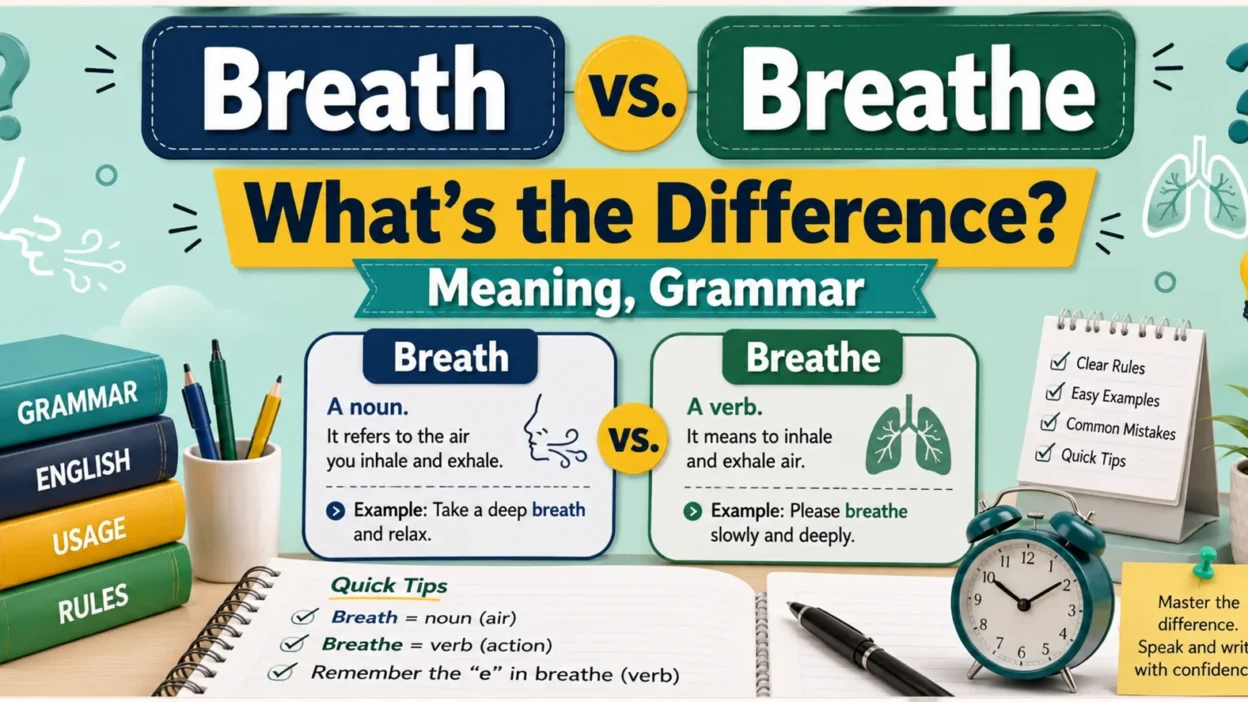
Breath vs. Breathe can seem confusing at first, but learning the difference helps you write clearer English every day with greater confidence. Many writers mix these words up because they have similar spellings, similar meanings, and are closely related. Once you know the two forms, your English grammar, writing, and communication become more natural. Breath is a noun, while breathe is a verb, and this word difference and spelling difference affect usage, context, sentence structure, and pronunciation. I still check the final e when proofreading because that one letter completely changes the meaning. Learning these commonly confused words is a simple way to improve your English vocabulary.
Think of breath as the air you take into your lungs and let out, while breathe describes the action of taking air in and out. That simple memory trick has stayed with me from school and still helps at work, in emails, and during everyday conversation. Looking at examples and practical examples makes it easier to choose the right form every time. Even a small change in spelling can change a sentence, and the wrong choice may sound awkward or incorrect, although the sound is very close. Understanding parts of speech, pronunciation, and context shows why one word names a thing and the other describes an action you perform.
When I was getting the hang of English, every lesson felt different. Some days were like a walk in the park, while others felt like a hike up a steep hill because I would bump into tricky words. I remember the last time I needed to remind myself to take a deep breath before trying to breathe deeply. That experience removed the confusion, and after years of speaking English, I rarely make the same mistake. The main difference lies in the noun and verb forms. Breath refers to air taken into or expelled from the lungs, while breathe means to draw air for living. For example, it can be hard to breathe in a crowded room. Additionally, the spoken forms have different ends: breath ends with a short, sharp sound, while breathe ends with a soft z sound. That understanding is the key to using both words correctly in sentences with confidence.
Breath vs. Breathe at a Glance
Here is the fastest way to tell them apart.
| Word | Part of Speech | Meaning | Example |
| breath | noun | air taken in or out of the lungs | Take a deep breath. |
| breathe | verb | to inhale and exhale | Try to breathe slowly. |
That table gives you the core rule. If you need a thing, use breath. If you need an action, use breathe.
A quick shortcut helps too:
- Breath = something you can take, catch, hold, or lose.
- Breathe = something you do.
That tiny difference solves most confusion.
What Does Breath Mean?
Breath is a noun that refers to the air you inhale and exhale during breathing. It can also describe a single intake of air or the natural movement of air in and out of your lungs. You use breath when talking about the air itself, not the action of breathing. For example, you might take a deep breath, hold your breath, or catch your breath after running, exercising, or feeling surprised.
Breath as a noun in real life
You might hear it in sentences like these:
- She took a deep breath before speaking.
- I could see his breath in the cold air.
- Hold your breath for a few seconds.
- He was out of breath after the climb.
In each case, breath behaves like a thing. It names an object-like idea, even though that “thing” is not something you can hold in your hand.
Breath pronunciation
Breath is usually pronounced like BRETH.
The vowel sound is short. It does not sound like “bree-th.”
That sound matters. Many learners see the word and expect it to sound like breathe, but it does not.
What breath often means in context
Beyond the literal meaning, breath can also appear in idioms and expressions. For example:
- catch your breath — to recover after exercise, stress, or surprise
- take a breath — to pause or calm down
- out of breath — breathing fast because of effort or anxiety
These phrases are common in everyday English. If you use them correctly, your writing sounds more natural right away.
What Does Breathe Mean?
Breathe is a verb that means to inhale and exhale air through your lungs. It describes the action of breathing, which your body does naturally to supply oxygen and remove carbon dioxide. You use breathe whenever you’re talking about doing the action, not the air itself. For example, you might breathe deeply during meditation, breathe slowly to calm your nerves, or breathe easier after recovering from a cold. Remember, if the word describes an action, breathe is always the correct choice.
Breathe as a verb in real life
Here are simple examples:
- Please breathe slowly.
- Try to breathe through your nose.
- Fresh air helps me breathe better.
- She forgot to breathe for a second when she got nervous.
Notice the pattern. The word shows an action. That is the biggest clue.
Breathe pronunciation
Breathe is usually pronounced like BREETH.
The vowel sound is longer than in breath.
That small sound change is one reason people mix them up. The spelling difference is only one letter, but the pronunciation difference is real.
Verb forms of breathe
Because breathe is a verb, it changes form depending on tense and subject:
- breathe — base form
- breathes — third-person singular present
- breathed — past tense
- breathing — present participle and gerund
Examples:
- I breathe deeply when I meditate.
- He breathes through his mouth.
- She breathed a sigh of relief.
- They are breathing fresh air outside.
That pattern helps you spot the verb form fast.
Breath vs. Breathe: The Key Differences Explained
Although breath and breathe look almost identical, they have different meanings, pronunciations, and grammatical roles. Breath is a noun that refers to the air you inhale and exhale, while breathe is a verb that describes the action of taking air into and out of your lungs. The easiest way to remember the difference is to ask whether you’re talking about a thing or an action. If it’s the air itself, use breath. If it’s the act of inhaling and exhaling, use breathe. Mastering this simple distinction will help you write and speak English with greater confidence and accuracy.
Meaning comparison
- Breath is the air itself.
- Breathe is the act of moving air in and out.
Grammar comparison
- Breath is a noun.
- Breathe is a verb.
Pronunciation comparison
- Breath rhymes with death.
- Breathe rhymes more closely with seethe or seeth.
Usage comparison
Here is a simple side-by-side view:
| Situation | Correct Word | Why |
| You need a noun | breath | It names the air |
| You need an action | breathe | It shows what someone does |
| After a run, you are tired | out of breath | “Breath” works as a noun |
| Someone tells you to calm down | breathe | The speaker wants an action |
That table is the heart of the lesson. Once you remember nouns versus verbs, the rest becomes much easier.
Why People Confuse Breath and Breathe
It’s easy to see why breath and breathe confuse so many English learners and even native speakers. The two words differ by only one letter, have similar pronunciations, and are closely related in meaning because they both involve breathing. However, they belong to different parts of speech—breath is a noun, while breathe is a verb. Since both words are correctly spelled English words, spell-check tools may not catch the mistake. Understanding whether your sentence needs a thing or an action is the simplest way to choose the correct word every time.
The spelling is nearly identical
Only one letter separates them. That makes it easy to mix up in a hurry.
The pronunciation is close
Both words start with the same sound. Both have the same consonant pattern. The vowel sound changes, but not everyone notices it right away.
English learners often focus on meaning first
That is natural. But with these words, grammar matters just as much as meaning. A sentence can make sense in your head and still be wrong on the page.
Spell check does not always save you
Sometimes spell check misses the wrong form because both words are real words. That means a sentence like “Please take a breathe” may slip through if the system does not catch the grammar issue.
A quick human check works better:
- Is the word naming a thing? Use breath.
- Is the word showing an action? Use breathe.
That one test solves many errors.
Breath vs. Breathe in Grammar
From a grammar perspective, the difference between breath and breathe is straightforward once you know their roles. Breath is a noun, so it names a thing—the air you inhale and exhale. Breathe, on the other hand, is a verb, so it describes the action of taking air into and out of your lungs. A simple grammar rule is to use breath after words like a, the, my, or your, while breathe usually follows a subject such as I, you, we, or they. Recognizing whether your sentence needs a noun or a verb will help you choose the correct word with confidence.
Breath is a noun
It can act as:
- a subject: Breath matters when you are anxious.
- an object: Take a deep breath.
- part of a phrase: He was out of breath.
Breathe is a verb
It can act as:
- a main verb: I breathe slowly.
- an instruction: Breathe deeply.
- a tense-based form: She breathed calmly.
Fast way to test the word
Try this simple check:
If you can replace the word with air, breath is probably correct.
Example:
- I need a deep breath.
- I need deep air.
That second sentence does not work in normal English, so breath is the correct choice.
If you can replace the word with inhale or exhale, breathe is probably correct.
Example:
- Please breathe slowly.
- Please inhale slowly.
That works, so breathe is correct.
Pronunciation Guide: Breath vs. Breathe
Although breath and breathe are spelled similarly, their pronunciations are different. Breath is pronounced with a short “e” sound and rhymes with “death.” In contrast, breathe has a long “ee” sound and rhymes with “seethe.” Paying attention to this small pronunciation difference can help you remember that breath is the noun, while breathe is the verb, making it easier to use both words correctly in speaking and writing.
Breath
- Pronunciation: BRETH
- Short vowel sound
- Same ending sound as death, health, or wealth
Breathe
- Pronunciation: BREETH
- Long vowel sound
- Same ending sound pattern as seethe or teethe
Why the sound matters
English spelling does not always match sound in a neat way. That is annoying, but it is also normal. The pair breath / breathe is one of the most common examples of a spelling difference that changes pronunciation and meaning.
A simple memory cue:
- breath feels short
- breathe feels longer
That is not a perfect rule for every word, but it works here.
A Simple Case Study: The Resume Mistake
A job seeker wrote this line on a resume:
“I have 10 years of breathe in customer support.”
The sentence looked almost right at first glance. But one letter changed the meaning and made the line look careless.
The correct version is:
“I have 10 years of experience in customer support.”
Or, if the word pair had truly been needed:
“I have 10 years of breath” would still be wrong, because the sentence needs neither word.
This is the real lesson: using the right word matters, but so does using the right word for the job. Sometimes the fix is not just swapping breath and breathe. Sometimes it is choosing a better sentence altogether.
That is how strong writing works. It is not only about grammar. It is also about precision.
Easy Tricks to Remember the Difference
Remembering the difference between breath and breathe is easier than it seems. A simple trick is to focus on the extra “e” in breathe—that extra letter reminds you it’s a verb, meaning the action of inhaling and exhaling. Breath, without the final “e,” is a noun that refers to the air itself. Another helpful tip is to ask yourself whether your sentence needs a thing or an action. If it’s a thing, use breath. If it’s an action, choose breathe.
The noun test
If the word answers what?, it is probably breath.
- What did she take? A breath.
- What did he lose? His breath.
The action test
If the word answers do what?, it is probably breathe.
- Do what? Breathe.
- Do what? Breathe slowly.
The silent letter trick
The extra e at the end of breathe can remind you that it is the action word. It stretches the sound a little, just like breathing itself stretches in and out.
The sentence swap trick
Replace the word with a clearer synonym:
- If air fits, use breath.
- If inhale fits, use breathe.
That is one of the quickest ways to check yourself.
Breath vs. Breathe in Everyday Language
In everyday English, breath and breathe appear in many common conversations, making it important to know the difference. You might say, “Take a deep breath before speaking,” where breath refers to the air you inhale. On the other hand, you could say, “Remember to breathe slowly during meditation,” where breathe describes the action of inhaling and exhaling. Using the correct word helps your speaking and writing sound more natural, accurate, and confident in both casual and professional settings.
Breath in common phrases
- take a breath
- catch your breath
- out of breath
- hold your breath
- under your breath
Breathe in common phrases
- breathe deeply
- breathe slowly
- breathe easy
- breathe in
- breathe out
A few examples in context:
- After the sprint, I needed to catch my breath.
- Before the presentation, she told herself to breathe.
- He whispered the words under his breath.
- In the yoga class, everyone was told to breathe deeply.
That is the pattern in real life. Breath usually appears inside a noun phrase. Breathe usually drives the action of the sentence.
Common Mistakes and Corrections
Here are some common wrong examples and the better versions.
| Wrong | Correct | Reason |
| Take a deep breathe. | Take a deep breath. | “Take” needs a noun |
| I can’t breath right now. | I can’t breathe right now. | “Can’t” needs a verb |
| Hold your breathe. | Hold your breath. | “Hold” here takes a noun |
| She breath slowly. | She breathes slowly. | Third-person singular verb form |
This table is worth memorizing. Most errors come from sentence structure, not from vocabulary size. Once you notice the role the word plays, the answer gets easier.
A Quote to Remember
A noun names the thing. A verb names the action.
That simple idea solves a huge number of grammar questions, not just this one.
Breath vs. Breathe: The Core Rule You Should Keep
If you remember only one thing from this article, remember this:
- Breath is a thing.
- Breathe is an action.
That is the whole game.
Use breath when you talk about air in the lungs, a pause, or a physical sign of breathing. Use breathe when you talk about the act of taking air in and out.
Conclusion
Understanding Breath vs. Breathe becomes much easier once you remember their different roles in a sentence. Breath is a noun that refers to the air you inhale and exhale, while breathe is a verb that describes the action of taking air in and out of your lungs. Paying attention to the spelling, pronunciation, and context will help you avoid common mistakes. With regular practice, you’ll use both words naturally and confidently in everyday writing and conversation.
FAQs
Q1. What is the main difference between breath and breathe?
Breath is a noun that means the air you take into and out of your lungs. Breathe is a verb that means to inhale and exhale air.
Q2. How can I remember when to use breathe?
A simple trick is to remember that breathe ends with the letter e, and verbs often describe an action. If someone is doing the action of taking in air, use breathe.
Q3. Is breath or breathe used after “take a deep”?
The correct phrase is take a deep breath because breath is the noun that names the air you inhale.
Q4. Do breath and breathe have different pronunciations?
Yes. Breath ends with a sharp “ht” sound, while breathe ends with a soft “ht” sound that sounds like “z”.
Q5. Why do people confuse breath and breathe?
People often confuse them because they have very similar spellings, meanings, and pronunciations. Learning their different parts of speech and practising them in sentences helps prevent mistakes.