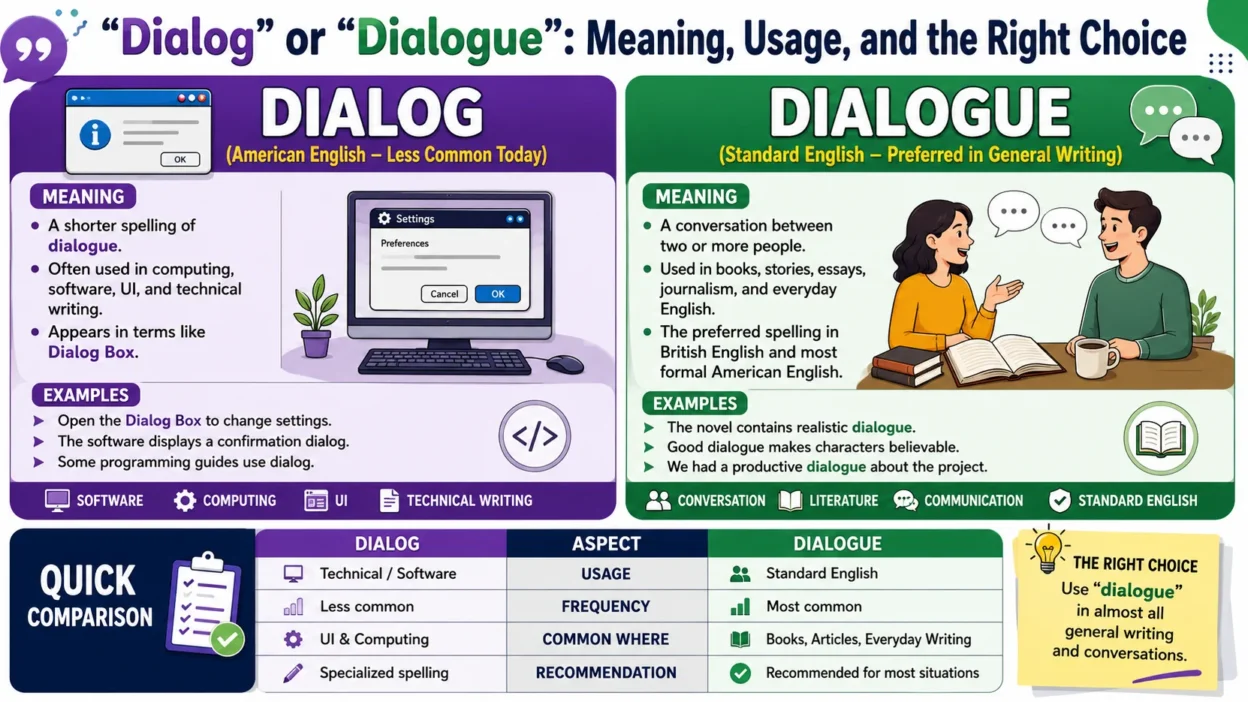
Dialog or Dialogue can look like the same word, but choosing the right spelling depends on where and how you use it every day. If you’ve ever paused and wondered which form is correct, you’re not alone. In everyday English, dialogue is the standard choice for general writing, books, a novel, movies, email, or a blog post because it describes a conversation, exchange, or discussion between two or more people. It is the preferred spelling in British English and is also widely accepted in American English. Dialog, however, appears mainly in technology, software, programming, technical documentation, software interfaces, and a dialog box, where it refers to an interface between users and systems instead of spoken communication.
Although both spellings share a similar meaning, the context, audience, tone, and choice of writing help you decide which version fits best. Every writer, writers, students, bloggers, and professionals benefit from learning this simple rule because the correct spelling builds confidence, reduces confusion, and helps avoid common mistakes. This guide explains the history, origins, forms, and rules in simple terms, using examples, real-life examples, and a comparison table to show what is correct, what is wrong, and why your technical, creative, casual, or plain style should match the sentence and work you are producing.
The good news is that the idea is much easier than it may sound. In most fields, dialogue remains the safer term, while dialog is commonly used when referring to software features online. Keeping this practical point in mind makes your language more clear, polished, and easier for readers to know exactly what you signify. The discussion can be formal, philosophical, or academic, including academic discussions, without changing its core meaning. From screen instructions on the latest gadget to written scripts, plays, a movie, or the news, every example helps you catch the difference. Many folks ponder it every day, but there are bigger fish to fry. Even so, taking time to tackle the topic, look beneath the surface, notice what is lurking beneath, watch ideas floating or popping up, and move beyond that niggling feeling will make your writing more commonly understood because the right choice naturally carries your message.
Dialog or Dialogue: What the Words Actually Mean
At the most basic level, dialogue means a conversation or exchange of ideas. It usually refers to spoken interaction between people, characters, groups, or nations. You will see it in literature, business, education, and formal writing.
Dialog is closely related, but modern English uses it more narrowly. In American English, it often refers to a computer window or pop-up box. In some style traditions, it can also appear as a shorter spelling of dialogue, but that usage is less common in polished writing.
Here is the core idea:
- Dialogue = conversation, discussion, communication
- Dialog = often a software interface term, especially in American English
The two words share the same root. The difference comes from usage, not meaning alone.
Simple examples
- The characters in the movie had powerful dialogue.
- The app opened a save-file dialog.
- The leaders resumed dialogue after months of tension.
- A permission dialog appeared on the screen.
That is the basic split. Now let’s go deeper.
The History of Dialog and Dialogue
The story begins long before modern English.
Both words come from the Greek dialogos, which referred to conversation, discussion, or a reasoned exchange of speech. That Greek root moved into Latin and then into English through older scholarly and literary usage.
Over time, English borrowed many words with similar endings from French and Latin. That is one reason the spelling -ogue became familiar in English words like:
- catalogue
- dialogue
- monologue
- epilogue
Later, American English started favoring shorter spellings in some words. That change gave us forms like:
- catalog
- analog
- program
- dialog in certain computing contexts
This was not random. It reflected a broader trend in American spelling toward simplification.
Why the spelling split matters
Language evolves in layers. One spelling may feel older and more formal. Another may feel newer and more practical. That is exactly what happened here.
Dialogue kept the traditional form.
Dialog became common in technical and software settings.
So the spelling difference is not just about preference. It reflects history, region, and context.
Dialog or Dialogue in American English
In American English, dialogue is the safer and more universal choice when you mean conversation. It works in essays, reports, articles, academic papers, business writing, and creative writing.
Dialog appears in American English too, but its strongest modern use is technical. If you are describing a window in software or a system prompt, dialog often feels natural and standard.
Use dialogue when you mean conversation
Choose dialogue for:
- spoken exchange between people
- discussion between groups
- character speech in fiction
- diplomatic talks
- meaningful communication
Use dialog when you mean a software box
Choose dialog for:
- pop-up windows
- settings prompts
- save confirmation boxes
- login prompts
- system interface elements
Examples
- The article examines dialogue in modern leadership.
- The app displays a confirmation dialog before deletion.
- Their dialogue about the issue was respectful and honest.
- The error dialog closes when you restart the program.
That distinction is clean and useful. It saves you from sounding vague.
The Computing Meaning of Dialog Box
This is where many people get confused.
In software, a dialog box is a small window that asks you to do something. It may request input, show a warning, confirm an action, or present options. Users see these boxes all the time.
Examples include:
- Save changes?
- Are you sure you want to delete this file?
- Enter your password
- Select a folder
- Allow access?
In this setting, dialog is the standard spelling in many American technical contexts. It is short, efficient, and widely recognized.
Why “dialog box” sounds natural in tech writing
Tech language often favors precision and brevity. A dialog box is a specific interface element. It is not a literary conversation. It does not need the more traditional spelling dialogue.
That is why software documentation often says:
- dialog box
- dialog window
- dialog prompt
A quick tech comparison
| Term | Common Use | Best Context |
| Dialog | UI window, prompt, software box | Technology, software documentation |
| Dialogue | Conversation, discussion, spoken exchange | Writing, speech, formal communication |
The table looks simple because the rules are simple. Most confusion disappears once you separate conversation from interface.
When Dialog Crosses Over Into Conversation
Could dialog ever mean conversation? Yes. But in modern writing, that is less common than dialogue.
Some dictionaries and style habits allow dialog as a shortened variant of dialogue, especially in American English. Still, most readers expect dialogue when the topic involves conversation. Using dialog there can look clipped or unusual unless your audience is used to that spelling.
When dialog may appear outside tech
You may see dialog in:
- informal American usage
- editorial shortcuts
- software-adjacent writing
- older or condensed style conventions
But there is a catch. A spelling that is acceptable is not always the best choice. In most editorial work, dialogue remains cleaner and more standard.
A simple rule of thumb
If you are writing about people talking, use dialogue.
If you are writing about a window on a screen, use dialog.
That rule covers most real-world cases.
Consistency Matters More Than Cleverness
Good writing depends on consistency. If one paragraph uses dialogue and the next uses dialog for the same idea, readers may think the spelling is accidental or inconsistent.
This becomes especially important in:
- academic writing
- publishing
- journalism
- UX writing
- brand style guides
- editing and proofreading
Why consistency protects your credibility
Readers notice patterns, even when they do not consciously analyze them. A consistent spelling choice signals control. It says the writer knows the field and respects the reader.
Inconsistent spelling has the opposite effect. It can make the writing feel rushed or careless.
Practical consistency tips
- Pick one form for conversation and stick with it.
- Follow the publication’s style guide.
- Use dialog for interface elements in tech writing.
- Use dialogue for speech, discussion, and narrative writing.
- Check your document for mixed usage before publishing.
In short, consistency is the glue that holds good writing together.
Dialogue in Literature, Film, and Creative Writing
In creative writing, dialogue does heavy lifting. It reveals character. It creates rhythm. It moves the plot. It makes scenes feel alive.
A story without dialogue can feel flat. Too much dialogue without control can feel messy. The best writers balance speech with action and description.
What strong dialogue does in creative work
- reveals personality
- shows conflict
- builds tension
- delivers information naturally
- makes scenes feel real
- keeps the pace moving
Example
Flat:
- “I am angry,” she said.
- “I understand,” he said.
Stronger:
- “You knew this would upset me,” she said.
- He looked away. “I thought you might see it differently.”
The second version feels more human because it adds texture. The words carry mood. Body language carries meaning.
Dialogue in film
In film, dialogue must sound natural when spoken aloud. That means it needs rhythm, clarity, and subtext. Good screen dialogue often says less than it means. That is where the power lives.
A character may say:
- “Fine.”
But the scene may actually mean:
- I am hurt.
- I am done arguing.
- I do not trust you anymore.
That is the craft of dialogue. It is not just words. It is pressure, motive, and emotion.
Case Study: Why One Spelling Works Better Than the Other
Imagine a software manual that says, “Click the dialog box to continue.” In this context, “dialog” is the correct choice because it refers to a user interface element. Now consider a novel review that says, “The dialogue between the main characters feels natural and engaging.” Here, “dialogue” is the right spelling because it describes spoken conversation. This simple comparison shows that the best spelling depends entirely on the context in which the word is used.
Version one
“The software opens a dialogue when the file cannot be saved.”
Version two
“The software opens a dialog when the file cannot be saved.”
In a technical help article, version two feels more natural. It matches the usual software term dialog box. It sounds like the writer understands UI language.
Now try this:
Version one
“The novel uses dialog to show the distance between the siblings.”
Version two
“The novel uses dialogue to show the distance between the siblings.”
Here, version two is clearly better. It fits literary language and reader expectations.
That is the heart of the difference. Context decides the best spelling.
How British and International English Handle Dialogue and Dialog
British English usually prefers dialogue in almost all cases. That includes conversation, drama, literature, and discussion. The shorter form dialog is much less common outside technical contexts.
In many international settings, the spelling dialogue remains the default because it feels standard, formal, and widely accepted.
General pattern
- British English: dialogue is the norm
- American English: dialogue is standard for conversation; dialog may appear in tech
- International English: dialogue is usually the safer choice
Why this matters for global writing
If your audience is international, dialogue often avoids confusion. It looks familiar across regions and reads smoothly in formal contexts.
That is especially useful for:
- educational content
- cross-border business writing
- global marketing
- academic publications
- editorial copy
When the audience is broad, the older and fuller spelling often wins.
Dialogue in Business and Communication
In business and professional communication, “dialogue” refers to a meaningful exchange of ideas that helps people build trust, solve problems, and make better decisions. Organizations often encourage open dialogue between employees, managers, customers, and stakeholders to improve collaboration and resolve conflicts. Using the word “dialogue” in these contexts reflects thoughtful, two-way communication rather than a simple conversation.
Examples in business contexts
- “The company opened dialogue with local communities.”
- “Healthy dialogue between departments improves workflow.”
- “The negotiation required careful dialogue on both sides.”
In this setting, dialogue signals collaboration and mutual understanding. It feels professional and measured.
That makes it useful in:
- leadership communication
- policy discussions
- HR documents
- public statements
- conflict resolution
Why dialogue sounds stronger than conversation in formal business writing
The word conversation can feel casual. Dialogue feels more structured. It suggests two-way exchange with purpose.
That is why it often appears in serious or strategic writing.
A Closer Look at Related -ogue and -og Words
The pair dialogue/dialog belongs to a bigger spelling pattern in English. Many words once ended in -ogue, and American English sometimes trims them to -og.
Here are some common examples:
- catalogue → catalog
- analogue → analog
- monologue → monolog in some contexts, though monologue remains common
- dialogue → dialog in technical use
Why some words shortened and others did not
Language rarely changes all at once. Some words shorten easily because the shorter form catches on. Others keep the older spelling because writers and readers prefer it.
That is why English can feel uneven. It is. But the unevenness has logic behind it.
What to learn from the pattern
The key lesson is this: spelling changes usually follow usage, not theory.
If enough writers, editors, and industries accept a shorter form, it can become standard in that field. That is how dialog survived in software. It did not replace dialogue everywhere. It found its own place.
Common Mistakes When Using Dialog and Dialogue
One of the most common mistakes is using “dialog” to describe a conversation in general writing when “dialogue” is the accepted spelling. Another frequent error is using “dialogue” for a software dialog box, where the shorter “dialog” is the standard technical term. Avoiding these mix-ups and using each spelling in the correct context will make your writing more professional, consistent, and easy to understand.
Mistake one: Using dialog for conversation in formal writing
This can look awkward in essays, articles, or novels unless you are writing for a specific style guide.
Better:
- “The dialogue between the characters was tense.”
Less natural:
- “The dialog between the characters was tense.”
Mistake two: Using dialogue for a software box
That can sound overly formal or slightly off in technical writing.
Better:
- “Click OK in the dialog box.”
Less precise:
- “Click OK in the dialogue box.”
Mistake three: Mixing both spellings without purpose
This creates a messy look and confuses readers.
Better:
- Use dialogue for speech.
- Use dialog for interface boxes.
- Keep the choice consistent.
Mistake four: Overthinking the word
Sometimes writers waste time worrying about one spelling when the bigger issue is clarity. Choose the form that fits the context. Then move on.
How to Choose Between Dialog and Dialogue
Choosing between “dialog” and “dialogue” is easier once you understand the context. Use “dialogue” when referring to conversations, discussions, or character interactions in books, articles, or everyday communication. Use “dialog” when describing a software interface, such as a dialog box or dialog window. Matching the word to its intended purpose keeps your writing accurate, clear, and consistent.
Use dialogue when:
- you mean conversation
- you are writing fiction
- you are discussing communication or exchange of ideas
- you are using general or formal English
- your audience may be international
Use dialog when:
- you mean a software window or prompt
- you are writing tech documentation
- your style guide prefers the shorter form
- you are describing a UI element in an app, program, or website
Ask one question
What am I describing?
If the answer is speech or exchange, choose dialogue.
If the answer is a screen box or prompt, choose dialog.
That one question solves most cases.
Quick Comparison Table
| Feature | Dialog | Dialogue |
| Core meaning | Often a software prompt or box | Conversation or exchange |
| Best context | Tech writing, UI documentation | Literature, business, general writing |
| Common in American English | Yes, especially in computing | Yes, in most contexts |
| Common in British English | Less common | Very common |
| Tone | Short, technical, practical | Traditional, formal, versatile |
| Best for characters talking | Not usually | Yes |
The table makes the difference easy to scan. That matters when you are editing fast.
Case Study: Editing a Paragraph for Clarity
Here is a rough paragraph:
“The app opens a dialogue before deletion. The dialogue asks the user to confirm the action. The customer service team also encourages dialogue with users through support channels.”
This paragraph is not wrong in a broad sense, but it feels repetitive and slightly off.
A stronger version would be:
“The app opens a dialog before deletion. The prompt asks the user to confirm the action. The customer service team also encourages dialogue with users through support channels.”
Now the spelling matches the meaning in each sentence. The paragraph reads more naturally. The distinction also helps the reader move from technology to communication without confusion.
That is a useful editing habit. Small choices can sharpen a whole paragraph.
What Style Guides Usually Prefer
Most style guides favor “dialogue” when referring to conversations, spoken exchanges, or written speech because it is the standard spelling in general, academic, and literary English. In contrast, technical and software documentation often use “dialog” for interface elements like a dialog box or dialog window. Following the preferred spelling of your chosen style guide helps maintain consistency, clarity, and a professional tone throughout your writing.
General editorial tendency
- Dialogue for conversation and writing
- Dialog for computing and interface language
Most guides care about clarity first. They want words that match the context and the audience.
What that means for you
If you are writing content for:
- blogs
- news sites
- education
- business
- books
- essays
then dialogue will usually be the better default.
If you are writing for:
- software documentation
- product help centers
- app interfaces
- developer guides
then dialog may be the better choice.
When in doubt, choose the form that your readers expect.
Dialogue as a Writing Tool, Not Just a Word
This word is more than a spelling choice. It is also a writing craft tool.
Good dialogue can do three things at once:
- reveal character
- move the story
- create emotional energy
That is why writers study it so closely. Real dialogue is not just realistic speech. It is a purposeful speech.
A few signs of strong dialogue
- It sounds natural when read aloud.
- It avoids unnecessary filler.
- It gives each character a distinct voice.
- It creates tension, humor, or insight.
- It does not explain everything too plainly.
A simple example
Weak:
- “I am upset because you forgot my birthday.”
Stronger:
- “You really forgot?”
- “I did not mean to.”
- “That does not help.”
The second version feels alive. It leaves room for emotion and subtext. That is the kind of dialogue readers remember.
When the Shorter Form Feels Right
Sometimes dialog looks right simply because the setting is technical and compact.
Think of a screen that says:
- Open file dialog
- Save dialog
- Print dialog
- Permission dialog
These phrases are short, functional, and easy to scan. They match the pace of technology use. Users need clarity fast. They do not need extra syllables.
That is one reason the shorter spelling survives. It is efficient.
Efficiency matters in:
- software copy
- user interface labels
- instruction text
- help documentation
In those places, the shorter form works like a tool. It gets out of the way and does its job.
When the Longer Form Feels Right
Dialogue feels better when language needs warmth, depth, or formality.
It fits:
- interviews
- speeches
- literary analysis
- negotiations
- thoughtful discussion
It also feels more complete. The extra letters carry a sense of tradition. That matters in formal and creative writing.
For example:
- “The dialogue between the two nations improved after the summit.”
- “The film uses dialogue to show the father’s regret.”
- “The classroom dialogue encouraged honest questions.”
The word has a range. It can sound intellectual without sounding stiff.
Common Questions Writers Ask Themselves
Many writers wonder whether they should use “dialog” or “dialogue”, especially when switching between creative writing, academic content, and technical documentation. The key question is whether you’re describing a conversation or a software interface. Understanding that distinction makes it much easier to choose the correct spelling and keep your writing clear, accurate, and consistent.
Is dialog wrong?
No. Not in every context. It is often correct in software and technical writing.
Is dialogue always better?
No. It is better for conversation and general writing, but not for every tech context.
Can I use dialog in an essay?
Usually not unless you are referring to software.
Can I use dialogue in UI copy?
You can, but dialog is usually the cleaner choice for a pop-up window or prompt.
Which one is safer when I am unsure?
Dialogue is usually the safer default outside technical writing.
Best Practices for Choosing the Right Word
Choosing the right word depends on your purpose, audience, and writing context. Use “dialogue” when discussing conversations, communication, or creative writing, as it is the standard spelling in most forms of English. Use “dialog” only when referring to software interface elements, such as a dialog box or dialog window. Keeping your spelling consistent throughout your writing improves readability and helps your content appear polished and professional.
Step one: Identify the meaning
Ask whether the word refers to:
- people talking
- characters speaking
- discussion or exchange
- a software box or prompt
Step two: Match the context
Then choose the spelling that fits the setting.
- conversation = dialogue
- software window = dialog
Step three: Check the audience
If your readers are broad or international, dialogue often feels safer.
If your readers are developers or users of a specific software product, dialog may be more precise.
Step four: Review for consistency
Read the document again. Make sure the spelling choice stays consistent throughout.
That last step is easy to skip. It is also one of the most important.
Conclusion
Choosing between dialog and dialogue is easier once you understand where each word belongs. Dialogue is the standard spelling for conversations in everyday English, literature, and most forms of writing, while dialog is mainly used in technology and software. Using the correct term helps your writing look more accurate, professional, and appropriate for your audience. When you match the spelling to the context, you avoid common mistakes and communicate your ideas more clearly.
FAQs
Q1.Is “dialog” or “dialogue” correct?
Both are correct, but they are used in different contexts. Dialogue is the standard spelling for conversations in general writing, while dialog is commonly used in software, programming, and user interface terminology.
Q2.Why do computer programs use “dialog” instead of “dialogue”?
In technology, dialog became a shorter technical term for a dialog box or a software interface that allows interaction between a user and a computer system. It is widely accepted in programming and technical documentation.
Q3.Is “dialogue” more common than “dialog”?
Yes. Dialogue is far more common in books, articles, education, journalism, and everyday English. Dialog is mostly limited to technical and software-related contexts.
Q4.Should I use “dialogue” in academic or professional writing?
Yes. In academic papers, business documents, novels, blogs, and most professional writing, dialogue is the preferred choice unless you are specifically referring to a software feature such as a dialog box.
Q5.Does British English and American English use different spellings?
British English strongly prefers dialogue. American English also commonly uses dialogue in general writing, although dialog is widely accepted in technology, programming, and software documentation.