Put Two and Two Together is an idiom that helps English learners connect clues and information to reach a logical conclusion naturally. When I first came across this phrase, I realised it was much more than a common expression. As a learner of the English language, I noticed that people use it in everyday conversations, storytelling, business communication, and even professional communication.
It describes the moment when you connect the dots, study facts, evidence, or available information, and make a reasonable conclusion through inference. Understanding its meaning, definition, and origin also improved my language skills, vocabulary skills, critical thinking, and logical thinking, making both spoken English and written English easier to understand.As I gained more experience, I began using this popular, widely used, and common idiom while teaching others.
It became a practical tool for problem-solving, helping learners analyse situations, interpret context, and draw conclusions from simple clues. Looking at figurative expressions, usage examples, and similar expressions also helped me connect ideas, improve communication skills, and better understand contextual, semantic, and NIP-related language patterns. Over time, following trusted guides, exploring real-life applications, and practising everyday logic helped me master this expression and communicate more naturally in different settings.
Put Two and Two Together Idiom Meaning
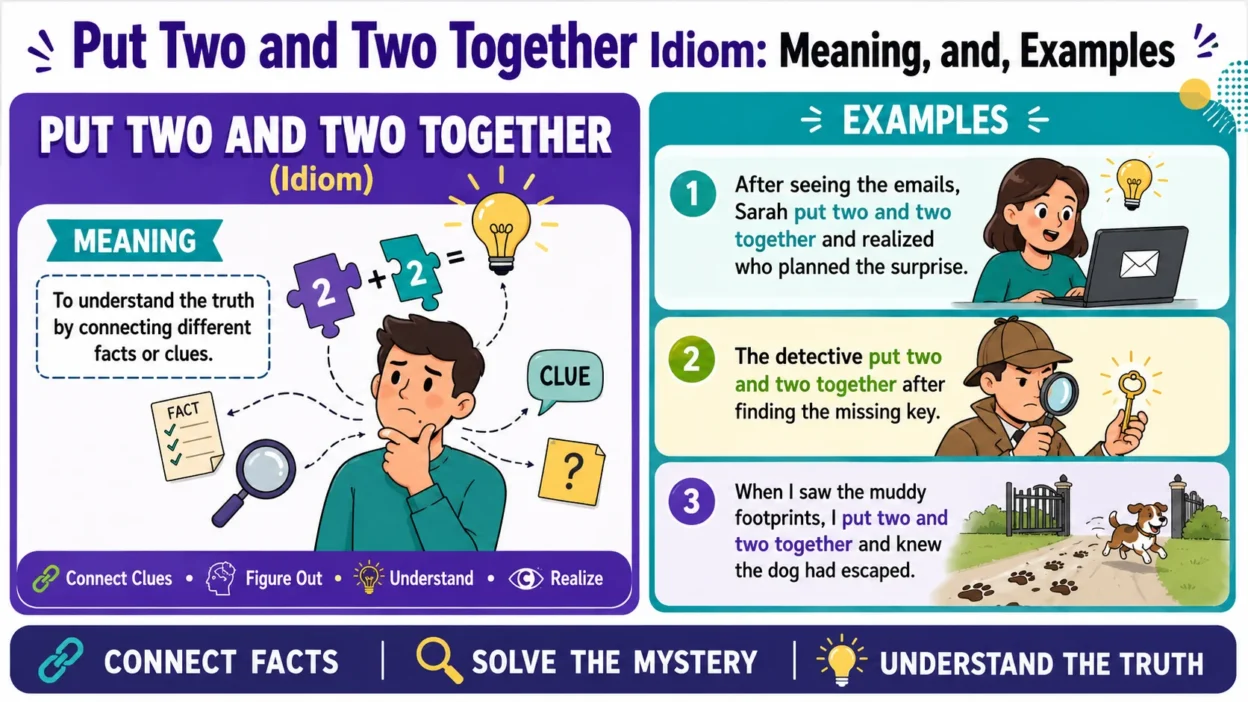
The idiom put two and two together means to notice separate facts and understand what they mean when combined. In plain English, it means you figure something out by connecting clues.
A person usually uses this phrase when the answer is not directly stated. Instead, the clues are there. The listener just needs to connect them.
For example:
- “She saw the empty suitcase and the train ticket, then put two and two together.”
- “He didn’t say he was quitting, but I put two and two together after the farewell email.”
- “You could have put two and two together from the way they were acting.”
The phrase often suggests that the conclusion is not random. It comes from logic, observation, or common sense.
Literal and Figurative Meaning
Literally, the phrase sounds like math. Two plus two equals four. That is the easy part.
Figuratively, though, the idiom has nothing to do with arithmetic. It means you take small bits of information and combine them to reach the right answer.
So, the phrase moves from math to meaning:
- Literal idea: adding numbers
- Figurative idea: adding clues
That shift is part of what makes idioms interesting. They borrow a simple image and turn it into a larger idea.
Tone and Use
The idiom is informal to neutral. It works well in everyday speech and writing. You can use it in casual conversation, storytelling, journalism, and some professional contexts.
It does not sound overly formal. It also does not sound slangy or childish. It sits comfortably in the middle.
Quick Definition of Put Two and Two Together
Here is the short version:
Put two and two together means to infer something from the facts or clues available.
In one sentence
- You use this idiom when you figure something out by connecting the dots.
In a sentence with context
- “When she saw the surprise decorations and heard the whispers, she put two and two together and realized it was her birthday party.”
The Origin of Put Two and Two Together
The phrase comes from the long-standing idea that if you have enough obvious facts, you should be able to reach the right answer. The expression has been part of English for a very long time, and its strength comes from its simplicity.
Its image is easy to understand. If someone gives you two facts and then two more facts, you should be able to combine them and arrive at four. In the same way, if life gives you a few clues, you should be able to reach a logical conclusion.
Why the phrase became popular
The idiom became popular because it is:
- Memorable
- Easy to understand
- Useful in everyday conversation
- Flexible in many situations
It also captures a very human habit. People love to search for patterns. They naturally try to make sense of hints, behavior, timing, and context. This idiom gives language to that process.
A simple historical note
English has used the idea of “two and two” as a symbol of obvious reasoning for centuries. The exact wording and popularity may have shifted over time, but the core image stayed the same: if the clues are clear, the conclusion should be clear too.
How Put Two and Two Together Works in Real Life
The put two and two together idiom appears when someone understands something without being told directly. That makes it useful in daily life, where people often speak indirectly.
Common real-life situations
- A friend starts acting strangely before announcing big news
- A coworker clears out their desk before a resignation becomes public
- A parent notices unusual behavior and figures out a child is hiding something
- A character in a story realizes the villain’s identity through clues
- A customer understands that a business change is coming because of pattern shifts
In each case, the person does not get the answer in a direct sentence. Instead, they connect the evidence.
Examples of Put Two and Two Together in Everyday Sentences
The best way to understand an idiom is to see it in action. Here are practical examples of the put two and two together idiom in different contexts.
Simple examples
- “I saw the moving boxes and put two and two together.”
- “She put two and two together after hearing the long silence on the phone.”
- “They didn’t need to explain anything. He put two and two together.”
- “Once the project deadline changed and the team stopped talking, I put two and two together.”
- “You could put two and two together from the clues.”
Family and relationships
- “When she saw the dinner reservation and the gift bag, she put two and two together.”
- “He put two and two together after his sister kept checking the mailbox.”
- “They put two and two together and realized their parents were planning a surprise trip.”
School and college
- “The students put two and two together when the teacher canceled class and handed out study guides.”
- “I put two and two together after the professor started repeating exam hints.”
- “She put two and two together and figured out the quiz topic before anyone else did.”
Workplace and business
- “When the manager stopped hiring and started cutting costs, employees put two and two together.”
- “The team put two and two together after the client requested an emergency meeting.”
- “I put two and two together when the company changed its policy without explanation.”
Put Two and Two Together in Literature and Media
Writers use this idiom because it feels natural in stories that involve mystery, tension, discovery, or emotion. It fits well in detective fiction, family drama, suspense, and comedy.
In fiction
A detective may not say, “I solved the case.” Instead, the narrator may say the detective put two and two together after examining footprints, timing, and motive.
That creates a stronger effect because the audience sees the detective’s reasoning process.
In movies and television
Characters often use this idiom when they realize a secret.
For example:
- A person sees a hidden gift and a suspicious schedule and says, “I put two and two together.”
- A hero notices the villain’s pattern and finally understands the plan.
- A parent realizes a teen’s story does not match the facts.
This idiom works so well on screen because it feels conversational. It sounds like something a real person would say after a lightbulb moment.
The Art of Inference Behind Put Two and Two Together
The phrase is not just a language tool. It points to a mental skill called inference.
Inference means drawing a conclusion from evidence. People do it constantly.
How inference works
You notice small details.
You compare them.
You look for patterns.
Then you reach a conclusion.
That process can be fast or slow. Sometimes the brain does it almost instantly. Other times, it takes careful thought.
A simple example
Imagine you hear footsteps at the door, see muddy shoes by the entrance, and smell rain. Nobody says, “It rained outside.” Still, you may put two and two together and realize someone just came in from the storm.
That is inference in action.
Why the brain does this
The brain likes order. It tries to reduce confusion by linking information. This helps people survive, solve problems, and make decisions.
In daily life, inference helps you:
- Understand tone
- Predict outcomes
- Read social signals
- Catch hidden meaning
- Respond wisely
That is why the idiom feels so natural. It reflects a skill people already use every day.
Psychology Behind Put Two and Two Together
The put two and two together idiom connects closely with how humans think. People are pattern-seeking creatures. They notice repetition. They compare behavior. They try to guess meaning from context.
Cognitive processes involved
Several mental steps happen when someone puts two and two together:
- Attention: noticing the clues
- Memory: comparing new details with past experiences
- Pattern recognition: seeing links between facts
- Reasoning: deciding what the clues mean
- Judgment: selecting the most likely conclusion
These mental steps often happen very quickly. That is why people sometimes say, “I just knew.”
A quote that fits the idea
“The clues were all there. The answer was waiting for someone to connect them.”
That kind of line captures the spirit of the idiom perfectly.
Why some people miss the clues
Not everyone notices the same details at the same time. Stress, distraction, lack of context, or missing information can make the conclusion harder to reach.
That is why someone may say:
- “I should have put two and two together sooner.”
- “She put two and two together faster than the rest of us.”
The phrase can praise quick thinking or regret slow realization.
Put Two and Two Together in Practice
You can use this idiom in many everyday settings. The key is to make sure the clues are clear enough for the conclusion to feel natural.
Good times to use it
- When someone learns a secret through clues
- When the answer feels obvious in hindsight
- When a situation becomes clear after small hints
- When you want to describe a thoughtful conclusion
When it sounds strongest
The phrase sounds strongest when the evidence was not direct but still fairly clear. It suggests the person was able to connect the dots.
For example:
- “Once I saw the canceled event and the packed suitcase, I put two and two together.”
- “After the repeated excuses, she put two and two together and understood the real reason.”
Put Two and Two Together vs Similar Expressions
This idiom overlaps with other common expressions, but each one has its own flavor.
| Expression | Core Meaning | Tone | Best Use |
| Put two and two together | Infer from clues | Natural, conversational | Everyday speech |
| Connect the dots | Link pieces of information | Slightly more visual | Problem solving, analysis |
| Read between the lines | Notice hidden meaning | More interpretive | Tone, subtext, communication |
| Figure it out | Solve a problem | Broad and casual | General use |
| Piece it together | Assemble information slowly | Often used for investigation | Mystery, research, memory |
Put two and two together vs connect the dots
These two are very close. Both involve inference.
The difference is that put two and two together often sounds more immediate and conversational. Connecting the dots can feel a little more visual or analytical.
- “She put two and two together after the meeting.”
- “She connected the dots after reviewing the reports.”
Put two and two together vs read between the lines
These are related, but not identical.
- Put two and two together = infer from facts and clues
- Read between the lines = understand hidden meaning in words or behavior
For example, someone may say, “His message seemed polite, but she read between the lines and noticed he was upset.”
Common Mistakes with Put Two and Two Together
Even simple idioms can be misused. Here are the most common problems.
Mistake one: Using it for wild guessing
This idiom does not mean making an unsupported guess. It means reaching a logical conclusion from clues.
Wrong:
- “I put two and two together and guessed the winner without any evidence.”
Better:
- “I put two and two together after seeing the score updates and the crowd reaction.”
Mistake two: Using it when the answer is already obvious
If the answer is directly stated, the idiom may sound unnecessary.
Better to use it when the conclusion comes from indirect evidence.
Mistake three: Confusing it with jumping to conclusions
These two are different.
- Put two and two together = logical inference
- Jump to conclusions = reach a conclusion too fast, often without enough evidence
That difference matters.
Put Two and Two Together and Jump to Conclusions
This is one of the most important comparisons.
Put two and two together
This phrase suggests the person looked at the evidence and made a reasonable decision.
Jump to conclusions
This phrase suggests the person made a decision too quickly, often unfairly.
Example
- “After seeing the receipts and the travel dates, she put two and two together.”
- “He jumped to conclusions and accused her without checking the facts.”
One sounds careful. The other sounds rash.
Formality Level of Put Two and Two Together
This idiom is mostly informal to semi-formal.
Best settings
- Conversation
- Emails with a friendly tone
- Articles
- Blog posts
- Storytelling
- Interviews
- Commentary
Less ideal settings
- Highly technical writing
- Very formal legal language
- Academic writing that needs precise terminology
In formal documents, writers may prefer:
- infer
- deduce
- conclude
- determine
- identify a pattern
Still, the idiom can work in many professional contexts when the tone is natural.
Put Two and Two Together in Professional Writing
This idiom can appear in workplace communication, but it should fit the tone.
Good example
- “The team put two and two together after the budget cuts and the hiring freeze.”
Less polished example
- “We put two and two together and now know everything.”
That second one sounds too casual and vague for professional use.
Better professional alternatives
- “The team inferred the likely direction of the project.”
- “The evidence suggests a shift in strategy.”
- “The pattern became clear after the updates.”
Case Study: A Real-Life Style Example of Put Two and Two Together
Here is a simple case study that shows the idiom in action.
Situation
A small online business noticed three things:
- Orders were slowing down
- Customer support tickets were rising
- Competitors had started advertising aggressive discounts
At first, the owner thought the slowdown was temporary. Then the pattern became impossible to ignore. The business had not lost interest from customers by chance. It had lost attention because competitors were pulling buyers away.
Result
After reviewing the data, the owner put two and two together and realized the business needed to respond quickly. The company adjusted its pricing, improved delivery messaging, and increased customer retention efforts.
Lesson
The idiom fits well when facts begin to form a clear picture. One detail alone may not mean much. Three or four details together can tell the full story.
Everyday Situations Where People Put Two and Two Together
This idiom appears in ordinary life more often than people realize.
Home life
- New keys on the counter
- Travel bags by the door
- Quiet excitement in the house
- Unexpected phone calls
Friendships
- A friend becomes unavailable
- Plans keep changing
- Messages get shorter
- Hints about an upcoming surprise appear
Work
- A meeting gets moved last minute
- A manager starts asking unusual questions
- Tasks are reassigned
- A project suddenly loses momentum
School
- A teacher spends extra time on one topic
- A quiz seems to be coming
- A classroom calendar changes
- Students notice repeated hints
In all these cases, people use observation and logic. That is the heart of the idiom.
Helpful Synonyms and Related Phrases
Here are some phrases that carry a similar meaning.
| Phrase | Meaning | Typical Tone |
| Infer | Draw a conclusion from evidence | Formal |
| Deduce | Reach a logical conclusion | Formal |
| Figure out | Solve or understand something | Casual |
| Connect the dots | Link clues or facts | Neutral |
| Piece together | Build understanding from parts | Neutral |
| Read between the lines | Notice hidden meaning | Neutral |
| Catch on | Start to understand | Informal |
How to choose the right one
Use put two and two together when you want a natural, everyday phrase. Use infer or deduce when you need a more formal word. Use figure out when the problem feels broader or more general.
More Examples of Put Two and Two Together in Context
Here are fuller examples to show the idiom in natural sentences.
- “When the lights went off, the cake came out, and everyone started singing, she put two and two together.”
- “He put two and two together after the vacation photos appeared before the official announcement.”
- “I put two and two together when my coworker kept laughing every time I mentioned Friday.”
- “They put two and two together and realized the delay had nothing to do with weather.”
- “She put two and two together the moment she saw the spare keys missing.”
In dialogue
- “You knew, didn’t you?”
- “Of course. I put two and two together.”
That kind of exchange sounds natural and strong. It shows a moment of realization without overexplaining it.
Best Practices for Using the Idiom Naturally
To use the put two and two together idiom well, keep these tips in mind:
- Use it when clues are present
- Keep the sentence clear
- Match the tone of the situation
- Do not force it into overly formal writing
- Pair it with concrete details for better impact
Example of a strong sentence
- “After the canceled lunch, the secret phone calls, and the sudden trip, she put two and two together.”
This works because the clues are specific and the conclusion feels earned.
Example of a weak sentence
- “He put two and two together about something.”
That line is too vague. It does not help the reader understand the situation.
Conclusion
The idiom Put Two and Two Together is a simple but powerful expression that describes the process of using clues, facts, or available information to reach a logical conclusion. It is widely used in everyday conversations, literature, business communication, and storytelling. Learning when and how to use this idiom will make your English sound more natural while also improving your reasoning and communication skills.
FAQs
Q1. What does Put Two and Two Together mean?
Put Two and Two Together means to connect clues, facts, or pieces of information to reach a logical conclusion or understand what has happened.
Q2. How do you use Put Two and Two Together in a sentence?
You can say, “After seeing the empty parking space and the lights off, I put two and two together and realised they had already left.”
Q3. Is Put Two and Two Together a metaphor or an idiom?
It is an idiom because its meaning cannot be understood by taking the words literally. Instead, it refers to figuring something out through reasoning.
Q4. Where is the idiom Put Two and Two Together commonly used?
It is commonly used in everyday conversations, storytelling, books, movies, workplaces, and professional communication whenever someone reaches a conclusion from available clues.
Q5. Why is Put Two and Two Together important for English learners?
Learning this idiom helps English learners understand native speakers more easily, improve vocabulary, strengthen critical thinking, and use natural-sounding English in both speaking and writing.